First Carbon Steel Order: A Step-by-Step Buyer’s Guide
Placing your first carbon steel order with an overseas supplier can feel risky. You are committing significant capital to a product you have not inspected, from a mill you have not visited, under laws and shipping rules you may not know. Yet thousands of buyers do this successfully every year by following a disciplined process. This guide walks a first-time buyer through the entire journey — from defining a specification to receiving the goods and handling a claim — with practical checklists at each stage. Follow it and your first order is far more likely to arrive on time, on spec, and on budget.
The central idea is simple: remove ambiguity early. Most first-order problems — wrong grade, wrong tolerance, unexpected duties, disputed quality — trace back to something that was assumed rather than written down. Every step below is about turning assumptions into documented agreements before money changes hands.
Step 1: Define Your Specification Completely
Everything starts with a complete, unambiguous specification. “Carbon steel pipe” is not a specification; “ASTM A106 Grade B seamless pipe, NPS 4 inch Schedule 40, 6 m fixed length, beveled ends, with EN 10204 3.1 MTC” is. The more precisely you define the product up front, the less room there is for a supplier to interpret it differently.
- Product form and exact dimensions (diameter, thickness, length, section size).
- Grade and governing standard (for example ASTM A36, A106 Gr B, EN 10025 S355JR).
- Tolerance class, surface condition, and end finish.
- Quantity, unit of sale (tonne, piece, metre), and allowable over/under tolerance.
- Required certificates, inspection, and marking.
Step 2: Choose the Right Grade — and a Sensible Substitute
Grade selection balances performance and cost. A common first-order mistake is over-specifying: choosing a higher grade than the application needs and paying a premium for properties that go unused. Equally risky is under-specifying. Use published equivalence tables to understand how ASTM, EN, JIS, and GB grades map to one another, but never substitute without written engineering approval — equivalent grades often differ in impact toughness or chemistry detail.
Ask the supplier which grades they stock. Choosing a grade that is readily available can cut lead time dramatically compared with a special mill order, and a good supplier will suggest a compliant stock alternative when one exists.
Step 3: Calculate Quantity and Weight
Steel is usually sold by weight, but dimensions are specified by count or length. Being able to convert between them protects you from invoice errors. For round bar, weight in kg per metre is approximately 0.00617 times the diameter in millimetres squared. For plate, it is 7.85 times thickness in mm times width in metres times length in metres. For pipe, weight per metre is 0.02466 times wall thickness in mm times the outside diameter minus wall thickness.
Always confirm the theoretical weight with the supplier and agree how actual weight will be billed — theoretical or scale weight. Note the allowed weight tolerance on the contract, since mills cannot hit theoretical weight exactly.
Step 4: Request and Compare Quotes Fairly
Send the same complete specification to at least three suppliers so the quotes are comparable. A quote is only meaningful when you know what is included. Ask each supplier to break out the unit price, packing, inland freight to port, ocean freight, insurance, and documentation. A lower unit price can be wiped out by higher freight or an aggressive currency clause.
- Confirm the Incoterm (EXW, FOB, CFR, CIF, DAP, or DDP) — see Step 7.
- Confirm validity period of the quote; steel prices move quickly.
- Confirm payment terms, lead time, and minimum order quantity.
- Confirm what documents are included (MTC, packing list, certificate of origin).
- Ask about price adjustment clauses if delivery is more than a few weeks out.
Step 5: Verify the Supplier Before Paying
This is the step that separates a smooth first order from a disaster. Verify that the company is real, has a physical factory or warehouse, and has a track record. Check business registration, request photos or a video of their facility, and ask for references from customers in your region. A video call walking through the warehouse is surprisingly revealing.
- Check business licence and factory address; confirm they match the quoting entity.
- Request a factory audit report or arrange a third-party audit (SGS, BV, TUV) for large orders.
- Verify certifications such as ISO 9001 and confirm the scope covers your product.
- Look for red flags: prices far below market, pressure to pay to a personal account, refusal to provide documents.
- Start with a small trial order if you are unsure — many suppliers will accommodate this.
Step 6: Confirm Samples and Mill Test Certificates
Before the bulk order ships, insist on seeing the documents that prove quality. A mill test certificate (MTC) reports the actual chemical analysis and mechanical test results for the specific heat of steel supplied. Under EN 10204, type 3.1 is the standard level, providing results certified by the manufacturer independent inspection department; type 3.2 adds third-party certification.
For first orders, request a physical sample if practical and have it tested locally. Compare the MTC values against your specification — not just the grade name. Confirm that the heat number on the MTC matches the markings on the actual goods when they arrive. This traceability chain is your strongest quality assurance.
Step 7: Agree Incoterms and Payment Terms
Incoterms define who pays for and is responsible for each leg of the shipment, and precisely where risk transfers from seller to buyer. For first orders, FOB (free on board) or CIF (cost, insurance, freight) are the most common. Under FOB you arrange and control the ocean freight yourself; under CIF the supplier arranges it but you still bear risk once goods are loaded. DDP, where the supplier delivers to your door with duties paid, is convenient but less transparent.
On payment, a letter of credit (L/C) offers the strongest protection for large first orders, though it costs more and adds documentation complexity. Telegraphic transfer (T/T) is simpler and cheaper; a common compromise is a 30 percent deposit with the balance against a copy of the bill of lading or inspection report. Avoid 100 percent prepayment to an unfamiliar supplier.
Step 8: Arrange Pre-Shipment Inspection
Third-party inspection before shipment is inexpensive insurance. An inspector from SGS, BV, or TUV can verify quantity, dimensions, surface condition, marking, and packaging at the factory, and issue a report before the balance payment is released. This catches problems while they are still cheap to fix — at the mill rather than at your port.
- Define the inspection scope: quantity, dimensions, visual, MTC review, and sampling.
- Agree who pays for inspection (commonly the buyer, sometimes split).
- Tie balance payment to a satisfactory inspection report where possible.
- Require inspection photos and the report to reference your contract and heat numbers.
Step 9: Shipping and Documentation
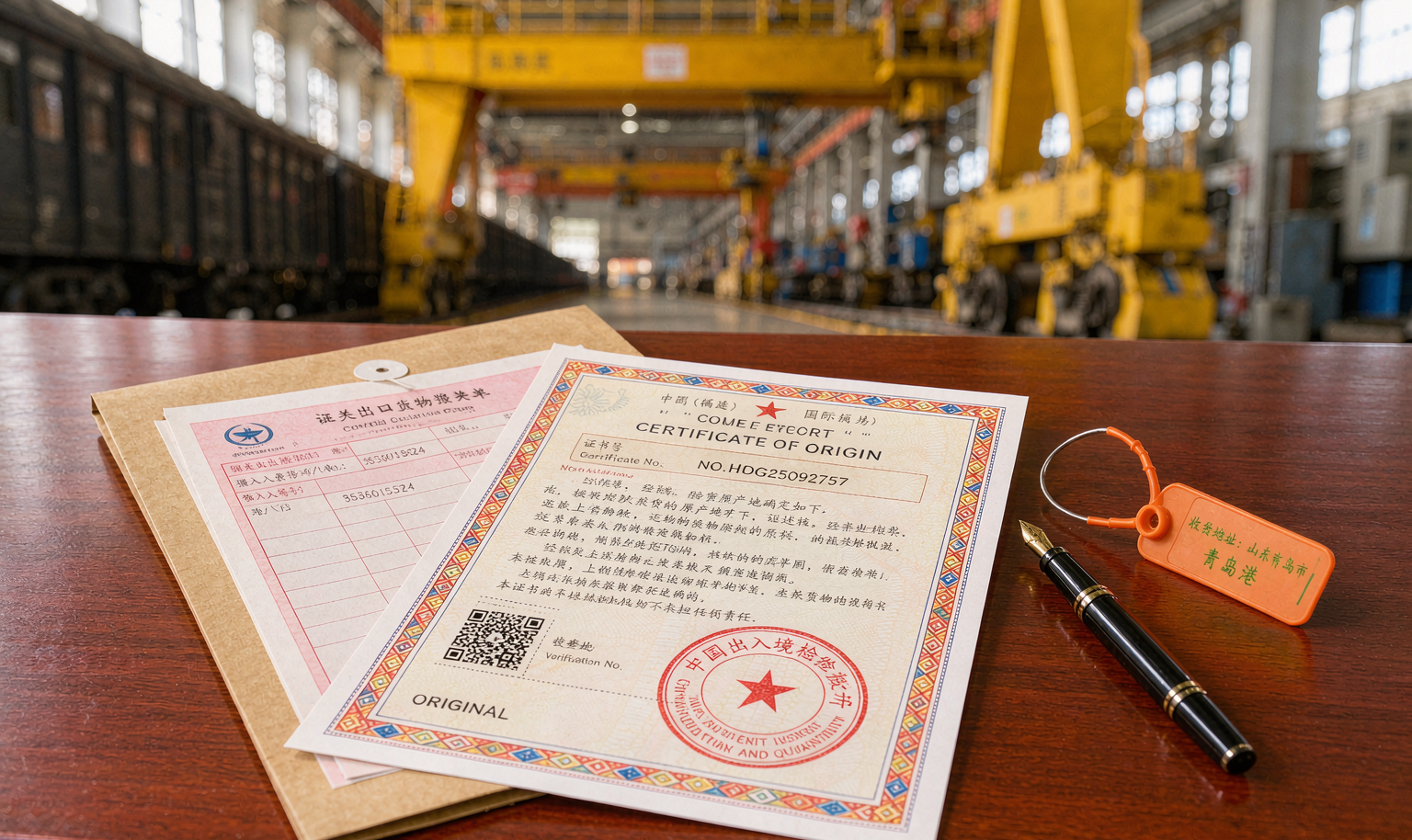
Once the goods are ready, a set of documents must accompany them. The bill of lading is the title document; the commercial invoice and packing list support customs clearance; the certificate of origin determines duty treatment; and the MTC proves quality. Confirm that every document matches the contract details exactly — discrepancies cause customs delays and demurrage charges.
- Commercial invoice with correct HS code, value, and Incoterm.
- Packing list with net and gross weight, package count, and marks.
- Bill of lading (or airway bill) with correct consignee and notify party.
- Certificate of origin (for example Form E, Form F, or a general CO).
- Mill test certificate and any inspection report.
- Insurance certificate if the Incoterm requires it.
Step 10: Receiving, Checking, and Handling Claims
When the shipment arrives, inspect it before accepting delivery. Check the container seal number against the documents, photograph any damage, and verify package count. Check that the goods match the specification and that heat numbers on the material match the MTC. If there is a discrepancy, document it immediately with photos and notify the supplier in writing within the contract claim period — usually 30 days.
Keep all documents and samples from the shipment. A well-documented claim is far more likely to be resolved favourably. Most reputable suppliers will replace material that is genuinely out of specification; the key is prompt, evidence-based communication.
Common First-Order Mistakes to Avoid
- Incomplete specifications that leave room for interpretation.
- Choosing a supplier purely on the lowest price without verification.
- Paying 100 percent in advance to an unfamiliar company.
- Skipping the MTC review or accepting a certificate that does not match the goods.
- Ignoring Incoterm details and being surprised by freight or duty costs.
- Failing to inspect on arrival or missing the claim window.
Frequently Asked Questions
What is a reasonable minimum first order?
Many suppliers accept a trial order of a few tonnes or even one container to build trust. Ask about sample and small-order options before committing to a large contract.
Which Incoterm is safest for a first order?
FOB gives you control of freight and is widely used. CIF is more convenient but less transparent. Either is acceptable if the contract is explicit; avoid vague terms.
How do I verify a supplier is legitimate?
Check business registration, confirm the factory address, request a video walkthrough, verify ISO certification scope, and ask for customer references.
What document proves the steel quality?
The mill test certificate (EN 10204 3.1 or 3.2) reports actual chemistry and mechanical results tied to a heat number that should match the material marking.
What if the goods arrive out of specification?
Document everything with photos, keep samples, and notify the supplier in writing within the contract claim window, typically 30 days, to seek replacement or credit.
HS Codes, Duties, and Import Rules
Every shipment crosses a customs boundary identified by a Harmonized System (HS) code. The HS code determines the duty rate, the applicability of trade remedies such as anti-dumping duties, and the documentation required. Carbon steel products fall under various chapters depending on form: flat-rolled products, bars and rods, tubes and pipes, and structural sections each have their own headings and subheadings.
Using the wrong HS code is a common and expensive mistake. It can trigger higher duties, customs holds, or penalties. Verify the code with your customs broker for the destination country and confirm that the code on the commercial invoice matches the one used for import declaration. Some destinations require additional certifications — for example, conformity assessment for structural steel — so check local regulations before shipping.
Trade remedies deserve particular attention. Many countries impose anti-dumping or countervailing duties on certain carbon steel categories from specific origins. These duties can dwarf the product cost, so confirm the applicable measures and the correct origin of the material before committing to an order. A reputable supplier will help by providing accurate origin documentation and, where relevant, certificates that support preferential duty treatment.
Payment Security Tools for New Buyers
- Letter of credit (L/C): banks guarantee payment against compliant documents; strongest protection, highest cost.
- Documentary collection (D/P, D/A): documents released against payment or acceptance; moderate protection.
- T/T with deposit: simple and fast; a 20-30 percent deposit with balance against documents is a common compromise.
- Trade assurance platforms: third-party escrow services that hold funds until delivery is confirmed.
- Credit insurance: insures against non-payment or non-delivery for larger, ongoing relationships.
The right tool depends on order size and trust level. For a first small trial order, a deposit plus balance against a bill of lading copy is usually acceptable. For a large first contract, an L/C gives meaningful protection. Never send the full amount to a personal account or an unverified entity — a legitimate supplier will always have a corporate account and will not resist reasonable payment safeguards.
Building a Long-Term Supplier Relationship
A first order is the beginning of a relationship, not a one-off transaction. Buyers who treat suppliers as partners — sharing forecasts, giving feedback on quality, and paying on time — consistently get better pricing, priority allocation when material is tight, and faster problem resolution. The best suppliers invest in good customers too, offering technical support and flexible terms as volume grows.
After the first shipment, hold a short review: what went well, what caused delays, and what should change next time. Document agreed specifications and packaging so the second order does not start from scratch. Over time, this discipline reduces transaction costs on both sides and turns a risky first purchase into a reliable supply chain.
A Reusable First-Order Checklist
- Complete written specification with grade, standard, dimensions, and tolerance.
- Three comparable quotes with Incoterm and validity stated.
- Supplier verification: registration, factory, references, certifications.
- Sample and MTC reviewed and approved.
- Contract signed with payment terms, inspection scope, and claim period.
- Pre-shipment inspection completed and report received.
- Shipping documents checked for consistency before release of balance.
- HS code and duties confirmed with the broker.
- Goods inspected on arrival; discrepancies documented within the claim window.
Keep this checklist as a living document and refine it after each order. Each improvement closes a gap and makes the next shipment smoother. Sourcing carbon steel internationally is entirely manageable when the process is systematic — and this guide gives you the system.
Incoterms Explained in Plain Language
Incoterms are a source of confusion for many first-time buyers, but the concept is straightforward: they allocate cost and risk between seller and buyer. EXW means you collect the goods at the factory and bear all costs from there. FOB means the seller delivers goods onto the vessel at the port of loading, and you bear the ocean freight and everything after. CFR adds ocean freight to the seller obligations; CIF adds insurance as well. DAP means the seller delivers to a named place at the destination, excluding import duties; DDP includes duties.
The choice affects both your cost and your control. FOB gives you control of the carrier and freight negotiation, which can save money if you ship regularly. CIF is simpler because the supplier arranges the main carriage, but you have less visibility and must still handle import clearance. DDP is the most convenient but can hide costs in the supplier margin, and the seller may not be familiar with your country import rules.
Whichever term you choose, name the exact port or place and cite Incoterms 2020. “FOB Shanghai Incoterms 2020” is precise; “FOB China” is not. Ambiguity here is a frequent source of disputes over who pays demurrage, terminal handling, or destination charges.
Preparing for Customs Clearance
Customs clearance goes smoothly when documents are consistent. The commercial invoice, packing list, bill of lading, and certificate of origin must agree on the seller, buyer, description, quantity, weight, value, and destination. Even small mismatches can hold a shipment. Work with a licensed customs broker who understands steel products and can confirm the HS code and any applicable trade measures.
Prepare for inspection by the customs authority. Steel shipments are sometimes selected for physical examination, and having the goods documented, marked, and packed accessibly speeds the process. Keep digital copies of all documents and photographs of packing and container loading — these are invaluable if a discrepancy must be resolved quickly.
Request a Quote
Ready to place your first carbon steel order? Huaxia-Steel supplies bars, plates, tubes, and structural sections with full documentation and third-party inspection options. Tell us your specification and destination and we will guide you through a smooth first shipment.
Contact our sales team at [email protected] with your specification, quantity, and destination port. We reply with a mill-direct quotation, lead time, and full documentation within one business day.