ASTM A307 Steel: Carbon Steel Bolts Explained
ASTM A307 is the standard specification for carbon steel bolts, studs, and threaded rods intended for general-purpose applications. It is the most widely used bolt standard in North America and a frequent choice in international projects where high strength is not required. Buyers often meet A307 for the first time on a bill of materials that simply says “A307 bolts” — and then discover that the specification covers three distinct grades with different strength levels, different chemistry, and different intended service. This guide explains what ASTM A307 steel is, how Grades A, B, and C differ, what the mechanical and chemical requirements are, and how to avoid the most common sourcing mistakes.
If your application involves structural joints, flanges, or general equipment assembly at ambient temperature, A307 is likely to be both sufficient and economical. If the joint is structural and code-governed, or exposed to high temperature or cyclic load, you probably need A325, A490, or a high-strength alloy stud instead. The sections below show exactly where the boundary lies.
What Is ASTM A307 Steel?
ASTM A307 / A307M is published by ASTM International and covers carbon steel threaded fasteners from 1/4 inch (6 mm) up to 4 inches (100 mm) in diameter, in coarse, fine, or 8-thread series. The standard was originally written for bolts used in flanged joints and general construction where a low-strength, ductile, easily fabricated fastener was preferred over a quenched-and-tempered high-strength bolt. It remains the default material for anchor bolts, structure bolts, and many types of threaded rod.
The key characteristic of A307 is modest, predictable strength combined with good ductility. Unlike ASTM A325 or A490, an A307 bolt is not quenched and tempered, so it is easier to machine, easier to straighten, and far less susceptible to hydrogen embrittlement. That makes it a sensible choice where the joint is not tension-critical and where field modification such as cutting or bending may be necessary.
ASTM A307 Grades A, B and C Explained
The 2019 revision of the standard formalised three grades. Understanding the distinction is essential because they are not interchangeable without engineering review.
- Grade A: The general-purpose grade, essentially the traditional A307 bolt. Supplied in the as-rolled or cold-finished condition with a minimum tensile strength of 60 ksi (414 MPa). Suitable for anchors, general construction, and non-critical connections.
- Grade B: A higher-strength option with a minimum tensile strength of 100 ksi (690 MPa), intended for use in flanged joints where greater clamping force is needed. Grade B bolts are normally made from medium-carbon steel and are commonly used in piping applications.
- Grade C: A grade introduced for applications needing enhanced notch toughness and weldability, typically with controlled chemistry and a lower carbon equivalent. It is specified where the fastener may be welded or where low-temperature toughness matters.
When you write an A307 callout, always state the grade. A purchase order that says only “A307 bolt” leaves the supplier free to deliver Grade A, which may be perfectly acceptable for an anchor bolt but seriously under-strength for a high-pressure flange.
Chemical Composition Requirements
ASTM A307 is primarily a mechanical-property specification, so chemistry limits are relatively broad compared with alloy steel standards. The main controls are on carbon, manganese, phosphorus, and sulfur, with Grade C imposing tighter limits to improve toughness and weldability.
| Element | Grade A typical max | Grade B typical max | Grade C typical max |
|---|---|---|---|
| Carbon | 0.29% | 0.40% | 0.25% |
| Manganese | 1.20% | 1.20% | 1.20% |
| Phosphorus | 0.04% | 0.04% | 0.035% |
| Sulfur | 0.05% | 0.05% | 0.04% |
| Silicon | 0.40% | 0.40% | 0.40% |
Because the chemistry range is wide, two heats of Grade A from different mills can differ noticeably in hardenability and machining behaviour. If your process is sensitive — for example, automated threading or tight hardness control — agree on a narrower chemistry range with your supplier or choose a more tightly defined specification such as ASTM A29 1045.
Mechanical Properties
| Property | Grade A | Grade B | Grade C |
|---|---|---|---|
| Tensile strength, min | 60 ksi / 414 MPa | 100 ksi / 690 MPa | 60 ksi / 414 MPa |
| Yield strength, min | 36 ksi / 248 MPa | Not specified in the same form; proof load applies | 36 ksi / 248 MPa |
| Elongation in 2 in., min | 18% | 12% | 18% |
| Reduction of area, min | 40% | 35% | 40% |
| Heat treatment | None required | Often quenched and tempered | Controlled rolling or normalising |
| Typical hardness | ≈120-180 HB | ≈200-260 HB | ≈120-180 HB |
The high elongation and reduction-of-area figures for Grade A are worth noting. They mean the bolt will stretch and deform visibly before it fractures, which is a desirable failure mode in general construction. High-strength bolts fail in a more brittle manner and require more careful installation and inspection.
Products and Thread Standards Covered
ASTM A307 covers hex bolts, heavy hex bolts, studs, and threaded rod. The threads are normally Unified Coarse (UNC) or Unified Fine (UNF), and are produced by rolling rather than cutting in most modern plants. Thread rolling work-hardens the surface and produces a better fatigue life than cut threads, and it is also faster and less wasteful.
Metric equivalents are not formally part of A307, although buyers sometimes use the standard as a reference for metric bolts. If your drawing is in metric units, specify a recognised metric property class such as 4.6 or 4.8 and the relevant ISO or DIN standard instead. Mixing an imperial ASTM callout with a metric thread specification is a reliable way to receive fasteners that do not assemble.
Marking and Identification
Bolt head marking is the fastest way to verify what has actually been delivered. Grade A bolts are normally marked with “A307” or simply “A”; Grade B bolts carry “A307B” or “B”; Grade C bolts carry “A307C” or “C”. Some manufacturers add their own logo and a heat or lot code. An unmarked bolt should be treated as unverified regardless of what the packing slip says.
- Check that the head marking matches the grade stated on the purchase order.
- Confirm the thread fit — 2A/2B is common for general-purpose UNC threads.
- Inspect the first article for head height, Across-Flats dimension, and thread runout.
- Ask for a certificate of conformance showing tensile, yield, and elongation results for the production lot.
- For anchor bolts, confirm the embossed marking survives galvanising and handling.
Typical Applications
Grade A is the standard material for anchor bolts, foundation bolts, general structural bolting, machinery hold-downs, and non-code structural connections. It is also widely used for threaded rod in hanging systems, cable trays, and light support frames. Its ductility and low cost make it the practical default when a bolt is simply clamping two pieces together.
Grade B is specified for flanged joints in piping systems where a higher clamping load is required but a full high-strength alloy stud would be excessive. Grade C is chosen for applications where weldability or low-temperature toughness is a concern, such as a bolt that will be welded to a plate or used in a cold-storage structure.
ASTM A307 vs A36 vs A325 vs A193 B7
| Standard | Type | Min tensile | Typical use |
|---|---|---|---|
| ASTM A307 Grade A | Plain carbon bolt | 414 MPa | Anchors, general construction, light clamping |
| ASTM A36 | Structural plate and bar | 400 MPa | Base material, not normally a bolt spec |
| ASTM A325 | High-strength structural bolt | 830 MPa | Code-governed structural joints |
| ASTM A193 B7 | Alloy steel stud (Cr-Mo) | 860 MPa | High-pressure and high-temperature flanged joints |
The most frequent sourcing error is substituting A36 bar-stock bolts for A307 fasteners. A36 is a structural material specification, not a fastener specification; it does not control thread quality, head geometry, or proof load. Conversely, upgrading a general-purpose anchor bolt to A325 adds cost without adding value. Match the standard to the joint, not to the nearest familiar grade name.
Corrosion Protection and Coatings
Uncoated A307 fasteners will rust in most outdoor environments, so protection should be specified at the enquiry stage. Plain finish is acceptable for indoor, dry service. Zinc plating (electro-galvanising) provides light corrosion resistance at low cost and is common for indoor equipment. Hot-dip galvanising to ASTM A123 gives much better outdoor durability and is the standard for anchor bolts and transmission structures. Mechanical zinc plating and phosphate coatings are options where hydrogen embrittlement or thread fit is a concern.
Note that hot-dip galvanising adds thickness to the thread, which can interfere with nut fit unless the bolt is ordered with an allowance or the nut is tapped oversize. Always state the coating and the thread-fit requirement together. For high-strength Grade B bolts, discuss hydrogen embrittlement relief with your supplier if acid pickling or electroplating is involved.
Procurement Checklist for A307 Fasteners
- State the exact grade: A307 Grade A, B, or C.
- Give diameter, length, thread series, and thread length.
- Specify the head style: hex, heavy hex, or stud with two nuts.
- State the coating and any thread allowance needed after coating.
- Request a certificate of conformance with mechanical test results and lot traceability.
- Confirm the marking requirement so incoming inspection can verify the grade quickly.
- For large projects, agree on an acceptable sampling plan and inspection level before production starts.
Dimensional Standards and Thread Details
ASTM A307 defines material properties, but the physical dimensions of the fasteners are governed by a separate family of standards. Hex bolts are normally made to ASME B18.2.1, which defines head across-flats width, head height, body length, and thread length for imperial sizes. Heavy hex bolts use a larger across-flats dimension to accommodate larger nuts and higher wrench torque. Thread form and tolerance are defined by ASME B1.1, with 2A/2B being the common fit class for general-purpose UNC and UNF threads.
Thread length is a frequent source of confusion. For bolts up to six inches long, ASME B18.2.1 specifies a thread length of twice the diameter plus a quarter inch; longer bolts use twice the diameter plus half an inch. If your joint requires a fully threaded bolt, you must order a stud or state “full thread” explicitly. Assuming that a standard hex bolt is threaded along its entire shank is a common and expensive misunderstanding, particularly for anchor applications.
Thread rolling is the preferred production method for A307 fasteners. In a rolling operation, hardened dies displace material to form the thread profile rather than cutting it away. The resulting thread has a work-hardened surface and a favourable grain flow, which improves fatigue strength. Rolled threads also have a smoother flank finish, reducing galling during nut installation. Cut threads are still used for very large diameters or short runs, but they should be specified deliberately rather than accepted by default.
Testing, Inspection and Certification
A certificate of conformance is the normal document supplied with an A307 order. It should identify the manufacturer, the lot or heat number, the grade, the size range, and the results of tensile and hardness testing. For Grade B bolts, proof-load testing is particularly important because the higher strength level relies on controlled processing. Buyers of critical anchors should also request a chemical analysis so the carbon equivalent can be checked before any field welding.
- Tensile test: a full-size bolt or a machined specimen is pulled to failure to verify minimum tensile and yield strength.
- Hardness test: Brinell or Rockwell readings taken on the head or shank provide a quick lot-consistency check.
- Proof load: the bolt is loaded to a specified proof stress and must not permanently elongate.
- Dimensional inspection: across-flats, head height, length, and thread gauge are checked against ASME B18.2.1 and B1.1.
- Marking check: head markings are verified against the declared grade before release.
For large projects, agree a sampling plan before production. A common approach checks a defined number of pieces per lot for dimensions and hardness, with one tensile test per heat. Defining the acceptance criteria at the enquiry stage avoids the situation where a supplier and a buyer have different expectations about what constitutes a valid test report.
Installation and Torque Considerations
Even a correctly specified bolt will perform poorly if it is installed without attention to preload. For a general-purpose A307 Grade A bolt, the target preload is normally a fraction of the proof load, and the corresponding torque depends heavily on thread condition and lubrication. Dry, galvanised, and oiled threads can produce preload differences of 30 percent or more at the same torque, which is why torque tables always state the assumed friction condition.
In anchor applications, the governing failure mode is often the concrete rather than the bolt. The embedment depth, edge distance, hole diameter, and curing condition of the grout matter more than a small difference in bolt tensile strength. Where an anchor is subject to tension or seismic load, have the connection designed by a qualified engineer and consider a headed or adhesive anchor system rather than a standard bent-hook bolt.
For flanged joints using Grade B studs, a controlled tightening sequence is essential to achieve even gasket compression. Bolts should be tightened in a cross-pattern over several passes, and the final torque should be applied after the joint has been given time to settle. A joint that leaks is more often the result of uneven tightening than of a material defect.
Sourcing A307 Fasteners From Overseas
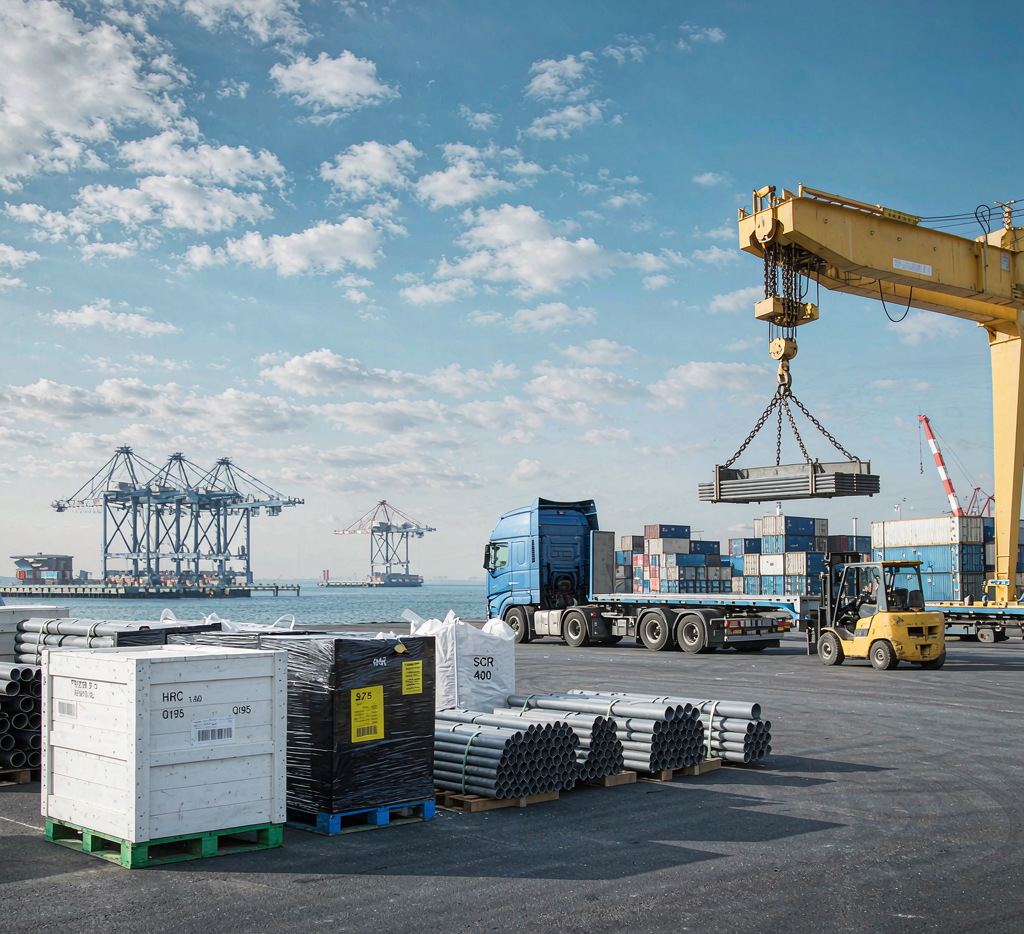
When importing A307 bolts, the commercial details matter as much as the material grade. Confirm the incoterm, the port of discharge, and whether the quoted price includes packaging suitable for sea freight. Loose bolts in wooden crates are standard for large anchor bolts, while smaller fasteners are usually packed in cartons on pallets and shrink-wrapped. Humidity during a long ocean voyage can damage an uncoated finish, so specify a rust-preventive oil or a sealed package if the goods will be stored before installation.
Allow time for documentation checks before shipment. A certificate of conformance, a packing list with net and gross weights, and a commercial invoice with the correct HS code are needed for customs clearance. For projects with inspection requirements, third-party inspection may need to be booked at the mill several weeks in advance. A supplier who can provide these documents as a complete package is usually worth a small price premium over one that cannot.
Finally, keep a sample of each delivered lot for reference. If a marking dispute or a quality question arises six months after installation, a retained sample and its certificate are far more useful than an email thread. Most suppliers are happy to provide duplicate samples, and the small storage cost is trivial compared with the effort of investigating an unverified fastener failure.
Frequently Asked Questions
What does ASTM A307 stand for?
It is the ASTM specification for carbon steel bolts, studs, and threaded rods for general use. It defines mechanical properties, chemistry limits, dimensions, and marking requirements.
Is A307 the same as Grade 5?
No. Grade 5 (SAE J429) has a minimum tensile strength of 120 ksi, roughly double that of A307 Grade A. They are not interchangeable.
Can A307 bolts be galvanised?
Yes. Hot-dip galvanising to ASTM A123 is common for anchor bolts. Confirm the thread allowance because the zinc coating increases thread diameter.
Which A307 grade is used for flanges?
Grade B is normally selected for flanged joints because it provides higher tensile strength and clamping load than Grade A.
Are A307 bolts weldable?
Grade A can be welded with normal precautions. Grade C is designed with weldability in mind. Always check the carbon equivalent if welding is required.
Request a Quote
We manufacture and supply ASTM A307 Grade A, B, and C carbon steel bolts, studs, and threaded rod with certificates of conformance and a choice of coatings. Send your specification, quantity, and destination port for a factory-direct quotation and lead time.
Contact our sales team at [email protected] with your grade, dimensions, quantity, and destination port. We reply with a mill-direct quotation, lead time, and full documentation within one business day.