Carbon Steel Shipping & Container Loading: Export Guide
Shipping carbon steel from China to global destinations involves more than booking a freight container. Container selection, loading plans, weight limits, packaging standards, and corrosion protection all determine whether your steel arrives in specification-grade condition — or as a rejected, rusted shipment.
This guide covers the complete export shipping workflow for carbon steel products, from container selection to arrival inspection, with practical cost optimization strategies for regular importers.
Container Types and Weight Limits
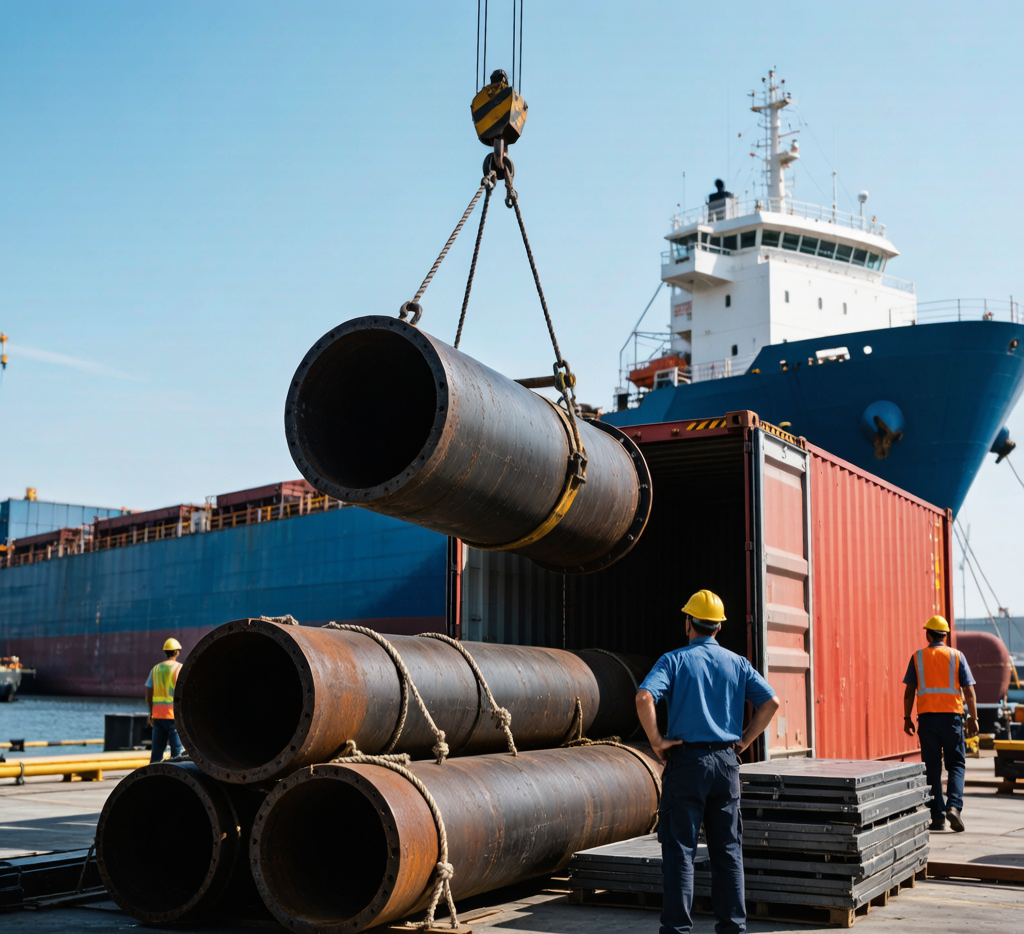
Steel is heavy — understanding container weight limits is the first step in freight planning:
| Container Type | Internal Volume | Max Payload (kg) | Max Payload (tons) | Common Use |
|---|---|---|---|---|
| 20′ GP (Dry) | 33.1 m³ | 21,750-28,250 | 21.7-28.3 | Heavy products: plate, bar, coil |
| 40′ GP (Dry) | 67.7 m³ | 26,510-28,750 | 26.5-28.8 | Light products: pipe, tube, sheet |
| 40′ HC (High Cube) | 76.3 m³ | 26,510-28,750 | 26.5-28.8 | Bulky products: long pipe, grating |
| 20′ OT (Open Top) | 33.1 m³ | 21,750-28,250 | 21.7-28.3 | Overheight: large coil, plate stack |
| 20′ FR (Flat Rack) | — | 22,000-31,000 | 22-31 | Overwidth/overlength: extra-long bar |
Critical rule: Steel shipments typically weight out before they volume out. A 20′ container filled with 25mm A36 plate reaches its 28-ton payload limit at only ~30% of internal volume. A 40′ container is cost-effective only when shipping lighter products (thin sheet, small-diameter pipe) where volume utilization reaches 80%+ before hitting weight limits.
Loading Plans for Different Steel Products
Steel Plate: Plates are stacked flat on wooden dunnage, strapped with steel bands every 1.5-2m. For 20′ containers, plate width must be ≤ 2,350 mm (container internal width). Stack height limited by payload — typically 4-8 plates depending on thickness. Corner protectors prevent band damage.
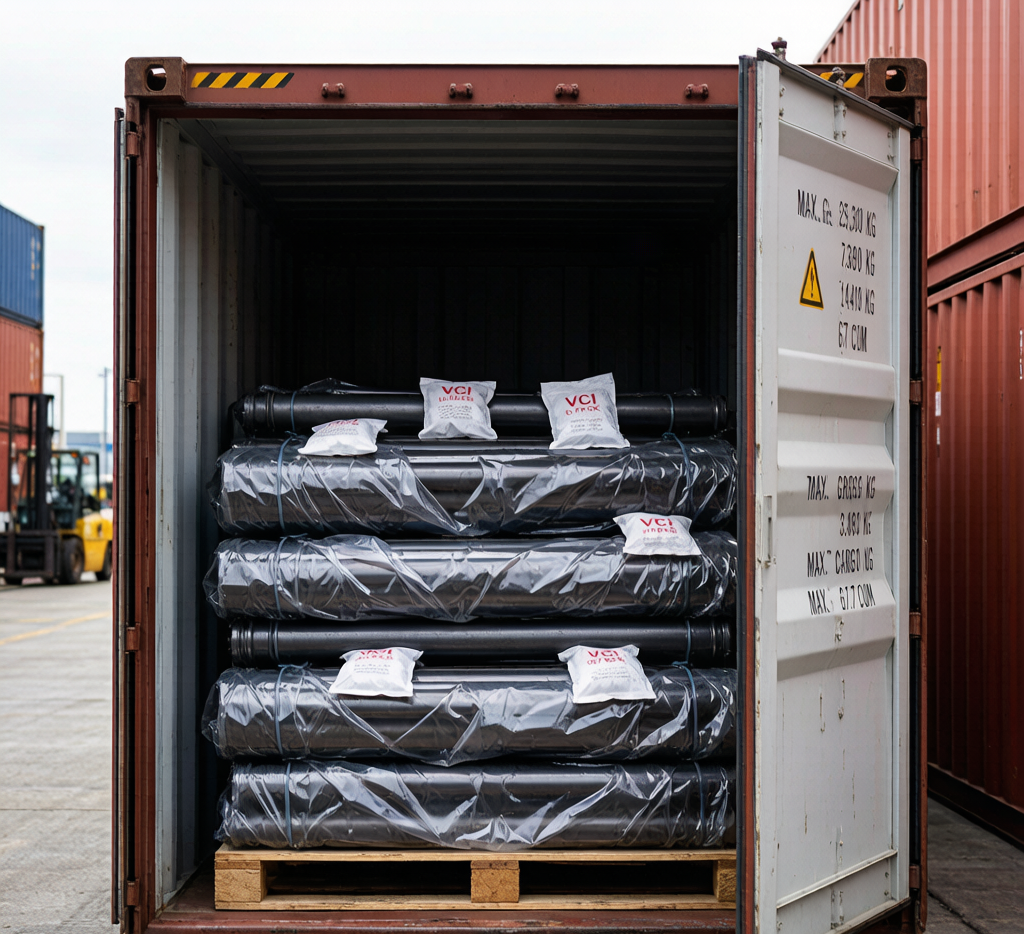
Steel Pipe/Tube: Pipes are loaded in bundles, either parallel (nested) or cross-stacked. 6m pipes fit a 20′ container; 12m pipes require 40′ or flat rack. Bundles are strapped at 3-4 points, separated by wooden spacers to prevent contact damage. For seamless pipe, plastic caps protect ends from denting.
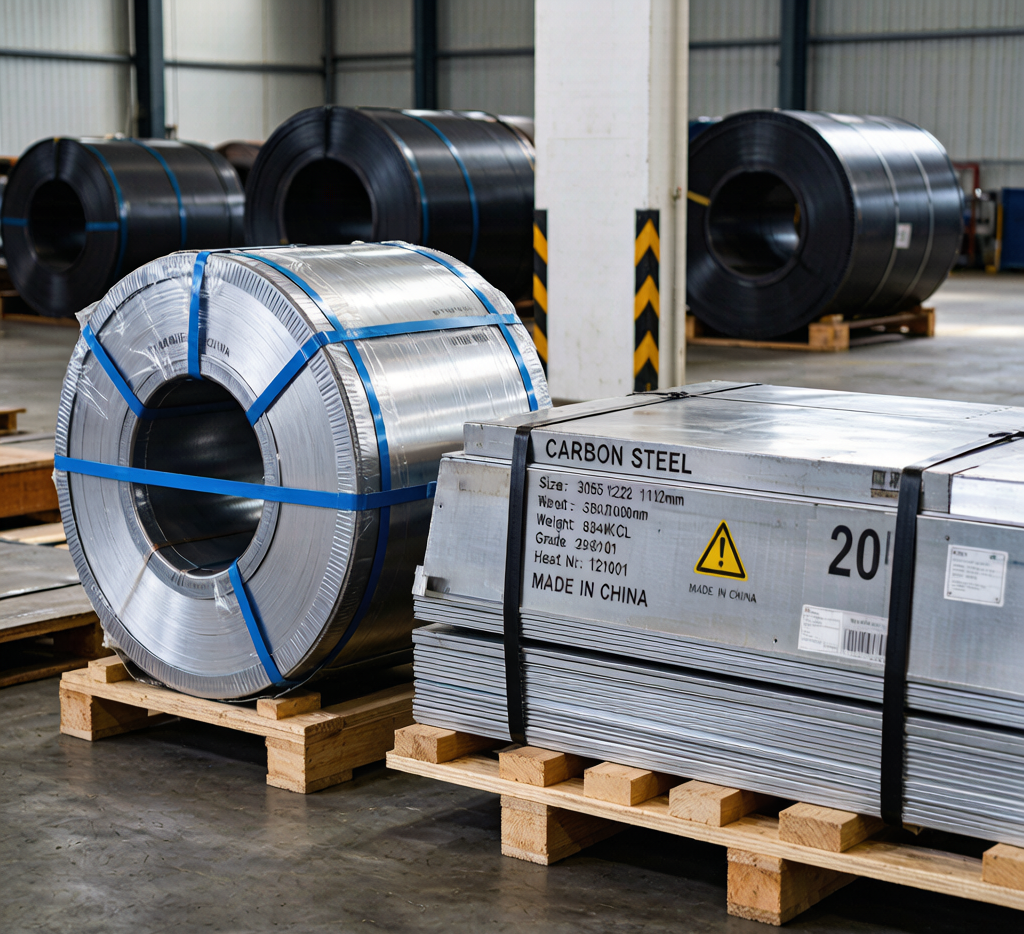
Steel Coil: Coils are loaded standing (eye vertical) on cradle supports, or lying flat (eye horizontal) for narrow coils. Maximum coil weight per 20′ container: typically 20-25 tons (1-2 coils). Coils must be secured with chocks and steel strapping to prevent rolling during transit — a loose coil can destroy a container.
Steel Bar/Section: Round bars, flat bars, channels, and I-beams are bundled and strapped. 6m lengths fit 20′; 12m requires 40’/flat rack. Bundles are stacked on wooden dunnage, with cardboard between layers to prevent surface scratching. Angles and channels are interleaved for compact loading.
Packaging Standards for Carbon Steel Export
Proper packaging is the difference between steel arriving in spec and arriving rusted or damaged:
| Protection Level | Packaging Method | Products | Cost Impact |
|---|---|---|---|
| Standard (dry cargo) | Steel strapping + wooden dunnage + corner protectors | Plate, bar, section | +2-3% of product cost |
| P&O + VCI paper | Pickled-oiled + VCI kraft paper wrap inside container | Coil, sheet, pipe | +4-6% |
| Full VCI package | VCI film wrap + VCI kraft + desiccant bags + sealed container | High-value, long transit | +6-8% |
| Export premium | Plastic cap + VCI + wooden crate + steel band | Seamless pipe, polished bar | +8-12% |
Desiccant bags (1-2 kg per container) absorb condensation moisture during ocean transit, preventing “container rain” — the leading cause of surface rust on unprotected steel. For shipments to humid destinations (Southeast Asia, Middle East), desiccant is strongly recommended.
Freight Modes: FOB, CIF, and Door-to-Door
| Mode | Supplier Responsibility | Buyer Responsibility | Best For |
|---|---|---|---|
| FOB (Free on Board) | Deliver to port, load container | Book freight, insurance, customs clearance, inland delivery | Buyers with established freight networks |
| CIF (Cost, Insurance, Freight) | Deliver to destination port + insurance | Customs clearance, inland delivery | Buyers wanting supplier-managed logistics |
| DDP (Delivered Duty Paid) | Complete door-to-door including customs | Receive goods at warehouse | First-time buyers, small orders |
Cost Optimization Strategies
Regular carbon steel importers can reduce freight costs by 15-30% through these strategies:
- Consolidate orders by product weight: Mix heavy (plate/coil) and light (pipe/sheet) products in the same container to maximize payload without exceeding weight limits.
- Use 20′ containers for heavy products: A 20′ container carrying 28 tons of plate costs less per ton than a 40′ carrying 26 tons — the weight efficiency of the 20′ unit is superior for dense products.
- Optimize coil dimensions: Order coils in widths that maximize container utilization. A 1,500 mm wide coil loads more efficiently than 1,250 mm in a 20′ container.
- Book freight during low season: Shipping rates from China peak Oct-Jan (pre-Chinese New Year) and are lowest Mar-Jun. Plan orders accordingly.
- Negotiate volume contracts: Monthly or quarterly shipping commitments with the same forwarder typically yield 10-15% rate reductions.
- Specify P&O instead of full VCI for short transit: For shipments under 20 days to nearby ports (Japan, Korea, Southeast Asia), P&O provides adequate protection at lower cost than full VCI packaging.
Arrival Inspection Checklist
When your steel shipment arrives, inspect these items before accepting delivery:
- Container condition: Check for water ingress, structural damage, or shifted cargo
- Surface condition: Verify no surface rust exceeds specification limits; light “transit rust” on as-rolled material is acceptable per most standards
- Bundle integrity: Steel strapping should be intact; broken bands indicate shifting during transit
- Quantity verification: Count bundles/pieces against packing list; weigh selected bundles against certified weights
- MTC review: Cross-check heat numbers on material against MTC heat numbers — traceability verification
- Dimensional spot-check: Measure 5-10% of pieces against ordered dimensions for initial acceptance
FAQ
How much carbon steel can a 20ft container hold?
A 20′ GP container holds 21.7-28.3 tons depending on road weight limits at origin and destination. For A36 plate (7,850 kg/m³ density), a 28-ton payload equals approximately 3.6 m³ of steel — roughly 8-10 plates of 25mm × 2,000mm × 6,000mm. The container “weights out” long before it fills volumetrically.
What causes container rain and how to prevent it?
Container rain occurs when moisture inside the container condenses on cold steel surfaces during temperature cycles (day heat → night cold). Prevention: (1) Use P&O or VCI packaging, (2) Place 1-2 kg desiccant bags per container, (3) Ensure container is dry before loading, (4) Avoid loading during rain.
Should I use 20ft or 40ft containers for steel?
Use 20′ for heavy products (plate, coil, bar) where payload efficiency is key. Use 40′ for light/voluminous products (thin sheet, small pipe, grating) where volume utilization reaches 70%+ before weight limits. For mixed orders, calculate both options — a well-packed 20′ can be more cost-effective per ton than a partially filled 40′.
What is the difference between FOB and CIF for steel?
FOB: supplier delivers steel to port and loads container; buyer arranges ocean freight, insurance, and destination logistics. CIF: supplier arranges freight and insurance to destination port; buyer handles customs and inland delivery. For a detailed comparison, see our FOB vs CIF vs EXW guide.
Conclusion
Effective carbon steel shipping requires careful container selection, professional loading, appropriate packaging, and corrosion protection matched to transit duration and destination conditions. For regular importers, optimizing these factors can reduce per-ton landed costs by 15-30% while ensuring specification-grade material at arrival.
At Huaxia-Steel, we provide professional container loading, VCI packaging, and flexible FOB/CIF arrangements for all carbon steel products. Contact our logistics team for a freight quotation and loading plan tailored to your next order.