Introduction: Two of the Most Ordered Grades — and Their Real Differences
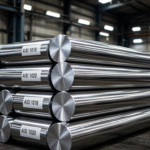
1018 and 1045 are two of the most frequently ordered carbon steel grades in international trade, and they sit on opposite ends of the medium-carbon spectrum: 1018 is a low-carbon steel (0.18% C) optimized for cold forming and cheap machining, while 1045 is a medium-carbon steel (0.45% C) chosen for strength and heat-treatment response. Because both are inexpensive, widely stocked, and often quoted interchangeably by trading companies, buyers regularly receive 1018 where the drawing says 1045 — or pay 1045 prices for 1018-quality steel.
This guide compares the two grades across chemistry, mechanical properties, machinability, weldability, heat-treatment behavior, typical part applications, and price — then gives a decision table for specifying the right grade on your next purchase order.

Chemical Composition Comparison
| Element | AISI 1018 (%) | AISI 1045 (%) |
|---|---|---|
| Carbon (C) | 0.15 – 0.20 | 0.43 – 0.50 |
| Manganese (Mn) | 0.60 – 0.90 | 0.60 – 0.90 |
| Phosphorus (P) | ≤ 0.040 | ≤ 0.040 |
| Sulfur (S) | ≤ 0.050 | ≤ 0.050 |
| Carbon classification | Low carbon | Medium carbon |
Chemically, the only meaningful difference is carbon — roughly 2.5x more in 1045. Everything that follows (strength, hardness, wear resistance, heat-treatability, weldability, formability) flows from that single difference. Manganese ranges are identical, which is why buyers cannot distinguish the grades by manganese on an MTC — always check carbon first.
Mechanical Properties: The Numbers
| Property | 1018 (hot rolled) | 1045 (hot rolled) | 1045 (Q&T) |
|---|---|---|---|
| Yield strength | ≥ 220 MPa | ≥ 310 – 340 MPa | ≥ 450 MPa |
| Tensile strength | 360 – 420 MPa | 540 – 620 MPa | 620 – 750 MPa |
| Elongation | ≥ 20 – 25% | ≥ 12 – 16% | ≥ 10 – 14% |
| Hardness | ~126 HB | ~163 – 190 HB | 28 – 34 HRC (typical) |
| Case hardness after carburizing | 55 – 62 HRC | Not typically carburized | — |
The headline: 1045 is roughly 40 – 50% stronger as-rolled, and can be quench-and-tempered to more than double 1018’s yield strength. Conversely, 1018 is more ductile, bends without cracking, and — through carburizing — achieves a hard, wear-resistant skin over a soft, tough core.

Machinability: Where Buyers See the Biggest Cost Difference
Machinability is rated against B1112 free-machining steel (= 100%):
- 1018: ~78% rating. Soft and gummy — it produces long stringy chips, needs sharp tooling and positive rake angles, and can build up on cutting edges at low speeds. Excellent for cold-drawn bar, where the cold work improves finish and chip breaking.
- 1045: ~55 – 60% rating. Harder, chips break cleanly, machines predictably; at higher volumes the shorter cycle on rigid setups often beats 1018 despite the lower rating. The usual cost trap is machining 1045 after hardening — rough-machine to 0.5 – 1 mm over final size before heat treatment.
Practical impact: for high-volume turned parts, the machining cost difference between the grades is usually smaller than the price difference buyers expect. Specify by service requirement, not by perceived machining cost alone.
Weldability: The Real Trade-Off
| Aspect | 1018 | 1045 |
|---|---|---|
| Weldability rating | Excellent — all processes, no preheat in thin sections | Fair — requires precautions |
| Preheat | Not required below ~25 mm | 150 – 260°C for sections above ~12 mm |
| Carbon equivalent | Low (~0.28) | Moderate (~0.55) |
| Post-weld | None needed | Stress relief at 550 – 650°C recommended; slow cool |
| Risk if ignored | Minimal | Hydrogen-induced cracking in HAZ |
Rule: if the part is welded after machining — brackets, welded frames, shafts with welded hubs — 1018 is the safer and cheaper choice. If the welded assembly needs 1045 strength, use low-hydrogen electrodes (E7018), preheat, and immediate stress relief.

Heat Treatment Response
- 1018 cannot be through-hardened by quenching — its carbon content is too low. Strengthening routes: cold drawing (up to ~30% higher yield), or carburizing (gas, carbonitriding) to get a 0.5 – 1.5 mm hard case (55 – 62 HRC) over a tough core. Ideal for gears, pins, and cams loaded in wear with shock.
- 1045 through-hardens effectively: austenitize at 820 – 860°C, water or oil quench (section-dependent), temper at 400 – 650°C to target hardness. Typical delivered condition Q&T to 28 – 34 HRC. Induction hardening works beautifully for local wear surfaces — shaft journals, sprocket teeth.
Typical Applications: Which Grade for Which Part
| Part | Recommended Grade | Why |
|---|---|---|
| Structural pins, clevises, spacers | 1018 | Cheap, weldable, ductile |
| Gears, sprockets, shafts (high load) | 1045 (Q&T) | Through-hardening strength |
| Light-duty gears with shock loads | 1018 (carburized) | Hard case + tough core |
| Welded brackets and frames | 1018 | No preheat needed |
| Hydraulic shafts, rams | 1045 (induction hardened) | Local wear surfaces |
| Cold-headed fasteners | 1018 | Cold formability |
| Machine keys, wear strips | 1045 | Higher hardness as-delivered |
Price and Availability
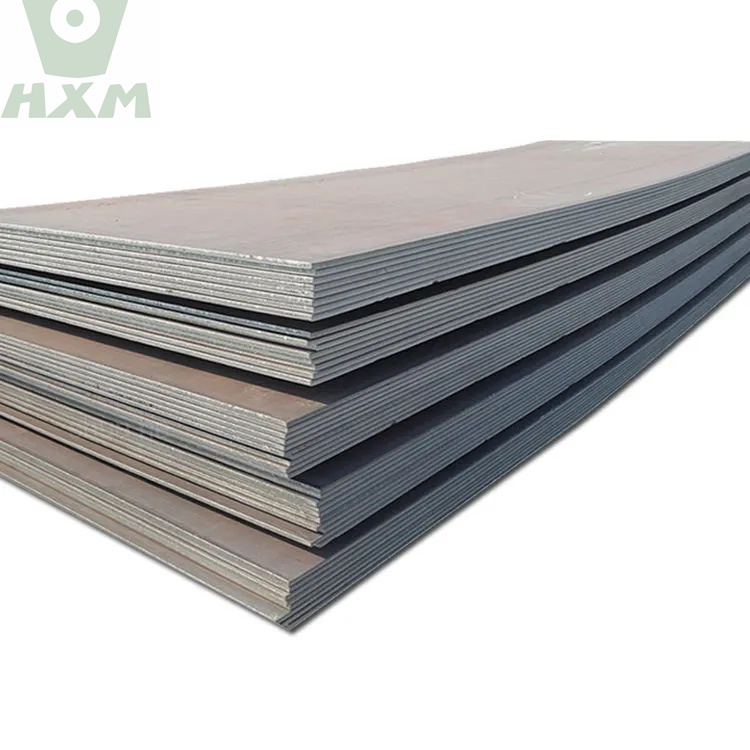
1045 typically prices 5 – 12% above 1018 for bar and plate in Chinese export stock, with the gap widening for Q&T-condition material (heat treatment adds 8 – 15%). Both grades are stocked in all common sections (round bar, flat bar, plate, hex bar). Beware quotations where “1045” undercuts 1018 market price — carbon substitution in either direction is the most common carbon steel fraud; the MTC carbon line settles it in seconds.
Buyer Verification Checklist
- MTC carbon content: 0.15 – 0.20% = 1018; 0.43 – 0.50% = 1045
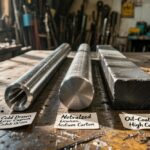
- Condition stated: as-rolled, cold-drawn, normalized, or Q&T — price and properties hinge on it
- Hardness spot check on delivery: ~126 HB vs 170 – 210 HB separates the grades physically
- Heat number on MTC matches stencil marking on material
- For Q&T orders: tempering temperature stated on certificate
Frequently Asked Questions
1. Can I substitute 1018 for 1045 to save money?
Only if the design has large safety margins and no wear or fatigue concerns. 1018 yields at roughly 220 MPa vs 310+ MPa for 1045 — a 30% strength drop. For shafts, gears, or any strength-governed part, substitution is a design change requiring engineer approval.
2. Is 1045 the same as C45 or S45C?
Functionally yes — DIN C45 (1.0503), EN C45E (1.1191), JIS S45C, and GB 45# are all medium-carbon steels with 0.42 – 0.50% C. Minor differences in sulfur limits and delivery conditions exist; most applications accept them interchangeably with documented equivalence.
3. Which grade machines faster?
1018 rates higher on paper (~78% vs ~55 – 60%), but cold-drawn 1045 with sharp carbide tooling achieves comparable cycle times on rigid CNC setups. For the cheapest machining overall, cold-drawn 1018 on high-volume small parts is hard to beat.
4. Can 1018 be surface hardened?
Yes — that is one of its main strengths. Carburizing or carbonitriding produces a 55 – 62 HRC case over a soft core, ideal for parts needing wear resistance with impact toughness. 1045 uses induction or flame hardening instead.
5. How do I quickly check which grade I received?
Three fast methods: spark test (1045 shows more bursting carriers), file hardness check (file cuts 1018 easily, skids on 1045), or the definitive method — carbon analysis on the MTC or a lab sample (~$30).
Conclusion
1018 and 1045 differ by one alloying element — carbon — and that difference splits their entire application space: 1018 for formability, weldability, and carburized wear parts; 1045 for strength, hardness, and heat-treated performance. Specify the grade the service condition demands, state the delivery condition on the purchase order, and verify carbon on every MTC.
Huaxia-Steel supplies AISI 1018 and 1045 (with C45 / S45C / 45# equivalents) in bar, plate, and custom-cut blanks — as-rolled, cold-drawn, normalized, or Q&T, with EN 10204 3.1 certification. Send us your part list and service conditions for a grade recommendation and quotation within 24 hours.