Introduction: Why the 1020 vs 1045 Decision Matters
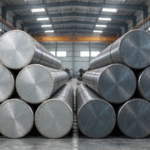
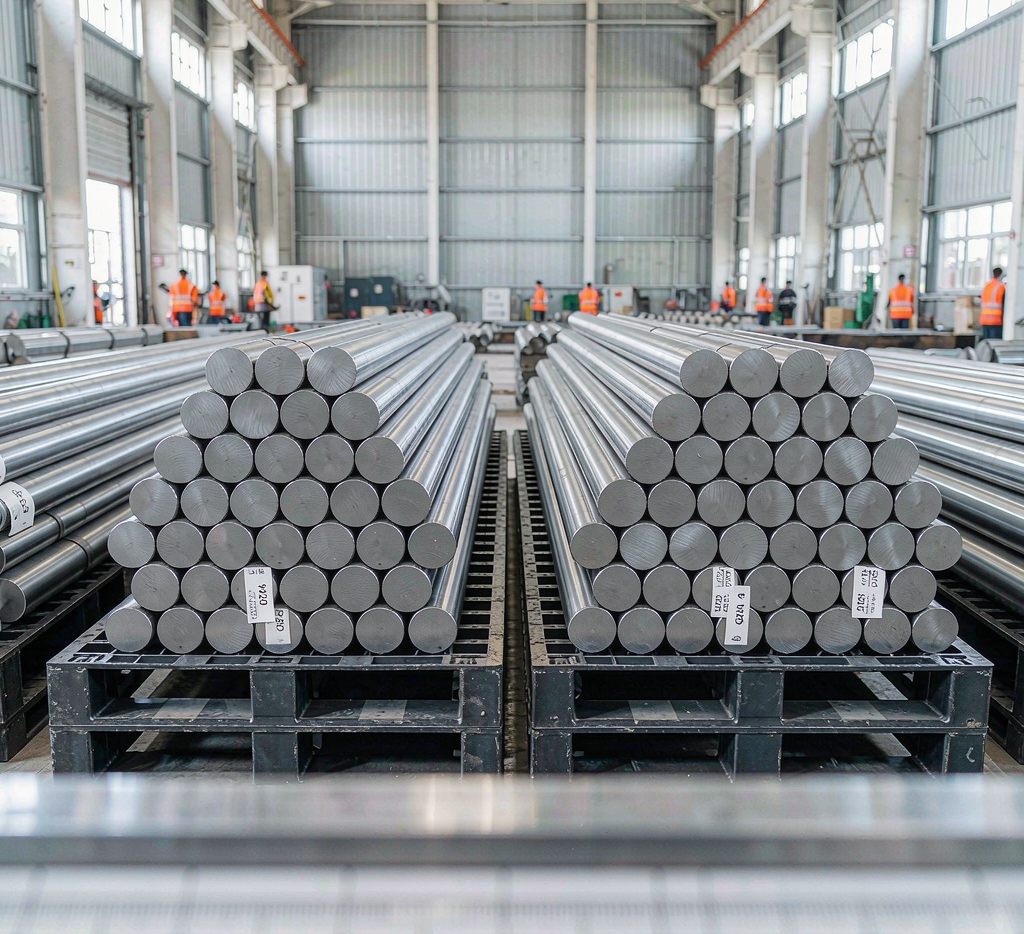
AISI 1020 and AISI 1045 are two of the most commonly ordered carbon steel grades in global trade, and they are separated by only one variable: carbon content. 1020 is a low-carbon steel with roughly 0.18% carbon, while 1045 is a medium-carbon steel at about 0.45% carbon. That small difference changes everything buyers care about: strength, hardness, machinability, weldability, heat-treatment response, and price.
Trading companies often quote the two grades at similar prices because both are stocked as round bar, flat bar, and plate. The problem is that they are not interchangeable in many applications. A shaft designed for 1045 will underperform if machined from 1020; a welded bracket that works fine in 1020 may crack if built from 1045 without proper preheat. This guide breaks down the real differences so you can specify the right grade on your next purchase order.
1. Chemical Composition: The Carbon Gap
| Element | AISI 1020 (%) | AISI 1045 (%) |
|---|---|---|
| Carbon (C) | 0.17 – 0.23 | 0.43 – 0.50 |
| Manganese (Mn) | 0.30 – 0.60 | 0.60 – 0.90 |
| Phosphorus (P) max | 0.040 | 0.040 |
| Sulfur (S) max | 0.050 | 0.050 |
| Classification | Low carbon steel | Medium carbon steel |
The carbon content in 1045 is roughly two and a half times that of 1020. Carbon is the main hardening and strengthening agent in plain carbon steels, which is why 1045 delivers significantly higher strength and responds well to heat treatment. 1020, with its lower carbon, stays softer, more ductile, and easier to form and weld.
2. Mechanical Properties Comparison
| Property | AISI 1020 (hot rolled) | AISI 1045 (hot rolled) | AISI 1045 (Q&T) |
|---|---|---|---|
| Yield strength | ≥ 210 MPa | ≥ 310 MPa | ≥ 450 MPa |
| Tensile strength | 380 – 420 MPa | 570 – 620 MPa | 620 – 750 MPa |
| Elongation | ≥ 25% | ≥ 16% | ≥ 12% |
| Hardness (as-rolled) | ~110 – 130 HB | ~170 – 200 HB | 28 – 34 HRC |
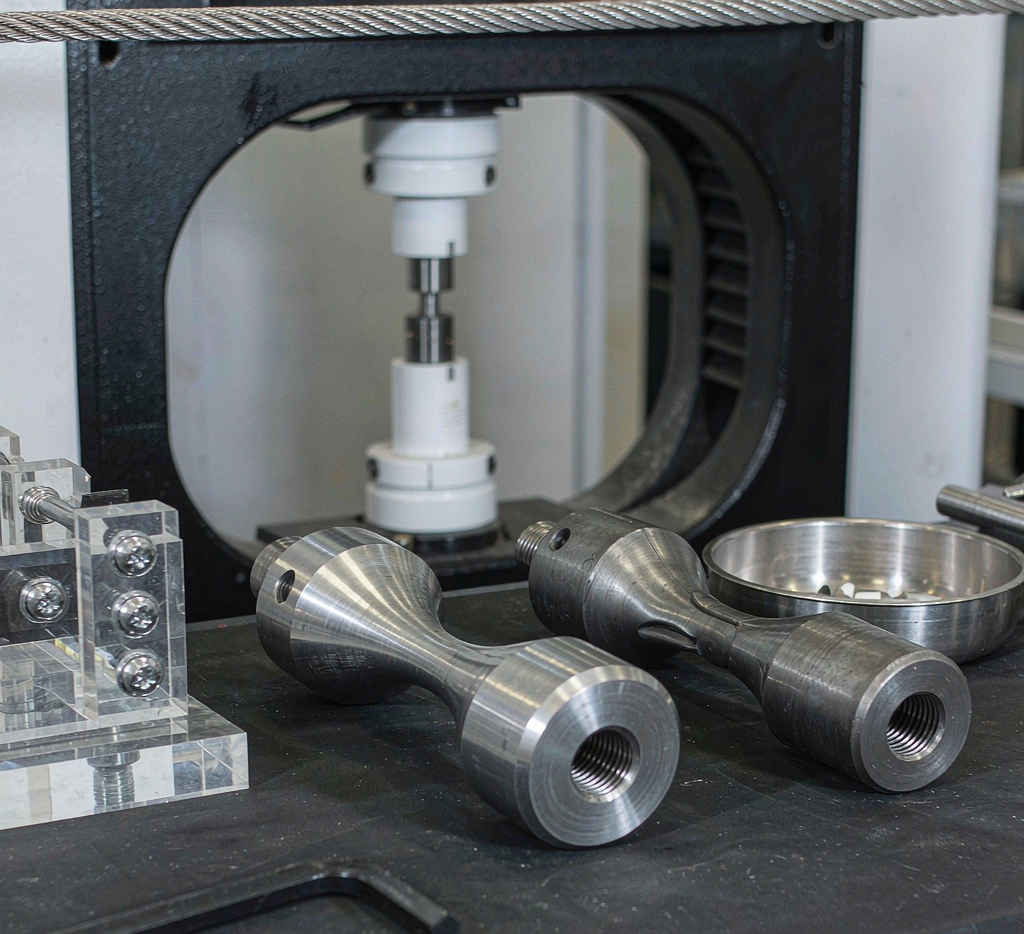
As-rolled 1045 is roughly 40 – 50% stronger than 1020. When quenched and tempered, 1045 can reach yield strengths above 450 MPa with good toughness. 1020 cannot be through-hardened in the same way, but it carburizes beautifully, producing a hard wear-resistant case over a tough, ductile core.
3. Machinability and Tool Life
Machinability ratings compare a material to free-machining B1112 steel at 100%:
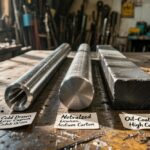
- 1020: ~75 – 78% machinability. Soft, produces long stringy chips, and can build up on tooling at lower speeds. Works best with sharp tools, positive rake angles, and adequate coolant. Cold-drawn 1020 improves finish and chip breaking.
- 1045: ~55 – 60% machinability. Harder, chips break cleanly, and it machines predictably. At higher volumes on rigid CNC lathes, the cycle time difference can be smaller than buyers expect. If the part is hardened before finish machining, carbide tooling and slower speeds are required.
Cost trap: do not assume 1045 is always more expensive to machine. For large rigid parts with short machining times, the higher strength may reduce the total cost of ownership by allowing smaller sections.
4. Weldability and Formability
| Aspect | AISI 1020 | AISI 1045 |
|---|---|---|
| Weldability | Excellent | Fair; precautions needed |
| Preheat | Generally not required below 25 mm | 150 – 260°C for sections over 12 mm |
| Carbon equivalent | ~0.28 | ~0.55 |
| Post-weld heat treatment | Usually not needed | Stress relief at 550 – 650°C recommended |
| Cold forming | Excellent bending, flanging, deep drawing | Limited; springback higher |
1020 is the better choice for welded assemblies, brackets, and cold-formed parts. 1045 can be welded successfully, but it requires low-hydrogen electrodes, controlled preheat, and often stress relief to avoid hydrogen-induced cracking in the heat-affected zone.
5. Heat Treatment Behavior
- 1020: Cannot be through-hardened by quenching because carbon is too low. Strengthening comes from cold drawing or surface hardening. Carburizing and carbonitriding create a 55 – 62 HRC case depth of 0.5 – 1.5 mm, ideal for gears, pins, and cams.
- 1045: Through-hardens well. Typical route: austenitize at 820 – 860°C, oil or water quench depending on section size, then temper at 400 – 650°C to target hardness. Induction hardening is popular for local wear surfaces such as shaft journals and sprocket teeth.
6. Application Selection Guide
| Part / Application | Recommended Grade | Reason |
|---|---|---|
| Welded brackets and frames | 1020 | No preheat, excellent ductility |
| Cold-headed fasteners and pins | 1020 | Good cold formability |
| Carburized gears and shafts | 1020 + carburizing | Hard case, tough core |
| General machinery shafts | 1045 as-rolled | Higher strength and hardness |
| High-load shafts and axles | 1045 Q&T | Best strength-to-cost ratio |
| Wear strips and machine keys | 1045 | Higher as-rolled hardness |
| Hydraulic rams and pins | 1045 induction hardened | Local wear resistance |
7. Price and Availability
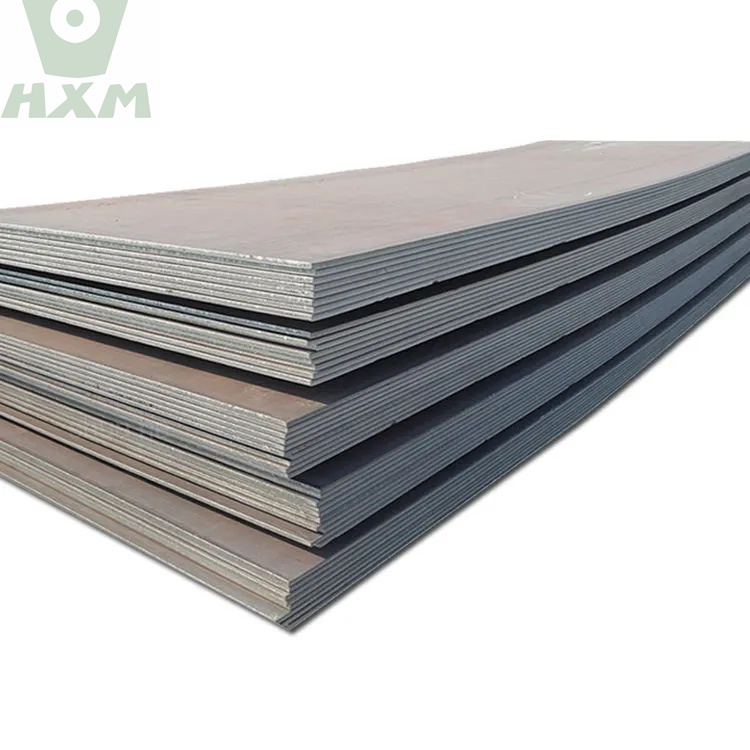
In Chinese export stock, 1045 typically costs 5 – 12% more than 1020 for bar and plate. Quenched-and-tempered 1045 adds another 8 – 15% for heat treatment. Both grades are widely available in round bar, flat bar, square bar, hex bar, and plate sections. If a supplier quotes 1045 below the 1020 market price, verify the certificate carefully — carbon substitution is a common quality risk.
8. Buyer Verification Checklist
- Check MTC carbon content: 0.17 – 0.23% for 1020; 0.43 – 0.50% for 1045
- Confirm delivery condition: as-rolled, cold-drawn, normalized, or Q&T
- Verify hardness spot check matches the ordered condition
- Match heat number on MTC to stencil marking on the material
- For welded parts, confirm preheat and consumables if 1045 is used
Frequently Asked Questions
1. Can I replace 1020 with 1045 to get a stronger part?
Yes, if strength or wear resistance governs the design and the part is not welded. 1045 is roughly 40 – 50% stronger as-rolled and can be heat treated for much higher strength. For welded or cold-formed parts, 1020 is usually the safer choice.
2. Is 1045 the same as C45, S45C, or 45#?
They are functional equivalents. AISI 1045, DIN C45 (1.0503), JIS S45C, and GB 45# all contain about 0.42 – 0.50% carbon. Minor differences in sulfur limits and delivery conditions exist, but most applications accept them interchangeably with documented equivalence.
3. Which grade machines faster?
On paper, 1020 machines faster (~75 – 78% vs ~55 – 60% machinability rating). In practice, cold-drawn 1045 with modern carbide tooling can achieve similar cycle times on rigid setups. For the fastest machining, choose cold-drawn 1020 for small, high-volume turned parts.
4. Can 1020 be hardened?
1020 cannot be through-hardened by quenching. It can be surface-hardened by carburizing or carbonitriding, which creates a hard case over a ductile core. 1045, by contrast, can be through-hardened and induction-hardened.
5. How can I quickly verify which grade I received?
Fast methods include a spark test (1045 produces more bursting sparks), a file hardness check (a file cuts 1020 more easily), and a portable hardness tester. The definitive check is carbon analysis on the MTC or a lab sample, usually costing under $40.
Conclusion
The 1020 vs 1045 choice comes down to one question: does the application need strength, hardness, and heat-treatability, or does it need ductility, weldability, and cold formability? 1045 wins on strength and wear resistance; 1020 wins on formability and weldability. Specify the condition on every order and verify carbon content on the mill certificate.
Huaxia-Steel supplies AISI 1020 and AISI 1045 (plus C45 / S45C / 45# equivalents) in round bar, flat bar, plate, and cut-to-length blanks — as-rolled, cold-drawn, normalized, or quenched-and-tempered, with EN 10204 3.1 certification. Send us your part list and service conditions for a grade recommendation and 24-hour quotation.