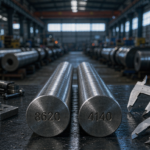
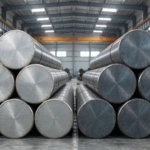
Walk into any machine shop procurement meeting and you will hear two grades mentioned more than almost any others: AISI/SAE 1045 and AISI/SAE 4140. One is the workhorse medium-carbon steel, the other the default alloy engineering steel. They can be heat treated to similar surface hardness numbers, they are both available in every size from every mill, and on a quote sheet they can look nearly interchangeable — yet their price can differ by 60-100% and their behavior in a fatigued shaft differs far more than most buyers expect. This guide compares 1045 vs 4140 across chemistry, mechanical properties, heat treatment response, hardenability, weldability, machinability, cost and typical applications, and ends with a selection checklist that sourcing teams can apply directly to RFQs.
1. Chemical Composition: Carbon vs Alloying
1045 is a plain medium-carbon steel with no deliberate alloying beyond manganese and silicon. 4140 is a chromium-molybdenum alloy steel. Here is the standard chemistry side by side (SAE J403 for 1045, SAE J404 for 4140, ladle analysis, %):
| Element | 1045 | 4140 |
|---|---|---|
| Carbon (C) | 0.43–0.50 | 0.38–0.43 |
| Silicon (Si) | 0.15–0.35 | 0.15–0.35 |
| Manganese (Mn) | 0.60–0.90 | 0.75–1.00 |
| Chromium (Cr) | — | 0.80–1.10 |
| Molybdenum (Mo) | — | 0.15–0.25 |
| Phosphorus (P) max | 0.040 | 0.035 |
| Sulfur (S) max | 0.050 | 0.040 |
Three points matter for buyers. First, 1045 actually carries slightly higher carbon (0.43-0.50% vs 0.38-0.43%), so it can reach comparable surface hardness in a thin section — a 20 mm 1045 bar water quenched can hit 55 HRC at the surface, similar to 4140. Second, the chromium and molybdenum in 4140 do two jobs: chromium deepens hardenability and adds mild abrasion resistance, while molybdenum suppresses temper embrittlement and improves elevated-temperature strength. Third, because 1045 has no alloy content, its price tracks ordinary carbon steel indices, while 4140 tracks an alloy surcharge — this alone explains most of the cost gap and most of the price volatility difference between quotations.
2. Mechanical Properties in Comparable Conditions
The honest comparison is at matched delivery conditions. The table below shows typical properties for normalized and for quenched-and-tempered bars around 25 mm diameter:
| Property | 1045 N | 1045 Q&T | 4140 N | 4140 Q&T |
|---|---|---|---|---|
| Tensile strength | 620–700 MPa | 750–900 MPa | 750–900 MPa | 1000–1200 MPa |
| Yield strength (0.2%) | 350–420 MPa | 450–550 MPa | 500–600 MPa | 850–1050 MPa |
| Elongation in 50 mm | 17–22% | 15–20% | 18–22% | 13–17% |
| Hardness (typical) | 170–200 HB | 220–260 HB | 210–240 HB | 300–360 HB |
| Charpy V-notch, room temp | 35–50 J | 40–60 J | 50–80 J | 50–90 J |
| Endurance limit (rotating beam) | ~280 MPa | ~350 MPa | ~420 MPa | ~560 MPa |
Two conclusions stand out. In fully quenched-and-tempered small sections, 4140 delivers roughly 30-40% higher tensile strength and nearly double the yield strength of 1045, with a fatigue endurance limit around 60% higher. For any component that sees cyclic bending or torsion — shafts, spindles, axles, connecting rods — that fatigue number is usually the deciding engineering argument. Conversely, if the duty is static loading at moderate stress with generous section size, 1045 Q&T at roughly half the material price does the same job, and any money spent on 4140 there is capability the part will never use.
3. Hardenability: Where the Grades Truly Separate
Surface hardness numbers hide the real difference. Hardenability — how deep the hardened zone reaches during quenching — is what separates a plain carbon steel from an alloy steel. On a Jominy end-quench test, 1045 loses hardness rapidly beyond about 5 mm from the quenched end; 4140 holds hardness out to 15-25 mm and beyond. Practical consequences:
- 1045: through-hardening is realistic only up to roughly 20-25 mm diameter in water (with real distortion and cracking risk). Above 30 mm, the core of a water-quenched 1045 bar remains ferrite-pearlite at around 170-200 HB no matter what the certificate says about the surface.
- 4140: through-hardens reliably to about 50-60 mm diameter in oil, and to 80-100 mm with vigorous quenching. This is why induction-hardened 4140 shafts achieve a deep, well-supported case with a tough core, while induction-hardened 1045 is essentially a case-hardening exercise.
- Large 1045 sections: for diameters above 50 mm, specifying 1045 “quenched and tempered through” invites failure; the correct call is either normalized 1045 for moderate strength or a move up to 4140.
A frequent sourcing dispute illustrates the point: a buyer orders 60 mm 1045 shafts “hardened to 28-32 HRC”, receives bars that measure 26-28 HRC at the surface, and rejects them. The mill replies that 1045 cannot physically reach the spec at that section. The failure was in the specification stage — the section size demanded 4140, or the spec demanded normalized 1045 at 200-230 HB. Agreeing on hardenability limits before purchase eliminates this entire class of claims.
4. Heat Treatment Windows and Distortion
1045 is quenched in water or brine because its hardenability is too low for oil. Water quenching brings consequences: thermal gradients are steep, distortion is 2-3 times higher than oil quenching, and thin sections or sharp corners can quench-crack. Typical 1045 Q&T: austenitize 820-860 °C, water quench, temper 400-650 °C depending on target hardness.
4140 quenches in oil (or polymer), which cuts distortion dramatically and makes it suitable for parts with machined threads, keyways or profile changes that must survive heat treatment without straightening. Typical 4140 Q&T: austenitize 830-870 °C, oil quench, temper 400-675 °C; a common export spec is temper at 540-600 °C delivering 28-34 HRC. For buyers procuring finished-machined components, the lower distortion of 4140 often saves more money in straightening, re-machining and scrap than the alloy surcharge costs in the first place.
5. Weldability Comparison
1045’s carbon equivalent (CEV ≈ 0.60-0.70) already places it in the “preheat required” category: 150-250 °C preheat, low-hydrogen electrodes such as E7018, and slow cooling are standard practice for repairs and fabricated joints. It welds acceptably in shaft repair and build-up work, which is one reason maintenance shops like it.
4140 sits at CEV ≈ 0.80-0.90 — firmly difficult. Welding requires 260-370 °C preheat, hydrogen bake-out immediately after welding, and ideally a full re-temper to restore the heat-affected zone. Underbead cracking is the dominant risk. Neither grade should be welded casually, but between the two, 1045 is clearly the more forgiving in the field. If the design involves welded assemblies, consider whether a lower-carbon grade (1045 is already at the practical carbon ceiling) or a weldable structural steel with localized hardening serves better.
6. Machinability and Production Cost
On the standard machinability index (B1112 = 100%), 1045 as-rolled scores about 55-60%, and 4140 annealed about 55-65% — but after Q&T the gap widens: hardened 4140 at 300-360 HB costs 20-40% more in tooling and cycle time than 1045 at 220-260 HB. Shops therefore prefer to rough-machine 4140 in the annealed state, heat treat, then finish-grind, which adds a process step that 1045 parts often avoid.
Price, expressed as typical export ranges from Chinese mills (2026 market, per ton): hot rolled 1045 round bar USD 540-680; 4140 annealed or Q&T bar USD 820-1050. The 55-80% premium buys hardenability, fatigue strength and lower distortion — real engineering value in rotating equipment, pure waste in brackets and supports. Minimum order quantities are similar (1-3 tons per size from stockists, full heats from mills), so the choice is rarely constrained by logistics.
7. Typical Applications Side by Side
| Application | Better choice | Why |
|---|---|---|
| General shafts < 25 mm, moderate load | 1045 | Q&T properties sufficient; lowest cost |
| Heavy-duty shafts, spindles, axles | 4140 | Deep hardenability, 60%+ fatigue limit |
| Gears and sprockets (through hardened) | 4140 | Core strength under tooth bending |
| Pins, bushes, linkages (static) | 1045 | Induction harden surface only |
| Hydraulic cylinder rods (before chrome) | 1045 / CK45 | Industry standard; cost matters |
| Injection molding tool holders | 4140 (P20 family) | Through hardness + polishability |
| Forged flanges and rings | Either | Depends on design stress and section |
| Rail and wear plates | 1045+ | Cost-driven abrasion duty |
8. Equivalents and Cross-References
Buyers working across standards should anchor to these equivalents, always verified by chemistry on the MTC rather than by name: 1045 corresponds to DIN C45 / 1.0503, JIS S45C, GB 45, and EN S45C under EN 10083-2; 4140 corresponds to DIN 42CrMo4 / 1.7225, JIS SCM440, GB 42CrMo, and in pre-hardened form to the P20 tool steel family. Note that “equivalent” steels differ in sulfur ceilings and test frequencies — Japanese and European versions of SCM440 often carry tighter cleanliness requirements than generic 4140, which matters for polished bars and high-cycle fatigue parts. When a drawing names one standard, ask bidders to state their exact cross-reference and to attach a recent MTC sample so the comparison happens before the order, not after delivery.
9. Total Cost of Ownership View
The material price premium of 4140 is only the entry ticket. A fair comparison includes: heat treatment cost per kg (similar for both, but 4140 straightening after quench is rarer), machining time (hardened 4140 costs more), expected service life (in fatigue-limited parts 4140 can last 2-3 times longer at the same dimensions), and failure cost. A conveyor drive shaft on a 24/7 line is a poor place to save USD 80 per ton of steel; a static pin in a hand-operated press is a poor place to spend it. Mature sourcing teams classify every part into “fatigue-critical”, “wear-critical” and “static” categories first, then assign the grade second — the reverse of the common habit of starting from a favorite grade and adjusting the design around it.
10. Buying Checklist: 1045 or 4140?
- Diameter over 30-40 mm with hardness above 250 HB required? 4140 — 1045 cannot deliver the core.
- Rotating bending or torsional fatigue? 4140 unless loads are light.
- Static loading, sections under 25 mm, moderate strength? 1045 Q&T.
- Surface-hardened only (induction), tough core irrelevant? 1045 is the economical answer.
- Tight distortion tolerances after heat treatment? 4140 oil quench.
- Field welding expected? Neither is good; 1045 is less bad.
11. Surface Finish, Tolerance and Straightness Options
Grade is only half the specification; the other half is condition and surface. Both 1045 and 4140 are traded in four common finishes, and the choice affects machining cost, scrap rate and final dimensions more than most buyers budget for. Hot rolled bar carries mill scale and rolling tolerance (roughly ±0.4 mm at 16-25 mm, widening with size) and is the right feed stock when the part will be heavily machined anyway. Cold drawn bar delivers h9-h11 accuracy, a brighter surface and a yield strength boost of 10-15% from cold work — the default choice for CNC turning centres producing pins and bushings. Peeled and polished bar removes all surface defects (seams, laps, decarburization) at ±0.2 mm, and is what buyers should specify before induction hardening or chrome plating, because surface seams become quench cracks. Ground bar at h7-h8 with Ra ≤ 0.8 µm serves precision spindles and hydraulic rods where finish-grinding is to be eliminated.
Straightness deserves explicit mention in the PO: standard mill straightness is around 1-2 mm per meter, which is adequate for bars that will be turned between centres but causes chatter in Swiss-type lathes. Precision-straightened bar at 0.3-0.5 mm per metre costs a modest premium and frequently pays for itself in reduced setup time and lower out-of-round scrap.
12. Corrosion, Wear and Surface Engineering Choices
Neither 1045 nor 4140 is corrosion resistant; both need protection. The common routes are black oxide (thin, cosmetic only, 1-2 µm), zinc plating (8-25 µm, good atmospheric protection, hydrogen embrittlement risk above 320 HB requiring bake-out), hard chrome plating (20-100 µm, 850-1000 HV, the standard for hydraulic rods — see CK45 chrome plated rod), nitriding (surface 700-900 HV, no dimensional change beyond a few microns, excellent for 4140 which forms stable nitrides thanks to chromium), and induction hardening (case 50-58 HRC for wear surfaces). 4140 nitrides particularly well and is often chosen specifically for that route because the chromium content produces a harder, deeper diffusion zone than plain carbon steel achieves.
If the part will see only mild indoor service, specify a rust-preventive oil or VCI packing and let the end user decide. Over-specifying plating on parts that never leave a dry workshop is one of the quietest sources of unnecessary cost in steel procurement.
13. Three Real Sourcing Decisions
Case 1 — conveyor drive shafts, 22 mm, 12 units per month. Loads are moderate and continuous, life expectation five years. The original drawing called for 4140 Q&T. Engineering re-analysis showed stress 40% below 1045 Q&T capability, and the change saved USD 180 per shaft per year with identical service. Lesson: confirm the actual stress level before accepting a legacy grade call.
Case 2 — hydraulic press ram, 90 mm diameter. Specified 1045 hardened to 30 HRC; first batch failed magnetic particle inspection with surface cracks after water quenching. The correct call was 4140 oil quenched to 28-32 HRC with the section size acknowledged from the start. Lesson: hardenability, not tensile strength, governs large sections.
Case 3 — gear blanks, 40 mm thick, 300 pieces. 4140 annealed rough machined, Q&T to 32 HRC, then finish ground. Total cost per part was 8% higher than 1045 but tooth life in field service roughly doubled, and warranty claims fell to zero. Lesson: where the cost of failure is high, the alloy premium is cheap insurance.
14. Incoming Inspection: 5 Checks Before Unloading
Before a bar bundle reaches your stores, five checks catch virtually every real problem. One: verify the heat number stenciled or tagged on each bundle against the MTC — mismatches mean the certificate describes different steel. Two: measure diameter and straightness on a sample (five bars per bundle) against the ordered tolerance class; cold drawn bar out of h9 usually indicates a supplier shipping hot rolled. Three: take a Brinell or Rockwell reading on the bar end and compare with the ordered condition — 1045 at 300 HB is not “extra strong”, it is the wrong condition or the wrong grade. Four: inspect surface condition for seams, laps and heavy pitting; run magnetic particle inspection on a sample if the parts will be hardened or plated. Five: run a spark test or portable OES on one sample; chromium-bearing 4140 sparks differently from 1045, and a 30-second check confirms the grade family before any material is cut. Document results per heat and keep them with the certificate — this file is what makes a subsequent claim winnable, and it costs about fifteen minutes per bundle.
FAQ: 1045 vs 4140 Steel
Can 1045 be substituted for 4140 to save cost?
Only where section size and loading allow. For diameters under 25 mm with static or light cyclic loads, 1045 Q&T matches 4140 service adequately. Substituting in fatigue-critical or large-section parts without an engineering sign-off is how shaft failures happen. Always let the drawing’s stress analysis decide, and record the substitution formally.
Which grade is easier to induction harden?
Both respond well. 1045 reaches 55-58 HRC surface hardness after induction hardening and tempering at low temperature; 4140 reaches the same surface but supports it with a deeper hardened layer and a stronger core. For heavy contact stress (gears, sprockets, cam followers), 4140’s support layer prevents case collapse; for pins and light-duty rollers, 1045 suffices.
What should I check on the MTC to tell them apart?
Look at the ladle chemistry: if chromium and molybdenum read 0.80-1.10% and 0.15-0.25% respectively, you have 4140; values near zero mean 1045. Also verify the heat treatment state (+N or +QT), the hardness or tensile results against the ordered condition, and the heat number matching the bars’ stamped identification. A supplier unwilling to send MTC samples before the order is a supplier to avoid.
Is 4140 always more expensive than 1045?
In bar and forging form, yes — typically 55-80% per ton, driven by chromium, molybdenum and lower rolling volumes. In finished small parts, the gap narrows because machining dominates cost, and pre-hardened 4140 may eliminate a customer’s heat-treatment step entirely. Compare at the finished-part level, not the raw-material level, before deciding.
Need 1045 or 4140 carbon steel round bar, forged shafts or custom cut-to-length bars from a certified China mill? Send your grade, diameter, quantity and required condition — we reply within 24 hours with mill options, MTC samples and a firm FOB/CIF quotation, third-party inspection available before shipment.