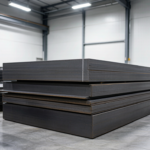
Introduction: Two Grades That Often Compete for the Same Order
When a drawing calls for carbon steel, two grades show up repeatedly in Chinese export quotations: 1045 and A36. They are not direct substitutes, yet they overlap in enough applications that buyers regularly ask which one to specify. The answer depends on what the part actually does: A36 is a structural grade chosen for weldability and ductility, while 1045 is a medium-carbon grade chosen for strength, hardness, and machinability.
This guide compares 1045 vs A36 carbon steel across chemistry, mechanical properties, hardness, machinability, weldability, price, and typical applications. The goal is simple: help you write a purchase order that matches the grade to the job, instead of letting the supplier decide for you.

What 1045 and A36 Actually Are
1045 steel is a medium-carbon steel specified by AISI/SAE. Its name comes from its nominal chemistry: roughly 0.45% carbon. It is produced to a chemical composition standard and is typically supplied as hot-rolled bar, cold-drawn bar, or normalized/quenched-and-tempered bar. Common international equivalents include C45 (EN), S45C (JIS), and Ck45 (DIN).
A36 steel is an ASTM structural steel specified by ASTM A36 / A36M. It is a low-carbon steel with a maximum carbon content of 0.29% and a minimum yield strength of 36 ksi (250 MPa). It is produced to a property standard and is supplied mainly as plate, angles, channels, and structural sections. Common equivalents include Q235B (GB), S235JR (EN), and SS400 (JIS).
The fundamental difference: 1045 is composition-defined and bought for its carbon content; A36 is property-defined and bought for its minimum yield strength. That distinction drives every other comparison below.
Chemical Composition Comparison
| Element | 1045 (typical max %) | A36 (max %) | Impact |
|---|---|---|---|
| Carbon (C) | 0.43–0.50 | 0.29 | Higher C in 1045 allows heat treatment to higher hardness |
| Manganese (Mn) | 0.60–0.90 | 0.80–1.20 (for shapes > 3/4 in.) | Both use Mn for strength; A36 allows more in thicker sections |
| Phosphorus (P) | ≤ 0.040 | ≤ 0.04 | Similar limits |
| Sulfur (S) | ≤ 0.050 | ≤ 0.05 | Similar limits; resulfurized 1045 exists for machinability |
| Silicon (Si) | 0.15–0.35 | 0.15–0.40 | Deoxidation and minor strengthening |
The carbon gap is the headline. At roughly 0.45% carbon, 1045 has more than 50% more carbon than A36. That extra carbon is what lets 1045 reach 55 HRC when quenched, while A36 cannot be hardened meaningfully by heat treatment.
Mechanical Properties and Hardness
| Property | 1045 (as-rolled) | A36 |
|---|---|---|
| Yield strength | ≥ 310 MPa (45 ksi) | ≥ 250 MPa (36 ksi) |
| Tensile strength | 570–700 MPa | 400–550 MPa |
| Elongation | ≥ 16% | ≥ 20% |
| Typical hardness | 170–210 HB | 120–160 HB |
| Heat treat response | Excellent (Q&T to 50+ HRC) | Limited (normalizing only) |

In practical terms, 1045 is roughly 20–25% stronger in yield and 30–40% stronger in tensile than A36 in the as-rolled condition. After quenching and tempering, the gap becomes much larger: a 1045 shaft can run at 700–850 MPa tensile while A36 plate remains in the 400–550 MPa range no matter what you do to it.
When to Choose 1045
Specify 1045 when the design values strength, hardness, wear resistance, or the ability to respond to heat treatment:
- Shafts and axles: higher yield and fatigue strength reduce section size.
- Gears, pins, and couplings: can be induction hardened or through-hardened for wear surfaces.
- Machine parts with heavy machining: 1045 machines cleanly in the normalized or annealed condition.
- Tools and fixtures: flame-hardened 1045 rails and blocks are common shop tooling.
- Replacement parts where a harder-wearing grade is needed: 1045 outlasts A36 in abrasive contact.
Common delivery conditions for export orders: as-rolled, normalized, annealed, or quenched and tempered. Always specify the condition and the required hardness range on the purchase order. A purchase order that says only “1045” will receive as-rolled bar, which may be too hard for some machining operations or too soft for wear applications.
When to Choose A36
Specify A36 when the design values weldability, ductility, and low cost per tonne in structural shapes:
- Building frames, platforms, and supports: governed by structural codes that reference ASTM A36 directly.
- Welded fabrications: low carbon equivalent means minimal preheat and forgiving weld quality.
- General structural plate: storage tanks, base plates, gussets, and brackets that carry modest loads.
- Cold-formed sections: higher elongation allows tighter bend radii without cracking.
- Projects where the drawing specifies A36: substituting 1045 here is usually not permitted without engineering approval.
A36 is also the safer default when the end use is unclear. Its lower strength is rarely a failure mode in light structural work, while its superior weldability and formability prevent costly shop-floor problems.
Machinability Comparison
1045 machines better than A36 in almost every condition. The higher carbon produces shorter chips, better surface finish, and more predictable tool wear. In the annealed condition, 1045 is a shop favorite for shafts and pins. A36, by contrast, is gummy and tends to produce long stringy chips; it is fine for simple cutting and drilling but not chosen for precision turned parts.
| Grade | Machinability Rating | Typical Tooling | Surface Finish |
|---|---|---|---|
| 1045 annealed | Good to excellent | Standard HSS or carbide | Smooth, predictable |
| 1045 as-rolled | Good | Carbide preferred | Acceptable |
| A36 | Fair | Carbide, generous speeds/feeds | Stringy chips, moderate finish |
Weldability: A36 Wins Clearly
A36 welds with ordinary E7018 electrodes or ER70S-6 wire, usually without preheat on sections under 25 mm. 1045 is weldable but requires more care: preheat to 150–250°C, low-hydrogen electrodes, and controlled cooling to avoid hydrogen cracking. The higher carbon equivalent of 1045 makes it a poor choice for complex welded structures.
Rule of thumb: if the drawing shows extensive welding, lean toward A36. If the part is mostly machined and only occasionally welded, 1045 is acceptable with the right procedure.
Price and Availability
In the Chinese export market, 1045 bar typically trades at a 5–15% premium over A36 plate or structural sections on a per-tonne basis. The premium widens for cold-drawn or heat-treated conditions. A36 is more widely available in plates and structural shapes; 1045 is more common in bar and forging billet form.
For buyers, the material cost difference is usually smaller than the fabrication cost difference. A 1045 part may cost more per tonne but require less welding and finishing; an A36 fabrication may cost less per tonne but require more weld labor. The total part cost often favors the grade that matches the manufacturing process.

International Grade Cross-Reference
| Grade | USA | Europe | Japan | China |
|---|---|---|---|---|
| Medium-carbon, ~0.45% C | 1045 | C45 / 1.0503 | S45C | 45# steel |
| Structural, ~250 MPa yield | A36 | S235JR | SS400 | Q235B |
When a drawing specifies one standard and the supplier offers another, treat it as an equivalence review, not a direct substitution. Confirm chemistry, mechanical testing, and delivery condition in writing.
Buyer Checklist for Ordering
- State the grade, standard, and delivery condition explicitly: “1045 hot-rolled bar per ASTM A830” or “A36 plate per ASTM A36, as-rolled.”
- Require EN 10204 3.1 mill test certificate with heat number, chemistry, and mechanical results.
- For 1045 used in wear or fatigue, specify hardness range and heat treatment condition.
- For A36 used in welded structures, specify carbon equivalent limits if the code requires them.
- Verify dimensions and tolerances: ASTM A6 for structural shapes, ASTM A568/A635 for plate.
- Request third-party inspection (SGS, BV, TUV) for first-time suppliers or orders above 50 tonnes.
Frequently Asked Questions
1. Can I weld 1045 to A36 in the same fabrication?
Yes, but design the weld procedure for the higher-carbon material. Preheat the 1045 side, use low-hydrogen consumables, and control cooling. Many shops normalize the welded assembly afterward to relieve residual stresses.
2. Is 1045 stronger than A36 after heat treatment?
Significantly. A36 cannot be through-hardened because its carbon content is too low. Quenched and tempered 1045 can reach tensile strengths of 700–900 MPa depending on tempering temperature.
3. Which grade is cheaper per tonne?
A36 is generally cheaper, especially in plate and structural shapes. 1045 carries a premium, but the total part cost depends on machining, heat treatment, and welding requirements.
4. Can A36 substitute for 1045 in a machined shaft?
Usually no. A36 lacks the carbon needed for wear resistance and through-hardening. A shaft in A36 will be softer, wear faster, and cannot be induction hardened for bearing surfaces.
5. What certificates should I request?
Request an EN 10204 3.1 mill test certificate for both grades. For 1045, confirm carbon content and hardness. For A36, confirm yield strength, tensile strength, elongation, and chemistry.
Conclusion
1045 and A36 serve different buying decisions. Choose 1045 when you need strength, hardness, and machinability in bar or forging form. Choose A36 when you need weldability, ductility, and low-cost structural plate or sections. The wrong choice rarely fails immediately, but it shows up later as excess machining time, weld repairs, or premature wear.
Huaxia-Steel supplies 1045, A36, C45, S45C, Q235B, and S235JR carbon steel bars, plates, and sections with mill certificates and third-party inspection support. Send us your grade, size, and quantity for a same-week quotation.