12L14 vs 1215 Steel: Machinability, Strength and Cost Compared
12L14 and 1215 are the two most widely specified resulfurized free-machining carbon steel bars for high-volume turned parts. Buyers constantly ask which one to choose: 12L14 machines about 20–30% faster thanks to its lead addition, while 1215 avoids lead entirely for environmental compliance and offers slightly better strength. This guide compares the two grades across chemistry, mechanical properties, machinability data, plating behavior, weldability, cost, and typical applications, so you can lock the right specification before releasing RFQs.
Chemical Composition Comparison
Both grades are low-carbon resulfurized steels produced to ASTM A108 (cold finished bars). The decisive differences are sulfur, lead, and phosphorus. Higher sulfur forms soft manganese sulfide (MnS) inclusions that act as chip breakers; lead coats those inclusions and acts as an internal lubricant at the cutting edge.
| Element (%) | 12L14 | 1215 | Effect |
|---|---|---|---|
| Carbon | 0.15 max | 0.09 max | Both low carbon; 1215 slightly lower |
| Manganese | 0.85–1.15 | 0.75–1.05 | Forms MnS inclusions, deoxidation |
| Phosphorus | 0.04–0.09 | 0.04–0.09 | Reduces sticking, improves finish |
| Sulfur | 0.26–0.35 | 0.26–0.33 | Chip breaking MnS stringers |
| Lead | 0.15–0.35 | None | Internal lubricant, only in 12L14 |
| Iron | Balance | Balance | — |
Neither grade is intended for carburizing-critical or pressure-retaining parts, and neither responds meaningfully to through hardening because of the low carbon. If your drawing calls for case hardening, note that 12L14 can be liquid nitrided or carburized to a shallow case, but the high sulfur content makes the case slightly less uniform than on plain 1018.
Mechanical Properties: Cold Drawn Condition
Typical as-drawn values for 12–38 mm (½–1½ inch) bars. Both grades lose ductility quickly above about 25 mm bar diameter because the drawn skin carries most of the strength.
| Property | 12L14 | 1215 |
|---|---|---|
| Tensile strength | 540 MPa (78 ksi) typ. | 510 MPa (74 ksi) typ. |
| Yield strength | 415 MPa (60 ksi) typ. | 440 MPa (64 ksi) typ. |
| Elongation in 50 mm | 10–15% | 10–18% |
| Reduction of area | 35% typ. | 40% typ. |
| Hardness (HRB) | 84–90 | 80–89 |
| Impact toughness | Low (MnS + lead stringers) | Low (MnS stringers) |
The practical takeaway: for strength-driven designs the two are interchangeable within drawing tolerances. Both are directional materials — transverse ductility and impact strength are markedly lower than longitudinal values because of elongated sulfide inclusions. Avoid using either grade for parts loaded in transverse bending or subject to shock loads.
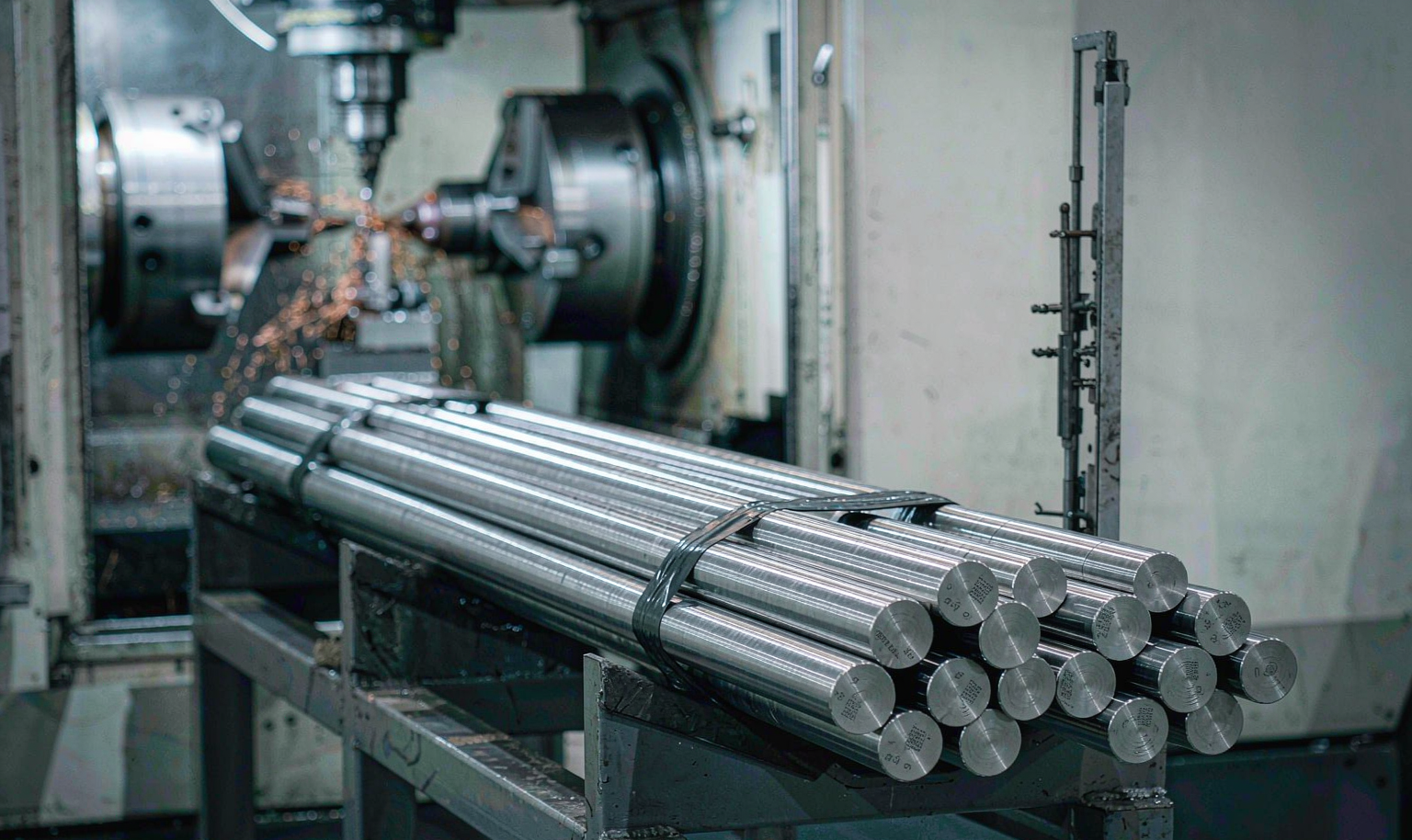
Machinability: The Decisive Difference
On the AISI machinability scale where B1112 = 100% and 1215 ≈ 136% speed for equal tool life, the two grades rank among the best bar steels available:
- 12L14: ~160–170% of B1112. The lead film reduces friction at the tool-chip interface, cutting tool life roughly 20–30% longer than 1215 at identical speeds, or allowing 20% higher surface speed for equal life.
- 1215: ~136% of B1112. Excellent chip control and surface finish up to Ra 0.8 µm without lead, but requires slightly more rigid setups for Swiss-type turning.
- Practical cycle time: on a typical 12 mm fitting turned from 3 m bars, 12L14 shortens cycle time by 0.4–0.8 s per part; across 1 million parts/year that is 110–220 machine-hours saved.
- Tooling: both run well with uncoated carbide grades; 12L14 tolerates higher feed rates (0.10–0.18 mm/rev drilling) before chip packing becomes an issue.
For shops quoting by the hour, 12L14’s faster cycles usually offset its 3–6% material price premium. For shops quoting by the piece with mature cycle times, 1215 often wins on raw material cost alone.
Plating, Welding and Secondary Operations
Plating is where many buyers get surprised. 12L14’s lead inclusions smear during burnishing and can leave micro-porosity in zinc, nickel, and chromium deposits; parts sometimes show stardusting after acid activation. 1215 plates more uniformly and is the standard choice for decorative chrome-plated fittings. Both grades accept black oxide, phosphate, and zinc flake coatings without issue.
Weldability is poor to limited for both grades. Sulfur causes hot short cracking in the fusion zone, and in 12L14 the lead can volatilize during welding, creating toxic fume exposure. Neither grade should be specified for welded assemblies. If joining is required, design for press fits, threads, or mechanical fasteners instead.
Applications and Grade Substitution Guide
| Application | Recommended grade | Why |
|---|---|---|
| Automatic screw machine parts, inserts, fittings | 12L14 | Maximum cycle speed on CNC lathes |
| Plated fittings, hose couplings, furniture hardware | 1215 | Cleaner plating, RoHS-friendly |
| Rivets, studs, dowel pins | 1215 | Slightly better ductility, no lead |
| Gears, splines under shock load | Neither — use 1144 or 4140 | Resulfurized grades lack toughness |
| Parts for EU drinking-water contact | 1215 | Lead-free compliance (4MS / UBA list) |
| California Prop 65 / RoHS sensitive exports | 1215 | No intentional lead addition |
Since 2020, an increasing share of 12L14 demand has shifted to lead-free alternatives such as 1215, 12SMn37+Bi (bismuth-enhanced), and 45S20, driven by RoHS exemptions expiring and drinking-water regulations in Europe and North America. Bismuth-treated grades recover most of 12L14’s machinability at a 8–12% cost premium over 1215, and are worth shortlisting when lead reporting becomes a contractual risk.
Cost, Availability and Sourcing Notes
Both grades are stocked worldwide in 3–6 m random lengths and drawn-over-mandrel conditions. 12L14 typically carries a 3–6% premium over 1215 in China and Korea, and up to 10% in Europe. Minimum order quantities from Chinese mills are commonly 3–5 tons per size for cold drawn bars; stockists hold more than 40 standard diameters of each grade for next-week delivery. Always specify: ASTM A108 condition (A = as drawn, SQ = stress relieved), bar diameter tolerance (h9/h10/h11), straightness (1 mm/m max typical), and end finish. For high-volume turning, ask for drawn and turned bars with surface defect depth below 0.1 mm, since seams on the bar skin propagate into the finished part surface.
Quick Selection FAQ
Which grade machines faster?
12L14, by roughly 20–30% in tool life or equivalent speed. The lead addition lubricates the cutting zone, which also yields a slightly better surface finish at aggressive feeds.
Can I substitute 1215 for 12L14 on an existing drawing?
Usually yes for unplated, moderately loaded parts — yield strength is comparable or higher. Run a first-article trial on plating quality and cycle time before switching the released drawing.
Are these grades suitable for case hardening?
Shallow case hardening is possible, but the high sulfur content makes case uniformity inferior to 1018 or 1117. For wear surfaces deeper than 0.5 mm, 1117 or 8620 is the better platform.
What certificates should I require with each shipment?
Mill test certificate to EN 10204 3.1 with heat chemistry, tensile results, and hardenability band if agreed. For 12L14 shipments into regulated markets, additionally request a lead content declaration referencing the applicable RoHS exemption.
Request a 12L14 / 1215 Bar Stock Quote
Huaxia-Steel supplies 12L14, 1215, 12SMn37+Bi and 1144 cold finished bars in rounds, hexagons and squares from 3 to 100 mm, h9 tolerance, with EN 10204 3.1 certificates and lead-free declarations. Contact us for mill-direct pricing and swatch samples for your machining trials.