AISI 1030 vs 1045 Medium Carbon Steel: Composition, Properties and Applications Compared
When buyers source steel for shafts, axles, gears, fasteners and medium-duty machinery parts, two grades appear on almost every quotation — AISI 1030 and AISI 1045. Both sit in the medium-carbon family, both are widely stocked in round bar and flat bar form, and both are usually cheaper than alloy alternatives. Yet the 0.15% carbon gap between them translates into meaningful differences in strength, hardness, weldability and finished-part performance. Pick the cheaper 1030 when the load demands a tougher part, or the stronger 1045 when the load demands a stronger one, and you may end up with premature wear or unnecessary cost. This guide compares AISI 1030 and AISI 1045 side by side so you can choose the right grade the first time.
Below we look at chemistry, mechanical properties, heat-treatment response, machinability, weldability, typical stock forms and the unit-price gap. Whether you are an importer, a distributor, or a fabrication shop writing a new BOM, the goal is to help you match the grade to the engineering requirement and the budget.
1. What Are AISI 1030 and AISI 1045?
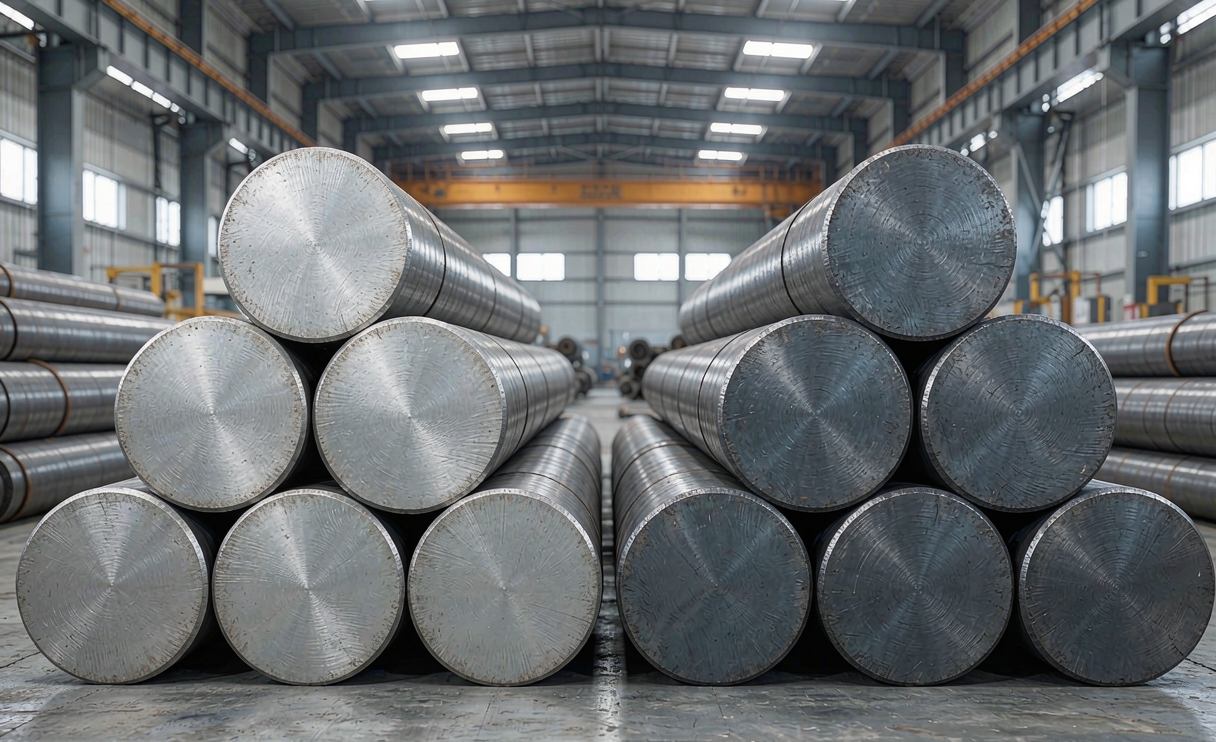
AISI 1030 and AISI 1045 are medium-carbon steels defined by the SAE/AISI carbon-steel designation system. They are unalloyed plain-carbon grades, typically supplied as hot-rolled or cold-drawn round bar, square bar, flat bar, plate and forgings. Both grades are workhorse materials for general engineering applications where cost matters more than the extreme performance of alloy steels such as 4140 or 4340.
The defining difference between them is carbon content. AISI 1030 contains roughly 0.27% to 0.34% carbon, while AISI 1045 carries 0.43% to 0.50%. Higher carbon means higher tensile strength, higher achievable hardness after heat treatment, and slightly better wear resistance. It also means lower ductility, slightly lower machinability in the annealed condition, and lower weldability. The table below summarises the chemistry.
| Element | AISI 1030 (%) | AISI 1045 (%) |
|---|---|---|
| Carbon (C) | 0.27 – 0.34 | 0.43 – 0.50 |
| Manganese (Mn) | 0.60 – 0.90 | 0.60 – 0.90 |
| Phosphorus (P), max | 0.040 | 0.040 |
| Sulfur (S), max | 0.050 | 0.050 |
| Iron (Fe) | Balance | Balance |
Manganese is held at similar levels in both grades, which keeps hardenability moderate. Sulfur is generally slightly higher in 1030 (often around 0.05% max) for improved machinability, while 1045 is typically produced to tighter sulfur limits because it is often used for parts that will be induction-hardened or through-hardened.
2. Mechanical Properties Comparison
The values below are typical for hot-rolled round bar in the as-rolled or normalized condition. Actual properties will vary with bar diameter, mill practice and heat treatment, so always request a mill test certificate before signing off on a shipment.
| Property | AISI 1030 (HR / Normalized) | AISI 1045 (HR / Normalized) |
|---|---|---|
| Tensile Strength | 510 – 600 MPa | 570 – 700 MPa |
| Yield Strength (0.2% offset) | ≥ 305 MPa | ≥ 345 MPa |
| Elongation in 50 mm | ≥ 20% | ≥ 16% |
| Reduction of Area | ≥ 45% | ≥ 40% |
| Hardness (Brinell HB) | 140 – 180 | 170 – 210 |
| Impact (Charpy V, room temp) | ≈ 40 – 60 J | ≈ 25 – 40 J |
The headline takeaway: AISI 1045 is about 60 – 100 MPa stronger in tension, roughly 30 HBW harder, and noticeably less ductile than 1030. In wear-critical applications that gap matters. In tough, impact-loaded applications where you do not want brittle failure, 1030 is the safer choice.
3. Heat Treatment Response
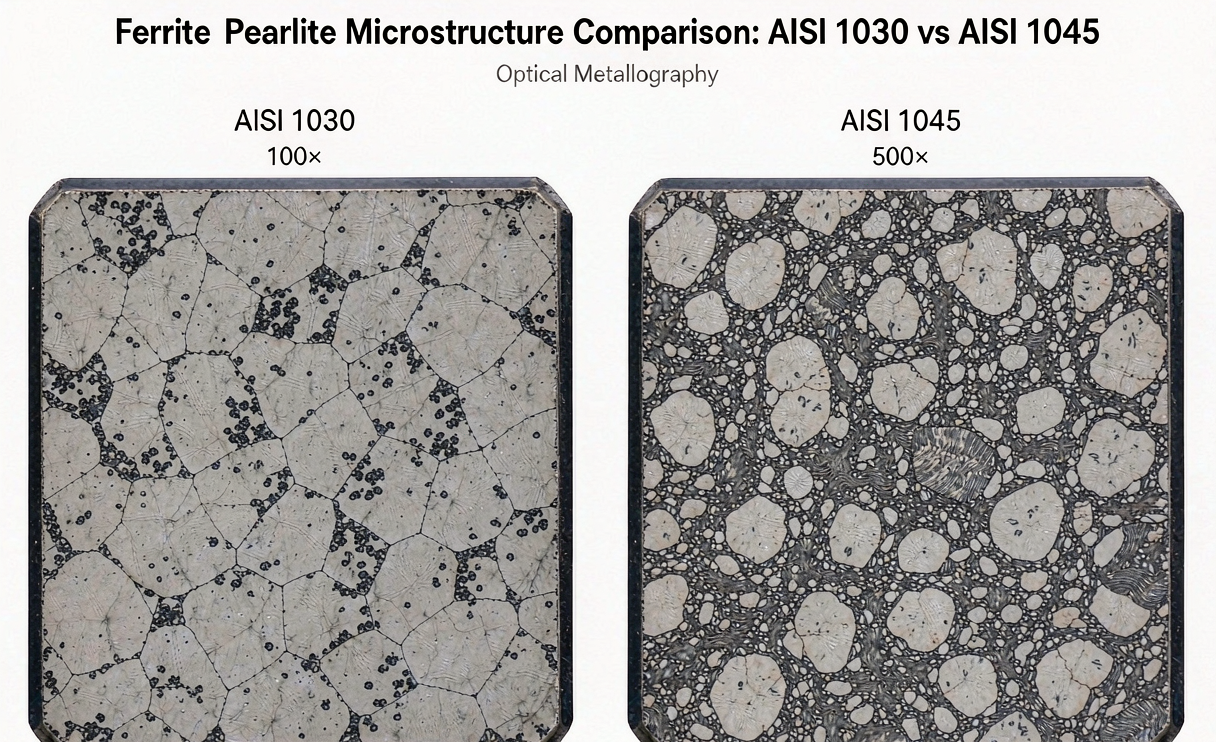
Both grades respond to standard heat-treatment processes — annealing, normalizing, quenching and tempering — but the higher carbon in 1045 lets it reach significantly higher surface hardness after quenching. The table below shows typical hardness ranges after each process.
| Process | AISI 1030 Hardness | AISI 1045 Hardness |
|---|---|---|
| Hot-Rolled (as-rolled) | 140 – 180 HB | 170 – 210 HB |
| Annealed | ≤ 125 HB | ≤ 163 HB |
| Normalized | 150 – 180 HB | 170 – 200 HB |
| Quenched & Tempered | 30 – 38 HRC | 38 – 50 HRC |
| Surface Induction-Hardened | up to 50 HRC | up to 60 HRC |
AISI 1045 is the standard choice for parts that are induction-hardened or flame-hardened on the wear surface while keeping a tough, machinable core. Crankshafts, kingpins, splined shafts and cam shafts are typical applications. AISI 1030 is rarely induction-hardened to the same depths because the lower carbon does not produce the same wear-resistant case.
The hardening depth in 1045 depends on the carbon content and the quenching medium. Water quenching gives deeper hardening but increases the risk of distortion and quench cracks. Oil quenching is the safer choice for complex shapes, while polymer quenchants (like Aquaquench) offer a compromise. AISI 1030 rarely benefits from through-hardening; it is usually supplied in the as-rolled, normalized, or annealed condition and used in the unhardened state.
4. Machinability and Weldability
In the cold-drawn or annealed condition, both grades machine at roughly 70–75% of free-cutting steel (AISI 1112 or 12L14). AISI 1030 machines slightly easier than 1045 in the as-rolled condition, which is why 1030 is sometimes preferred for high-volume turned parts on Swiss-type or multi-spindle automatics. After quenching, 1045 machines harder but produces cleaner chips because of the higher carbon.
Weldability is the reverse story. AISI 1030 can be welded with mild precautions (pre-heat to about 150 °C, low-hydrogen electrodes). AISI 1045 should be treated as a “limited weldability” grade — pre-heat to 200 – 300 °C, control interpass temperature, and consider a sub-critical post-weld stress relief. Welded 1045 is prone to hard heat-affected zones and hydrogen cracking, so engineers often redesign to use 1030 or a low-carbon grade (A36, S275JR) where welding is heavy.
5. Stock Forms and Dimensional Availability
Both grades are stocked by global mills and distributors in the following forms:
- Hot-rolled round bar: Ø 10 – 300 mm, in 6 m standard length.
- Cold-drawn round bar: Ø 6 – 80 mm, in 3 m standard length, with tighter dimensional tolerance.
- Hot-rolled square bar: 10 – 100 mm side.
- Hot-rolled flat bar: thickness 5 – 80 mm, width 20 – 200 mm.
- Hot-rolled hex bar: 10 – 70 mm across flats.
- Plate: thickness 3 – 80 mm, width up to 2,500 mm.
- Forged round bar: Ø 200 – 600 mm, for heavy shafts and axles.
6. Typical Applications
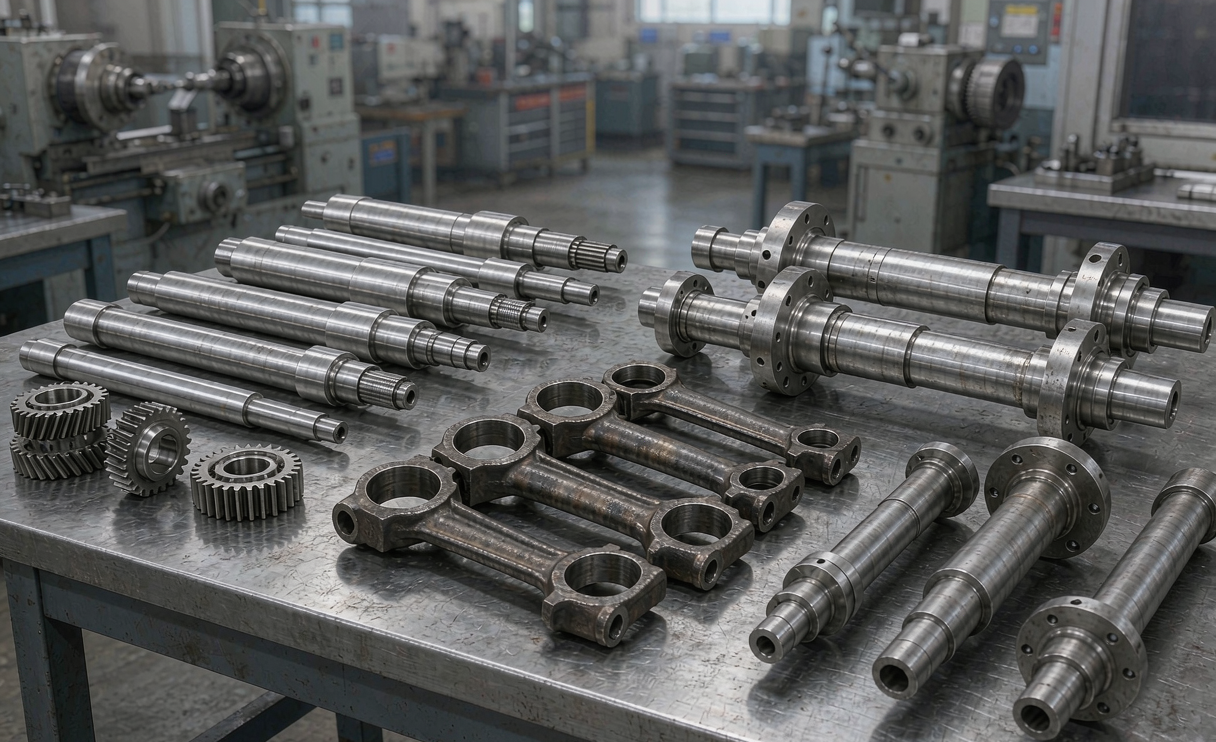
- AISI 1030 — General machinery shafts of moderate load, light-duty gears, bolts, studs, agricultural parts, pump shafts, hydraulic cylinder rods, conveyor components, and welded fabrications where post-weld forming is needed.
- AISI 1045 — Splined drive shafts, kingpins, piston rods, crankshafts, medium-duty axles, couplings, machine tool spindles, wear plates, sprockets, hammer-mill parts, forged connecting rods and parts that will be induction-hardened for wear resistance.
7. Cost and Availability
Both grades are produced in large volumes in China, India, Turkey and Germany. Pricing tracks hot-rolled coil feedstock plus conversion cost. AISI 1045 carries a small premium — usually 5 – 10% over 1030 — because of the tighter chemistry, more demanding hot-rolling practice and the higher rejection rate when surface defects are flagged for induction-hardening applications. Cold-drawn 1045 (better surface finish, tighter tolerance) commands a larger premium because of the extra drawing pass.
Stock forms are similar: round bar (Ø 10 – 300 mm), square bar, flat bar, hex bar, plate (3 – 80 mm) and forgings. Lead times are 4 – 6 weeks from Chinese mills for standard sizes and 6 – 10 weeks for non-standard dimensions.
8. How to Choose Between AISI 1030 and AISI 1045
Use AISI 1030 when:
- The part is primarily loaded in tension or impact and ductility matters more than surface hardness.
- Welding is a major part of the manufacturing process.
- The application requires extensive cold forming or bending after machining.
- Cost is the primary driver and surface hardness is not critical.
Use AISI 1045 when:
- The part will be surface-hardened (induction or flame) to 55 – 60 HRC for wear resistance.
- The application requires higher static strength — splined shafts, kingpins, drive axles.
- The finished part must hold dimensional accuracy under heavy cyclic loading.
- The higher per-ton premium can be justified by longer service life.
9. Sourcing from China
When importing AISI 1030 or 1045 from China, request an EN 10204 3.1 mill test certificate with each heat number, confirm the surface condition (hot-rolled, peeled, cold-drawn, ground), and verify heat-treatment condition (as-rolled, normalized, annealed, Q&T) on the certificate. For parts that will be further machined or hardened, ask for ultrasonic-tested bar (UT to SEP 1921 class 3 / 5 for critical applications). Huaxia Steel supplies both AISI 1030 and 1045 round bar, hex bar, flat bar, plate and forgings with full traceability from Chinese mills.
10. Common Mistakes to Avoid
- Welding AISI 1045 without pre-heat — leads to hydrogen cracking in the HAZ.
- Induction-hardening AISI 1030 to the same depth as 1045 — produces a softer case that wears quickly.
- Using 1045 for a part that will be heavily cold-formed after machining — the high carbon causes cracking.
- Quenching 1045 in water instead of oil for complex shapes — distortion and quench cracks.
- Buying 1045 cold-drawn bar without specifying tolerance class — over-paying for default h10 when h7 would do.
Frequently Asked Questions
Q1: Is AISI 1045 equivalent to C45 or S45C?
Yes. AISI 1045 is the closest American designation. C45 is the EN 10083 European designation. S45C is the JIS G4051 Japanese designation. All three are medium-carbon steels with similar chemistry and mechanical properties. For procurement purposes, specify the standard you need (AISI, EN or JIS) and the heat-treatment condition on the certificate.
Q2: Can AISI 1045 be case-hardened?
1045 is not typically carburized because the carbon content is already high. It is normally used in the through-hardened or induction-hardened condition. For deep case-hardening with a low-carbon core, AISI 1018 or 1020 are the correct starting grades.
Q3: What is the difference between 1030 and 1035 carbon steel?
AISI 1035 sits between 1030 and 1045 with about 0.32 – 0.38% carbon. It offers slightly higher strength than 1030 at a modest cost premium, but does not achieve the same hardness as 1045 after quenching. 1035 is sometimes used as a lower-cost alternative to 1045 when full hardness is not required.
Q4: How should I store AISI 1030 / 1045 to prevent rust?
Both grades are supplied in the as-rolled or cold-drawn condition with a thin mill oil film. For short-term storage (under 3 months), keep bars off the ground in a dry, ventilated warehouse. For long-term storage or overseas shipment, specify a protective oil coating or VCI anti-rust paper. Avoid prolonged exposure to salt-laden air or repeated wet-dry cycles.
Q5: Can I substitute AISI 1045 for AISI 4140?
In some applications yes, in others no. AISI 4140 is an alloy steel with chromium and molybdenum, giving it deeper hardenability and higher toughness at the same carbon level. For through-hardened shafts above 50 mm diameter, 4140 is the better choice because 1045 will not fully harden through the section. For surface-hardened parts, 1045 is often adequate and much less expensive.
Three Real-World Sourcing Scenarios for AISI 1030 and 1045
The first scenario is a small fabrication shop in Eastern Europe buying 50 mm diameter AISI 1030 round bar in 6 m lengths for hydraulic-cylinder rods. The application requires a 25 HRC minimum surface hardness and a tough core that can absorb shock load when the cylinder cycles. AISI 1030 induction-hardened to 0.8 – 1.5 mm case depth and tempered at 180 °C hits the spec at lower cost than 1045, and the deeper ductile core reduces the risk of chip-out at the seal groove during impact loading.
The second scenario is a South-East Asian agricultural-machinery OEM that needs AISI 1045 hex bar for spline shafts in pto gearboxes. The component is through-hardened to 28 – 32 HRC and then finish-ground on the spline. AISI 1045 offers the carbon content needed to hit 30 HRC in a 40 – 60 mm section without resorting to water quench, which would distort the spline teeth. 1030 simply cannot reach that hardness in oil quench at the same bar size.
The third scenario is a North American fastener manufacturer stamping AISI 1030 wire rod into M16 high-strength structural bolts that will subsequently be quenched and tempered to grade 8.8. The lower carbon in 1030 makes the cold-heading operation smoother — fewer header cracks at the die shoulder — and the slightly higher sulfur is acceptable because the surface is machined off during thread rolling. If the same shop tried to use 1045 wire rod, header life would drop by 15 – 20% and die replacement would dominate the operating cost.
Get a Quote for AISI 1030 or 1045 Carbon Steel
Huaxia Steel supplies AISI 1030 and AISI 1045 round bar, square bar, flat bar, hex bar, plate and forgings from certified Chinese mills. Every shipment is delivered with an EN 10204 3.1 mill test certificate, optional ultrasonic test report, and full traceability to the heat number. Tell us your required size, quantity, grade and heat-treatment condition — we will reply with a factory-direct quotation within 24 hours.