ASTM A210 Boiler Tube Standard: Grades, Sizes and Testing
ASTM A210 covers seamless medium-carbon steel boiler and superheater tubes. It is one of the most frequently specified standards for power-plant tubing, industrial boiler coils, and heat-exchanger applications where temperatures reach 450–550°C. Buyers sourcing A210 tubes need to understand the two grades (A-1 and C), dimensional tolerances, testing requirements, and how A210 compares with ASTM A179 and A192. This guide breaks down the standard into practical procurement criteria.
Scope and Typical Applications
ASTM A210 applies to seamless carbon steel tubes with a minimum wall thickness, intended for use in boilers, boiler flues, and superheaters. Typical applications include water-tube boiler generating tubes, economizer tubes, superheater tubes in power stations, and process-heat-exchanger tubing in refineries and chemical plants. The standard does not cover tubes for high-pressure service above the pressure-temperature ratings of the applicable ASME Boiler and Pressure Vessel Code section; for those conditions, alloy grades such as T11 or T22 are required.
Chemical Composition: Grade A-1 vs Grade C
| Element | Grade A-1 (%) | Grade C (%) |
|---|---|---|
| Carbon (C) | 0.27 max | 0.35 max |
| Manganese (Mn) | 0.93 max | 0.29 – 1.06 |
| Phosphorus (P) max | 0.035 | 0.035 |
| Sulfur (S) max | 0.035 | 0.035 |
| Silicon (Si) min | 0.10 | 0.10 |
Grade C allows higher carbon and a wider manganese band, which gives higher strength at room and elevated temperatures. Grade A-1 is the default for general boiler service; Grade C is selected when higher allowable stresses are needed and when the design engineer has verified that the higher carbon does not reduce weldability or impact toughness below project requirements.
Mechanical Properties
| Property | Grade A-1 | Grade C |
|---|---|---|
| Tensile strength (min, MPa) | 415 | 485 |
| Yield strength (min, MPa) | 255 | 275 |
| Elongation in 50 mm (min, %) | 30 | 30 |
| Hardness (HRB max) | 79 | 89 |
The elongation requirement is identical for both grades, ensuring adequate ductility for bending and expanding during boiler manufacture. Hardness limits help control machinability and minimize galling during tube-end facing and beveling.
Size Range and Dimensional Tolerances
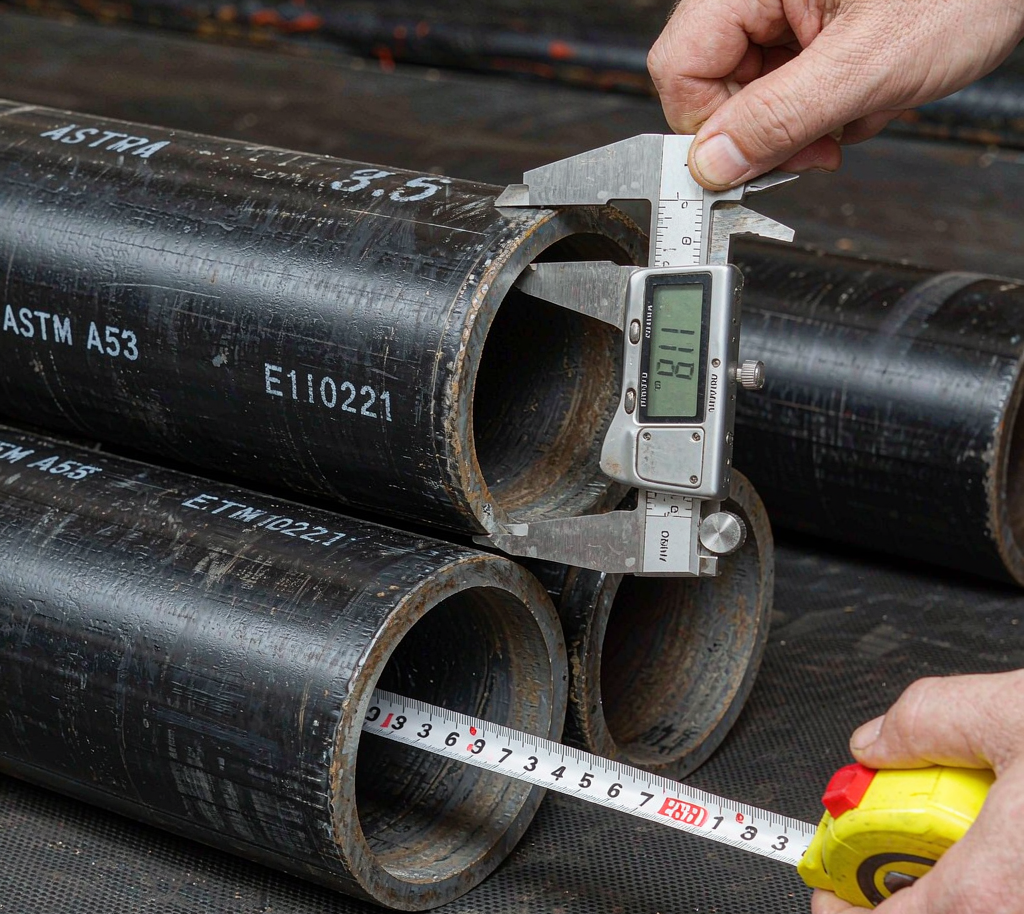
ASTM A210 tubes are supplied in outside diameters from 12.7 mm (½ inch) to 127 mm (5 inches), with wall thickness from 0.9 mm to 12.7 mm. Lengths are typically random (4–7 m) or cut to exact length (+6 mm / –0 mm). Key tolerances:
- Outside diameter: ±0.40 mm for OD ≤ 38.1 mm; ±1% for OD > 38.1 mm.
- Wall thickness: +18% / –0% (no negative tolerance on minimum wall).
- Weight: +10% / –3.5% on theoretical weight per length.
- Straightness: 1 mm in any 1 m; total bow typically ≤ 0.15% of length.
Buyers should specify whether they need minimum-wall or average-wall tubing. Minimum-wall is standard for boiler tubes because the design calculation depends on the thinnest point surviving pressure stress.
Required Testing and Inspection
| Test | Requirement | Frequency |
|---|---|---|
| Tensile test | Yield, tensile, elongation per table | One per heat / 200 tubes |
| Flattening test | No cracks through wall at specified compression | One per 200 tubes per heat |
| Flaring test | No cracks through wall after 60° flare | One per 200 tubes per heat |
| Hydrostatic test | Hold pressure without leakage (or substitute NDE) | Every tube |
| Non-destructive exam (NDE) | Eddy current or ultrasonic if hydrostatic omitted | Every tube |
| Surface inspection | Visual, no cracks, seams, or injurious defects | Every tube |
The flattening and flaring tests validate ductility and seam integrity. If a tube fails, two additional tubes from the same lot are tested; if either fails, the entire lot is rejected or individually tested. Buyers should verify that the mill test certificate explicitly lists hydrostatic pressure or NDE method and acceptance standard.
ASTM A210 vs A179 vs A192: Quick Comparison
| Standard | Carbon range | Typical OD range | Strength | Best for |
|---|---|---|---|---|
| ASTM A179 | 0.06 – 0.18% | 6 – 76 mm | Lower | Low-pressure heat exchangers, condensers |
| ASTM A192 | 0.06 – 0.18% | 12.7 – 76 mm | Medium | High-pressure boilers, smaller OD |
| ASTM A210 | 0.27 – 0.35% | 12.7 – 127 mm | Higher | Boiler and superheater tubes, larger OD |
A210 is the stronger, larger-OD option among the three common carbon boiler tube standards. Its higher carbon content raises elevated-temperature creep resistance, making it suitable for superheater sections where metal temperatures exceed 450°C. A179 and A192 are lower-carbon grades with better weldability and lower cost, but their allowable stresses drop faster as temperature rises.
FAQ
Can A210 tubes be welded?
Yes, with standard carbon-steel welding procedures. Preheat to 100–150°C is recommended for wall thickness above 6 mm to prevent HAZ cracking. Post-weld heat treatment is typically required by ASME Code for pressure-boundary welds.
What is the Chinese equivalent of ASTM A210?
GB 5310 20G is the closest Chinese grade for boiler tubes, with similar chemistry and mechanical properties. GB 3087 20# is used for lower-pressure boilers. Cross-referencing should include dimensional standards because OD and wall schedules differ between ASTM and GB.
Does A210 require heat treatment?
The standard does not mandate heat treatment as-supplied; tubes are typically furnished hot-finished or cold-finished. However, many buyers specify normalizing to refine grain size and improve uniformity, especially for thick-wall tubes.
How do I verify tube quality on receipt?
Check MTC for heat number, chemical analysis, mechanical test results, and hydrostatic or NDE statement. Inspect for surface defects, measure OD and wall at both ends, and verify marking matches the certificate.
What surface finish should I expect?
Hot-finished tubes have a dark oxide scale; cold-finished tubes are brighter with better dimensional accuracy. For bending or flaring, cold-finished is preferred. For welding, either is acceptable if scale is removed from the weld zone.
Request ASTM A210 Boiler Tube Quotation
Huaxia-Steel supplies ASTM A210 Grade A-1 and Grade C seamless boiler tubes from 12.7 mm to 127 mm OD, with full MTC including hydrostatic test and third-party inspection. Contact us for mill-direct pricing and delivery.