Introduction
ASTM A500 is the dominant U.S. standard for carbon steel cold-formed welded and seamless hollow structural sections (HSS) — square, rectangular, and round tubing used in buildings, bridges, racks, towers, and equipment frames. If you import hollow sections to North American specs, A500 Grade B (and increasingly Grade C) is the designation you will quote most often.
This guide breaks down the A500 grade system, chemical and mechanical requirements, shape and tolerance rules, differences from EN 10219/10210 and JIS standards, and what to check on mill certificates before accepting a container.
The A500 Grade System
ASTM A500 covers four grades, and the rules changed in the 2021 revision (A500/A500M-21), which buyers should know because old and new datasheets conflict:
| Grade | Min. yield (MPa) | Min. tensile (MPa) | Typical use |
|---|---|---|---|
| A | 228 (round) / 270 (shaped) | 310 (round) / 400 (shaped) | General, low-stress |
| B | 290 (round) / 315 (shaped) | 400 (round) / 425 (shaped) | Workhorse — structures, racks |
| C | 345 (round) / 380 (shaped) | 425 (round) / 480 (shaped) | High-strength members |
| D | 250 | 400 | Special shapes (pre-2021) / other per 2021 |
Note the round-vs-shaped split: cold-formed round tube achieves lower yield than square/rectangular because the forming pass does not work-harden the corners the way square and rectangle rolls do. Always quote the strength that matches your shape.
Chemical Requirements
A500 is a performance standard, so chemistry limits are loose — phosphorus ≤ 0.035% and sulfur ≤ 0.035% (0.045/0.058 for some older grades), with carbon and manganese left largely to the mill’s discretion. This is a double-edged sword for buyers:
- Good: mills can run economical chemistries (often similar to Q235B/Q355B) and still certify A500.
- Careful: carbon equivalent is not specified, so if your fabricator needs CEV data for weld procedure qualification, require it as a supplementary note on the MTC.
Tolerance Rules That Matter
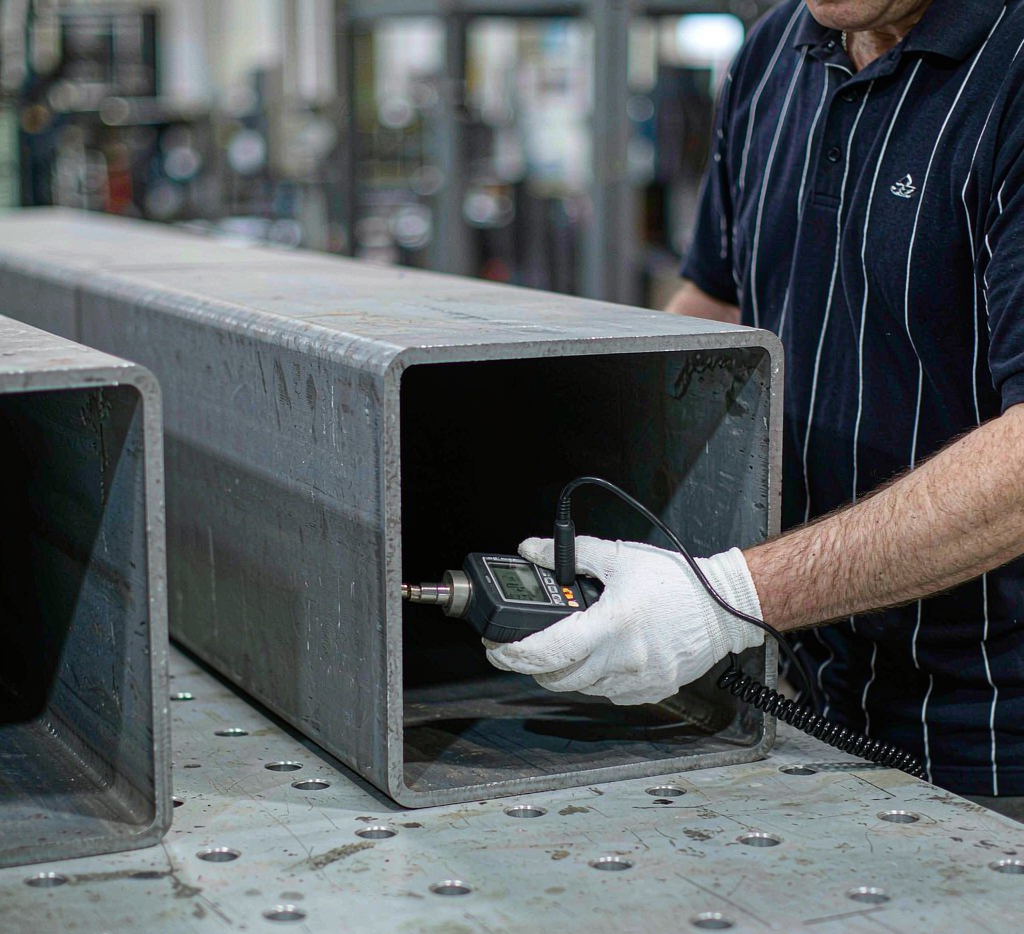
- Wall thickness: −5% minimum on specified wall (no negative allowance below that). Beware “standard wall” quotes that ignore this — measure actual walls on arrival.
- Outside dimensions: ±0.5% of specified size (min 0.8 mm / max 13 mm) for square/rect; ±0.5% for round OD.
- Squareness (sides 90°): within ±1.5° for square and rectangular sections.
- Corner radius: outer corners of square/rect tube have defined radii (typically up to 3× wall thickness for cold-formed); architectural jobs should specify maximum radius if appearance matters.
- Straightness: 1/8″ per 10 ft (≈ 1 mm/m) for most sizes.
- Twist: limited per length for rectangular sections (e.g., 1 mm/m scaled by size class).
A500 vs EN 10219/10210 vs JIS G3466
| Aspect | ASTM A500 | EN 10219 (cold-formed) | EN 10210 (hot-finished) | JIS G3466 |
|---|---|---|---|---|
| Forming | Cold-formed (welded/seamless) | Cold-formed | Hot-finished | Cold-formed |
| Yield basis | Grade-based, round/shaped split | S235–S460 with impact classes | Same grades, better corner properties | STKR400/490 |
| Impact test | Not required (2021 added optional CVN) | 27 J at 0/−20°C common | 27 J at 0/−20°C common | Not required |
| Corner ductility | Not addressed | Cold corners allowed | Hot-formed — no corner strain aging | Not addressed |
Practical translation: A500 Grade B ≈ EN S275 class strength; A500 Grade C ≈ S355 class. But A500 has no mandatory Charpy requirement, so for cold-climate or seismic-critical work, engineers often prefer hot-finished EN 10210 S355J2H or specify CVN testing as a supplement. Conversely, EN-projects cannot accept bare A500 certs without a documented equivalence review.
Manufacturing Route
- ERW (electric resistance welded): the overwhelming majority of A500 tube. Strip is roll-formed and welded at high frequency; weld seam is normalized or left as-welded depending on mill practice and size.
- Cold drawing / sizing: smaller precision rounds may be drawn for tighter OD tolerance.
- Seamless: available for round A500 where a weld seam is unacceptable, at a meaningful premium.
- Post-forming: stress relieving or normalizing improves corner ductility for demanding applications — ask for it if your sections see heavy bending or seismic loading.
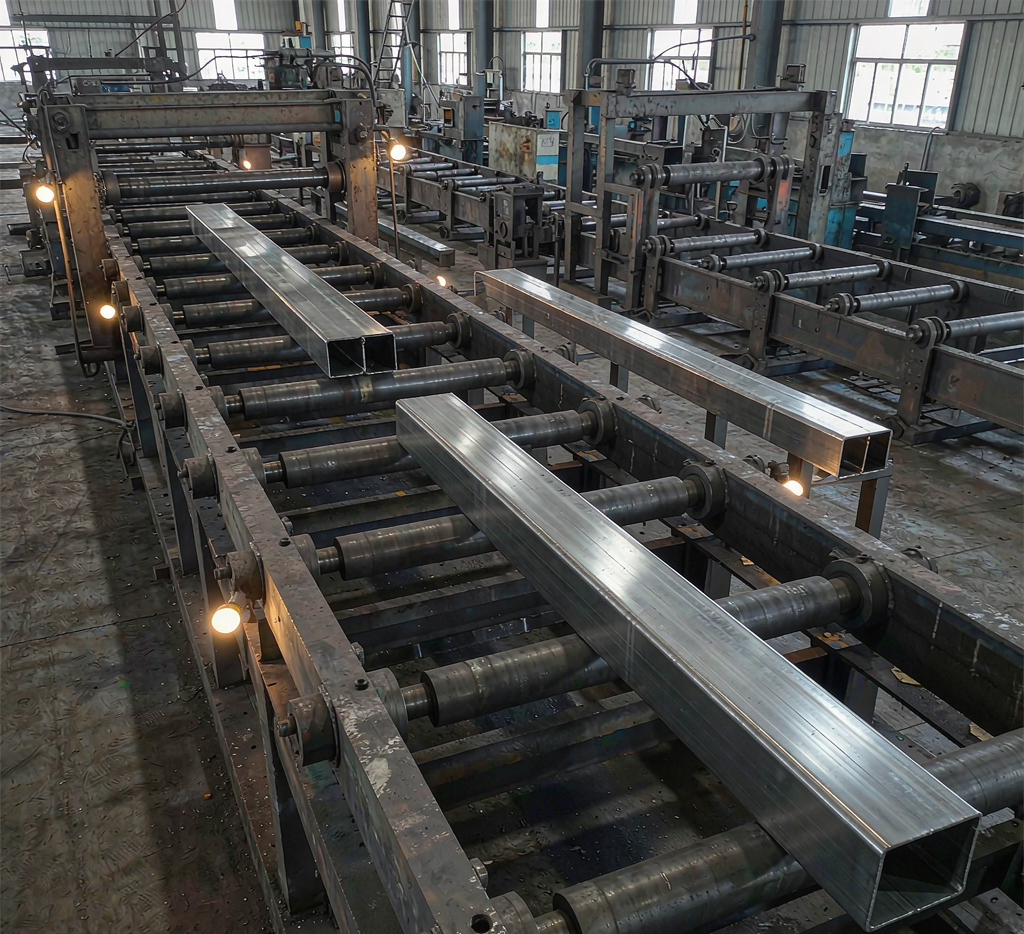
Common Applications
- Structural columns and braces (HSS in buildings per AISC 360)
- Telescoping handlers, trailer and truck bodies, crane booms
- Racking and warehouse systems
- Transmission and telecom towers, sign structures
- Equipment frames, conveyors, and machine bases
Quality Verification Before Acceptance
- Mill certificate: EN 10204 3.1 (or ASTM-compliant MTC) listing grade, heat numbers, actual yield/tensile/elongation, and flattening test results for welded sizes.
- Flattening test: welded A500 tube is tested for seam ductility — check it appears on the MTC.
- Wall measurement: sample 5–10% of pieces with an ultrasonic gauge; the −5% rule is the most-abused tolerance in the trade.
- Weld seam location: for architectural exposed work, agree whether the seam is ground and where it must sit.
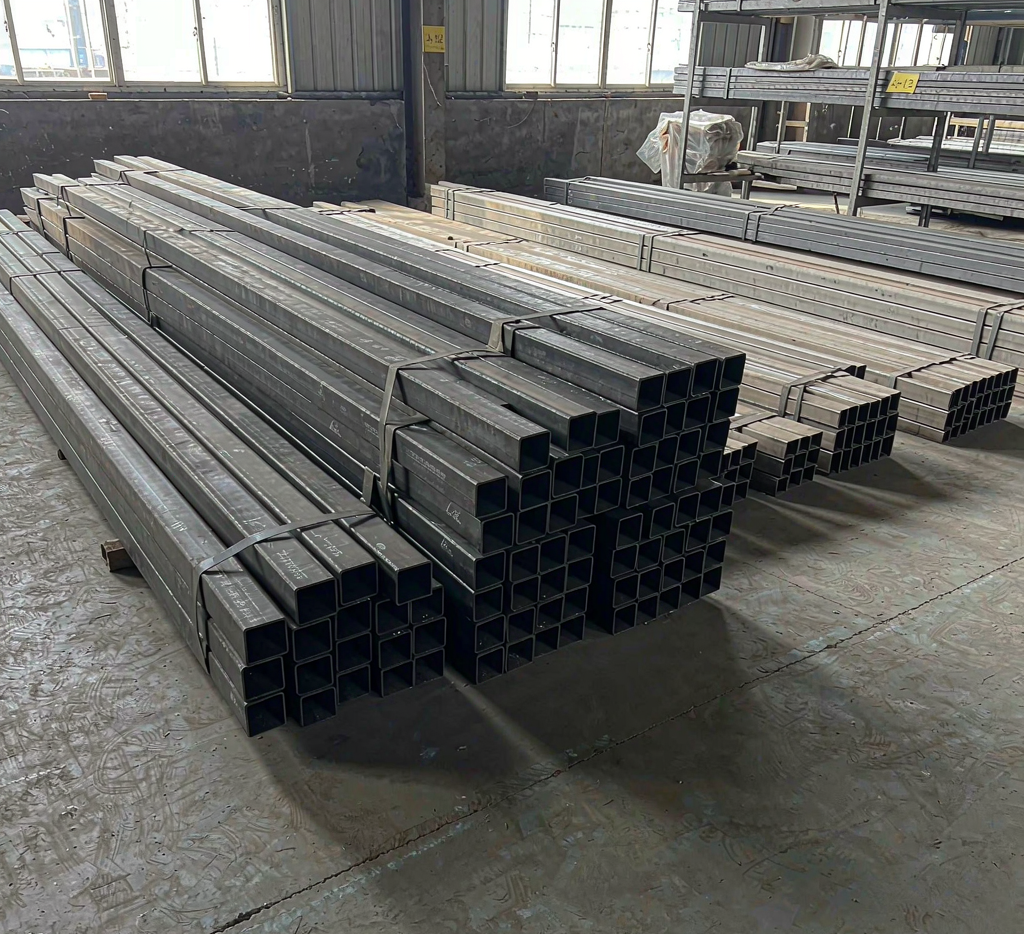
- Marking: each bundle stenciled with grade, size, wall, heat number, and standard — heat numbers must match the MTC line by line.
Ordering Checklist
- Specify: A500 grade (B or C), shape, OD × wall, length (random 5.8–12 m or fixed with tolerance), and end condition (plain, beveled, threaded).
- State the edition if your engineer requires it: pre-2021 (grades A–D) or 2021 revision rules.
- Surface: black mill varnish standard; pickling/oiling, priming, or galvanizing per ASTM A123 on request.
- Packing: steel-strapped bundles, end caps for beveled/threaded ends, seaworthy dunnage.
FAQ
1. What is the most common A500 grade?
Grade B. It covers the bulk of structural and mechanical demand; Grade C is specified when designers want to shave weight at higher strength, typically for columns and booms.
2. Is A500 seamless or welded?
Both are permitted, but ERW welded tube dominates the market on price. Seamless A500 is ordered mainly for smaller mechanical rounds or pressure-adjacent uses.
3. Can I use A500B in place of EN 10219 S275J2H?
Strength matches closely, but A500 lacks the mandatory −20°C Charpy value. Substitution requires engineer approval; adding supplementary CVN testing usually resolves it.
4. Why is wall thickness always the problem area?
Cold forming stretches material; mills working at the edge of tolerance deliver tube that is dimensionally “on size” but light on wall. Always verify wall on arrival — it directly changes section modulus.
5. What lengths are available for export?
Random lengths 5.8–12 m standard; fixed lengths with cutting tolerance for racks and towers; container-optimal 5.8 m and 11.8 m are the most common for sea freight.
Conclusion
ASTM A500 is a straightforward performance standard, but the details — round-vs-shaped yield, the −5% wall tolerance, and the absence of mandatory impact testing — are where importers get burned. Specify grade and edition clearly, verify MTCs line by line, and measure walls on arrival. Huaxia-Steel supplies A500 Grade B/C square, rectangular, and round carbon steel tubing with full certification and export packing.
Need ASTM A500 tubing quotes? Send sizes, wall, grade, and destination — response within 24 hours.