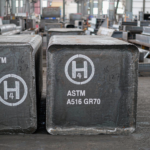
ASTM A516 Grade 70 and ASTM A36 are two of the most commonly specified carbon steel plates in global procurement. While both are carbon steels, they are designed for very different service conditions. A516 Grade 70 is engineered for pressure vessels and boilers, whereas A36 is a general structural steel. This comparison covers chemistry, mechanical properties, typical applications, certification requirements and pricing to help buyers specify the correct plate.
1. Purpose and Scope of Each Standard
ASTM A36 is a structural steel specification covering carbon steel shapes, plates and bars for general construction and bridges. ASTM A516 covers carbon steel plates intended primarily for service in welded pressure vessels where improved notch toughness is important. A516 includes Grades 55, 60, 65 and 70, with Grade 70 offering the highest strength.
2. Chemical Composition Comparison
Both standards limit carbon, manganese, phosphorus and sulfur, but A516 Grade 70 imposes stricter controls to ensure weldability and toughness at pressure-vessel operating temperatures.
Element
ASTM A36
ASTM A516 Grade 70
C max
0.29
0.27–0.31*
Mn
0.80–1.20
0.85–1.20
P max
0.04
0.035
S max
0.05
0.035
Si
0.15–0.40
0.15–0.40
*Carbon limit varies by plate thickness under A516.
3. Mechanical Properties and Toughness
A36 plate has a minimum yield strength of 250 MPa and tensile strength of 400–550 MPa. A516 Grade 70 has a minimum yield strength of 260 MPa and tensile strength of 485–620 MPa. The key advantage of A516 is its notch toughness at low temperatures, verified by Charpy V-notch impact testing.
A36: General strength, no mandatory impact test.
A516 Grade 70: Higher strength with mandatory toughness testing for pressure service.
4. Heat Treatment and Delivery Condition
A36 is typically supplied in the as-rolled condition. A516 Grade 70 plates are normally supplied in the as-rolled condition up to 1.5 inches thick and may be normalized for thicker sections or when improved toughness is required. Buyers should specify the heat-treatment condition in the purchase order to avoid mismatches.
5. Applications and Industries
A36 plate is used in buildings, bridges, general fabrication, truck frames, tanks and structural supports. A516 Grade 70 is used in boilers, pressure vessels, storage tanks for liquefied gases, process columns, heat exchangers and power generation equipment.
6. Certification and Inspection Requirements
Pressure-vessel plate usually requires more rigorous documentation. Buyers should request mill test certificates showing heat analysis, product analysis, tensile test results, Charpy impact values and ultrasonic test reports when applicable. A36 plates typically require standard MTC with tensile and chemistry data.
7. Price and Procurement Tips
A516 Grade 70 generally costs 8–18% more than A36 for equivalent thickness because of tighter chemistry controls, testing requirements and lower production volumes. When importing from China, confirm that the mill holds the correct ASTM certification and can provide third-party inspection from agencies such as SGS, BV or TUV.
Frequently Asked Questions
Can A36 plate be used for pressure vessels?
No. A36 is not designed for pressure containment. Use ASTM A516 or a similar pressure-vessel specification.
Is A516 Grade 70 weldable?
Yes. A516 Grade 70 has controlled carbon equivalent and is readily weldable with qualified procedures.
What thicknesses are common for A516 Grade 70?
Common thicknesses range from 6 mm to 150 mm, with widths up to 4,000 mm and lengths up to 18,000 mm.
Do Chinese mills produce A516 Grade 70?
Yes. Major Chinese plate mills produce A516 Grade 70 to ASTM standards with full MTC and third-party inspection.
What is the difference between normalized and as-rolled A516?
Normalized plate is reheated and air-cooled to refine grain structure, improving toughness and consistency compared with as-rolled plate.
Ready to Source Carbon Steel?
Get a Quote — contact Huaxia-Steel today for factory-direct pricing, mill test certificates, and reliable export delivery.
If you require further information about our metal sheet products or architectural projects, please don’t hesitate to leave your contact details and message here.
Our team of experts will respond within 24 hours to continue the discussion and provide you with any additional information you requires.