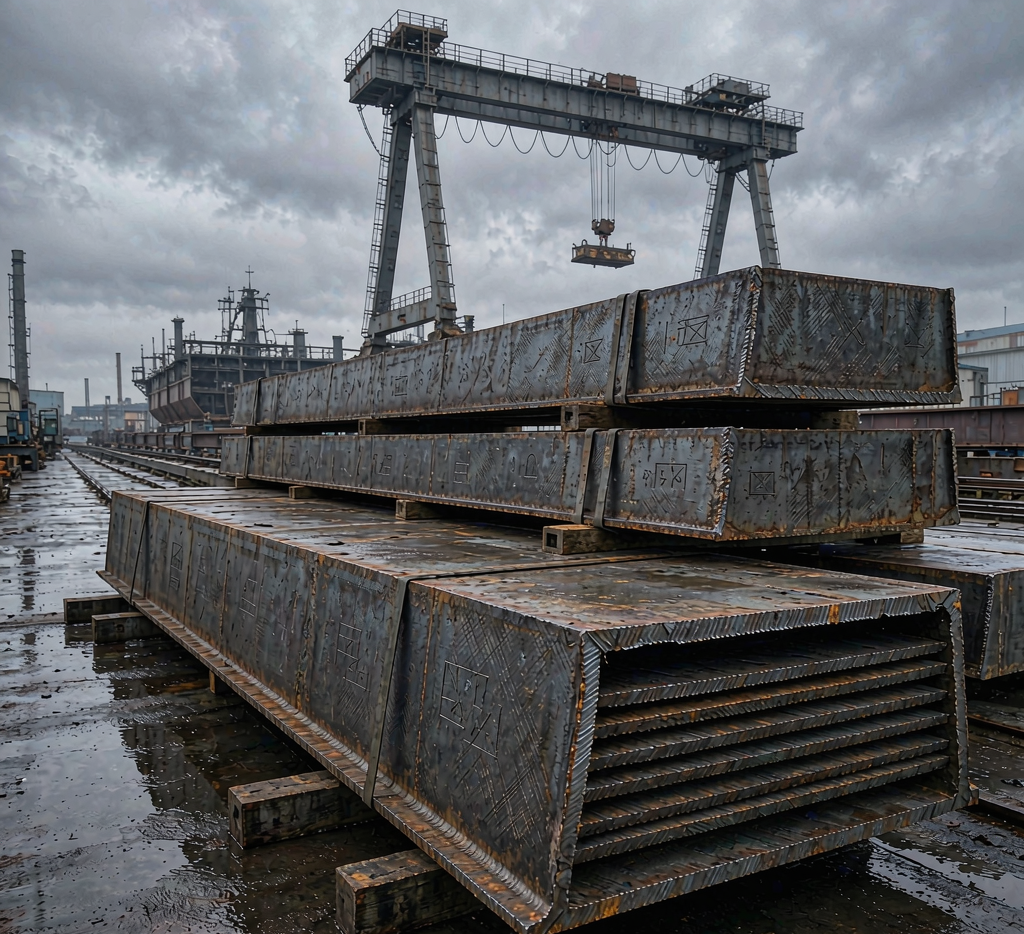
Bridges demand structural steel that is not only strong but proven tough under dynamic, often cold and corrosive service. In the United States, ASTM A709 is the standard specification that supplies that steel. It is the bridge counterpart to the more familiar A36 and A992 building steels, and it adds one critical requirement those grades lack: mandatory impact testing. This article walks through A709 grades, Charpy zones, weathering options and how to specify it correctly.
1. What ASTM A709 Covers
ASTM A709 / A709M is the specification for structural steel used in bridges. It is built on the chemistry and strength of A36, A572 and A588, but every A709 plate, beam or bar must pass impact testing so the steel will not fracture suddenly under impact or low temperature. The standard offers carbon and high-strength low-alloy grades.
2. Main Grades and Yield Strength
Grade
Min yield (MPa)
Base chemistry
Use
A709 36
250
A36-type carbon steel
General bridge members
A709 50
345
A572-type HSLA
Primary load-carrying members
A709 50W
345
Weathering (A588-type)
Exposed, unpainted bridges
A709 70W
485
Weathering HSLA
Heavy, corrosion-exposed members
3. Charpy V-Notch Zones
The defining feature of A709 is impact testing tied to the bridge location. The standard defines three Charpy zones — Zones 1, 2 and 3 — representing how exposed a member is to the coldest, most impact-prone service (Zone 3 being the most demanding, typically the coldest regions or fracture-critical members). Each zone sets a minimum Charpy V-notch energy and a test temperature.
4. Weathering Grades (50W and 70W)
A709 50W and 70W are “weathering” steels that develop a stable rust patina, allowing bridges to be left unpainted in many environments and cutting life-cycle cost. They must be detailed correctly — proper drainage, no trapped water, and avoid contact with certain dissimilar metals — or the benefit is lost.
5. Supplementary Requirements
A709 frequently carries supplementary requirements such as S1 (Charpy impact), S2 (drop-weight test), S5 (CEQ limit) and S75 (zinc coating preparation). Bridges also typically require a 3.2 MTC and often third-party inspection at the mill. Specifying the right combination up front prevents costly rejection at the fabrication shop.
6. Welding A709 Steel
A709 36 and 50 weld much like A36 and A572. The higher grades and weathering versions need low-hydrogen electrodes and attention to preheat on thick sections to avoid hydrogen cracking. Welding procedure qualification (WPS/PQR) is mandatory on bridge projects.
7. How to Specify A709 Correctly
A correct call-out reads something like “A709 Grade 50, Zone 3, with supplement S75.” Stating only “A709” is incomplete — the grade, Charpy zone and any supplementary requirements must all appear on the purchase order and the MTC.
8. A709 vs A588 Weathering Steel
A709 50W and 70W are weathering steels chemically similar to ASTM A588, but A709 is the bridge-specific specification with the impact and certification requirements bridges demand. You will often see A588 referenced for the same weathering behaviour; the practical difference is that A709 carries the Charpy and documentation package a bridge owner requires. Always specify the A709 grade on a bridge contract.
9. Fracture-Critical Members
Bridge standards classify certain members as fracture-critical — their failure could collapse the structure. These members face the strictest Charpy zone (Zone 3), additional ultrasonic testing, and sometimes tighter chemistry. Material for fracture-critical use is not interchangeable with general members, and the MTC must clearly identify it.
10. Procurement and Mill Documentation
Ordering A709 correctly means the purchase order states grade, Charpy zone, and every required supplement, and the mill returns a 3.2 certificate plus test reports. Delivery should include material traceable by heat number, and many owners require independent inspection at the mill before shipment. Getting the paperwork right at order time prevents expensive rejection at the fabrication shop.
11. Common Specification Errors
The mistakes that cause the most delays: writing only “A709” without a grade; omitting the Charpy zone; assuming A36 can substitute; and forgetting that weathering grades need special detailing. A complete call-out — grade, zone, supplements — removes ambiguity and keeps the project on schedule.
12. Welding Consumables and Preheat
Welding A709 demands matching the filler to the base strength and controlling hydrogen. For A709 50, low-hydrogen electrodes (E70XX class) are typical; for 70W, higher-strength consumables and stricter storage of electrodes apply. Preheat on thick sections suppresses hydrogen cracking, and the welding procedure specification must be qualified by test (WPS/PQR). Weathering grades need care so the weld and heat-affected zone develop a patina consistent with the base metal; sometimes a weather-resistant filler is used. Getting consumables and procedure right is as important as the base steel quality.
13. Coating and Corrosion Protection
Weathering grades (50W, 70W) are designed to be used unpainted, forming a protective oxide that slows further corrosion. Conventional A709 36 and 50 are usually painted with a zinc-rich primer and topcoat system to reach a 50–100 year design life. For bridges in de-icing-salt or marine environments, the coating system is specified separately from the steel and applied under surface-prep standards such as SSPC or ISO 8501. Specifying both steel and coating together avoids conflicts at the fabrication stage.
14. Global Sourcing of A709
A709 is primarily a North American specification, but bridges abroad often reference it or an equivalent such as AASHTO M270. Buyers outside the US sometimes specify the equivalent EN or JIS grade with added impact testing to achieve the same toughness. When sourcing, confirm whether the mill is familiar with A709’s supplementary requirements and can issue the 3.2 certificate and zone-specific Charpy data. A mill that routinely supplies bridge steel will handle this smoothly; one that does not may struggle with documentation.
15. Summary Checklist for Buyers
To order A709 correctly: state the grade (36/50/50W/70W), the Charpy zone (1/2/3), any supplements (S1, S2, S5, S75…), the quantity and sections, and the required certificate level. Confirm welding and coating scope, and book independent inspection if the contract requires it. Complete specifications prevent the delays and rejections that plague bridge steel procurement.
16. Grade 36 in Bridge Service
A709 Grade 36 is the bridge adaptation of A36, used for secondary and non-fracture-critical members where the added impact toughness of higher grades is not required. It is the economical default for items such as gusset plates, stiffeners and connection material, and it welds with the same mild-steel consumables as A36. Because it still carries A709’s documentation and impact testing, it satisfies bridge-owner quality systems without paying for the strength of Grade 50. Specifiers use it to trim cost on members where the extra yield would be wasted.
17. Grade 50 as the Workhorse
A709 Grade 50, with its 345 MPa yield, is the most common primary bridge steel, carrying main girders, trusses and bearings. Its high-strength low-alloy chemistry gives strength without high carbon, keeping weldability good. It is the grade most fabricators are set up to process, and it balances cost, strength and fabricability better than any other in the family. When a bridge simply calls for “A709” without a grade, Grade 50 is usually what is meant, though writing it explicitly avoids any doubt.
18. Weathering Grades 50W and 70W
The W grades add corrosion-resistant alloying (copper, chromium, nickel) that forms a protective oxide, allowing unpainted use in many environments and reducing life-cycle cost. 50W matches Grade 50 strength; 70W reaches 485 MPa for heavy members. They require careful detailing — positive drainage, no trapped water, controlled contact with dissimilar metals — or the patina benefit is lost and staining occurs. For the right structure, they eliminate painting and its recurring maintenance, a major owner benefit over a 75-year design life.
19. Inspection Points That Matter
Bridge steel inspection focuses on chemistry, mechanical properties, Charpy values for the stated zone, dimensional accuracy and surface condition. Ultrasonic testing screens for internal lamination in heavy plates, and visual inspection checks for seams and roller marks. The 3.2 certificate, signed by an approved surveyor, ties every test to the heat. Buyers should review the certificate against the purchase order before acceptance; discrepancies in zone or supplement are the usual grounds for rejection and must be caught at the mill, not on site.
20. Sustainability of Bridge Steel
Structural steel is highly recyclable and often made with significant scrap content, supporting infrastructure sustainability goals. Weathering grades add value by removing paint and its maintenance cycle. Mills increasingly publish embodied-carbon data and environmental product declarations, which help bridge owners meet green-infrastructure targets. Specifying regionally available A709 also cuts transport emissions. For publicly funded bridges with environmental mandates, these factors are increasingly written into the material specification alongside strength and toughness.
21. A709 in Seismic Zones
Bridges in earthquake regions demand steel with tested ductility and toughness, and A709’s impact requirements already point in that direction. For seismic members, specifiers often pair Grade 50 with strict Charpy zones and supplemental requirements limiting sulfur and phosphorus to improve weld toughness. The fabrication must also control through-thickness properties where stress is normal to the plate face. Engaging the mill early ensures the heat is melted and tested to the seismic supplement, avoiding the painful discovery at inspection that a standard heat cannot meet the zone.
22. Coating Interaction Revisited
Beyond the basic primer system, bridge owners increasingly use duplex systems — a zinc coating with an organic topcoat — to extend life in aggressive environments. Weathering grades complicate this because their patina must be preserved; coating them defeats their purpose unless specified as a hybrid. The steel specification and the coating specification must be written by the same team so the surface condition, edge preparation and drainage all support the chosen protection strategy rather than fighting it.
23. Buyer’s Checklist Recap
To recap: specify grade, Charpy zone and supplements explicitly; require a 3.2 certificate; confirm the mill’s familiarity with A709; arrange independent inspection for critical jobs; and align welding and coating scopes with the steel order. Following this checklist turns bridge steel procurement from a source of delays and rejects into a predictable, documented process that satisfies owners, fabricators and auditors alike.
24. A709 Versus Competing Bridge Steels
Besides A709, bridge projects may reference AASHTO M270 (the US highway version), A572 with impact testing, or European S355 structural grades with added toughness. The practical question is which specification your contract names; substituting between them requires confirming equivalent yield, impact zone and certification. A709 remains the clearest choice when the contract explicitly calls for bridge steel with Charpy zones, because its supplementary requirements are purpose-built for bridges and accepted by owners and auditors without debate.
25. Lifecycle Cost of Bridge Steel
The purchase price of A709 is a small fraction of a bridge’s lifecycle cost, which is dominated by fabrication, coating, inspection and maintenance. Weathering grades reduce painting and its recurring cost; higher grades reduce steel tonnage; rigorous documentation reduces dispute and rework cost. Specifiers who optimise the whole lifecycle — not just the steel price — deliver the lowest total cost over a 75-year design life, and A709’s flexibility supports that optimisation better than a bare structural grade.
26. Huaxia-Steel Bridge Steel Supply
Huaxia-Steel supplies A709 equivalent grades and their EN and GB counterparts with the impact testing, supplementary requirements and 3.1 or 3.2 certificates bridge projects demand. We coordinate independent inspection, weld-procedure support and export packing, and we phase deliveries to match erection schedules. For bridge fabricators and owners, our mill-direct, fully documented supply removes the documentation and compliance risks that most often delay bridge steel procurement.
27. The Documentation Pack for Audit
Bridge owners and auditors expect a complete file: purchase order with grade, zone and supplements; 3.2 mill test certificate with heat analysis, mechanical and Charpy results; welding procedure and qualification records; coating specification and inspection; and independent inspection reports. Keeping these together and reconciling the heat numbers across documents is what passes an audit first time. Gaps — a missing Charpy value or an unsigned certificate — are the usual reasons bridge steel is rejected at fabrication, so disciplined documentation is as important as the steel itself.
28. Typical Lead Times and Logistics
A709 lead times depend on grade and mill load; common Grades 36 and 50 from stock or regular production may ship in a few weeks, while weathering or supplementary-heavy orders can take longer. Because bridge schedules are tight, early release of the steel order and early booking of inspection protect the programme. Huaxia-Steel coordinates mill, test, inspection and export shipment so the documentation and the steel arrive together, avoiding the classic delay where material lands before its certificates.
29. Closing Note on Specifying A709
ASTM A709 exists for one reason: bridges fail catastrophically, so their steel must be proven tough, not just strong. The specification wraps familiar chemistry in mandatory impact testing, fracture-critical controls and strict documentation, and that is exactly what makes it the right choice for bridge members. The practical lesson for any buyer is to treat the grade, Charpy zone and supplementary requirements as a single non-negotiable package, to verify the certificate against the order, and to involve inspection early. Done properly, A709 gives decades of safe, low-maintenance service; done loosely, it becomes a source of rejects and delays. Huaxia-Steel’s role is to deliver the steel and the paperwork together, fully aligned to your bridge specification.
30. Fabrication Tolerances and Fit-Up
Bridge fabrication follows tight dimensional tolerances for camber, sweep, hole spacing and fit-up because members must assemble in the field without forced alignment. A709’s documentation discipline extends to these tolerances: the mill certificate confirms the material, while the fabricator’s QC confirms the shape. Specifiers should state fabrication standard (for example AISC or EN 1090) and the required execution class on the order so the shop plans fit-up, drilling and welding to the right level. Good tolerance control at fabrication is what makes bridge erection fast and safe, and it starts with clearly specified, properly certified steel.
31. A Note on Grade Confusion
Buyers sometimes see “A709” used loosely to mean any bridge steel, but the grade, zone and supplements are what matter. If a mill offers “A709” without specifics, ask for the exact grade and Charpy zone in writing and confirm the certificate will show them. That single clarification prevents most of the grade-confusion problems that delay bridge steel procurement, and it costs nothing but a line in the email.
Frequently Asked Questions
Is A709 the same as A36?
No. A709 36 shares A36 chemistry but adds mandatory impact testing, so an A36 plate cannot be substituted for A709 without separate impact qualification.
What does the Charpy zone mean?
It defines the impact-energy and test-temperature requirement based on how cold and fracture-critical the member’s service location is; Zone 3 is the strictest.
Can A709 50W be used unpainted?
Yes, that is its purpose, provided detailing allows drainage and avoids prolonged moisture traps; otherwise conventional painting is needed.
Do I need third-party inspection for A709?
For most public bridge projects, yes — mill 3.2 certificates plus independent inspection are normally contractually required.
Get a Mill-Direct Quote on Carbon Steel
Huaxia-Steel supplies the full range of carbon steel products with mill test certificates, third-party inspection and worldwide export. Tell us your grade, size and quantity — we respond within one business day.
If you require further information about our metal sheet products or architectural projects, please don’t hesitate to leave your contact details and message here.
Our team of experts will respond within 24 hours to continue the discussion and provide you with any additional information you requires.