Carbon Steel Carburizing Process: Case Depth, Temperature and Quality Control
Carburizing is the go-to case hardening process for carbon and low-alloy steels that must combine a tough core with a hard, wear-resistant surface: gears, shafts, cam followers, chain pins, and bearings. Because the process runs at 850–980°C for hours and adds carbon to the surface layer, getting it wrong is expensive — a scrapped carburized gear set can cost more than the raw forgings. This guide explains how the process works, how to specify case depth and hardness, what furnace data you should demand from your heat treater, and the classic defects buyers encounter during incoming inspection.
How Carburizing Works
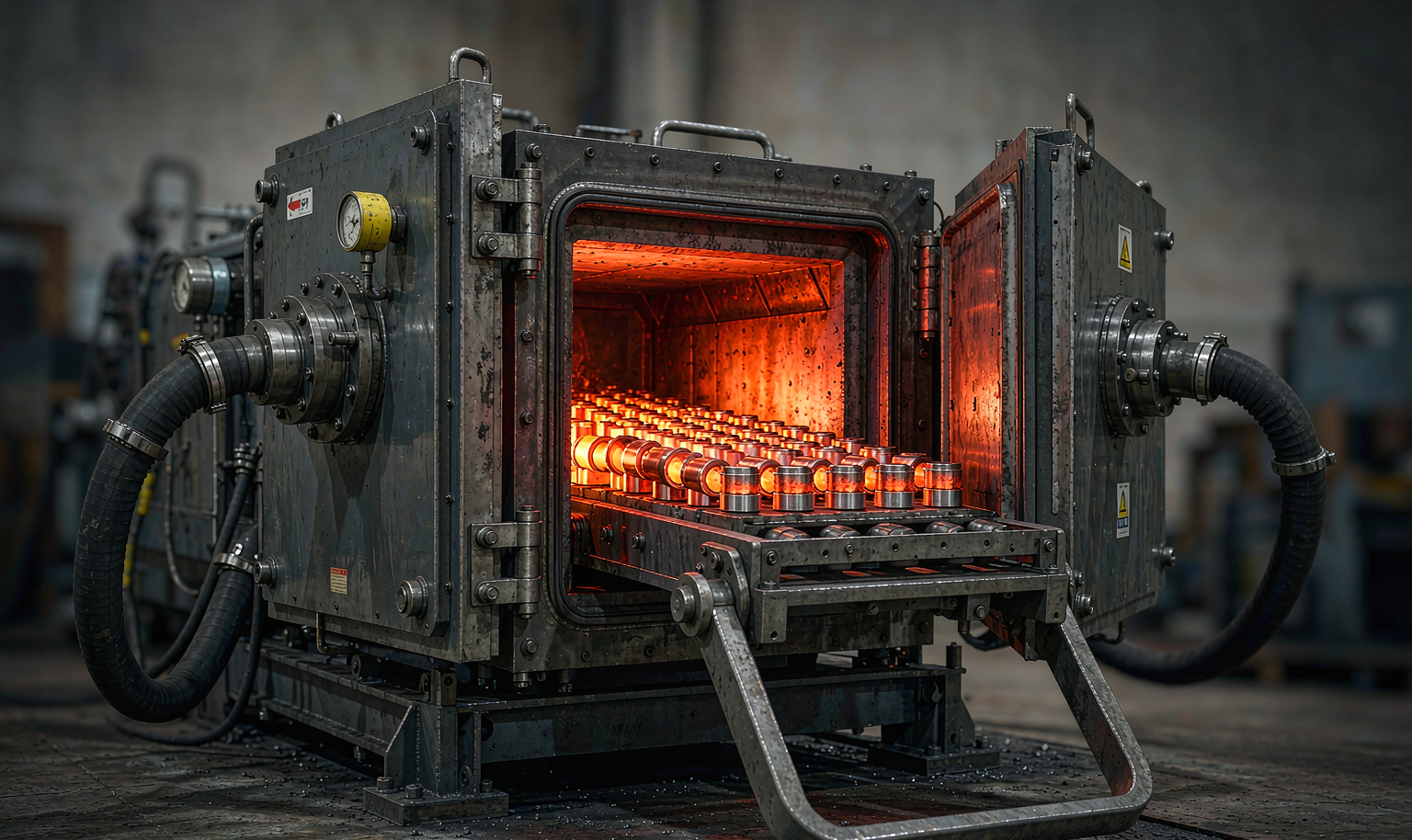
Carburizing diffuses carbon into the steel surface at austenitizing temperature, followed by quenching to transform the carbon-rich case into martensite while the low-carbon core remains tougher (bainitic or ferritic-pearlitic). Only steels with roughly 0.10–0.25% initial carbon respond usefully — the surface carbon rises to 0.75–1.00% at the end of the carburizing cycle. Typical production variants:
- Gas carburizing (dominant, >90% of tonnage): parts cycle in endothermic atmosphere (CO/CO₂/H₂) at 900–925°C, with carbon potential controlled by dew point, oxygen probe, or infrared CO₂ analysis.
- Vacuum (low-pressure) carburizing: acetylene or propane pulses at 900–980°C in a vacuum furnace. Faster diffusion at higher temperature, no intergranular oxidation, cleaner parts — preferred for aerospace and EV gearing.
- Pack (solid) carburizing: parts buried in charcoal compound in boxes. Slow, labor-intensive, but still used for single-piece repairs and very large sections.
- Carbonitriding: carburizing with 2–5% ammonia addition, used on thin sections (<3 mm case) for improved hardenability at lower quench severity.
Case Depth: How to Specify It Correctly
Case depth is the single most disputed specification on carburized parts. Drawings must state which definition applies, because three different numbers circulate:
| Definition | Meaning | Typical use |
|---|---|---|
| TCH (Total Case Depth) | Depth where hardness equals core + 50 HVC (ISO 2639) or drops to 50 HRC | Gearing, wear surfaces |
| ECD (Effective Case Depth) | Depth to 50 HRC (550 HV1) | Standard for most drawings |
| CHD | Effective case depth measured by microhardness traverse (ISO 6507) | ISO drawing notation |
As a sizing rule for through-hardened gearing, ECD ≈ 0.15–0.20 × module; for a module 4 gear that is 0.6–0.8 mm. Diffusion time follows Fick’s law roughly as depth ∝ √time: reaching 1.0 mm effective case at 925°C takes about 6–8 hours, while 1.5 mm takes 14–18 hours. Specifying excessive case depth is a real cost driver — every extra 0.2 mm can add 2–4 hours of furnace time and increase distortion.
Process Control Numbers Worth Checking
When auditing a heat treater or reviewing certificates, these are the numbers that separate controlled shops from hopeful ones:
- Carbon potential accuracy ±0.05%C: verified weekly by shim stock or foil test; a drifting oxygen probe silently produces soot or decarburized cases.
- Temperature uniformity ±7°C (AMS 2750 Class 3 typical): surveyed quarterly with certified thermocouples.
- Quench oil temperature 50–70°C: warm oil reduces distortion on thin webs; agitation level (propeller or spray) must match the steel’s hardenability.
- Temper within 1–2 hours of quench at 150–200°C: skipping or delaying temper is the top cause of grinding cracks found days later at final machining.
- Intergranular oxidation (IGO) depth <13 µm: gas carburizing always oxidizes grain boundaries slightly; deeper IGO pits act as fatigue initiators on gear roots and must be removed by grinding stock.
Vacuum carburizing eliminates IGO entirely, which is why high-reliability gearbox manufacturers pay the 30–60% heat treatment premium for it on premium product lines.
Typical Defects and How They Show Up
| Defect | Cause | Detection |
|---|---|---|
| Soft spots | Uneven quench, part contact in basket, soot on surface | File test, hardness map, Nital etch |
| Grinding cracks | Retained austenite + overheat during grinding, no temper | Magnetic particle, nital etch |
| Excess retained austenite | Surface carbon >0.9%, low temper | XRD, metallography (X-ray >25% reject) |
| Carbide network at surface | Carbon potential too high, slow cool from carburizing | Metallography — brittle network causes spalling |
| Distortion beyond drawing | Poor racking, asymmetric sections, quench severity mismatch | First-piece CMM after HT |
| Decarburized case | Carbon potential collapse mid-cycle | Hardness traverse flat-topped instead of peaked |
Grade Selection for Carburizing
| Grade | Core carbon | Best for | Note |
|---|---|---|---|
| 1018 / 20# | 0.15–0.20% | Light-duty pins, small sprockets | Water quench, distortion risk |
| 1117 / 1215* | 0.15%* | Small fasteners, moderate wear | *1215 marginal — high S welds badly |
| 5120 / 5115 | 0.17–0.22% | Gears module ≤ 4 | Chromium adds case hardenability |
| 8620 / 20CrMnTi | 0.18–0.23% | Automotive gears, shafts | Industry default for power transmission |
| 4320 | 0.17–0.22% | Heavy-duty, large cross-sections | Nickel-moly, tough core |
| 9310 | 0.08–0.13% | Aerospace gearing | 3.5% Ni, premium cost |
What to Ask For on the Purchase Order
A complete carburizing PO should lock down: ECD with measurement method (microhardness traverse per ISO 6507 or file test per drawing note), surface hardness range (typically 58–63 HRC), core hardness range, tempering temperature window, retained austenite limit if gearing (≤ 25–30%), IGO depth limit, straightness/flatness after HT with grinding stock stated separately, and process records retention (chart printouts per load). Reputable Chinese heat treaters supplying export gears routinely attach load charts and hardness traverse plots per batch; if a supplier refuses to share furnace charts, treat that as a red flag equal to missing MTCs on bar stock.
Frequently Asked Questions
How long does it take to reach 1.0 mm case depth?
About 6–8 hours at 925°C in gas carburizing, including a boost-and-diffuse cycle. Vacuum carburizing at 950–980°C shortens this to roughly 4–5 hours of equivalent processing.
Can 1045 steel be carburized?
It is not recommended. With 0.45% core carbon, the case and core hardness difference becomes meaningless, and quench cracking risk rises. 1045 is normally induction hardened instead of carburized.
Why do carburized parts need grinding stock on gear flanks?
To remove the intergranular oxide layer (IGO) and any surface carbide network — both sit within the first 10–25 µm and would otherwise become fatigue initiation sites under root bending stress.
How do I verify case depth on incoming parts?
Request the heat treater’s hardness traverse on a coupon processed with the load, and spot-check by sectioning a sacrificial part and running a microhardness profile per ISO 6507 on the metallographic cross-section.
Source Carburizing-Ready Carbon Steel
Huaxia-Steel supplies 1018, 1117, 5120, 8620 and 20CrMnTi bar and forgings with carburizing-optimized chemistry, low sulfur options, and in-house heat treatment to your ECD and hardness specification, complete with load charts and hardness traverses. Send us your drawing for a quote covering material, heat treatment and machining in one package.