Carbon Steel Impact Testing: Charpy V-Notch & Izod Methods
When sourcing carbon steel for structural, pressure vessel, or offshore applications, impact toughness is just as critical as tensile strength or hardness. A steel plate that meets minimum yield requirements can still fail catastrophically under sudden loading if its impact resistance is insufficient. Impact testing — primarily Charpy V-Notch and Izod methods — quantifies this toughness and is mandated by major international standards.
This guide covers the two principal impact testing methods for carbon steel, their ASTM E23 standard procedures, how test temperature affects results, and what buyers need to know when reviewing mill test certificates (MTCs) that include impact values.
Why Impact Testing Matters for Carbon Steel Buyers
Impact toughness measures a material’s ability to absorb energy under rapid loading — a scenario far more demanding than slow, static deformation. Carbon steels exhibit a dramatic ductile-to-brittle transition at low temperatures: the same grade that performs well at 20°C may shatter at -20°C. This transition is especially relevant for:
- Offshore and marine structures operating in sub-zero environments (ASTM A572 Gr 50 requires Charpy values at -20°F)
- Pressure vessels per ASME Section VIII, which mandate minimum impact energy at design minimum temperature
- Bridge steel per ASTM A709, where fracture-critical members must demonstrate minimum Charpy absorbed energy
- Pipeline steel per API 5L, requiring transverse Charpy tests at specified temperatures
For importers, impact test results on the MTC confirm that the delivered steel meets the toughness specification at the required test temperature — not merely at room temperature. Verifying this distinction prevents costly project rejection.
Charpy V-Notch Impact Test: Procedure and Standards
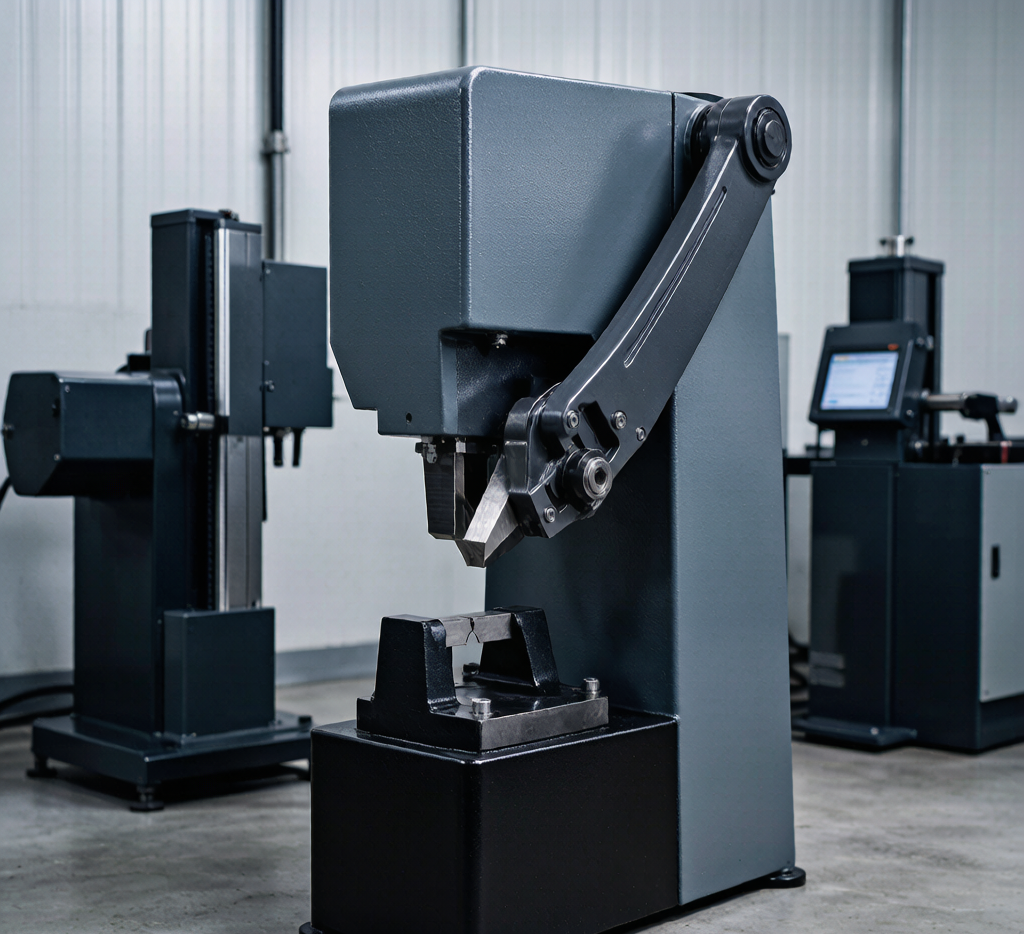
The Charpy V-Notch test (ASTM E23 / ISO 148-1) is the most widely used impact test for carbon steel. A notched rectangular specimen (10 mm × 10 mm × 55 mm) is struck by a swinging pendulum, and the energy absorbed during fracture is recorded in joules (J).
Specimen preparation:
- Standard dimensions: 10 × 10 × 55 mm (sub-size 10 × 7.5 × 55 or 10 × 5 × 55 for thin material)
- V-notch: 2 mm deep, 45° angle, 0.25 mm root radius — machined per ASTM E23 Figure 4
- Orientation: longitudinal (L-T) or transverse (T-L), depending on specification requirement
- Surface finish: notch root must be smooth, no machining marks that could act as stress concentrators
Test procedure (ASTM E23):
- Calibrate the pendulum impact tester (verify striking edge, anvil spacing, and energy scale)
- Condition the specimen at the specified test temperature (using liquid bath or environmental chamber)
- Position the specimen on the anvil with the notch facing away from the striker
- Release the pendulum — the striker impacts the specimen opposite the notch
- Record the absorbed energy from the dial or digital display
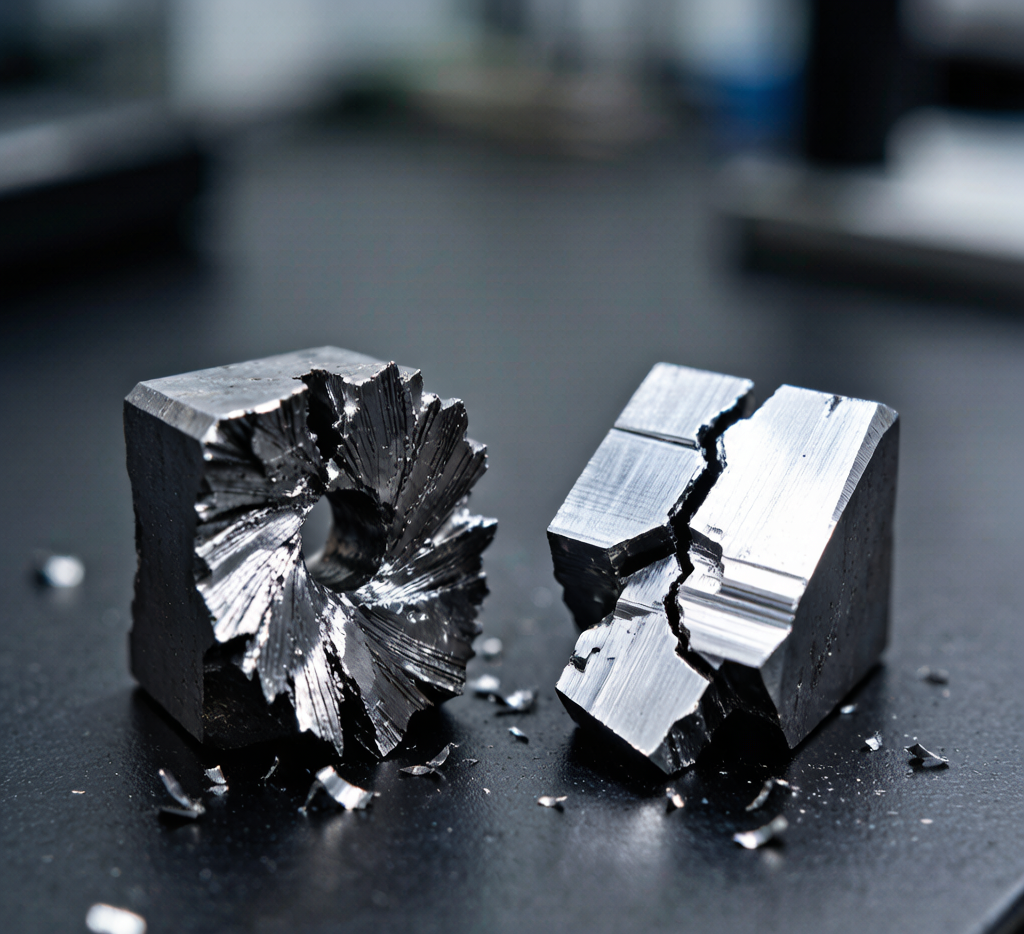
- Examine the fracture surface: classify as ductile (fibrous), brittle (cleavage), or mixed
| Carbon Steel Grade | Test Temp (°C) | Min. Absorbed Energy (J) | Specimen | Standard |
|---|---|---|---|---|
| A36 | Room temp | Not required | — | ASTM A36 |
| A572 Gr 50 | -20°F (-29°C) | 15 J (min 3 avg) | Full-size | ASTM A572 |
| A516 Gr 70 | -40°F (-40°C) | 27 J (min 3 avg) | Full-size | ASTM A516 |
| A709 Gr 50W | -20°F | 27 J (fracture critical) | Full-size | ASTM A709 |
| API 5L X52 | 0°C | 27 J transverse | Full-size | API 5L |
| Q345B (GB) | 20°C / 0°C / -20°C | 34 / 27 / 21 J | Standard | GB/T 1591 |
Izod Impact Test: Comparison with Charpy
The Izod test (ASTM E23, same standard covers both methods) uses a specimen clamped vertically as a cantilever beam, struck by a pendulum at the free end above the notch. While less common in modern steel specification, Izod remains relevant in certain legacy standards and British specifications (BS).
Key differences from Charpy:
| Parameter | Charpy V-Notch | Izod |
|---|---|---|
| Specimen position | Horizontal, supported at both ends | Vertical, clamped at one end |
| Notch orientation | Facing away from striker | Facing toward striker |
| Notch type | V-notch (2mm, 45°) | V-notch (same geometry) |
| Impact direction | Centered on specimen | At free end above notch |
| Standard dimensions | 10 × 10 × 55 mm | 10 × 10 × 75 mm |
| Modern usage | Dominant worldwide | Legacy / niche applications |
| Energy conversion | Not directly comparable | Not directly comparable |
Important: Charpy and Izod absorbed energies are not directly convertible. The stress state, loading rate, and specimen geometry differ significantly. Always specify which test method is required in your purchase order — most modern standards (ASTM, EN, ISO) default to Charpy.
Ductile-to-Brittle Transition Temperature (DBTT)
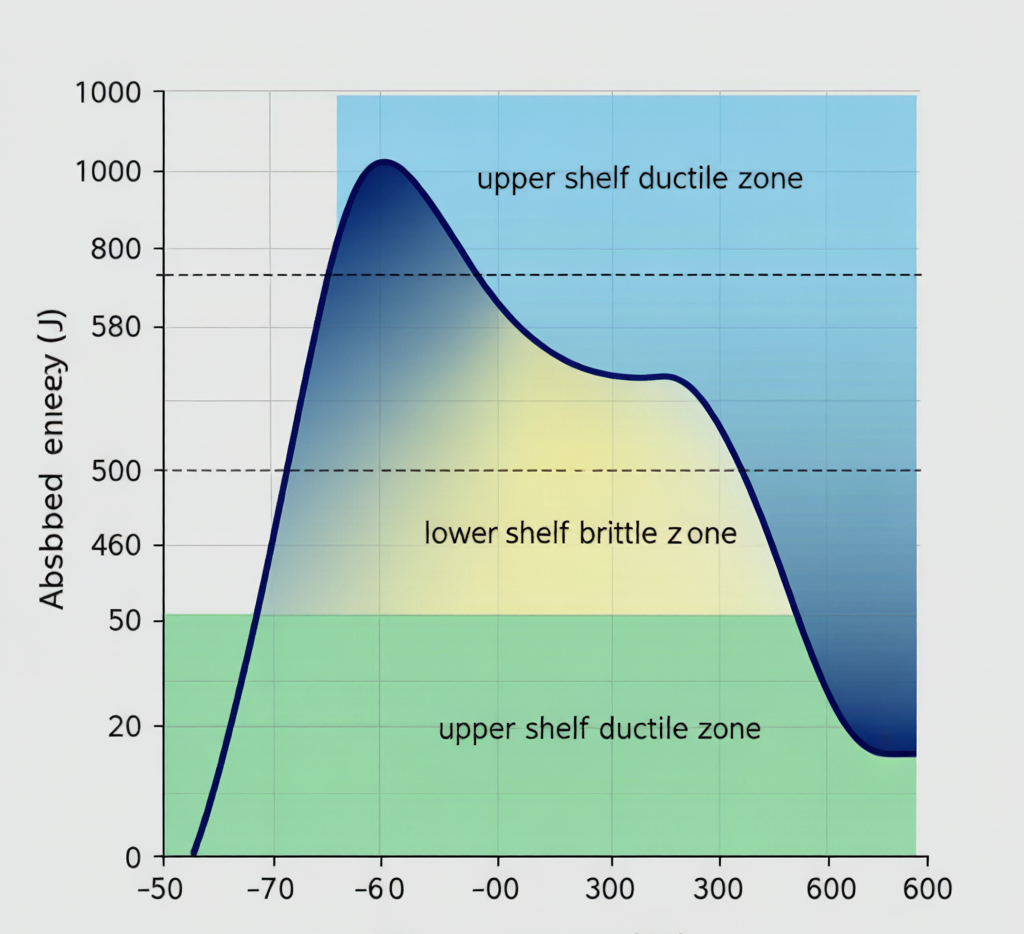
Carbon steels exhibit a characteristic transition curve when tested across a range of temperatures. At high temperatures, fracture is ductile and absorbs significant energy (upper shelf). At low temperatures, fracture is brittle (cleavage) with minimal energy absorption (lower shelf). Between these regimes lies the transition zone, where mixed-mode fracture occurs.
Factors that shift DBTT:
- Carbon content: Higher carbon raises DBTT — 0.20% C steel transitions around -30°C; 0.45% C transitions near -10°C
- Grain size: Fine grain (ASTM grain size #7-8) lowers DBTT by 15-30°C compared to coarse grain (#4-5)
- Manganese ratio: Mn/C ratio ≥ 3:1 promotes lower DBTT (key reason A36 specifies min 0.20% Mn)
- Phosphorus: Even 0.01% P above spec raises DBTT significantly — strict P control is essential for low-temperature service
- Heat treatment: Normalizing refines grain and lowers DBTT compared to as-rolled condition
- Thickness: Thicker sections cool slower during rolling, producing coarser grain and higher DBTT
Interpreting Impact Test Results on MTCs
When reviewing a mill test certificate, verify these critical details:
- Test temperature — Must match the specification requirement (e.g., A516 Gr 70 at -40°C, not at 20°C)
- Specimen size — Sub-size specimens produce lower energy values; verify the size matches your specification
- Orientation — Longitudinal (L-T) specimens typically show 30-50% higher energy than transverse (T-L); specify orientation in purchase order
- Number of specimens — Most standards require 3 specimens and specify both individual minimum and average minimum
- Lateral expansion — Some standards (API 5L) require minimum lateral expansion alongside absorbed energy
- Shear area percentage — Visual estimation of ductile fracture percentage; useful for assessing transition behavior
Common MTC pitfalls: Suppliers sometimes report impact values at room temperature when the specification demands sub-zero testing. Others may use sub-size specimens without adjusting the minimum energy requirement. Both practices can mask insufficient toughness. Always cross-check the MTC impact values against the exact requirements in your purchase specification.
Impact Testing for Common Carbon Steel Grades
Not all carbon steel grades require impact testing. Below is a summary of which grades mandate Charpy testing and at what conditions:
- A36: Impact testing not required by standard (general structural use). If buyer specifies, test at agreed temperature.
- A572 Gr 50/60/65: Charpy required for columns and fracture-critical members at specified temperatures per A572 Supplement S1/S2.
- A516 Gr 55/60/65/70: Charpy mandatory per A516 Section 9. Test temperature determined by design minimum temperature per ASME UCS-66.
- A106 Gr B/C: Charpy required only for low-temperature service per client specification; not standard requirement.
- API 5L PSL2 (X42-X80): Charpy mandatory — transverse for pipe body, longitudinal for seam weld HAZ. Full-size specimens at specified temperature.
- Q345B/Q345C/Q345D: Impact at 20°C (B), 0°C (C), -20°C (D), -40°C (E) per GB/T 1591.
FAQ
What is the difference between Charpy and Izod impact tests?
Charpy uses a horizontally supported specimen struck at the center; Izod uses a vertically clamped cantilever struck at the free end. Both use V-notched specimens, but the stress states differ. Charpy is the modern standard for steel specification worldwide. The two tests are not directly convertible.
Why is impact testing done at sub-zero temperatures?
Carbon steels undergo a ductile-to-brittle transition at low temperatures. Testing at the design minimum temperature verifies that the steel retains sufficient toughness under the actual service conditions — not just at room temperature. For offshore, cryogenic, and cold-climate applications, this verification is critical to prevent brittle fracture.
Can I compare Charpy values from sub-size and full-size specimens?
Sub-size specimens (7.5 mm or 5 mm thick) produce lower absorbed energy values than full-size (10 mm) specimens. ASTM E23 provides conversion factors, but direct comparison is inaccurate. When your specification requires full-size testing, ensure the MTC reports full-size results — not sub-size values that may appear to meet minimums.
What Charpy absorbed energy is considered “good” for structural steel?
For structural carbon steel at 0°C, 27 J (full-size longitudinal) is typically the minimum for most specifications. At -20°C, 15-27 J is common. Higher values (40+ J) indicate excellent toughness. The specific minimum depends on the grade, application, and governing standard — always reference the applicable specification.
How do I specify impact testing requirements in my purchase order?
Include: (1) test method (Charpy V-Notch per ASTM E23), (2) specimen orientation (longitudinal or transverse), (3) specimen size (full-size preferred), (4) test temperature, (5) minimum absorbed energy (individual and average), (6) number of specimens per heat (typically 3). Reference the applicable product standard (ASTM, EN, GB) for default requirements, then add any supplementary requirements.
Conclusion
Impact testing is an indispensable quality verification tool for carbon steel procurement. Understanding Charpy V-Notch procedures, ductile-to-brittle transition behavior, and how to interpret MTC impact values empowers buyers to specify the right toughness requirements and avoid the most common specification pitfalls.
At Huaxia-Steel, we provide comprehensive mill test certificates including Charpy impact values at specified temperatures for all grades that require them. Contact our team to discuss your impact testing requirements and ensure your next steel shipment meets the toughness specification your project demands.