EN 10025 Carbon Steel Standard — Complete Specifications for Structural Steel Export
EN 10025 is the cornerstone European standard governing hot-rolled structural steel products. For importers, fabricators, and project managers sourcing carbon steel from mills in China, India, Turkey, or Europe itself, understanding EN 10025 is essential — it defines not just the chemistry and mechanical properties, but also the inspection, testing, marking, and documentation requirements that determine whether your shipment clears customs and passes site acceptance.
This guide walks through all six active parts of EN 10025, explains the grade designation system, and provides practical compliance checklists for steel buyers importing into EU and Middle Eastern markets.
1. EN 10025 Structure: Six Parts, One Standard Family
EN 10025 is published in six parts, each covering a different product form or delivery condition. Understanding which part applies to your order is the first step toward compliance:
| Part | Title | Covers | Key Grades |
|---|---|---|---|
| EN 10025-1 | General technical delivery conditions | Common requirements across all parts | — |
| EN 10025-2 | Non-alloy structural steels | Plates, sections, bars, sheet piling | S235JR, S275JR, S355J2, S450J0 |
| EN 10025-3 | Normalized fine-grain steels | Weldable fine-grain structural steels | S275N, S355N, S420N, S460N |
| EN 10025-4 | Thermomechanical rolled fine-grain steels | TMCP-produced weldable steels | S275M, S355M, S420M, S460M |
| EN 10025-5 | Atmospheric corrosion resistant steels | Weathering steels (Corten-type) | S235J0W, S355J2WP, S355K2W |
| EN 10025-6 | Quenched and tempered fine-grain steels | High-strength QT plates | S460Q, S500Q, S690Q, S890Q |
EN 10025-2 is by far the most commonly referenced part for general structural carbon steel — covering the familiar S235, S275, S355, and S450 grade families that make up the vast majority of construction steel consumption worldwide.
2. Decoding the EN 10025-2 Grade Designation System
European steel grade names are systematic — once you learn the code, you can read any grade designation instantly:
Example: S355J2+N
- S = Structural steel
- 355 = Minimum yield strength in MPa (for thickness ≤16mm)
- J2 = Impact test: 27 Joules minimum at -20°C
- +N = Delivery condition: normalized (or normalized rolled)
| Quality Suffix | Impact Energy | Test Temperature |
|---|---|---|
| JR | 27 Joules min | +20°C (room temperature) |
| J0 | 27 Joules min | 0°C |
| J2 | 27 Joules min | -20°C |
| K2 | 40 Joules min | -20°C |
The delivery condition suffix is equally important:
- +AR: As-rolled (no heat treatment)
- +N: Normalized (or normalized rolled — equivalent grain refinement)
- +M: Thermomechanical rolled (TMCP)
- +QT: Quenched and tempered
3. Chemical Composition Limits for EN 10025-2 Grades
The chemistry of EN 10025-2 grades is carefully controlled to ensure predictable welding behavior, toughness, and galvanizing response. Here are the ladle analysis limits for the most commonly traded grades:
| Element | S235JR | S275JR | S355J2 | S450J0 |
|---|---|---|---|---|
| C max (%) | 0.17 (≤16mm) | 0.18 (≤16mm) | 0.20 (≤16mm) | 0.20 (≤16mm) |
| Mn max (%) | 1.40 | 1.50 | 1.60 | 1.70 |
| Si max (%) | — | — | 0.55 | 0.60 |
| P max (%) | 0.035 | 0.035 | 0.030 | 0.035 |
| S max (%) | 0.035 | 0.035 | 0.025 | 0.030 |
| N max (%) | 0.012 | 0.012 | 0.012 | 0.015 |
| Cu max (%) | 0.55 | 0.55 | 0.55 | 0.60 |
| CEV typical | 0.35 | 0.38 | 0.43 | 0.47 |
4. Mechanical Properties: Thickness-Dependent Design Values
Unlike some standards that use a single value, EN 10025-2 applies thickness-dependent reductions to yield and tensile strength. This matters enormously when designing with thick plates or heavy sections:
| Thickness (mm) | S235 Yield (MPa) | S275 Yield (MPa) | S355 Yield (MPa) |
|---|---|---|---|
| ≤16 | 235 | 275 | 355 |
| 16–40 | 225 | 265 | 345 |
| 40–63 | 215 | 255 | 335 |
| 63–80 | 215 | 245 | 325 |
| 80–100 | 215 | 245 | 315 |
| 100–150 | 195 | 235 | 295 |
| 150–200 | 185 | 225 | 285 |
| 200–250 | 175 | 215 | 275 |
Notice that S355 at 200mm thickness drops to 275 MPa — the same as S275 at 16mm. This is why thick-section design must always use the thickness-corrected value, not the “nameplate” grade number.
5. Inspection, Testing, and Certification Requirements (EN 10204)
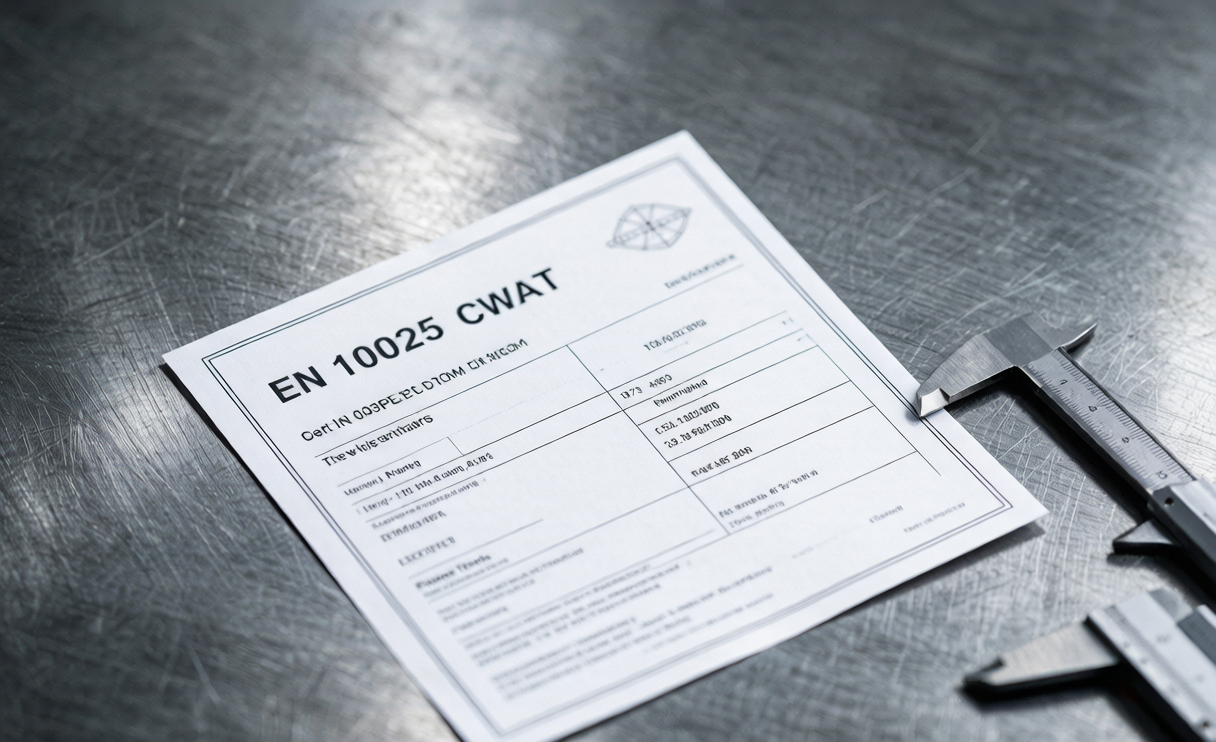
EN 10025 references EN 10204 for inspection documentation. When ordering, you must specify which type of certificate you require:
| Certificate Type | Issued By | Based On | When to Require |
|---|---|---|---|
| 2.1 — Declaration of compliance | Manufacturer | Non-specific inspection | Non-structural, low-risk applications |
| 2.2 — Test report | Manufacturer | Specific inspection | General structural use, standard projects |
| 3.1 — Inspection certificate | Manufacturer’s authorized inspector (independent of production) | Specific inspection | CE-marked structural steel, Eurocode projects |
| 3.2 — Inspection certificate | Manufacturer’s + purchaser’s authorized inspector | Specific inspection | Critical structures, pressure equipment, offshore |
For structural steel imports into the EU, EN 10204 Type 3.1 is the minimum for CE marking under the Construction Products Regulation (CPR). Without it, the steel cannot legally be placed on the EU market for structural applications — regardless of how well the chemistry and mechanical properties match.
6. CE Marking and the Construction Products Regulation (CPR)
Under EU Regulation 305/2011 (CPR), structural steel products governed by EN 10025-1 require CE marking when placed on the EU market. The CE mark must appear on the product label and be supported by a Declaration of Performance (DoP) issued by the manufacturer.
A compliant CE label for structural steel must include:
- CE marking symbol
- Manufacturer’s name and registered address
- Last two digits of year of first affixing
- DoP reference number
- Harmonized standard (EN 10025-1)
- Product description (grade, dimensions, heat number)
- Declared performance (yield, tensile, elongation, impact)
Importers outside the EU: Even if your destination country doesn’t require CE marking, specifying EN 10025 with 3.1 certification from a CE-compliant mill gives you confidence that the steel meets a recognized international benchmark.
7. Practical Compliance Checklist for Importers
When ordering EN 10025 structural steel from a foreign mill (e.g., sourcing from China for a Middle Eastern project), use this checklist to avoid compliance gaps:
- Specify the full standard + part: “EN 10025-2:2019” not just “EN 10025”
- Include delivery condition: S355J2+N, not just S355J2
- State required certificate type: EN 10204 3.1 — and specify if 3.2 third-party inspection is needed
- Define tolerances: EN 10029 for plates, EN 10034 for sections, EN 10058/10059/10060 for bars
- Specify surface quality: EN 10163-2 Class A, B, or C (especially if painting or galvanizing)
- Require CE marking and DoP: If the project is in the EU/EEA
- Request ultrasonic testing: EN 10160 for plates if internal soundness matters (specify acceptance class S2/E2 or higher)
- Verify marking on every piece: Heat number, grade, mill logo, and dimensions — traceability is non-negotiable
8. Common Pitfalls When Ordering EN 10025 Steel from Overseas Mills
Huaxia-Steel’s quality team sees these recurring issues with imported EN 10025 steel:
- Dual marking confusion: Some mills mark products with both SS400 and S235JR. If EN 10025 compliance is essential, insist on single-standard marking and testing.
- Missing impact tests: A mill might produce chemistry and tensile results that match S355, but without Charpy impact testing at -20°C, it is not S355J2. Demand the impact test report.
- Thickness tolerance creep: Mill margins being thin, some producers deliver near the bottom of the tolerance band. For critical applications, specify EN 10029 Class A (tighter) rather than Class D (commercial).
- Silicon content and galvanizing: Silicon above 0.25% can cause thick, brittle zinc coatings. If the steel will be hot-dip galvanized, specify Si 0.15–0.25% in addition to the standard chemistry limits.
Frequently Asked Questions
Can S275 substitute for S235 in a design?
Structurally, yes — S275 exceeds S235’s minimum yield. However, S275 may have a higher carbon equivalent, affecting weldability. The substitution must be approved by the structural engineer, and the higher grade cost must be weighed against potential section weight savings.
What is the difference between EN 10025-2 and EN 10025-4 steel?
Both are structural steels, but EN 10025-4 uses TMCP (thermomechanical controlled processing) to achieve fine-grain structure and high strength without high alloy content. EN 10025-4 steels (S355M, S460M) offer better weldability at equivalent strength and are preferred for heavy offshore and bridge applications.
Do I need CE marking for steel used outside the EU?
No — CE marking is only legally required for products placed on the EU/EEA market. However, many Middle Eastern, African, and Asian projects specify EN 10025 as a quality benchmark without requiring CE marking. Check your project specifications.
What if the mill’s test results show borderline values?
EN 10025 allows product analysis tolerances above the ladle analysis limits for certain elements. However, mechanical properties (yield, tensile, elongation, impact) are absolute minimums — there is no negative tolerance. Borderline mechanical results = non-conforming product.
How do I verify that imported steel genuinely meets EN 10025?
Three independent checks: (1) Review the EN 10204 3.1 certificate for completeness — all required tests present with actual values, not “conforms”. (2) Perform independent chemical analysis (OES spectrometer) on a sample — 1 minute per reading on-site. (3) For critical items, arrange third-party inspection (EN 10204 3.2) with an agency like SGS, Bureau Veritas, or TUV before shipment.
Source EN 10025 Certified Steel with Full Traceability
Huaxia-Steel supplies EN 10025-2, -3, -4, -5, and -6 structural steels from ISO 9001 and CE-certified mills — with full EN 10204 3.1 certification, heat-by-heat traceability, and optional third-party inspection. Our export team handles HS code classification, packing list preparation, and shipping documentation for smooth customs clearance worldwide.
Contact us for EN 10025 carbon steel with full certification — tell us your grade, dimensions, quantity, and destination, and we’ll deliver a competitive CIF quotation within 24 hours.