EN 10204 3.1 vs 3.2 Mill Test Certificate Explained for Carbon Steel
EN 10204 3.1 vs 3.2 Mill Test Certificate Explained for Carbon Steel
Every shipment of structural plate, pipe, or bar arrives with paperwork. The most important page is the mill test certificate – the document that confirms what you actually bought. In international carbon steel trade, the certificate is almost always per EN 10204, but the “type” printed in the top-right corner – 2.1, 2.2, 3.1, or 3.2 – decides whether the certificate is enough for your project.
This guide explains the difference between EN 10204 3.1 and 3.2 mill test certificates, when each is required, and how to write the requirement clearly in your RFQ.
1. What Is EN 10204?
EN 10204 is the European standard that defines the types of inspection documents delivered with metallic products. It was developed by CEN (European Committee for Standardization) and is now used worldwide. The standard organizes documents into four families:
Type 2.1 – Declaration of compliance with the order. The manufacturer states the products meet the order, without specific test results.
Type 2.2 – Test report. The manufacturer reports test results from non-specific inspection (batch-level or typical values).
Type 3.1 – Inspection certificate. Issued by the manufacturer’s own inspection body, with specific test results for the delivered batch.
Type 3.2 – Inspection certificate. Issued jointly by the manufacturer’s inspection body and an independent external inspector or the buyer’s representative.
2. Why 3.1 and 3.2 Dominate Carbon Steel Trade
Types 2.1 and 2.2 are weak documents – they do not pin the test results to the actual batch on the vessel. Most importers, EPC contractors, and code-stamped fabricators require at least a 3.1 certificate. Pressure vessel, nuclear, marine, and pipeline projects usually require 3.2 certification as a contractual baseline.
3.1 is the everyday standard for general structural plate, pipe, bar, and sections.
3.2 is required for code-stamped pressure equipment, sour-service pipelines, offshore, marine class, and many government-tender projects.
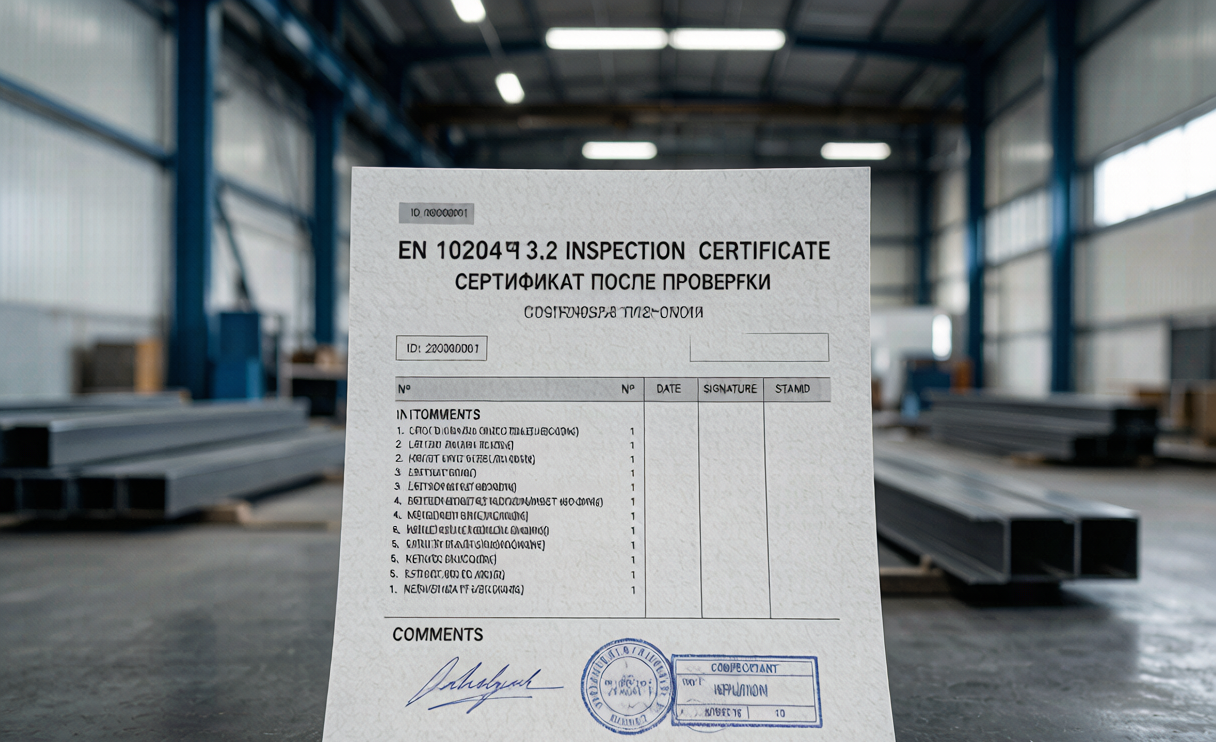
3. What EN 10204 3.1 Looks Like
An EN 10204 3.1 certificate is signed by a person who is independent from the manufacturing process but works for the mill (the mill’s own quality or inspection department). The certificate includes:
Heat number and batch reference traceable to the steel
Cast and ladle analysis (chemical composition per heat)
Product analysis (chemical composition of the sample from the delivered batch)
Tensile test results (yield, tensile, elongation)
Charpy impact test results (where specified)
Hardness results (where specified)
Reference to the product standard (ASTM, EN, JIS, GB)
Signed by the mill’s authorized inspection representative
The mill’s own department – not the production line – issues the certificate, which gives the document independence from the operators who made the steel.
4. What EN 10204 3.2 Adds
Type 3.2 goes further by adding an external signature. The certificate is counter-signed by:
An inspector from an independent third-party inspection company (SGS, BV, TUV, Intertek, Lloyds, DNV, or equivalent), OR
An inspector designated by the purchaser (typically the buyer’s quality representative or an authorized third-party inspection (TPI) agent), OR
A person authorized by official regulations (for example, a marine surveyor or PED authorized inspector).
The independent inspector reviews the certificate data, can witness tests or audit the mill, and takes responsibility for the document alongside the mill. This is what gives the certificate its weight for code-stamped fabrications.
5. Side-by-Side Comparison Table
Attribute
EN 10204 3.1
EN 10204 3.2
Issuer
Mill inspection body
Mill inspection body + independent inspector
Signatories
1 (mill inspector)
2 (mill inspector + independent inspector)
External witness of tests
No
Yes, optional
Specific test results per delivered batch
Yes
Yes
Heat traceability to delivered material
Yes
Yes
Average added cost per tonne
Baseline
USD 8-25 per tonne
Typical lead-time impact
None
3-7 days for inspector mobilization
Code references
PED 2014/68/EU (Cat I-II), ASME B31.3
PED 2014/68/EU (Cat III-IV), ASME B31.3, ASME Section VIII Div 1, ASME B31.4, ASME B31.8
6. When 3.1 Is Sufficient
Standard structural plate (ASTM A36, A572, A588)
Standard pipe (ASTM A53, A106 Gr.B, API 5L PSL1)
Hot-rolled sections and bars for construction
General fabrication for non-code work
Inventory plate for stockists
Low-pressure tanks and vessels not under national or international code
7. When 3.2 Is Mandatory
Pressure vessels under ASME Section VIII (Div. 1 or 2) or PED 2014/68/EU Category II-IV
Boilers under ASME Section I
Pipelines under ASME B31.4 (liquid), B31.8 (gas), or ISO 13623
Offshore structures under DNV, ABS, Lloyds class rules
Marine components under class rules (ABS, BV, Lloyds, DNV)
Nuclear components under ASME Section III
Government-tender projects that require third-party witnessed testing
8. Inspection Workflow for 3.2 Certificates
Pre-shipment planning: Inspector mobilizes to the mill 3-7 days before production. The mill’s inspection plan, heat-treatment records, and test procedures are reviewed.
Witness of tests: The independent inspector selects samples and witnesses or performs the required mechanical tests. For very large orders, the inspector reviews 1 sample per 50-100 tonnes.
Document review: The independent inspector reviews the chemistry, tensile, Charpy, and dimensional reports prepared by the mill.
Certification: The independent inspector counter-signs the 3.2 certificate after all tests pass and the documentation is complete.
Stamping and release: Material is released for shipment with the certificate attached. Many inspectors stamp each plate or pipe with a unique number for traceability.
9. How Buyers Specify the Certificate
Use clear, standard language in your RFQ and purchase order. Examples:
“Mill test certificate per EN 10204 3.1, issued in English, with chemical analysis, tensile, Charpy at -20 degrees C, and dimensional report per ASTM A6.”
“Mill test certificate per EN 10204 3.2, with witnessed Charpy testing at -46 degrees C by SGS or equivalent independent inspector. Inspector’s travel and accommodation at supplier’s cost.”
Avoid vague wording such as “with certificate” or “with test report”. Always cite the standard type (2.1, 2.2, 3.1, 3.2) and the test scope.
10. Common Pitfalls to Avoid
Accepting 3.1 in a project that strictly needs 3.2: Most EPC contracts define 3.2 for code-stamped work; substituting 3.1 can fail the inspector at site.
Forgetting the language: Chinese mills default to bilingual or Chinese certificates – confirm that English is required for customs clearance.
Mixing certificate types within a lot: Ensure all plates in the lot carry the same certificate type to avoid disputes with inspectors.
Omitting the heat-treatment record: The certificate should describe the heat-treatment cycle (normalized at 910 degrees C, tempered at 600 degrees C, etc.).
Skipping supplementary tests: If your RFQ specifies Charpy, hardness, or drop-weight tests, the certificate must include them.
11. Cost and Lead-Time Considerations
In mid-2026, the surcharge for upgrading from 3.1 to 3.2 certificate on Chinese mill orders:
Inspector mobilization: USD 1,500-3,500 per visit (typically added to the first lot).
Inspector day rate: USD 350-700 per day at mill, depending on location.
Per-tonne surcharge: USD 8-25 per tonne, depending on test scope.
Lead-time impact: 3-7 days to mobilize the inspector and complete certification.
For small quantities (under 50 tonnes), the inspector mobilization share per tonne is significant. For large orders (over 500 tonnes), the cost per tonne becomes negligible.
12. Alternatives and Equivalents Worldwide
Region
Equivalent to EN 10204 3.1
Equivalent to EN 10204 3.2
USA (ASTM)
MTC per ASTM A6 Section 6 or per ASTM A20
MTC + signed by independent inspector
China (GB)
Quality certificate per GB/T 18253 – type 3.1
Quality certificate per GB/T 18253 – type 3.2
Japan (JIS)
Inspection certificate per JIS G 0415
Inspection certificate per JIS G 0415 + external signatory
Marine class
Mill certificate accepted under class rules
Class surveyor-witnessed certificate
FAQ
Is EN 10204 3.1 the same as an MTC?
Yes – the MTC (Mill Test Certificate) is the everyday shorthand for an EN 10204 3.1 inspection certificate. The mill issues the document, signed by its own inspector.
Can 3.2 be issued without an inspector?
No. The defining feature of 3.2 is the independent counter-signature by an external inspection body or the buyer’s representative. Without that, the document remains 3.1.
Who pays for the 3.2 inspector?
Typically the buyer, but the cost is built into the supplier’s offer. EPC contracts and many procurement frameworks allow the mill to absorb the cost in the unit price.
Does 3.2 certification slow the order?
Only by 3-7 days for inspector mobilization. Tests run on the mill’s normal schedule; the inspector observes rather than performs.
What happens if a test fails during 3.2 witnessing?
The lot fails the test. The mill will either re-treat the material (sometimes possible) or scrap the affected pieces. A retest from a different sample location may also be negotiated under the project specification.
Conclusion
The EN 10204 3.1 vs 3.2 choice is about the level of independent verification your project requires. 3.1 is the everyday certificate for general carbon steel plate, pipe, sections, and bar. 3.2 adds independent witness for code-stamped pressure vessels, pipelines, offshore, marine class, and nuclear work. State the certificate type by name in every RFQ, confirm that the certificate language matches your customs and inspector requirements, and the paperwork will move smoothly at the receiving end.
Buying carbon steel with certified paperwork from China? Huaxia-Steel supplies EN 10204 3.1 certificates as standard and can coordinate EN 10204 3.2 certification through SGS, BV, TUV, Lloyds, or DNV. Send the order quantity, standard, and the certificate level required, and our team will include the certification cost in the offer.
Related Images
Figure 2: EN 10204 3.1 vs 3.2 Mill Test Certificate Explained for Carbon SteelFigure 3: EN 10204 3.1 vs 3.2 Mill Test Certificate Explained for Carbon Steel
If you require further information about our metal sheet products or architectural projects, please don’t hesitate to leave your contact details and message here.
Our team of experts will respond within 24 hours to continue the discussion and provide you with any additional information you requires.