Factory Audit Checklist for Carbon Steel Suppliers in China
A low steel price means nothing if the mill cannot deliver consistent quality, reliable documentation, and on-time shipments. A well-structured factory audit is the best way to separate capable suppliers from trading companies or under-equipped workshops before you place a large order.
This article provides a practical factory audit checklist for carbon steel suppliers in China, covering quality system, production capability, inspection and testing, documentation, packaging, and red flags that should stop the audit.
1. Audit Goals and Preparation
Before traveling or commissioning a third-party auditor, define what the audit must answer:
- Does the supplier actually manufacture the product, or do they trade it?
- Can they produce the required grade, size, quantity, and tolerance?
- Do they have a functioning quality management system?
- Can they provide valid mill test certificates and third-party reports?
- What is their on-time delivery and complaint-handling track record?
Bring a checklist, sample specifications, and a list of questions tied to your specific product. Plan to spend at least one full day on site and request access to production areas, testing labs, and warehouse.
2. Company Profile and Legal Documents
| Item | What to verify | Why it matters |
|---|---|---|
| Business license | Legal name, registered capital, scope of business | Confirms the entity can legally trade or manufacture steel |
| Export license | Valid customs registration and export rights | Required for direct export; without it, you rely on a broker |
| ISO 9001 certificate | Scope, issue date, accreditation body | Basic quality system evidence; check validity online |
| ISO 14001 / 45001 | Environmental and safety certificates | Important for large buyers and ESG reporting |
| API / CE / other product approvals | Relevant to your product | Shows capability for specialized markets |
3. Production Capability Assessment
Walk the production line and match the equipment to your product requirements.
- Melting route: EAF, BOF, or induction? BOF and EAF mills generally produce cleaner, more consistent steel than small induction furnaces.
- Continuous casting: Slab, bloom, or billet casting? Ask about slab thickness and width range.
- Rolling mills: Reversing mill or continuous mill? Maximum rolling width and thickness?
- Heat-treatment furnaces: Normalizing, annealing, quenching and tempering capability? Furnace dimensions?
- Pipe mills: For pipe suppliers – seamless piercing mill, ERW line, LSAW line, or spiral line?
- Finishing: Cutting, straightening, shot blasting, pickling, oiling, galvanizing lines?
Ask for a typical production schedule for your product and the bottleneck stage. If the lead time they quote is shorter than the real production cycle, the order may be subcontracted.
4. Quality Management System
| Area | Questions to ask |
|---|---|
| Incoming inspection | How are raw materials checked? Do they test billet/slab chemistry? |
| Process control | Are rolling temperatures, furnace cycles, and cooling rates recorded? |
| Non-conformance | Show examples of recent NCRs and how they were closed |
| Calibration | Are testing machines calibrated by accredited bodies? Check certificates |
| Traceability | Can each heat number be traced back to raw material and test results? |
| Document control | How are MTCs issued and stored? Is there an electronic record? |
5. Laboratory and Testing Capability
A supplier without an in-house lab will rely on external testing, which adds cost and delay. Verify the following equipment exists and is calibrated:
- Universal tensile testing machine for yield, tensile, and elongation.
- Charpy impact testing machine with low-temperature bath.
- Hardness testers (Brinell, Rockwell, Vickers).
- Spectrometer for chemical analysis.
- Ultrasonic flaw detector for internal defects.
- Dimensional measuring tools (calipers, micrometers, ultrasonic thickness gauge).
- Metallographic microscope for grain size and inclusion rating.
Ask to see a recent test report and compare it with the corresponding MTC. Discrepancies are a serious red flag.
6. Inspection During Production
Confirm the inspection points along the production flow:
- Before rolling: Billet/slab surface check and chemistry confirmation.
- During rolling: Temperature monitoring, thickness gauges, width gauges.
- After rolling: Dimensional check, visual surface inspection, straightness.
- After heat treatment: Hardness survey, mechanical retest if required.
- Final inspection: Full dimensional report, marking check, packing check.
7. Documentation and MTC Review
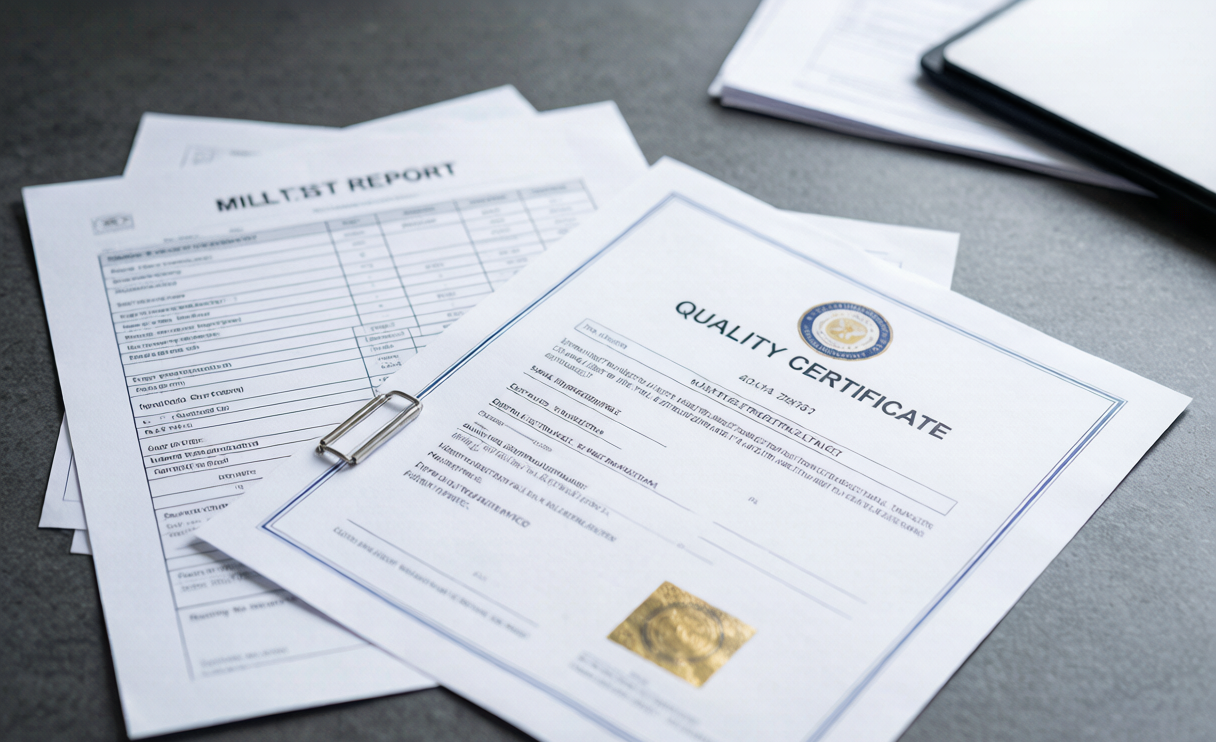
The mill test certificate is the buyer’s main protection. A valid MTC should include:
- Heat number and batch number.
- Chemical composition (ladle and/or product analysis).
- Mechanical test results (yield, tensile, elongation, hardness).
- Impact test results if required (temperature and energy).
- Dimensional summary and weight.
- Standard and grade reference.
- Delivery condition (as-rolled, normalized, annealed, etc.).
- Inspector signature and mill stamp.
For exports to Europe, request EN 10204 3.1 or 3.2. For North America, a mill test report to the applicable ASTM standard is usually sufficient.
8. Packaging, Marking, and Loading
| Item | What to check |
|---|---|
| Marking | Heat number, grade, dimensions, standard, and mill name on each piece or bundle |
| Bundle weight | Within crane and truck limits; typically 2-5 tonnes for easy handling |
| Strapping | Steel straps strong enough for sea transport; no loose bundles |
| Protection | Edge protectors, anti-rust oil, plastic caps for pipe ends, moisture barriers |
| Loading | Proper dunnage, even weight distribution, lashing plan for container or bulk vessel |
9. Red Flags That Should Stop the Audit
- The facility refuses access to the production floor or testing lab.
- The company cannot produce the ISO certificate or it is expired/forged.
- Production equipment is clearly idle, outdated, or unrelated to the product.
- No in-house testing capability for the mechanical or chemical tests your order needs.
- Mill test certificates are generic templates with no heat-specific data.
- The quoted lead time is impossibly short for the claimed production route.
- Workers cannot explain the grade or standard you are asking about.
- The same address hosts multiple unrelated trading companies.
10. Third-Party Inspection
For first orders, high-value orders, or certified projects, hire a third-party inspector such as SGS, BV, Intertek, or TUV. The inspector can:
- Witness production and testing.
- Verify dimensions and marking.
- Take independent samples for retesting.
- Supervise loading and seal containers.
- Issue an inspection report accepted by banks and end clients.
11. Follow-Up Actions After the Audit
The audit report is only useful if it drives action. After the site visit, prepare a concise report with:
- Executive summary and overall pass/fail score.
- List of non-conformities with photos and evidence.
- Corrective action request with deadlines.
- Recommended order conditions, such as third-party inspection or tighter sampling.
- Re-audit date if major non-conformities were found.
Share the report with the supplier and request a written corrective action plan. For minor issues, a follow-up questionnaire may be enough. For major issues, a re-audit is the safest path.
12. Virtual Audit Options
When travel is not possible, a virtual audit via live video can cover document review, management interviews, and a partial production-floor walk. Virtual audits work best for repeat suppliers or small orders. They are not a full substitute for an on-site visit because you cannot independently verify equipment condition, calibration labels, or warehouse stock.
13. Using Audit Results in Contract Terms
Translate audit findings into purchase-order clauses:
- Require pre-shipment inspection if testing capability was weak.
- Add hold points for witness testing if traceability was questionable.
- Specify acceptable MTC format and mandatory data fields.
- Define rejection rights for out-of-specification material.
- Set liquidated damages for late delivery if scheduling was unreliable.
14. Building a Supplier Development Program
For strategic suppliers, audits should not be one-off events. A supplier development program includes annual re-audits, joint quality improvement projects, training on your documentation requirements, and shared performance scorecards. Over time, this reduces inspection costs and improves first-pass yield.
15. Social Compliance and Safety
Beyond quality, responsible buyers evaluate social compliance and workplace safety. During the audit, observe whether workers use personal protective equipment, whether emergency exits are clear, and whether overtime practices comply with local labor law. Ask to see safety training records and fire drill logs. Poor safety performance can indicate broader management weaknesses that eventually affect product quality.
16. Environmental Permits and Waste Management
Steel production and processing generate scale, pickling acid, oil, and dust. A legitimate supplier should hold valid environmental permits and maintain waste-treatment records. Ask how spent pickling acid and oily sludge are disposed of. Suppliers that cannot produce environmental permits face shutdown risk, which can disrupt your supply chain.
17. Communication and Response Time
Technical responsiveness is part of supplier capability. During the audit, evaluate how quickly the sales and quality teams answer technical questions. A supplier that needs many days to respond to simple inquiries may struggle with urgent quality issues or engineering changes. Look for dedicated English-speaking technical contacts and clear escalation paths.
18. Evaluating Subcontractors
Many steel suppliers subcontract heat treatment, galvanizing, or machining. A good supplier should disclose subcontractors and demonstrate that they are qualified and audited. Ask for subcontractor names, locations, and the scope of work they perform. If a supplier hides subcontracting relationships, quality control may be weaker than the audit suggests.
19. Cultural and Language Considerations
Chinese suppliers may avoid saying “no” directly. Questions should be specific and require evidence rather than yes-or-no answers. Use drawings, photos, and samples to communicate requirements. Follow up verbal agreements in writing. Having a Mandarin-speaking auditor or interpreter improves the depth of the audit and reduces misunderstandings.
20. Audit Timing and Sample Selection
The best audits are unannounced or announced with only a short lead time. Announced audits give suppliers time to tidy up or temporarily move stock. If a pre-announced audit is unavoidable, ask to inspect production records from the previous two weeks, not just the current day. Select samples randomly from the warehouse rather than accepting the supplier’s prepared samples. Random sampling gives a more accurate picture of normal quality.
16. Supplier Self-Assessment Questionnaire
Before committing to a site audit, send a self-assessment questionnaire. The questionnaire should cover legal status, main products, equipment list, annual capacity, key customers, quality system, testing capability, and export experience. Review the completed questionnaire for inconsistencies before scheduling the on-site audit. A supplier that cannot complete a simple questionnaire is unlikely to pass a full audit.
17. Audit Report Template Essentials
A good audit report should be concise but complete. Include the following sections:
- Supplier name, address, audit date, and auditors.
- Scope of audit and products covered.
- Overall score and pass/fail conclusion.
- Summary of strengths and weaknesses.
- Non-conformity list with severity ranking.
- Corrective action plan with responsible person and deadline.
- Photographic evidence of key findings.
- Recommendation for supplier approval, conditional approval, or rejection.
18. Audit Checklist Summary
| Area | Key checkpoints |
|---|---|
| Legal | License, ISO, export rights, product approvals |
| Production | Equipment, capacity, bottleneck, subcontracts |
| Quality | Incoming check, process control, NCR, calibration |
| Testing | Spectrometer, tensile, impact, hardness, UT/ET |
| Documentation | MTC format, traceability, EN 10204 level |
| Packing | Marking, strapping, rust protection, loading |
| Safety/Environment | PPE, exits, permits, waste disposal |
| Communication | Technical response, English support, escalation |
19. Re-audit Frequency and Performance Tracking
Approved suppliers should be re-audited at least annually or after any major quality failure. Maintain a supplier scorecard tracking on-time delivery, defect rate, customer complaints, and audit results. Use the data to rank suppliers and allocate future orders. Suppliers that consistently score well can move to reduced inspection levels, while poor performers should be placed on improvement plans or removed from the approved vendor list.
20. Sample Factory Audit Scorecard
| Category | Max score | Pass threshold |
|---|---|---|
| Legal and certification | 15 | 10 |
| Production capability | 25 | 17 |
| Quality system | 25 | 17 |
| Testing and lab | 20 | 14 |
| Documentation and packing | 15 | 10 |
| Total | 100 | 68 |
A score below 68 usually means the supplier is not ready for a critical order, or the order should be placed with strict third-party supervision.
FAQ
How long does a factory audit take?
A typical audit takes one full day. Complex mills with multiple product lines may require two days.
Should I audit myself or hire a third party?
For first-time suppliers, a third-party auditor is recommended. For repeat suppliers, an in-person visit by your quality team adds value.
What is the cost of a factory audit in China?
Third-party audits typically cost USD 500-1,500 per man-day plus travel expenses, depending on location and scope.
Can a trading company pass as a manufacturer?
Sometimes. Check the business license scope, visit the production floor, and verify equipment ownership. Trading companies often rent office space near mills.
What documents should I request before the audit?
Business license, ISO certificates, recent MTC samples, equipment list, and a production flow chart for your product.
Conclusion
A disciplined factory audit checklist for carbon steel suppliers in China protects your project from quality failures, documentation gaps, and shipping delays. Focus on legal status, production capability, quality system, testing, documentation, and packaging. Use a scorecard to compare suppliers, and always consider third-party inspection for first orders.
Looking for a pre-qualified carbon steel supplier in China? Huaxia-Steel operates with ISO 9001 quality control, full mill test certificates, third-party inspection support, and export packing tailored to your project. Contact us for a factory profile, sample MTC, or a same-day quote.
Related Images