Marine Cargo Insurance for Steel Export Shipments
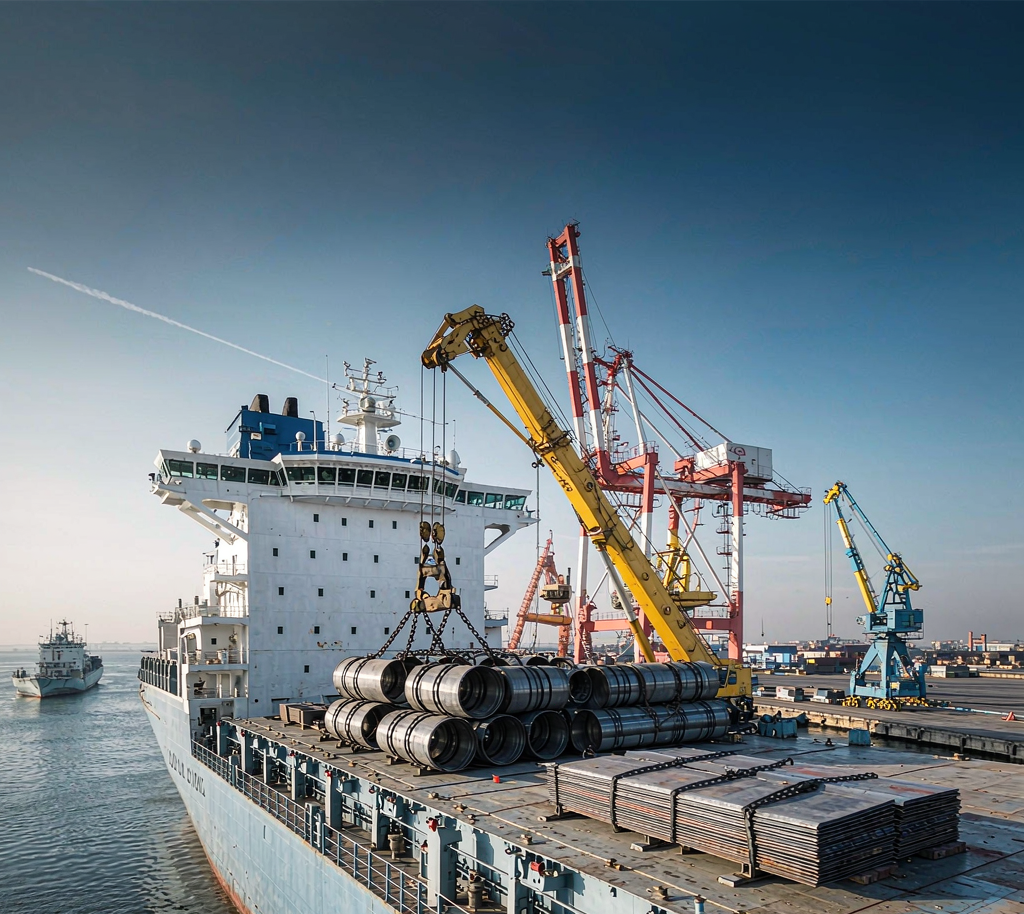
Steel is heavy, it rusts, and it does not forgive bad stowage. That combination makes marine cargo insurance for steel export shipments a different problem from insuring consumer goods, and buyers who treat it as a checkbox often discover the gap only after a claim is rejected. A coil that arrives with rust blooms, a bundle of pipe that shifted and bent, a plate stack that was crushed under a container — these are common steel losses, and whether they are covered depends entirely on the clauses purchased and the packing and stowage that were agreed.
This guide explains how marine cargo insurance works for steel, the difference between the three Institute Cargo Clauses (A, B and C), the steel-specific exclusions that catch buyers out, how general average can create a surprise bill, what valuation means in practice, and how to build insurance into FOB, CIF and DAP terms so there is no gap between who is responsible and who is covered. It is written for importers, exporters and trading-house staff moving carbon steel by sea.
Why Steel Cargo Needs Its Own Insurance Logic
General cargo insurance is built around the risk of total loss and major perils: sinking, fire, collision, and the consequences of those events. Steel rarely sinks a ship and rarely burns, but it suffers a different family of losses: corrosion from condensation and seawater, mechanical damage from poor handling and stowage, and dimensional damage from stacking and shifting. Those losses are exactly the ones that cheap, minimum cover tends to exclude.
Steel is also high-value per tonne and often shipped in large parcels, so a single event can produce a claim far larger than the premium suggests. And because steel is a commodity with a resale market, the question is often not total loss but depreciation — a rusted coil still has scrap value, and the claim becomes a calculation of the difference between sound and damaged value. Understanding that distinction early shapes both the cover you buy and the evidence you keep.
The Three Institute Cargo Clauses: A, B and C
The Institute Cargo Clauses (ICC) are the standard wording for marine cargo cover, and the letters A, B and C describe descending breadth of cover. ICC (A) is all-risks cover subject to the exclusions listed in the clause; ICC (B) and ICC (C) are named-perils cover, insuring only the perils listed. The single most common mistake in steel trade is buying ICC (C) because it is cheapest, then discovering that handling damage or rust is not among its named perils.
| Clause | Basis | Covers | Steel suitability |
|---|---|---|---|
| ICC (A) | All risks | All loss/damage except exclusions | Best for high-value or finished steel |
| ICC (B) | Named perils | Wider list incl. earthquake, water entry | Adequate for many bulk parcels |
| ICC (C) | Named perils | Major casualties only | Minimum cover, many gaps for steel |
ICC (A) is the default recommendation for finished or high-value steel — cold rolled coil, coated product, precision tube, machined parts — because it covers accidental damage that the named-perils clauses miss. ICC (B) adds perils such as earthquake, volcanic eruption, water entry into the vessel and washing overboard, and is a reasonable compromise for robust bulk steel. ICC (C) covers essentially the catastrophic events and leaves handling damage, rust and many transit losses uncovered.
What the Clauses Exclude — and the Steel-Specific Gaps
Even ICC (A), the broadest cover, excludes a list of causes that matter enormously to steel. These typically include the ordinary leakage, loss of volume or weight, or wear and tear of the subject matter; insufficiency or unsuitability of packing or preparation; and inherent vice — the tendency of the goods to deteriorate without external cause. For steel, inherent vice and insufficient packing are the two exclusions that decide most claims.
Rust that develops because the steel was shipped with residual moisture, or because the packing did not include adequate protection, can be treated as inherent vice or insufficient packing and rejected. Handling damage caused by the shipper’s own loading may fall outside cover unless the clause and the commercial terms place responsibility clearly. The lesson is not that insurance is unfair but that insurance only covers what it says it covers, and the exclusions are where steel claims live or die.
General Average and Why It Surprises Buyers
General average is a principle of maritime law that requires all parties in a sea venture to share proportionally in a loss voluntarily incurred to save the ship and cargo — for example, jettisoning cargo or incurring salvage costs after a grounding. If general average is declared, cargo owners can be asked to contribute to the cost even though their own goods may be undamaged, and the cargo may not be released until the contribution is secured.
For steel buyers this is a real cash-flow event, not a theoretical one. A vessel grounding with thousands of tonnes of steel aboard can trigger a general average demand that arrives weeks later and must be paid before delivery. Cargo insurance that includes general average contributions covers this exposure; cover that does not leaves the buyer writing a large unexpected cheque. It is one of the strongest arguments for proper cargo cover rather than the minimum.
Valuation: CIF Plus 10% and Insurable Interest
Marine policies are usually written on a CIF-plus-10% basis, meaning the insured value is the CIF value of the goods plus a 10% margin to cover expected profit and incidental costs. The insured must have an insurable interest in the goods — a financial stake that would be harmed by loss — and that interest must exist at the time of loss. This is why the Incoterm matters: under FOB the buyer’s interest begins when goods pass the ship’s rail, while under CIF the seller arranges cover for the buyer’s benefit.
Buyers should confirm the declared value matches the actual CIF value, including freight and insurance, because under-insurance leads to proportional claim reductions. A policy written at invoice value alone when the true CIF-plus-margin value is higher leaves the buyer short on a partial loss. Getting the declared value right at the outset costs nothing and prevents the quiet shortfall that appears only when a claim is settled.
Packaging, Stowage and Their Effect on Claims
Insurance and packing are two sides of the same coin. A policy can cover handling damage in principle, but a claim still fails if the packing was inadequate for the voyage. Steel should be bundled with steel strapping to specification, pipe ends protected with caps, plate edges protected against chafing, and moisture-sensitive product wrapped with VCI or barrier film and desiccant. Loose steel that shifts in a container is a classic cause of both damage and rejected claims.
Stowage also matters. Steel is dense and must be distributed to avoid over-stressing the vessel or the container floor, and it should be kept away from cargo that releases moisture. Heavy lifts need proper spreader and sling practice. A buyer who specifies packing and stowage requirements in the purchase order, and has them verified before loading, both reduces the chance of loss and strengthens any claim that does arise. Insurance does not replace good logistics; it backs it up.
Rust, Condensation and Sweat: The Hidden Claims
The most frequent steel loss is not dramatic: it is condensation. Temperature swings during a sea voyage cause moisture to condense on cold steel surfaces, and steel in a humid hold or container can develop rust that eats into the value of the parcel. This “sweat” damage is often excluded as inherent vice unless the packing and stowage were adequate and the cause can be tied to an insured peril such as sea water entry.
Prevention is the buyer’s best insurance: desiccants, barrier packaging, ventilation where appropriate, and avoiding stowage next to moisture-releasing cargo. Where rust does occur, the claim turns on evidence — pre-shipment inspection records, packing photographs, and a surveyor’s report separating sea-water damage (covered) from condensation damage (often excluded). Buyers who document the condition at loading give themselves the best chance of a fair settlement.
Documents Needed to File a Claim
A steel claim is won or lost on paperwork. The core set includes the policy or certificate of insurance, the bill of lading, the commercial invoice, the packing list, the survey report, photographs of the damage, and correspondence with the carrier. For partial loss, a sound-value versus damaged-value assessment is essential. Missing documents are the most common reason claims stall, so the file should be assembled as soon as damage is discovered.
- Policy or insurance certificate with the clause basis stated.
- Bill of lading and commercial invoice matching the insured value.
- Packing list and pre-shipment inspection or loading photographs.
- Independent survey report separating covered from excluded damage.
- Sound-value and damaged-value assessment for partial losses.
- Notice of claim to the carrier within the contractual time limit.
Who Buys the Policy: FOB vs CIF vs DAP
The Incoterm decides who arranges and pays for insurance, and getting it wrong creates a gap. Under FOB and CFR the buyer arranges insurance from the point goods are loaded, so the buyer must have cover in place before shipment. Under CIF the seller must arrange minimum ICC (C) cover for the buyer’s benefit, but buyers who need broader cover should specify ICC (A) in the contract rather than accept the default minimum. Under DAP and DDP the seller carries the risk to destination and should insure accordingly.
| Incoterm | Who insures | Default cover | Buyer action |
|---|---|---|---|
| FOB / CFR | Buyer | Buyer’s choice | Arrange cover before loading |
| CIF | Seller | ICC (C) minimum | Specify ICC (A) if needed |
| DAP / DDP | Seller | Seller’s choice | Confirm cover to destination |
The practical rule is to read the Incoterm alongside the insurance clause and confirm there is no gap at the handover point. A CIF contract that promises only ICC (C) while the buyer assumes all-risks cover is a recipe for dispute. Writing the required clause basis and insured value into the sales contract removes the ambiguity before the vessel sails.
Choosing a Cover Level for Your Shipment
The cover decision should follow the value and vulnerability of the cargo. Finished and high-value steel — cold rolled and coated coil, precision tube, machined components — justifies ICC (A) because handling damage and contamination losses are realistic and expensive. Robust bulk steel such as hot rolled plate, structural sections and black pipe can often be covered adequately under ICC (B) at lower cost. ICC (C) should be reserved for cases where the buyer consciously accepts the gaps, not used as a default.
Buyers should also consider whether to add specific extensions — for example cover during inland transit to the final destination, or storage cover after discharge — because the standard clauses end at a defined point. An annual open cover can simplify repeated shipments and avoid the per-shipment paperwork, which matters for buyers running regular steel programs.
Cost: Premium Rates for Steel
Steel premiums are usually a small fraction of cargo value but vary with route, vessel, packing, season and clause basis. ICC (A) costs more than ICC (B) or (C), and high-risk routes or poorly packed cargo attract loadings. Because steel is dense and relatively low-value per cubic metre compared with its weight, the premium per tonne is often modest — but the potential loss from a single rusted or damaged parcel is large, which is why cutting cover to save a fraction of a percent is a false economy.
The right way to think about cost is expected loss, not premium. A slightly higher premium for ICC (A) on a high-value coil shipment buys protection against the exact losses that occur most often in steel trade. Buyers who compare the premium to the value at risk, rather than to a competitor’s cheaper quote, usually land on the cover that actually protects them.
Frequently Asked Questions
Does CIF include insurance?
Yes, but only minimum cover. Under CIF the seller must arrange ICC (C) cover for the buyer’s benefit. If you need all-risks or broader protection, specify ICC (A) in the contract rather than accepting the default.
Is rust covered by marine cargo insurance?
Sometimes. Rust caused by an insured peril such as sea water entry can be covered, but condensation or sweat damage is often excluded as inherent vice or insufficient packing. Adequate packing and good evidence are essential to a successful claim.
What is general average?
A maritime principle requiring all cargo interests to share proportionally in a loss voluntarily incurred to save the ship and cargo. If declared, cargo owners may have to contribute even if their own goods are undamaged, and cargo may be held until the contribution is secured.
Who arranges insurance under FOB?
The buyer. Under FOB and CFR the buyer’s risk begins when goods are loaded, so the buyer must arrange cover before shipment. Confirm the policy is in place before the vessel sails to avoid an uninsured gap.
A Practical Framework for Choosing Cover
Rather than choosing a clause by habit, match it to the cargo and route. Ask three questions: how valuable is the parcel relative to the premium, how vulnerable is the surface to damage and corrosion, and what is the likely loss mode on this route? The answers point to a clause basis and to the packing standard that must support it.
| Cargo type | Loss exposure | Suggested basis |
|---|---|---|
| Cold rolled / coated coil | Surface damage, rust | ICC (A) plus VCI packing |
| Hot rolled plate, sections | Handling, shifting damage | ICC (B) with good stowage |
| Seamless / welded pipe | End damage, bending | ICC (B) with end protection |
| Precision tube, machined parts | Damage, contamination | ICC (A) plus barrier packing |
This is a starting point, not a rule. A high-value parcel on a long route may justify ICC (A) regardless of how robust the steel is; a low-value bulk parcel on a short, low-risk route may reasonably use ICC (B). What matters is that the clause, the packing and the commercial term are consistent, so there is no gap between what the buyer assumes is covered and what the policy actually says.
Reducing Losses Before They Happen
The cheapest claim is the one that never happens. Pre-shipment inspection that records the condition of the steel, the packing and the loading protects both the cargo and the claim. Bundling to specification, protecting pipe ends, using desiccant where condensation is a risk, and photographing the loaded container or hold all cost little and pay back when something goes wrong.
Buyers should also review the carrier and the route: transhipment adds handling and delay, which raise both damage and rust risk. Where a shipment must move through a humid or monsoon region, extra moisture protection is not optional. Treating insurance as one part of a loss-prevention program — rather than as a post-loss formality — is what separates buyers who rarely claim from those who claim often and successfully.
Get a Quote from Huaxia-Steel
Factory-direct carbon steel with MTC, third-party inspection, and fast export shipping. Tell us your grade, size, quantity and destination — we return a firm quote within 24 hours.