Pickling vs Shot Blasting vs Sand Blasting: Surface Cleaning for Carbon Steel
Surface cleaning is the first and most important pretreatment step in producing a paint-ready, inspection-ready, or coating-ready carbon steel surface. Pickling, shot blasting and sand blasting are the three dominant methods used by Chinese mills, service centers and export packagers to remove mill scale, rust, oil and drawing compounds from hot rolled plate, coil, pipe, section and bar. Each method uses a different physical or chemical mechanism, leaves a different surface profile, generates different waste streams and has its own acceptance window. Choosing the wrong cleaning method on an RFQ leads to rejected deliveries at port, coating failures within six months, or unexpected cleaning surcharges on the seller side. This guide compares the three processes across chemistry, profile depth, throughput, environmental handling, cost, application match and inspection acceptance so that buyers, EPC coating inspectors and quality managers can specify the right cleaning method in the order document the first time.
1. Why Surface Cleaning Matters in Procurement
Mill scale is the dense, blue-grey oxide layer that forms on hot rolled carbon steel as the slab, billet or beam cools between 900 deg C and 200 deg C. The scale is a mixture of wustite (FeO), magnetite (Fe3O4) and hematite (Fe2O3) in roughly that ratio, and it is hard, brittle and poorly adhered to the parent metal. If the mill scale is left in place under a paint or zinc coating, the bond fails within months because the scale itself detaches from the steel. Every major coating standard therefore specifies that the substrate must be cleaned to a defined ISO 8501-1 visual grade (Sa 2, Sa 2-1/2, Sa 3) or to an SSPC-SP6 / SP10 equivalent before primer application. Pickling, shot blasting and sand blasting are the three industrial routes to achieve that cleanliness on carbon steel products.
The cleaning method you specify drives four commercial outcomes:
- Painting and galvanizing adhesion life in service
- Visual acceptance under buyer-arrived pre-shipment inspection
- Surfaces for inline NDT (magnetic particle, ultrasonic)
- Cost and lead time in the mill scheduling
Most export RFQs that originate from Europe, the Middle East and South-East Asia reference a specific cleaning grade (commonly Sa 2-1/2 shot blasting or acid pickled) on the order. Vague specifications like “rust-free” or “mill finish” almost always lead to disputes because every factory interprets them differently.
2. Pickling – Acid Chemical Cleaning
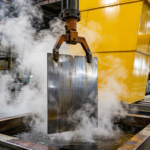
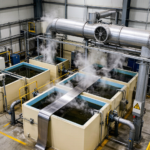
Pickling dissolves the mill scale by immersing the steel in a hot acid bath, typically sulfuric acid (H2SO4, 10 to 20 percent at 60 to 80 deg C) or hydrochloric acid (HCl, 10 to 18 percent at 20 to 40 deg C). Phosphoric acid (H3PO4) is used for thinner stainless and coated products but rarely for plain carbon steel. A pickling line in a Chinese plate mill is a long sequence of tanks: hot acid tank (8 to 15 minutes), water rinse tanks, neutralizer tank (weak alkali), and a final rinse plus dryer before exit.
The pickling reaction for sulfuric acid on wustite is:
FeO + H2SO4 -> FeSO4 + H2O
and for hydrochloric acid:
FeO + 2 HCl -> FeCl2 + H2O
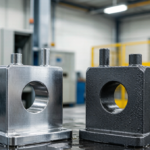
Once the scale is dissolved, the acid attacks the bare steel underneath – this produces the “acid etched” silvery-grey, slightly rough surface familiar on pickled-and-oiled (PO) plate and on cold rolled feedstock. The surface profile from pickling alone is shallow (typically 15 to 35 microns Ra) because the etch is uniform and chemistry-controlled.
Most Chinese mills now use hydrochloric acid because it operates at room temperature and the ferrous chloride by-product is recovered and sold as a coagulant for water treatment. Sulfuric acid lines are still common in older facilities, especially for large-diameter pipe and thick plate. After pickling the steel is either oiled (PO), dried, or forwarded to a galvanizing line for hot dip galvanizing.
3. Shot Blasting – Mechanical Impact Cleaning
Shot blasting fires a stream of small spherical steel shots (typically SAE 660 chilled iron or cut wire, 0.4 to 1.2 mm diameter) at the moving steel by a high-speed wheel. The shot hits the surface, fractures the brittle mill scale, and leaves a dimpled profile on the steel. A shot blast line typically consists of multiple wheels in series (four-wheel, six-wheel, eight-wheel configurations), a dust collector, and a recoater or sealer. The line speed can reach 4 to 8 m/min for plate 8 to 25 mm thick, and 20 to 60 m/min for thin coil.
Shot blasting leaves a measurable anchor profile, controlled at the line by:
- Shot size and hardness
- Wheel rpm and feed (impact energy)
- Line speed
- Number of wheels in pass
The typical profile depth on a shot blasted carbon steel plate is 50 to 100 microns Ra for primer-grade surface, controlled to ISO 8503-1 “fine”, “medium”, or “coarse” categories. The shot is recycled through an air-wash separator that removes scale dust and broken shot pieces; the reusable shot is returned to the wheels.
For hot rolled plate going into structural fabrication, bridge girders and pressure vessel shells, shot blasting has become the default because it produces a uniform, paintable, environmentally clean finish without producing acid wastewater. Most modern Chinese plate mills run their structural plate and ship plate through shot blasting lines before stacking in the export yard.
4. Sand Blasting – Abrasive Cleaning
Sand blasting (also called abrasive blasting or grit blasting) is the original manual or semi-automatic cleaning method, in which a stream of abrasive particles (silica sand, garnet, aluminum oxide, slag grit) is propelled at the surface by compressed air or by a wheel. In an export-mill context, sand blasting is now mostly reserved for:
- Heavy plate profiles deeper than 100 microns Ra
- Welded pipe and fitting surfaces where shot cannot reach inside corners
- Field repair and on-site maintenance blasting
- Hand blasting inside pipe ID for corrosion assessment
Sand blasting by free silica is increasingly restricted by occupational health legislation because of silicosis risk; in modern Chinese mills the abrasive is usually copper slag, garnet or aluminum oxide. The profile depth can be varied widely, from 25 microns Ra (light brush blast) to 200 microns Ra (deep anchor for thick-film epoxy), depending on grit size, pressure and dwell.
The surface profile from sand blasting is sharper and more angular than the dimpled profile of shot blasting. This sharper profile favours thick-film coating adhesion (zinc-rich primer, coal tar epoxy) where mechanical keying is important, but it also raises the consumption of coating material and the air-borne dust load.
5. Side-by-Side Process Comparison
| Attribute | Pickling | Shot Blasting | Sand Blasting |
|---|---|---|---|
| Cleaning mechanism | Chemical acid attack on scale | Mechanical impact of steel shot | Mechanical abrasion by mineral grit |
| Surface finish | Silvery-grey, slightly matte (PO finish) | Bright metallic, dimpled profile | Bright to dull depending on grit, sharp profile |
| Typical Ra profile | 15 to 35 microns | 50 to 100 microns | 25 to 200 microns |
| ISO 8501-1 grade achieved | Sa 3 if full pickle, or “pickled finish” | Sa 2 to Sa 2-1/2 typical, Sa 3 with multiple passes | Sa 2-1/2 to Sa 3, with appropriate grit |
| Waste stream | Spent acid (H2SO4 or HCl) + rinse water + iron salts | Scale dust + broken shot fines (recoverable) | Used abrasive + scale dust (often landfill) |
| Environmental treatment | Neutralization + iron salt recovery; high capex | Dust collector + cyclone; low capex | Dust collector + abrasive recycling; capex depends on scale |
| Throughput (typical) | 15 to 30 minutes immersion for plate | 20 to 60 m/min plate line speed | 1 to 4 m^2/min hand blast, faster for automated |
| Plant capex (relative) | High (acid bath, scrubber, dryer) | Moderate (blast cabinet, dust collector) | Low to moderate (pot, hose, compressor) |
| Suitable for products | Plate, sheet, coil, wire, bar, tube | Plate, section, pipe OD, structural shapes | Plate, fabricated parts, pipe ID, weld zones |
| Limitations | Hydrogen embrittlement risk on high-carbon steel; acid handling licence | Cannot reach deep recesses; not for thin coil below 1 mm | Slow; dust; operator exposure |
The most important takeaway is that the three methods are not interchangeable in buyer specifications. A plate that has been merely shot blasted cannot be substituted for acid-pickled plate on a contract calling for “pickled and oiled, ASTMB254” finish, and a sand-blasted plate cannot be substituted for shot-blasted plate if the contract calls for “white metal Sa 2-1/2”.
6. Surface Profile and Anchor Pattern
Surface profile is the controlled micro-roughness that allows mechanical adhesion between the paint film and the steel substrate. Without sufficient profile, the paint adheres to only the tops of the peaks and peels away from the valleys. ISO 8503-1 defines four profile grades by visual comparison with a segment:
- Fine – profile below 25 microns Ra
- Medium – 25 to 60 microns Ra
- Coarse – 60 to 100 microns Ra
- Extra coarse – above 100 microns Ra
Pickled surfaces typically fall in “fine” to “medium” category. Shot blasted surfaces are typically “medium” to “coarse” depending on the wheel configuration. Sand blasted surfaces span the entire range depending on grit selection and air pressure. The buyer chooses the profile based on the coating system: thin-film primers (50 to 80 microns DFT) require medium profile, while thick-film epoxies (200 to 500 microns DFT) require coarse profile.
If your contract is silent on profile grade, raise it as a clarification. A statement like “blast clean to Sa 2-1/2” is incomplete without also naming the profile. Specify “Sa 2-1/2 with medium profile 50 to 85 microns Ra” if the downstream coating is a standard zinc-rich primer / epoxy / polyurethane system.
7. Waste Handling and Environmental Considerations
Pickling plants generate spent acid and iron-laden rinse water. Discharge to municipal sewer is prohibited; the plant must either recycle by ion exchange or neutralize with lime to precipitate iron hydroxide sludge (FHS) for landfill. In modern Chinese export hubs like Tianjin and Tangshan, pickling plants must hold a “pollution discharge permit” (排污许可证) and report annual discharge volumes to the local ecology bureau. Mills with poor waste handling will fail buyer audits.
Shot blasting generates scale dust collected by cyclone and baghouse. The dust is recycled back to the blast furnace as iron-bearing feedstock when the mill has an integrated line, otherwise it is sold to cement kilns as iron ore substitute. Spent shot fines are sold as abrasive feedstock to other industries.
Sand blasting with free silica sand is now restricted in many jurisdictions including China. Mills that still use silica sand typically enclose the blast cabinet and supply workers with full-face air-fed respirators. Garnet or copper slag grit is preferred because the dust does not contain respirable crystalline silica.
8. Selection by Application
| Product | Default cleaning | Alternate cleaning | Notes |
|---|---|---|---|
| Hot rolled plate for fabrication | Shot blasting Sa 2-1/2 | Pickling (when mirror finish required) | Shot blasting is faster and lower waste |
| Pickled-and-oiled (PO) plate and sheet | Pickling + oiling | None (process is part of the spec) | PO surfaces are recognizable by their silvery matte look |
| Galvanized coil / sheet | Pickling before galvanizing | None | Pre-galv pickle is short (3 to 8 minutes) and tightly controlled to avoid over-pickling |
| ERW pipe for structural / furniture | Shot blasting | Pickling (rare) | Pipe OD is shot blasted inline; ID is flushed or pickled |
| Scaffold tube | Pickling before hot dip galvanizing | None | HDG line always pickles first then dips in zinc |
| Bar and wire rod for forging / cold heading | Pickling + phosphate coating | Mechanical descaling (rare) | Drawing compounds removed by alkaline cleaner then acid |
| Heavy plate for offshore wind tower | Shot blasting Sa 2-1/2 + primer | Pickling | Most wind tower specs call for shot blast plus zinc-rich shop primer |
| Ship plate (pre-painted primer) | Shot blasting Sa 2-1/2 + prefabrication primer | Pickling | ABS / LR / DNV rules accept shop primer on blast-cleaned surface |
| Section / beam for galvanizing | Pickling | None | HDG standard ASTM A123 requires pickling before dip |
| Stainless-clad or Ti-clad plate | Pickling (low concentration) | Sand blasting (light) | Avoid heavy grit impact on clad surface |
Whenever the downstream consumption is for fabrication with subsequent painting, the safest default is shot blasting Sa 2-1/2 with medium profile and a thin rust-preventative primer. When the downstream consumption is for cold drawing, galvanizing or export stock, the safest default is pickling with rust preventive oil.
9. Inspection and Acceptance Criteria
Visual cleanliness is judged against ISO 8501-1 reference photographs. Each grade is represented by a high-quality image of the standard surface:
- Sa 1 – light blast, most loose rust removed
- Sa 2 – thorough blast, at least 95 percent free of visible residue
- Sa 2-1/2 – very thorough blast, 98 percent, faint streaks only
- Sa 3 – white metal, 100 percent
A buyer-arrived inspector will carry the photographic standard, a 10x magnifying loupe, a replica comparator for profile depth (ISO 8503-1 segment or Elcometer 224 surface profile gauge), and dust test tapes for soluble salt contamination. The Visual grade is binary: the surface either matches the photograph or it does not. Argument seldom wins at the loading dock; pre-arrangement and pre-shipment photo evidence does.
10. What to Write on the RFQ
A clean specification reads:
“All plate to be blast cleaned to ISO 8501-1 Sa 2-1/2 with medium profile 50 to 85 microns Ra. Surface to be dust-free (dust rating no greater than 2 per ISO 8502-3) and free of oil, grease, marking crayon and weld spatter. Mill to apply one coat of zinc-rich shop primer 25 to 35 microns DFT, red oxide or grey colour as buyer option. Pre-shipment photograph of representative surface to accompany MTC.”
Compare that to the ambiguous “rust free delivery” – the first will be accepted by a competent mill and the second will be disputed at the dock.
FAQ
Can shot blasting replace pickling for hot dip galvanizing?
No. Hot dip galvanizing lines always pickle first because the zinc-iron reaction needs a chemically clean iron surface, not a mechanically rough surface. Shot blasting can replace pickling only when the downstream process is painting with zinc-rich primer.
Will pickling weaken the steel?
Mild acid pickling (15 to 30 minutes total immersion at room temperature) does not change the mechanical properties. However, prolonged pickling in strong acid, or pickling of high-carbon steel above 0.30 percent C, can produce hydrogen embrittlement. Specify post-pickle baking at 200 deg C for 2 hours if the steel grade is above 0.30 percent C or if the part is heavily cold-worked before pickle.
Does sand blasting inside a pipe cause dimensional change?
Yes, sand blasting in confined spaces (pipe ID, tank internals) consumes the wall thickness. Typical consumption is 10 to 30 microns per pass. For thin-wall pipe ID, hand blast must be limited or replaced by chemical circulation.
Which cleaning gives the longest paint life?
Both Sa 2-1/2 shot blasting and full acid pickling give equivalent paint life when paired with a good coating system. The deciding factor is the surface profile: a 50 to 85 microns profile on shot blasted steel anchors paint at least as well as a 25 micron profile on pickled steel, provided the coating system is matched to the profile.
Can I specify “shot blasted or pickled, seller option”?
You can, but only if the downstream process tolerates either finish. For feeding into an auto-coating line that depends on a specific profile grade, the choice must be fixed in the RFQ. For export stock where the buyer will recoat in their own facility, “seller option” is acceptable provided the contract states the optional finish and the MTC records it.
Request a Quotation
Huaxia-Steel supplies hot rolled plate, sheet, coil, section and pipe to buyers worldwide with mill-direct pickling, shot blasting and anti-rust oiling to ISO 8501-1 grades Sa 2, Sa 2-1/2 and Sa 3, full EN 10204 3.1 / 3.2 mill test certificate, and pre-shipment photographs. Send your grade, thickness, profile requirement and target port to [email protected] for a same-day offer.