Introduction: Why This Comparison Matters for B2B Buyers
If you source carbon steel from China, two grade names will appear in almost every quotation: Q235 and Q345. They are the two most widely supplied structural carbon steels under the Chinese national standards, and the choice between them typically moves your material cost by 5–15% while changing the load capacity of the finished structure by 40% or more. Specifying the wrong grade either wastes budget or creates a structural risk that no inspection report can repair after delivery.
This guide compares Q235 and Q345 across chemical composition, mechanical properties, weldability, international equivalents, price behavior, and typical applications — with the practical details buyers actually need when reviewing a mill test certificate or negotiating with a factory.

What Are Q235 and Q345? The Standards Behind the Names
The “Q” in both names stands for the Chinese word qufuqiangdu (yield strength), and the number is the minimum yield strength in MPa measured on 16 mm or thinner material. Both grades are covered by two separate standards:
- Q235 — specified in GB/T 700, the standard for general structural carbon steel. It is a plain carbon steel with no deliberate microalloying, roughly comparable to a commodity construction grade. Within GB/T 700 it is subdivided into quality levels A, B, C, and D according to impact test requirements (Q235A has none; Q235B is tested at +20°C; Q235C at 0°C; Q235D at −20°C).
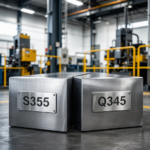
- Q345 — specified in GB/T 1591, the standard for high-strength low-alloy (HSLA) structural steel. Important update: the 2018 revision of GB/T 1591 renamed Q345 to Q355 to align with European S355 conventions, but Q345 remains the name used on drawings, in trade, and on most certificates you will receive from Chinese mills. In this article we use Q345, as it still dominates purchase orders.
The practical consequence of this standards split: Q235 is a composition-defined carbon steel, while Q345 is a property-defined HSLA steel where the mill is allowed flexibility in chemistry as long as the strength and toughness targets are met. This has direct implications for how you should read each grade’s mill test certificate.
Chemical Composition Comparison
The table below shows typical maximum values for the most commonly ordered quality levels, Q235B and Q345B (per 16 mm max thickness):
| Element | Q235B (%) | Q345B (%) | Why It Matters |
|---|---|---|---|
| Carbon (C) | ≤ 0.20 | ≤ 0.20 | Weldability and hardness; lower C improves both |
| Silicon (Si) | ≤ 0.35 | ≤ 0.50 | Deoxidation control |
| Manganese (Mn) | ≤ 1.40 | ≤ 1.70 | Main strengthener; also affects weldability |
| Phosphorus (P) | ≤ 0.045 | ≤ 0.035 | Cold brittleness; lower is better for low-temp service |
| Sulfur (S) | ≤ 0.045 | ≤ 0.035 | Hot shortness; lower improves weld quality |
| V, Nb, Ti | Not required | ≤ 0.15 total | Microalloying that delivers yield strength without extra carbon |
Two points worth noticing. First, on paper the carbon ceilings look similar — the strength gap does not come from carbon, it comes from manganese plus microalloying elements (vanadium, niobium, titanium). Second, Q345 carries tighter phosphorus and sulfur limits, which is one reason it performs better in demanding welded structures and colder environments.
Verification tip: because Q345 is property-defined, some mills report carbon well below 0.17% while meeting yield with microalloys. If a certificate claims “Q345” but shows no V/Nb/Ti and manganese below 1.0%, treat it as a red flag and request re-testing.
Mechanical Properties Comparison
Yield strength for both grades varies with thickness — thinner material is always stronger. The table summarizes GB requirements:
| Property | Q235B | Q345B |
|---|---|---|
| Yield strength, ≤16 mm | ≥ 235 MPa | ≥ 345 MPa |
| Yield strength, 16–40 mm | ≥ 225 MPa | ≥ 335 MPa |
| Yield strength, 40–100 mm | ≥ 215 MPa | ≥ 305 MPa |
| Tensile strength | 370–500 MPa | 470–630 MPa |
| Elongation (A5) | ≥ 26% | ≥ 20% |
| Impact test | 27 J at +20°C (Q235B) | 47 J at +20°C (Q345B) * |
* GB/T 1591 specifies a 34–47 J Charpy requirement depending on quality level and direction of test specimens; Q345B longitudinal specimens require 47 J at +20°C. Q235B requires 27 J at +20°C. If your project has a sub-zero service temperature, move to Q345C (≥34 J at 0°C) or Q345D (at −20°C) rather than accepting a B-quality level.
The headline numbers: at the same thickness, Q345 offers roughly 47% higher yield strength and about 25% higher tensile strength. It gives up 6 percentage points of elongation, which matters for deep drawing or severe cold forming but rarely for structural use.

International Equivalents: Mapping to ASTM, EN, and JIS
Most international buyers need to justify a Chinese grade against the standard their design office specified. The commonly accepted equivalences are:
| China (GB) | USA (ASTM) | Europe (EN 10025-2) | Japan (JIS) | Caveat |
|---|---|---|---|---|
| Q235B | A36 | S235JR | SS400 | A36 has a 0.26% C ceiling and mandatory 20 J Charpy; SS400 has no impact requirement |
| Q345B / Q355B | A572 Gr. 50 | S355JR | SM490A | SM490 tensile range differs slightly; A572 does not require impact testing |
None of these are exact substitutes on paper. They are “equivalent use” grades: similar strength levels and similar chemistry, but different test requirements. Three practical rules:
- If your specification says ASTM A36 and the supplier offers Q235B, demand a Charpy report even though Q235B includes one — A36 also requires the yield/tensile ratio context and chemistry within ASTM windows, which Q235B does not always satisfy (its Mn ceiling differs).
- If your specification says S355 and the supplier offers Q345B, check the impact energy direction (transverse specimens are more onerous) and the CEV (carbon equivalent value) limit if welding is critical.
- Never accept “equivalent” grades for pressure equipment or structural work governed by a national building code without written engineering approval. Codes are prescriptive about allowed standards.
Key Difference #1: Strength and Load Capacity
In bending-dominated members such as beams, the moment capacity scales with yield strength. A Q345 beam carries approximately 45–47% more load than the same geometry in Q235 before reaching yield. Designers exploit this in two ways: either accept a lighter section for the same load (typically 15–25% weight saving in optimally designed frames), or keep the section and bank the extra safety margin.
For buyers, the weight-saving logic is where Q345 pays for its premium. In welded frames, crane runways, and long-span structures, the steel weight reduction often offsets the 8–12% per-tonne price premium entirely, especially when fabrication and painting costs are calculated per tonne.

Key Difference #2: Weldability in Practice
Both grades weld well with standard SMAW, GMAW, and SAW processes, but the shop-floor details differ:
- Q235: plain J422 (E4303) electrodes or ER70S-6 wire handle everything up to ~20 mm without preheat. No special precautions beyond normal interpass temperature control.
- Q345: matching-strength consumables are required — J507 (E5015) or J506 (E5016) electrodes, or ER50-6/ER55 wire for GMAW. For sections thicker than ~25 mm in constrained joints, a 100–150°C preheat and low-hydrogen consumables are recommended to avoid hydrogen-induced cracking.
The carbon equivalent (CEV per IIW formula) of Q345B typically runs 0.38–0.45 depending on the mill’s chemistry route, versus roughly 0.25–0.35 for Q235B. If your fabrication partner is a light-gauge shop accustomed to Q235, brief them before switching grades — most weld quality problems we see in export orders come from this exact mismatch.
Key Difference #3: Price and Market Behavior
Historically in the Chinese market, Q345 commands a premium of roughly 120–350 RMB per tonne over Q235 (about 5–12%), and the spread widens when vanadium or niobium feedstock prices spike, because microalloying is Q345’s cost driver. Both grades move together with iron ore and coking coal cycles, so the absolute spread is a better negotiation target than either grade’s absolute price.
Availability note: Q235 is produced by virtually every rolling mill in China, including small re-rollers with inconsistent QC. Q345 requires HSLA capability and is concentrated in larger mills. For export orders, restrict Q235 to mills that can issue EN 10204 3.1 certificates and accept third-party inspection (SGS, BV, TUV), and be more careful still with small-mill Q235 offers that underprice the market by more than 5%.
Key Difference #4: Formability, Toughness, and Fatigue
Q235’s higher elongation (26% vs 20%) and lower yield ratio make it more forgiving for cold bending, rolling into rings, and deep-forming operations. Q345’s finer grain structure from microalloying, however, gives it better low-temperature toughness and generally better fatigue behavior in welded details — one reason it is the default for bridges and crane structures.
- Cold-forming intensive work (rings, clamps, channels from plate): Q235 bends with larger radius margins and fewer springback surprises.
- Cyclically loaded structures (cranes, booms, conveyor gantries): Q345’s toughness and fatigue performance justify the premium.
- Low temperature service below −10°C: only Q345C/D or Q235D should be considered — never Q235B.
When Should Buyers Choose Each Grade?
Choose Q235 when:
- The design stress is low and sections are governed by stiffness, not strength (light frames, brackets, fencing, shelving).
- The part needs heavy cold forming.
- Budget is the binding constraint and loads are modest.
- You need small quantities from any available mill quickly.
Choose Q345 when:
- The structure carries heavy or dynamic loads (cranes, heavy equipment frames, bridges, transmission towers).
- Weight reduction has downstream value (transport, foundation loads, galvanizing per tonne).
- The engineer specified S355 / A572 Gr.50 / SM490 and equivalence will be reviewed.
- Service temperatures fall below 0°C.
Common Buyer Mistakes and How to Avoid Them
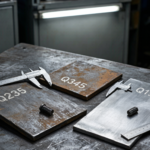
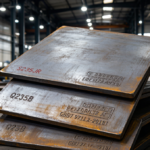
- Accepting “Q345” on the invoice only. Some suppliers quote Q345, then ship Q235 with a photocopied certificate. Always require the heat number on the MTC to match the stenciling on the material, and verify with portable spectrometry (PMI) on arrival for critical lots.
- Ignoring the thickness-yield derating. A 60 mm Q345 plate delivers 305 MPa yield, not 345. Designs checked against the 16 mm value fail verification at incoming inspection.
- Ordering Q345 where Q235 suffices “to be safe.” You pay twice: a per-tonne premium and extra welding consumable cost, for strength the design never uses.
- Assuming the B-quality level covers cold climates. The B suffix impact test is at +20°C. For outdoor work in cold regions, upgrade to C or D quality — the cost delta is small; the risk reduction is large.
Pre-Shipment Verification Checklist
- EN 10204 3.1 mill test certificate with heat number, full chemistry, yield/tensile/elongation, and impact results
- Heat numbers stenciled or stamped on material and recorded on the packing list
- PMI spot check (2–3 pieces per lot) for Mn, V/Nb/Ti presence on Q345
- Dimensional check against the agreed tolerance standard (GB/T 709 for plate, GB/T 706 for sections)
- Surface condition: no rolled-in scale pits beyond agreed limits, edges free of lamellar tears on plate ≥25 mm
- Third-party inspection (SGS/BV/TUV) for orders above 50 tonnes or first-time suppliers
Frequently Asked Questions
1. Can I substitute Q345 for Q235 in an existing design?
Yes in most cases — higher yield strength never reduces static load capacity, and weldability is manageable with matching consumables. But check three things: minimum yield ratio requirements in your code, fatigue detail categories if cyclically loaded, and cold-forming operations that may need adjusted bend radii. Get engineer sign-off for code-governed structures.
2. Is Q355 just a renamed Q345?
Functionally yes. GB/T 1591-2018 renamed Q345 to Q355 and adjusted the impact energy requirements to align with EN 10025 S355. Certificates may show either name depending on the mill’s certification date; both refer to the 345–355 MPa yield family and are treated as interchangeable in trade.
3. What is the price difference between Q235 and Q345 per tonne?
Typically 120–350 RMB/tonne (roughly 5–12% of material value) depending on the microalloying market and mill capacity utilization. The spread narrows in soft markets and widens when vanadium prices spike.
4. Which grade welds better for thin sheet?
Q235. Its lower carbon equivalent and higher elongation make it more tolerant of fit-up gaps and faster welding speeds on material under 3 mm. This is one of the few situations where the “stronger” grade is objectively worse.
5. How do I verify the grade on delivered material?
Three-step check: match heat numbers between MTC and material marking, run PMI spectrometry on 2–3 samples (Q345 will show microalloying signatures), and have a tensile coupon cut from the lot tested at a local lab. For large lots, third-party inspection before shipment is cheaper than a rejected container.
Conclusion
Q235 and Q345 are not competitors — they are tools for different jobs. Q235 wins on formability, weldability simplicity, and price; Q345 wins on strength-to-weight, toughness, and fatigue. The expensive mistake is not choosing the “wrong” one, but specifying without verifying: demanding Q345 and receiving Q235 in a crate with a borrowed certificate costs far more than either grade’s premium.
Need Q235 or Q345 mill-certified material for your next project? Huaxia-Steel supplies plates, bars, and sections in both grades with EN 10204 3.1 certificates, third-party inspection support, and factory-direct pricing. Send us your specification and quantity for a same-week quotation.