SAE 1040 vs 1045 vs 1050 Carbon Steel Comparison for Buyers
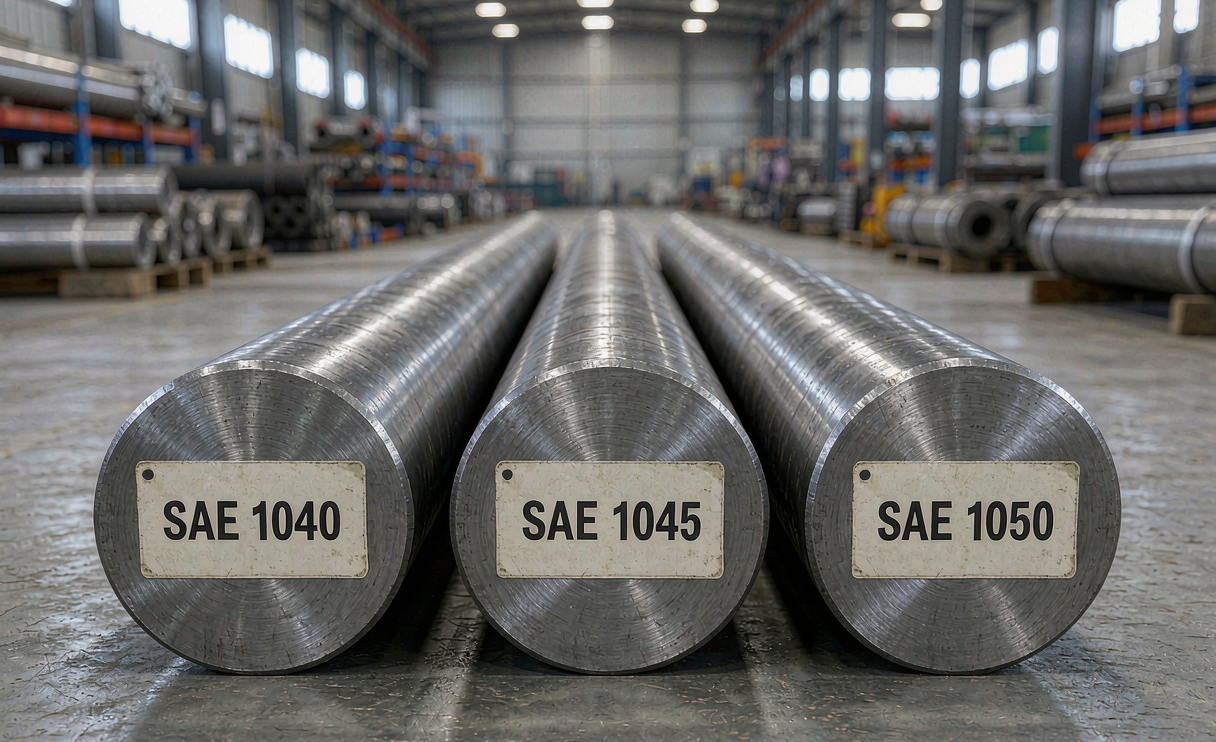
When you are sourcing carbon steel bar, plate or forgings for shafts, gears, axles, crankshafts and medium-stress machinery parts, the SAE 10xx family is usually the first place buyers look. SAE 1040, SAE 1045 and SAE 1050 are three grades that sit close together in carbon content, yet the small differences in chemistry create large differences in strength, hardenability, weldability and price. This guide compares all three grades side by side so you can choose the right material, avoid over-engineering and control your landed cost.
We cover chemical composition, mechanical properties, heat-treatment response, machinability, weldability, typical stock forms, common applications and sourcing tips for importers. Whether you are buying from China, India or Turkey, the same rules apply: match the grade to the engineering requirement, confirm the heat-treatment condition and always request a mill test certificate.
1. Chemical Composition Comparison
The SAE/AISI 10xx series is a plain-carbon steel family. The last two digits roughly equal the mean carbon content in hundredths of a percent. SAE 1040 therefore contains about 0.40% carbon, SAE 1045 about 0.45% carbon and SAE 1050 about 0.50% carbon. Manganese, phosphorus and sulfur are held within standard ranges to keep the grades weldable and machinable.
| Element | SAE 1040 (%) | SAE 1045 (%) | SAE 1050 (%) |
|---|---|---|---|
| Carbon (C) | 0.37 – 0.44 | 0.43 – 0.50 | 0.48 – 0.55 |
| Manganese (Mn) | 0.60 – 0.90 | 0.60 – 0.90 | 0.60 – 0.90 |
| Phosphorus (P), max | 0.040 | 0.040 | 0.040 |
| Sulfur (S), max | 0.050 | 0.050 | 0.050 |
| Iron (Fe) | Balance | Balance | Balance |
All three grades are unalloyed, so their hardenability is limited. If you need deeper hardening or higher through-hardness, you would move to alloy grades such as SAE 4140 or 4340. The higher carbon in 1050 gives it the highest strength and best wear resistance of the three, but also the lowest ductility and weldability.
2. Mechanical Properties at Room Temperature
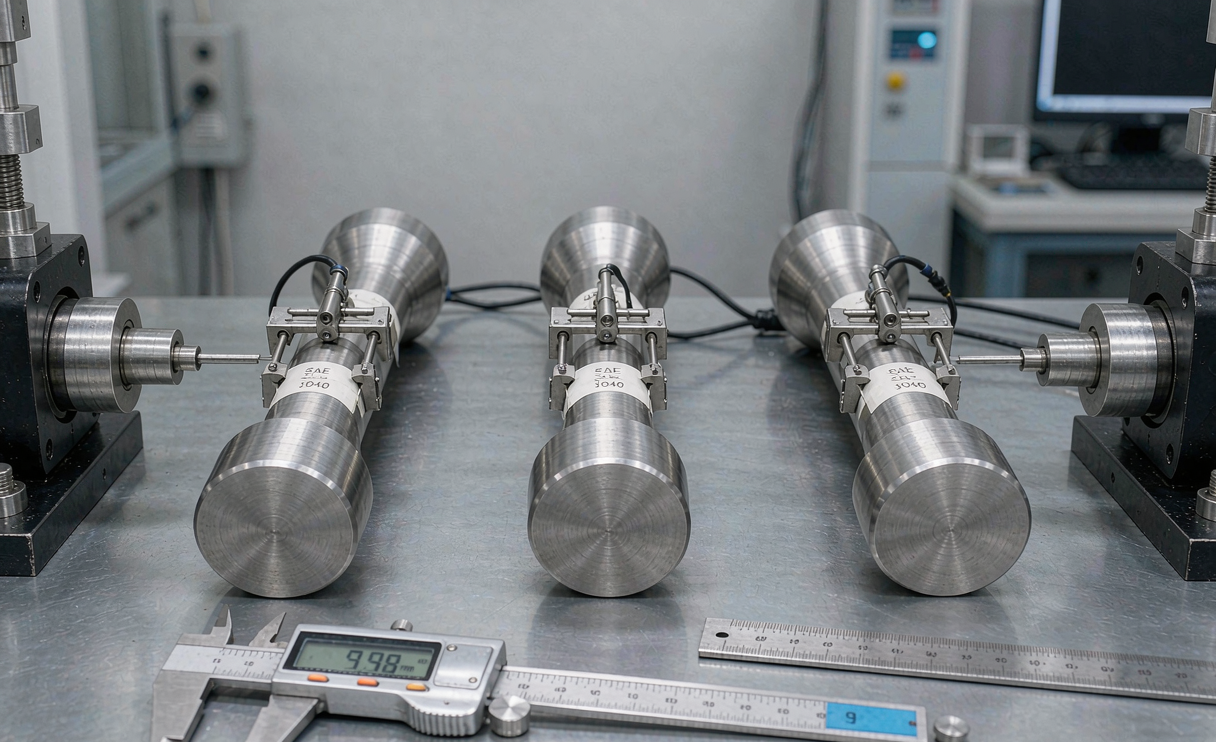
The values below are typical for hot-rolled round bar in the as-rolled or normalized condition. Actual values depend on bar diameter, mill practice and heat-treatment state. Always request a mill test certificate before accepting a shipment.
| Property | SAE 1040 | SAE 1045 | SAE 1050 |
|---|---|---|---|
| Tensile strength | 520 – 620 MPa | 570 – 700 MPa | 620 – 750 MPa |
| Yield strength (0.2%) | ≥ 290 MPa | ≥ 345 MPa | ≥ 380 MPa |
| Elongation in 50 mm | ≥ 18% | ≥ 16% | ≥ 14% |
| Reduction of area | ≥ 45% | ≥ 40% | ≥ 35% |
| Hardness (HBW) | 150 – 190 | 170 – 210 | 190 – 230 |
| Impact energy (Charpy V) | ≈ 35 – 55 J | ≈ 25 – 40 J | ≈ 20 – 30 J |
SAE 1050 is roughly 20% stronger than SAE 1045 and 30% stronger than SAE 1040 in the normalized condition. That extra strength is useful for heavily loaded springs, wear plates and small shafts, but it comes at the cost of ductility. SAE 1040 remains the toughest of the three, which makes it a safer choice for impact-loaded or welded fabrications.
3. Heat Treatment and Hardenability
All three grades respond to normalizing, annealing, quenching and tempering. The higher the carbon, the harder the grade can become after quenching and the better it responds to surface induction hardening. The table below shows typical hardness ranges after common processes.
| Condition | SAE 1040 | SAE 1045 | SAE 1050 |
|---|---|---|---|
| Hot-rolled | 150 – 190 HB | 170 – 210 HB | 190 – 230 HB |
| Normalized | 160 – 190 HB | 170 – 200 HB | 190 – 220 HB |
| Annealed | ≤ 140 HB | ≤ 163 HB | ≤ 180 HB |
| Quenched & tempered | 28 – 36 HRC | 38 – 50 HRC | 45 – 55 HRC |
| Induction-hardened surface | up to 55 HRC | up to 60 HRC | up to 62 HRC |
SAE 1045 is the most common choice for induction-hardened shafts and machine parts because it gives a good balance of core toughness and surface hardness. SAE 1050 is used when higher surface hardness is needed and the part is small enough to be through-hardened in oil. SAE 1040 is rarely induction-hardened because the lower carbon produces a shallow, low-hardness case.
4. Machinability and Weldability
Machinability is similar across the three grades in the annealed or normalized condition, typically 60–70% of free-machining steel. SAE 1040 machines slightly easier in the as-rolled condition because of its lower carbon. SAE 1050 produces harder chips and requires sharper tooling, especially after normalizing or quenching.
Weldability moves in the opposite direction. SAE 1040 can be welded with light pre-heat and standard low-hydrogen electrodes. SAE 1045 requires pre-heat to 200 – 300 °C and careful post-weld cooling. SAE 1050 is generally avoided for welded assemblies unless the design is pre-heated, post-weld stress-relieved and inspected for cracks. For heavy welded fabrications, buyers often drop to SAE 1020 or A36/S275JR.
5. Typical Applications
- SAE 1040 — light-duty shafts, crankshafts, connecting rods, spindles, hand tools, agricultural parts, pump and valve components, welded brackets and medium-strength machine parts where ductility is important.
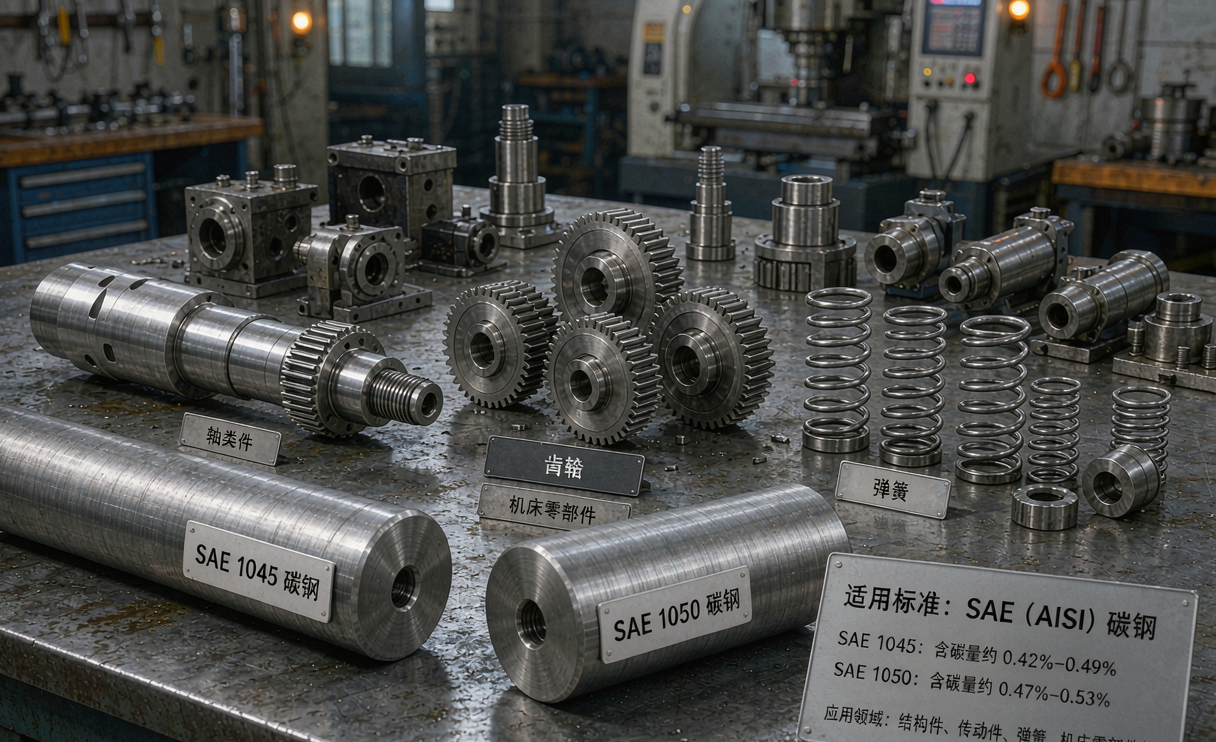
- SAE 1045 — drive shafts, axles, kingpins, crankshafts, couplings, machine-tool spindles, sprockets, gears, wear plates, hydraulic cylinder rods and parts that will be induction-hardened.
- SAE 1050 — heavy-duty springs, plow blades, scraper blades, wear rails, clutch plates, brake discs, small shafts, high-strength pins and components requiring higher hardness than 1045 can deliver.
6. Stock Forms and Dimensional Availability
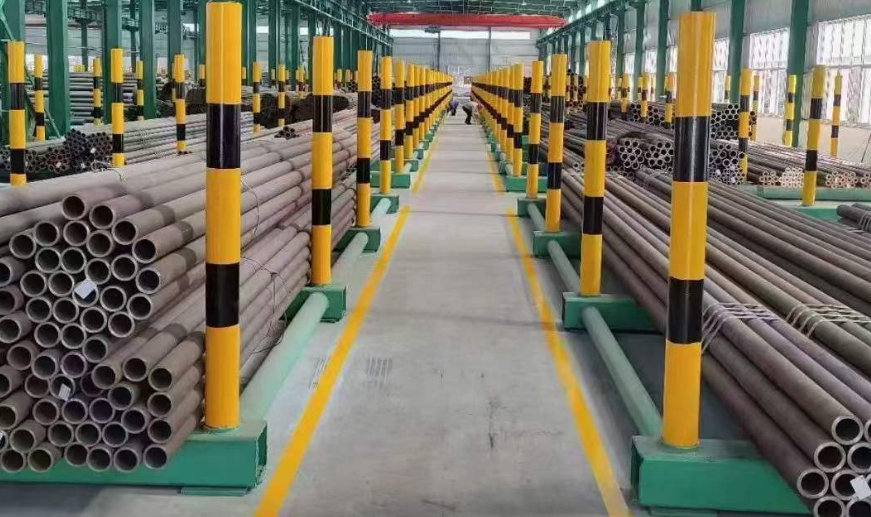
Chinese, Indian and Turkish mills stock all three grades in similar forms. Lead times for standard sizes are usually 4 – 6 weeks; non-standard dimensions and forged bars can take 8 – 12 weeks.
- Hot-rolled round bar: Ø 10 – 300 mm, 6 m length
- Cold-drawn round bar: Ø 6 – 80 mm, 3 – 6 m length
- Square bar: 10 – 100 mm side
- Flat bar: 5 – 80 mm × 20 – 200 mm
- Hex bar: 10 – 70 mm across flats
- Plate: 3 – 80 mm × up to 2,500 mm width
- Forged bar: Ø 200 – 600 mm
7. How to Choose the Right Grade
Use SAE 1040 when the part needs good ductility, will be welded, or when the load is moderate and cost is the main driver. Use SAE 1045 when you need higher strength, better wear resistance and the part will be induction-hardened. Use SAE 1050 only when the design needs the highest strength and hardness of the three and welding is not required.
8. Sourcing from China
When importing SAE 1040, 1045 or 1050 from China, request an EN 10204 3.1 mill test certificate with each heat number. Confirm the delivery condition (as-rolled, normalized, annealed or Q&T) on the certificate, and specify sulfur content if the part will be machined extensively. For induction-hardened parts, ask for controlled hardenability or tighter carbon ranges. Huaxia Steel supplies all three grades as round bar, flat bar, square bar, hex bar, plate and forgings with full traceability.
FAQ
What is the main difference between SAE 1040 and SAE 1045?
The carbon content. SAE 1045 contains roughly 0.05% more carbon, which raises tensile strength by about 50 – 80 MPa and allows higher surface hardness after induction hardening.
Can SAE 1050 be welded?
It can, but it requires pre-heat to 250 – 350 °C, low-hydrogen electrodes and post-weld stress relief. Many buyers avoid welding SAE 1050 and choose SAE 1040 or low-carbon grades instead.
Is SAE 1045 the same as C45?
They are very close. C45 is the European EN/DIN designation, while SAE 1045 is the North American designation. Chemistry and mechanical properties overlap strongly, but certificates should always be checked for the specific standard.
Which grade is best for induction hardening?
SAE 1045 is the most common because it gives a hard wear surface while keeping a tough core. SAE 1050 gives a slightly harder case but is more brittle. SAE 1040 is rarely used for induction hardening.
How do I avoid fake certificates when buying from China?
Cross-check heat numbers with the mill, look for third-party inspection stamps (SGS, BV, Intertek), and ask for EN 10204 3.2 certificates if the project is critical. Huaxia Steel can arrange independent inspection on request.
Get a Quote for SAE 1040, 1045 or 1050
Not sure which grade fits your BOM? Send us your dimensions, quantity and delivery condition and our engineering team will recommend the most cost-effective grade. Request a quote for SAE 1040, SAE 1045 or SAE 1050 round bar, flat bar, plate or forgings today.
9. International Grade Equivalents
SAE 1040, 1045 and 1050 have close equivalents in European, Japanese and Chinese standards. Buyers sourcing outside North America often encounter these designations on mill test certificates. The table below shows the most common cross-references, but always confirm the exact chemical and mechanical requirements because national standards are not perfectly identical.
| SAE/AISI | DIN / EN | JIS | GB | BS |
|---|---|---|---|---|
| SAE 1040 | C40 / 1.0511 | S40C | 40# | 080M40 |
| SAE 1045 | C45 / 1.0503 | S45C | 45# | 080M46 |
| SAE 1050 | C50 / 1.0540 | S50C | 50# | 080M50 |
10. Dimensional and Tolerance Standards
When ordering round bar, specify the tolerance standard. ASTM A29 covers general tolerances for hot-rolled and cold-finished carbon steel bars. Cold-drawn bars are held to tighter tolerances, often h9 or h11 per ISO 286. For turned and polished shafting, tighter tolerances such as f7 may be required. Plate thickness tolerances are governed by ASTM A6 or EN 10029 depending on the destination market.
- Hot-rolled round bar: ASTM A29, EN 10060, JIS G3191
- Cold-drawn round bar: ASTM A29, EN 10278, JIS G3123
- Flat bar: ASTM A29, EN 10058, JIS G3194
- Plate: ASTM A6/A6M, EN 10029, JIS G3193
11. Buyer Checklist for SAE 10xx Bar
- Confirm grade, carbon range and whether restricted sulfur is required for machining.
- State delivery condition: as-rolled, normalized, annealed, Q&T or induction-hardened.
- Specify dimensional standard and tolerance class.
- Request EN 10204 3.1 or 3.2 mill test certificate.
- Ask for ultrasonic testing if the bar will be used for critical shafts.
- Define surface condition: black, peeled, ground, polished or cold-drawn.
- Agree on straightness, maximum allowable camber and cut-length tolerances.
12. Common Mistakes Buyers Make
- Specifying SAE 1045 for welded assemblies without pre-heat and post-weld stress relief.
- Assuming SAE 1045 and C45 are identical in every respect; always check the certificate.
- Ordering as-rolled material when the drawing calls for normalized or Q&T properties.
- Ignoring sulfur content and then struggling with poor machinability.
- Buying from traders who cannot provide heat-number traceability.