Stress Relieving Carbon Steel: Temperatures, Process, and When You Need It
Weldments that warp during machining, flame-cut plates that crack at the cut edge, machined spools that drift out of tolerance days after final inspection — almost all of these trace back to residual stress that was never relieved. Stress relieving is the cheapest heat treatment in the steel industry, yet it is also the most frequently omitted, because its absence shows up as a distortion or cracking problem days or weeks later, far from the cause. This guide explains what stress relieving does, the correct temperature ranges by grade and process, when buyers should require it on the purchase order, and how to specify it so the supplier cannot quietly skip it.
1. What Stress Relieving Actually Does
Residual stresses are locked-in internal forces left by uneven plastic deformation: welding shrinks the joint and stretches surrounding metal, flame cutting quenches the cut edge while the plate core stays hot, and heavy machining removes material asymmetrically so the remaining section balances in a strained state. These stresses typically sit at yield-level magnitude near welds — strong enough to cause distortion, stress-corrosion cracking, or brittle fracture initiation when the part is loaded or cooled.
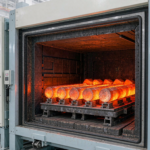
Stress relieving heats the steel to a temperature where the yield strength drops below the residual stress level, allowing the metal to creep and redistribute the locked-in forces — then holds it long enough for the whole section to equalize, and cools slowly enough that new gradients do not rebuild the stress. No phase transformation occurs (the temperature stays below Ac1, roughly 727°C), so hardness and microstructure are essentially unchanged. It is a geometry-stabilizing treatment, not a property-changing one — that is the key distinction from annealing, normalizing, and tempering.
2. Temperature Ranges by Grade and Application
| Application | Typical temperature | Notes |
|---|---|---|
| Low-carbon steel weldments (A36, S235, Q235) | 590–620°C | Standard PWHT band; 1 h per 25 mm |
| Medium-carbon steel machined parts (1045, C45) | 550–650°C | Keep below prior temper temp |
| Q&T alloy steel (4140, 42CrMo4) | 30–50°C below temper temperature | Exceeding temper temp softens the part |
| Pressure vessel welds (ASME) | 595–620°C per code tables | Holding time per thickness, code-mandated |
| Flame-cut or heavy machined plates | 550–600°C | Often applied before finish machining |
| Cold-worked or straightened parts | 450–650°C | Lower band enough for bending stresses |
| Subcritical stabilization of precision spools | 400–500°C, 2–8 h | Dimensional stability, not stress removal |
Two constraints drive the numbers in that table. First, the temperature must stay below Ac1 (~727°C) — going above starts transforming ferrite to austenite, and the treatment silently becomes an anneal, with grain refinement and property changes the drawing never authorized. Second, for quenched-and-tempered grades the stress relief temperature must stay below the tempering temperature, otherwise the hardening that the temper delivered is partly undone. A supplier who stress-relieves a 620°C-tempered 4140 part at 640°C has changed the delivery hardness — this is a real and common failure when the heat-treat shop is a subcontractor who never saw the drawing.
3. Soak Time, Heating and Cooling Rules
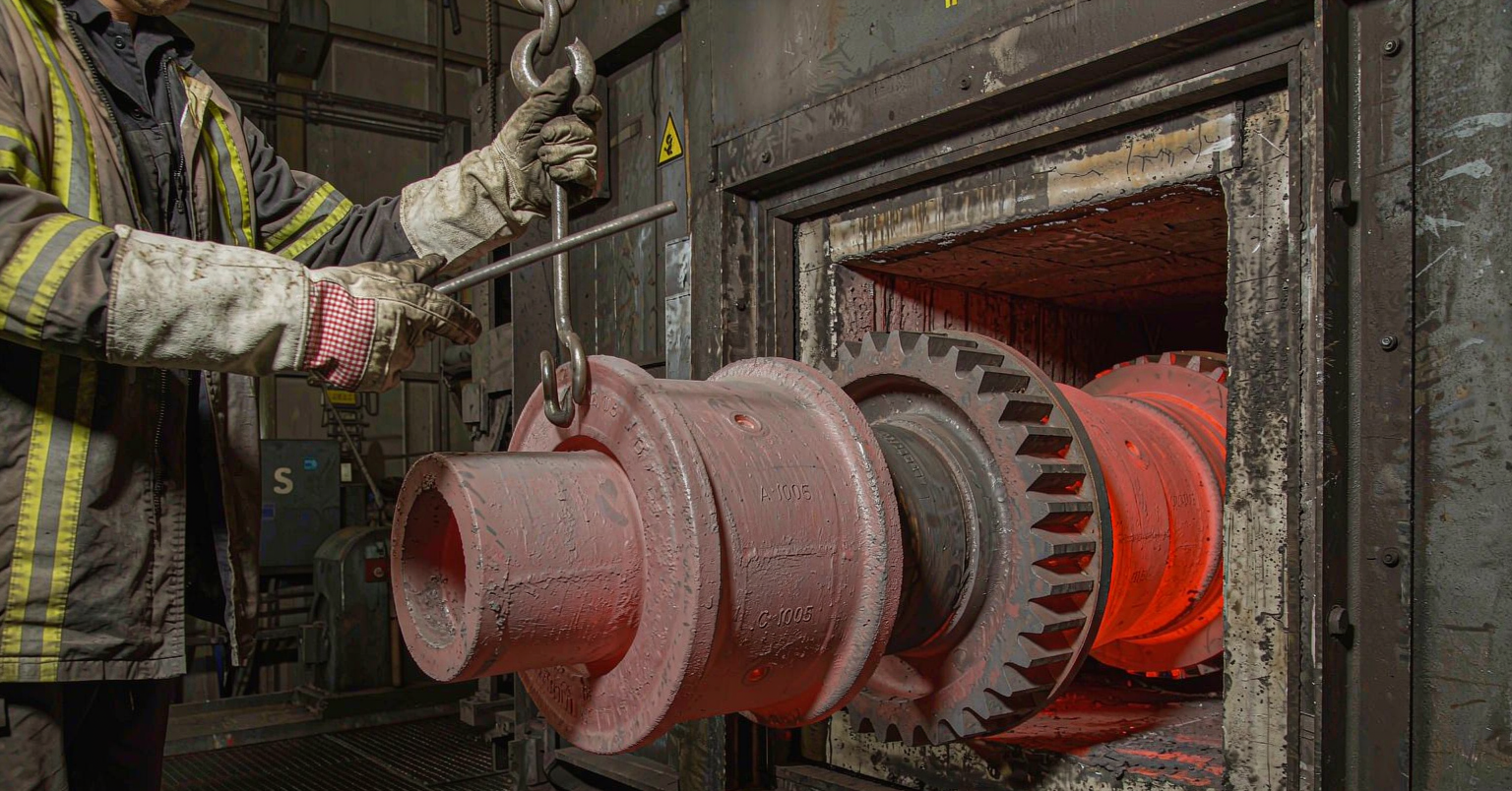
Soak time follows the same 1 hour per 25 mm of thickness rule used across steel heat treatment, with a 30-minute minimum for thin sections. A 50 mm weldment soaks 2 hours; a 200 mm section needs 8. Heating rate should be controlled — typically 100–200°C per hour above 400°C — because thermal gradients in thick or complex sections generate new stresses faster than the treatment removes them. Cooling is the step most often botched: furnace cooling to 300–400°C (at roughly 50°C/hour max for heavy sections), then air cooling. Pulling a 620°C weldment out to cool in open air can rebuild 50–80% of the stress you just paid to remove, because the surfaces contract over a hot, soft core.
Practical furnace-loading notes from export production: parts should not touch each other or the furnace battens; long shafts and beams go in vertically or on wide-spaced supports to prevent sagging at temperature (steel at 600°C has roughly half the room-temperature yield); and thin-to-thick transition weldments benefit from preheating the whole charge together. If the supplier cannot show a calibrated chart recorder trace for the cycle — charge temperature, soak band, cooling rate — the treatment is not verifiable and, in a dispute, did not happen.
4. When Buyers Should Require Stress Relieving
5. Stress Relief vs Annealing vs Normalizing vs Tempering
| Treatment | Temperature | Phase change? | Purpose |
|---|---|---|---|
| Stress relieving | 450–650°C (below Ac1) | No | Reduce residual stress, stabilize geometry |
| Full annealing | Above Ac1, slow furnace cool | Yes | Soften fully, refine grain, max machinability |
| Normalizing | Above Ac1, air cool | Yes | Refine grain, uniformize structure, modest strength |
| Tempering | 150–680°C after quench | No | Restore toughness to hardened steel, set final hardness |
The confusion is expensive in both directions. A buyer who writes “anneal” on a drawing that needed only stress relief pays for a full furnace cycle above Ac1, risks scaling and distortion, and may get a softer part than intended. A buyer who writes “stress relieve” when the design needed normalization gets a part with residual casting or rolling structure unrefined — a fatigue risk in dynamically loaded fabrications. If you are unsure which applies, state the objective (“reduce welding residual stress to enable finish machining tolerance ±0.05 mm”) as well as the treatment name, and ask the supplier’s heat-treat engineer to confirm the cycle before production.
6. Sequencing: Heat Treatment and Machining in the Right Order
For welded and machined components, the sequence is a design decision, not a shop-floor preference. The standard export-production route for a precision fabrication: cut → weld → rough machine → stress relieve → finish machine → inspect. Roughing removes most of the stock while the part is still distorted by welding; the stress relief equalizes what remains; finishing then works on a dimensionally stable part. When the drawing demands tighter than ±0.02 mm stability (spindles, gauge furniture), a second, lower-temperature stabilization cycle after finish machining squeezes out the last of the relaxation.
Machining stock matters as much as sequence: leave 2–4 mm total stock on surfaces to be finished after stress relief. Too little and the finish cut does not remove the distorted layer; too much and finishing re-introduces cutting stress that partially undoes the treatment. On very large fabrications where furnace size is a limit, local PWHT with resistance or induction heating pads on the weld zone is accepted by most codes — but confirm the band width and thermocouple layout are documented, since a heat-treated band with cold corners can crack at the transition.
7. How to Specify Stress Relieving on a Purchase Order
Price expectation: subcritical stress relieving in China typically adds USD 200–400 per tonne for batch work, less per part in volume. Compare that with the cost of a rejected, already-shipped weldment that fails flatness after machining in your plant — the treatment is almost always cheaper than its absence. The only common reason to skip it legitimately is thin, lightly welded structures with generous tolerances, where stresses cannot move the geometry enough to matter.
Can stress relieving reduce hardness of a Q&T part?
Not if it is done correctly — that is, at least 30–50°C below the tempering temperature. If it is done above the temper temperature, yes: hardness drops and the part may fall below its specified band. This is the single most common stress-relief error on alloy steel parts and the reason the PO should state the maximum temperature explicitly.
How much stress does stress relieving actually remove?
A properly executed 600°C cycle removes roughly 80–95% of residual stress in carbon steel; a 500°C cycle removes perhaps 50–70%. Removal efficiency falls steeply with temperature, which is why “we heated it a bit” is not equivalent to a code cycle. Full removal (near 100%) requires going above Ac1 — that is a different treatment with different consequences.
Do I need to stress relieve after every weld repair?
Follow the original construction code. If the weldment was PWHT-required by ASME, EN 13480, or the design specification, each significant repair weld normally requires re-PWHT of the repaired zone (local PWHT is commonly accepted). Minor cosmetic repairs on non-code weldments generally do not. When in doubt, ask for the repair procedure (WPS) to state whether PWHT is included.
Is vibration stress relief a valid substitute?
VSR (sub-resonant vibration) can reduce peak stresses modestly and helps dimensional stability on very large fabrications that cannot fit a furnace, but it is not accepted by most pressure-equipment codes as PWHT replacement and its effect is hard to verify. For export orders, insist on thermal stress relief unless the end customer’s engineering authority explicitly approves VSR.
8. Special Cases: Large Weldments, Machined Spools and Flame-Cut Plate
Large weldments that exceed furnace capacity present a real production problem in export fabrication. Options, in descending order of preference: build the weldment in sections small enough for whole-part stress relief, then final-weld the splice with a documented local PWHT band; use local induction or resistance heating on the restrained joints with code-compliant band width (typically 4–6× wall each side of the weld); or redesign to reduce restraint — fewer full-penetration joints, more fillet welds, staggered welding sequences. What is not acceptable is quietly omitting the treatment and hoping dimensional tolerance was generous; on precision fabrications it never is.
Machined spools and shaft-type parts have the stress-relief decision driven by machining stresses as much as by welding. Heavy turning removes asymmetric stock and leaves residual stress that bows thin-wall spools within hours. The fix sequence: rough turn with 2–3 mm stock → stress relieve 580–600°C → finish turn → final grind. On parts that cannot tolerate any movement after finish machining, a lower-temperature stabilization (450–500°C, 4–6 h) between finish turning and grinding catches the relaxation without risking oxidation of finished surfaces.
Flame-cut plate parts deserve their own note: cutting at 3,000°C on the edge line while the plate body stays at ambient creates a hard edge zone (on higher-carbon grades, effectively a local quench) plus tension across the cut. For parts that will be finish-machined all over, stress relief before machining removes both; for parts keeping the cut edge, check hardness at the cut line against your service requirements — a 1045 plate cut edge can reach 45+ HRC locally, which matters for subsequent welding or fatigue loading.
9. Buyer Checklist: Stress-Relief Line Items for the PO
10. The Cost Arithmetic: What Skipping Stress Relief Actually Costs
Run the numbers on a typical export fabrication — a welded 30 mm baseplate spool, 800 kg, machined to ±0.1 mm flatness. Stress relief at 600°C: roughly USD 250–350 per tonne in batch, call it USD 250 for the part, plus two days in schedule. The failure mode without it: the spool machined flat at the mill relaxes 0.3–0.8 mm in the weeks after shipment, arrives out of flat at installation, and either ships back for re-machining or gets shimmed on site with a permanent performance compromise. One avoided return shipment pays for stress relief on the next forty spools.
The arithmetic gets sharper for pressure equipment, where codes make the treatment mandatory anyway, and for precision machinery, where dimensional drift shows up as warranty claims spread across months — the most expensive kind because the root cause is invisible by then. The only consistent argument against stress relief is schedule, and even that dissolves once you count the rework probability. Our production rule of thumb: any weldment above 20 mm section that gets finish-machined, or any machined part where flatness/roundness tolerance is tighter than 0.1 mm, carries stress relief in the route by default — and removing it requires an engineering decision, not a cost-saving one.
A final note on record-keeping discipline across your supplier base: stress-relief practice is one of the few process areas where the paper trail is as predictive as the metal. Suppliers who maintain calibrated chart records by charge number, who quote the treatment as a priced line item, and who volunteer furnace-cooling details in their proposals are, statistically, the suppliers whose weldments arrive flat and stay flat. The paper is not the product — but it is the cheapest early screen for shops whose process discipline you never see directly.
Where does stress relief sit among priority spend on a constrained project budget? Below code-mandated treatments, above anything cosmetic. If a scope review forces cuts, the safe order of sacrificial items is: cosmetic coatings first, then non-structural secondary operations — never the subcritical relief cycle on restrained or finish-machined weldments. The treatment is cheap, fast, and its failure modes are delayed, distributed and expensive to attribute. Few line items on a fabrication quote protect the invoice as efficiently per dollar spent.
Buy Carbon Steel With Documented Heat Treatment
Huaxia-Steel supplies plate, bar and fabricated parts with in-house stress relieving, normalizing and Q&T — calibrated chart records and EN 10204 3.1 certificates with every lot.
Request a quote: Contact Huaxia-Steel.