Carbon Steel Flange — Factory Direct Supplier | Huaxia-Steel
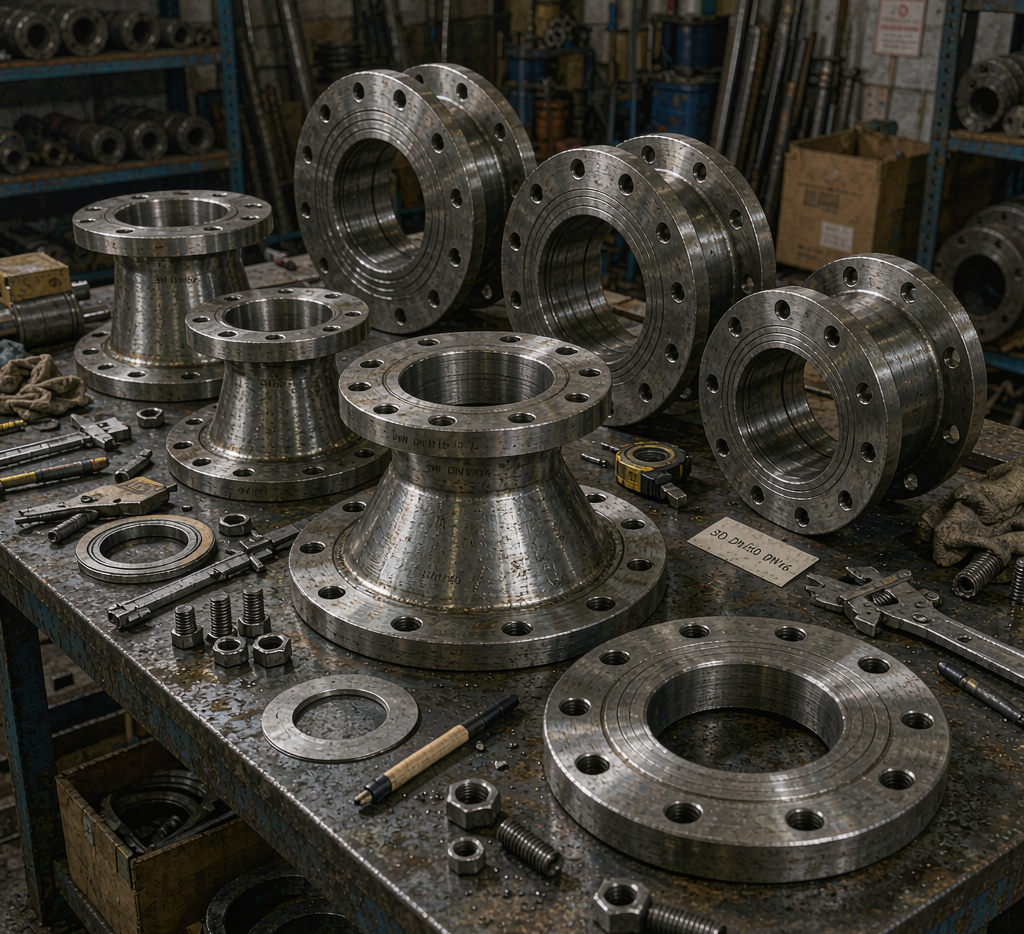
A carbon steel flange is a precision-machined forged disc or ring used to join pipes, valves, pumps, and other equipment into a secure, demountable piping system. Huaxia-Steel manufactures and supplies a full range of carbon steel flange products direct from our production lines, eliminating intermediate distributors so that project engineers and procurement teams receive mill-level pricing, full material traceability, and short lead times. Our flanges are produced to ASME, EN, and API standards and are shipped worldwide with Material Test Certificates (MTC) for every lot.
1. Product Overview
In any pressurized piping network, the carbon steel flange serves as the primary mechanical connection interface between two separable components. Unlike a permanent welded butt joint, a flanged connection allows the pipeline to be opened for inspection, cleaning, maintenance, or equipment replacement without cutting the pipe. A flange is welded (or threaded) to the pipe end on one side and brought face-to-face with a mating flange on the other side. A gasket seated between the two raised faces seals the joint, while a ring of bolts and nuts drawn to a specified torque compresses the gasket to maintain a leak-tight seal under internal pressure and thermal cycling.
The geometry of a carbon steel flange is defined by four key parameters: nominal pipe size (NPS), pressure class (or pressure rating), facing type, and the governing dimensional standard. The bore of the flange is matched to the internal diameter of the connected pipe so that flow is not restricted at the joint. The hub or neck provides a smooth transition that reduces stress concentration at the weld and improves fatigue resistance under cyclic loading. Because flanges are safety-critical components, every carbon steel flange leaving our works is dimensionally inspected, hardness checked, and accompanied by a certified MTC.
Flanged connections dominate industrial piping because they combine high integrity with serviceability. A single carbon steel flange assembly can hold line pressures from a few bar up to the rated class maximum while remaining fully reversible. This makes the flange the default choice wherever process lines must be modified, where instruments must be tie-in points, or where future expansion is anticipated. Huaxia-Steel stocks and produces flanges across the most common pressure ratings used in refineries, power plants, and water systems.
2. Flange Types
We supply the complete family of carbon steel flange configurations. Selecting the correct type depends on the line pressure, available weld access, the need for disassembly, and temperature excursions. The table below summarizes the six principal types we manufacture.
| Type | Description | Typical Use |
|---|---|---|
| Weld Neck (WN) | Long tapered hub welded to pipe; highest strength and fatigue resistance, best for high pressure and thermal cycling | Critical process lines, high-pressure steam, refinery headers |
| Slip-On (SO) | Ceases two fillet welds (inside and outside); low cost, easy alignment, moderate pressure service | Low-pressure utility and water lines, general plant piping |
| Blind (BL) | Solid disc with no bore; seals the end of a pipe or closes a vessel nozzle | Line termination, isolation, future tie-in points, pressure test caps |
| Socket Weld (SW) | Female socket accepts pipe; single fillet weld, used for small bore only | Small-bore high-pressure lines, instrument connections (NPS ≤ 2″) |
| Threaded (THR) | Internal threads engage a threaded pipe; no welding required | Low-pressure, non-flammable, non-toxic services where welding is impractical |
| Lap Joint (LJ) | Used with a stub end; flange can rotate freely for bolt-hole alignment | Frequent dismantling, low-pressure systems, lines needing rotation |
The weld neck carbon steel flange is the preferred type for high-stress and high-cycle service because the tapered hub distributes loads into the pipe wall. Slip-on flanges are chosen where budget and ease of fit-up dominate. Blind flanges, though simple, are subjected to high bending stresses and must be specified at the correct rating. For small-bore instrument and sample lines, the socket weld and threaded variants provide compact, reliable connections.
3. Specification Table
The following dimensions apply to our standard ASME B16.5 carbon steel flange line in pressure classes 150 and 300. Values are nominal inches for reference; full tables are provided on the MTC and drawing. Outside diameter (OD), bolt circle diameter (BCD), and flange thickness (T) are the three dimensions most often verified at goods-in inspection.
| NPS (DN) | Class | OD (mm) | Bolt Circle (mm) | Thickness (mm) | Bolts | Facing |
|---|---|---|---|---|---|---|
| 1/2″ (DN15) | 150 | 89 | 60.3 | 11.2 | 4 × 1/2″ | RF |
| 1″ (DN25) | 150 | 108 | 79.4 | 12.7 | 4 × 1/2″ | RF |
| 2″ (DN50) | 150 | 152 | 120.7 | 17.5 | 4 × 3/4″ | RF |
| 4″ (DN100) | 150 | 229 | 190.5 | 24.1 | 8 × 3/4″ | RF |
| 2″ (DN50) | 300 | 165 | 127.0 | 22.4 | 8 × 3/4″ | RF |
| 4″ (DN100) | 300 | 254 | 200.0 | 32.0 | 8 × 7/8″ | RF |
| 8″ (DN200) | 300 | 381 | 311.2 | 41.3 | 12 × 1″ | RF |
| 12″ (DN300) | 300 | 483 | 406.4 | 48.0 | 12 × 1-1/4″ | RF |
Our standard size range runs from 1/2″ to 24″ (DN15 to DN600) and covers pressure classes 150 and 300, equivalent to PN16 and PN40. Facings are supplied as raised face (RF) with a 1.6 mm (1/16″) serrated finish as standard, or flat face (FF) on request. All dimensions conform to ASME B16.5 for NPS ≤ 24″. For large-diameter requirements beyond 24″, we produce to ASME B16.47 Series A (MSS) and Series B (API). Bolt holes are drilled and chamfered, and the bolt circle is held to close tolerance so that mating flanges align without forced assembly.
4. Material Grades
The selection of carbon steel flange material governs the service temperature envelope, impact toughness, and weldability. Huaxia-Steel routinely forges the grades below and certifies each heat.
| Grade | Standard | Key Characteristics | Service Notes |
|---|---|---|---|
| A105 | ASTM A105 | Carbon steel forging, good weldability, no specified impact | Ambient to moderate temperature; most common general-service flange |
| A350 LF2 | ASTM A350 | Low-temperature forged carbon steel with charpy impact requirement | Sub-zero service down to -46°C; cryogenic and winterized lines |
| A181 | ASTM A181 | General-purpose carbon steel forging, Class 60/70 | Lower-stress flanges, economical commodity service |
A105 is the workhorse carbon steel flange grade, suitable for the vast majority of refinery, water, and plant applications within its temperature limits. When the line operates below freezing or experiences rapid cool-down, A350 LF2 is specified because its mandated impact testing confirms toughness at low temperature, preventing brittle fracture. A181 offers a cost-effective alternative for non-critical, low-stress flanges. For every order we declare the heat number, chemical composition (C, Mn, P, S, Si), and mechanical properties (tensile, yield, elongation) on the MTC so that the carbon steel flange you receive is fully traceable to the melted heat.
5. Manufacturing Standards
Conformance to recognized standards is non-negotiable for interchangeability and safety. Our carbon steel flange production is controlled to the following specifications:
- ASME B16.5 — Pipe flanges and flanged fittings, NPS 1/2″ through 24″, ratings 150 to 2500.
- ASME B16.47 — Large diameter flanges NPS 26″ through 60″ (Series A MSS, Series B API).
- EN 1092-1 — European flange standard, PN6 to PN100, Type 01 to 05.
- API 605 — Large diameter companion flange standard for the petroleum industry.
Manufacturing starts with certified steel billets that are heated in a forge furnace and shaped by open-die or closed-die forging to distribute the grain flow along the flange contour, improving strength. After forging, flanges are normalized (and tempered where required) to achieve uniform microstructure. Machining centers then cut the bore, facing, hub, and bolt holes to the nominated standard’s dimensional schedule. Final inspection verifies every critical dimension against the drawing before the carbon steel flange is stamped and packed.
6. Applications
Because a carbon steel flange provides a robust, serviceable joint, it appears in nearly every fluid-handling industry. Typical deployment includes:
- Oil & Gas — upstream gathering lines, refinery process units, and pipeline pump stations where weld neck and blind flanges handle high pressure and thermal swing.
- Petrochemical — reactor and fractionation column tie-ins, where material certification and traceability are mandatory.
- Water Treatment — municipal and industrial water and wastewater plants using slip-on and blind flanges for low-pressure large-bore mains.
- General Piping — power plant auxiliaries, HVAC chilled water, compressed air, and fire protection networks.
In each of these sectors the carbon steel flange must perform under specific pressure, temperature, and media conditions. Our engineering team assists with grade and type selection so that the supplied flange matches the design basis rather than a generic catalogue value, reducing the risk of premature joint failure.
7. Quality Assurance
Every carbon steel flange we ship is backed by a documented quality system. Our assurance program covers the full production chain:
- Material Test Certificate (EN 10204 3.1) — issued per heat and per order, declaring chemistry and mechanical results.
- Ultrasonic Testing (UT) — volumetric inspection of forged blanks to detect internal discontinuities per ASME Section V.
- Positive Material Identification (PMI) — verified by portable spectrometer to confirm grade before machining and before dispatch.
- Hardness Testing — Brinell or Rockwell checks to confirm the flange is within the specified hardness band, important for sour-service limits.
- Marking — each flange is permanently stamped with size, rating, material, standard, heat number, and our manufacturer’s mark for full traceability.
These controls mean the carbon steel flange delivered to your site arrives with verifiable identity. Third-party inspection (SGS, TUV, BV, or client appointed) can be arranged at the works prior to shipment, and additional testing such as hydrostatic proof, magnetic particle (MT), or charpy impact can be added to the inspection plan on request.
8. Packaging & Shipping
Correct packaging protects the machined faces and preserves the carbon steel flange condition through long ocean or road transit. We apply the following export packing routine:
- Flanges are visually cleaned and lightly coated with anti-rust oil on machined surfaces.
- Each item is wrapped in plastic film or placed in individual bubble protection for small sizes.
- Flanges are stacked in strong plywood cases or on fumigation-free wooden pallets, with separators to prevent face-to-face contact that could damage the gasket seat.
- Cases are banded, labeled with part description, quantity, and order number, and strapped for forklift handling.
For container shipments we optimize case dimensions to maximize load factor and minimize freight cost, while ensuring the carbon steel flange faces are shielded from moisture. Palletized shipments are available for domestic or short-haul delivery. All export packaging meets the ISPM-15 requirements for solid wood, so customs clearance proceeds without phytosanitary delay.
9. Contact Huaxia-Steel for Carbon Steel Flanges
Whether your project requires a single special carbon steel flange or a full vessel package across multiple sizes and ratings, Huaxia-Steel supplies directly from the factory with competitive pricing and complete documentation. We offer weld neck, slip-on, blind, socket weld, threaded, and lap joint flanges in A105, A350 LF2, and A181, to ASME B16.5, B16.47, EN 1092-1, and API 605, with MTC 3.1 as standard.
Tell us your required size, pressure class, facing, standard, and quantity, and our sales engineers will return a quotation with lead time and a clear material certification plan. Choose Huaxia-Steel as your carbon steel flange partner and receive mill-direct quality, full traceability, and dependable export packaging on every order.