Carbon Steel Flanges – Weld Neck, Slip-On, Blind, Threaded | Factory Direct | Huaxia-Steel
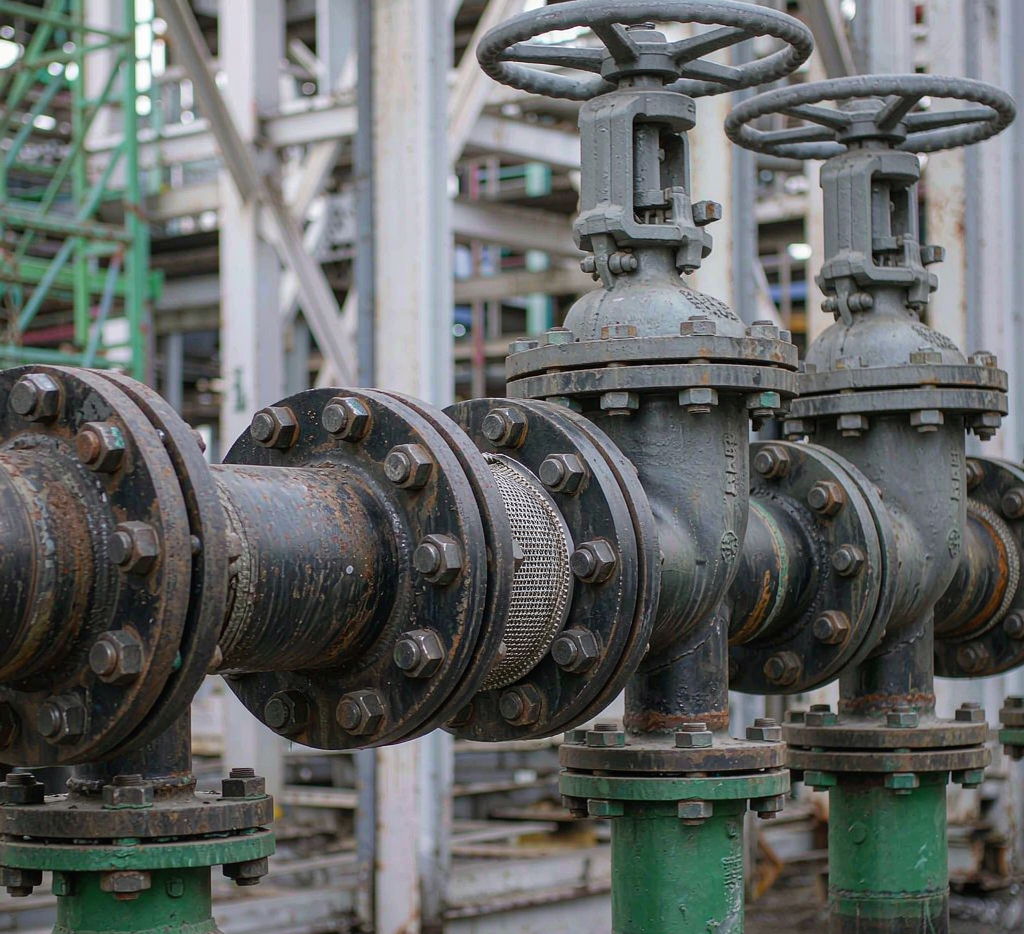
Carbon steel flanges are the standard pipe connection component for low-pressure and high-pressure piping systems across oil and gas, petrochemical, power, water, and shipbuilding. A flange is a forged or plate-rolled ring with machined bolt holes and a sealing face, joined to a pipe end by welding or threading, then bolted to a mating flange with a gasket between the faces.
Huaxia-Steel supplies a complete line of carbon steel flanges in ASME B16.5 and ASME B16.47 Series A and B dimensions, in classes 150, 300, 600, 900, 1500, and 2500. Material grades cover ASTM A105 / A105N for standard service, A350 LF2 for low-temperature, and A694 F42 / F52 / F60 / F65 / F70 for high-yield transmission. All flanges are manufactured under ISO 9001 with full traceability and EN 10204 3.1 mill test certification.
1. Flange Types Available
Carbon steel flanges are produced in five primary types, each suited to a different installation, maintenance, and pressure class:
- Weld Neck (WN) flanges: Long tapered hub welded to the pipe. Highest integrity at high pressure and high temperature. Used in critical service – process piping, refinery, power station.
- Slip-On (SO) flanges: Slip over the pipe, fillet welded inside and outside. Lower cost, easier alignment. Used in low-pressure and non-critical service.
- Blind (BL) flanges: Solid disc with bolt holes. Used to close the end of a pipe, vessel, or valve. Removes the need for a cap.
- Threaded (TH) flanges: Internal taper thread matching the pipe taper. Used where welding is not possible – high-pressure utility lines, instrument connections.
- Lap Joint (LJ) flanges: Two-piece design with a loose backing ring and a stub end welded to the pipe. Used where the flange must be rotated to align bolt holes.
- Socket Weld (SW) flanges: Pipe is inserted into a socket and fillet welded. Used in small-bore high-pressure systems.
Special types such as orifice, expander, reducing, and tongue-and-groove are also available on request.
2. Size and Pressure Class Range
| Standard | Size Range (NPS / DN) | Pressure Class |
|---|---|---|
| ASME B16.5 (1/2″ – 24″) | NPS 1/2 to NPS 24 | Class 150, 300, 600, 900, 1500, 2500 |
| ASME B16.47 Series A (MSS SP-44) | NPS 26 to NPS 60 | Class 150, 300, 600, 900 |
| ASME B16.47 Series B (API 605) | NPS 26 to NPS 60 | Class 75, 150, 300, 600, 900 |
| EN 1092-1 (PN) | DN 10 to DN 2000 | PN 6, 10, 16, 25, 40, 63, 100, 160 |
| JIS B2220 | DN 10 to DN 1500 | 5K, 10K, 16K, 20K, 30K, 40K |
| GOST 33259 | DN 10 to DN 2000 | PN 1.0 to PN 25.0 MPa |
Standard production covers NPS 1/2 to NPS 24 in ASME B16.5 and NPS 26 to NPS 60 in ASME B16.47. Larger diameters (above NPS 60) are available as rolled-and-welded plate flanges on order.
3. Material Grades
| ASTM Grade | Yield (min MPa) | Tensile (MPa) | Elongation (min percent) | Service |
|---|---|---|---|---|
| A105 / A105N | 250 | 485-655 | 22 | Standard carbon steel, ambient and high temperature |
| A350 LF2 CL1 | 250 | 485-655 | 22 | Low temperature down to -46 °C |
| A350 LF3 | 260 | 485-680 | 22 | Low temperature down to -101 °C (LPG, LNG) |
| A694 F42 | 290 | 415-585 | 23 | High yield transmission piping |
| A694 F52 | 360 | 455-620 | 22 | High yield transmission piping |
| A694 F60 | 415 | 515-690 | 20 | High yield transmission piping |
| A694 F65 | 450 | 530-700 | 19 | High yield transmission piping |
| A694 F70 | 485 | 565-740 | 18 | High yield transmission piping |
| A516 Gr.70 | 260 | 485-620 | 21 | Plate flanges for low-temperature pressure vessel |
| A537 Class 1 / 2 | 345 / 415 | 485-620 / 550-690 | 22 / 21 | Normalized plate flanges for pressure vessel |
| A266 Gr.1 / 2 / 3 / 4 | 205-260 | 415-585 | 19-25 | Carbon steel forgings for flanges (legacy) |
Each grade carries a defined carbon equivalent, hardness, and impact requirement. A105 and A105N are the most common general-purpose grades, and A105N adds mandatory normalization for improved notch toughness.
4. Facing Types
The flange face (sealing surface) determines the gasket style and pressure rating. Three facing types are standard:
- Raised Face (RF): Default. A 1.6-2 mm raised surface around the bore, machined smoother than the back face. Suitable for class 150 to class 2500 with spiral-wound, ring-joint, or compressed sheet gaskets.
- Flat Face (FF): No raised surface. Used with full-face gaskets, common for class 150 and in cast iron or fiberglass flanges. Not recommended for class 300 and above.
- Ring Type Joint (RTJ): A precisely machined groove accommodates a metal ring gasket. Used for class 600 and above, in high-pressure and high-temperature service.
Tongue-and-groove (T&G) and male-and-female (M&F) facings are available on order. The facing roughness is standardized – RF stock finish is 125-250 micro-inch AA, smooth finish is 63-125 micro-inch AA for use with spiral-wound gaskets.
5. Manufacturing Process
Carbon steel flanges are produced by three methods:
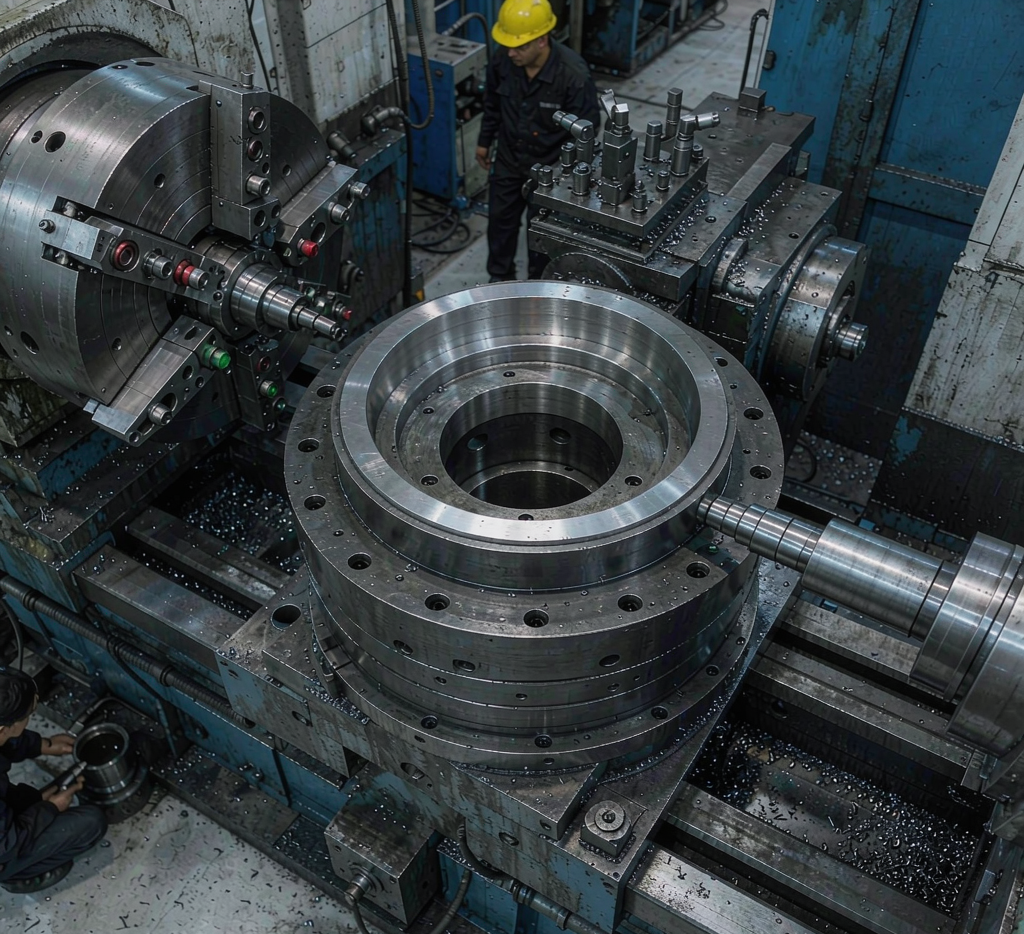
- Forging: Billet heated to 1,200-1,250 °C, upset and pierced (for ring shape), then ring-rolled or hammer-forged to a disc blank. Machined to final dimensions. The standard method for A105, A350 LF2, A694 grades up to NPS 24. Produces the highest mechanical integrity.
- Plate cutting: Plate is flame-cut or plasma-cut to the flange disc, then the sealing face and bolt holes are machined. Used for large-diameter plate flanges (above NPS 36), or for grades that are difficult to forge (e.g., A516 plate for low-temperature service).
- Casting: Sand casting in A216 WCB / WCC. Lower cost but lower mechanical properties. Used for non-critical water service and low-pressure applications. Not available for low-temperature grades.
After machining, flanges are hydrostatically tested, dimensionally inspected, and marked with grade, size, class, manufacturer mark, and heat number. Surface protection is typically rust-preventative oil; galvanizing, yellow zinc, and PTFE coatings are available on order.
6. Dimensional Standards and Tolerances
All flanges supplied comply with the dimensional tolerances of ASME B16.5 / B16.47 (US market) or EN 1092-1 (European market). Critical tolerances include:
- Outside diameter: +/- 2 mm for class 150, +/- 1 mm for class 300 and above.
- Bore: +1.0 mm / -0.0 mm for weld neck (allows slip-over of pipe).
- Bolt circle diameter: +/- 1.5 mm for class 150, +/- 1.0 mm for class 300 and above.
- Hub length (WN): +/- 2 mm.
- Face finish: 125-250 micro-inch AA for RF stock finish, 63-125 micro-inch AA for smooth finish.
Each flange carries a heat number that ties it back to the original ingot. Mill test certificates per EN 10204 3.1 are supplied with each shipment and trace the chemistry, mechanical, and heat treatment record for the heat.
7. Applications
Carbon steel flanges are used across virtually every pressure piping application:
- Oil and gas transmission: Pump station piping, manifold headers, scraper traps.
- Refinery and petrochemical: Crude unit piping, hydrocracker piping, FCC piping, reformer piping.
- Power generation: Boiler feedwater piping, condensate return, cooling water lines, deaerator drains.
- Chemical processing: Reactor feed lines, acid and alkali lines (with PTFE-lined flanges for severe service).
- Water and wastewater: Treatment plant, pumping stations, sludge lines, penstock piping.
- Shipbuilding: Bilge lines, fuel lines, ballast lines, fire-fighting systems.
For sour service (H2S-containing fluids per NACE MR0175 / ISO 15156), specify flanges tested and certified to NACE with hardness HRC 22 maximum.
8. Quality Assurance
Each Huaxia-Steel flange carries the following QA documentation:
- EN 10204 3.1 mill test certificate: Heat-traceable chemistry and mechanical results.
- Dimensional inspection report: OD, bore, bolt circle, bolt holes, hub length, facing finish.
- Hydrostatic test report: 1.5 x design pressure hold for 30 minutes, no leakage.
- Visual and surface inspection report: No surface defects, no decarburization, no cracks.
- Marking verification: Grade, size, class, manufacturer mark, heat number.
- NACE certificate (when specified): Hardness, chemistry compliance to NACE MR0175.
- Third-party inspection: SGS, BV, TUV, or customer-nominated inspector accepted.
We also accept customer witness inspection at the mill before shipment.
9. Packaging and Shipping
Flanges are protected against corrosion and impact damage during shipment:
- Standard export packing: Each flange wrapped in VCI anti-rust paper, then in bubble film. Multiples packed in plywood crates strapped with steel bands.
- Fumigation-free plywood: Compliant with destination country phytosanitary requirements (EU, US, AU).
- Marking: Heat number stencilled on each flange and on every crate. Packing list inside a waterproof pouch on the crate.
- Container loading: Flanges loaded into 20-ft or 40-ft containers, blocked and braced to prevent shifting. Bulk loading for unwrapped flanges on flat racks (large diameters only).
Lead time is 15-25 days for standard sizes in stock or 30-45 days for made-to-order quantities.
10. Order Information
To order carbon steel flanges, specify:
- Type: WN, SO, BL, TH, LJ, SW (or other)
- Size: NPS (or DN)
- Pressure class: 150 / 300 / 600 / 900 / 1500 / 2500 (or PN rating)
- Material grade: A105, A105N, A350 LF2, A694 F60/F65/F70, etc.
- Facing: RF / FF / RTJ
- Quantity: in pieces
- Special requirements: NACE MR0175, sour service, low-temperature, third-party inspection
Huaxia-Steel supplies carbon steel flanges from factory-direct stock at mill-direct prices. ASME B16.5, B16.47, EN 1092-1, JIS B2220 standards, A105 / A350 LF2 / A694 grades, all pressure classes, all facings. Container or bulk worldwide shipment. Send your inquiry with size, class, grade, facing, and quantity for a same-day quotation.
Related Images