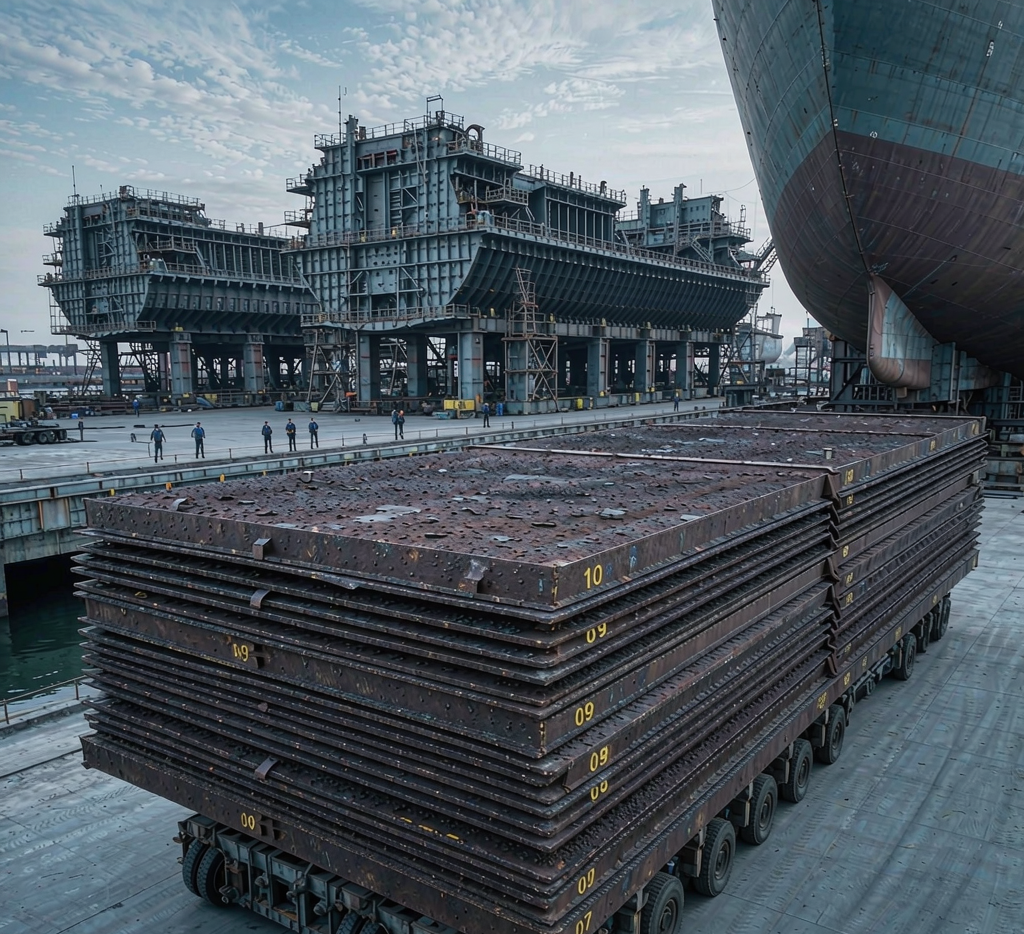
Carbon Steel Ship Plate – ASTM A131 / GB 712 Factory Direct Supplier | Huaxia-Steel
Carbon steel ship plate is the standard hull structural plate for merchant ships, offshore platforms, tug boats, fishing vessels, and dredgers. Huaxia-Steel supplies factory-direct carbon steel ship plate per ASTM A131, GB 712, JIS G3106 SM-grade, and corresponding Class Society specifications (ABS, LR, DNV, BV, CCS, KR, RINA). Grades A, B, D, E, AH32, AH36, DH32, DH36, EH32, EH36 are available in thicknesses 4 to 100 mm with mill test certificate per EN 10204 3.1 or 3.2 and third-party witnessed stamping per the relevant Class Society.
1. Grade System and Classification
Ship plate grades are organized by yield strength tier and low-temperature impact category:
| Tier | Common Grades (ASTM A131) | Common Grades (GB 712) | Yield (MPa) | Charpy @ (-) | Application |
|---|---|---|---|---|---|
| Ordinary strength | A, B, D, E | A, B, D, E | 235 | 27 J @ 0 (B), -20 (D), -40 (E) | Light hull, superstructure, tonnage limit per Class rules |
| Higher strength | AH32, DH32, EH32, AH36, DH36, EH36 | AH32, DH32, EH32, AH36, DH36, EH36 | 315 / 355 | 32 to 50 J @ sub-zero | High-tensile hull, offshore, ice-classed |
| Extra high strength | FH32, FH36, EH40 | FH32, FH36, EH40 | 390 / 420 | 50 J @ -60 | Polar vessels, icebreakers, large container ships |
Each Class Society (ABS, LR, DNV, BV, CCS) maintains equivalent grades with slightly different nomenclature but matching composition, mechanical and testing protocols under the IACS Unified Requirements (UR).
2. Chemical Composition (Ordinary Strength – Grade A / B / D / E per ASTM A131)
| Element (percent) | Grade A | Grade B | Grade D | Grade E |
|---|---|---|---|---|
| Carbon (C, max) | 0.21 | 0.21 | 0.21 | 0.18 |
| Manganese (Mn) | 2.5 x C minimum | 0.60 to 0.90 (above 25 mm); 0.80 to 1.20 (below 25 mm) | 0.60 to 1.20 | 0.70 to 1.20 (above 25 mm); 1.00 to 1.30 (below 25 mm) |
| Silicon (Si) | 0.50 max | 0.35 max | 0.10 to 0.35 | 0.10 to 0.35 |
| Phosphorus (P, max) | 0.035 | 0.035 | 0.035 | 0.035 |
| Sulfur (S, max) | 0.035 | 0.035 | 0.035 | 0.035 |
| Aluminum (Al, min) | – | – | 0.015 | 0.015 |
Grades B, D, E require finer Mn and Si control and aluminum grain-refining addition to ensure the mandatory Charpy testing passes. Grade E has the tightest chemistry for the lowest temperature (-40 deg;C) impact requirement.
3. Chemical Composition (Higher Strength – AH32 / DH32 / EH32 / AH36 / DH36 / EH36)
| Element (percent) | AH32 / DH32 / EH32 | AH36 / DH36 / EH36 |
|---|---|---|
| Carbon (C, max) | 0.18 | 0.18 |
| Manganese (Mn) | 0.60 to 1.60 | 0.70 to 1.60 |
| Silicon (Si) | 0.10 to 0.50 | 0.10 to 0.50 |
| Phosphorus (P, max) | 0.035 | 0.035 |
| Sulfur (S, max) | 0.035 | 0.035 |
| Aluminum (Al, min) | 0.015 | 0.015 |
| Nb, V, Ti microalloy | per Class; total 0.020 to 0.050 typical | per Class; total 0.020 to 0.050 typical |
Higher-strength grades are typically produced by thermo-mechanical controlled processing (TMCP) rather than normalizing, to achieve the 315 or 355 MPa yield with low carbon equivalent.
4. Mechanical Properties
| Grade | Yield (MPa, min) | Tensile (MPa) | Elongation (percent, min) | Charpy (J, min) |
|---|---|---|---|---|
| A | 235 | 400 to 520 | 22 | not required |
| B | 235 | 400 to 520 | 22 | 27 @ 0 deg;C |
| D | 235 | 400 to 520 | 22 | 27 @ -20 deg;C |
| E | 235 | 400 to 520 | 22 | 27 @ -40 deg;C |
| AH32 | 315 | 440 to 590 | 22 | 31 @ 0 deg;C |
| DH32 | 315 | 440 to 590 | 22 | 31 @ -20 deg;C |
| EH32 | 315 | 440 to 590 | 22 | 34 @ -40 deg;C |
| AH36 | 355 | 490 to 620 | 21 | 34 @ 0 deg;C |
| DH36 | 355 | 490 to 620 | 21 | 34 @ -20 deg;C |
| EH36 | 355 | 490 to 620 | 21 | 34 @ -40 deg;C |
5. Size Range and Dimensional Tolerance
| Parameter | Range | Tolerance |
|---|---|---|
| Thickness | 4 to 100 mm | +/- 0.30 to +/- 1.0 mm by Class rule |
| Width | 1,500 to 4,500 mm | +/- 5 to +/- 25 mm |
| Length | 3,000 to 18,000 mm | +/- 10 to +/- 50 mm |
| Flatness | per Class rule | 3 to 8 mm / meter typical |
Widths above 4,500 mm are required for bulk carrier deck plates. Lengths above 15 m are required for VLCC double-bottom sections. Confirm heavy-plate mill capacity before placing very large tonnage orders.
6. Delivery Conditions
| Condition | Process | Notes |
|---|---|---|
| As-rolled (AR) | Direct hot-rolled | Allowed for Grade A only (ASTM A131) |
| Normalized (N) | Heated 880 to 920 deg;C, air-cooled | Standard for Grade B, D, E |
| TMCP | Controlled rolling with accelerated cooling | Standard for AH32 / AH36 and above |
| Quench and tempered (QT) | Heated, water-quenched, tempered | For EH40 and high-strength |
7. Class Society Stamps and Acceptance
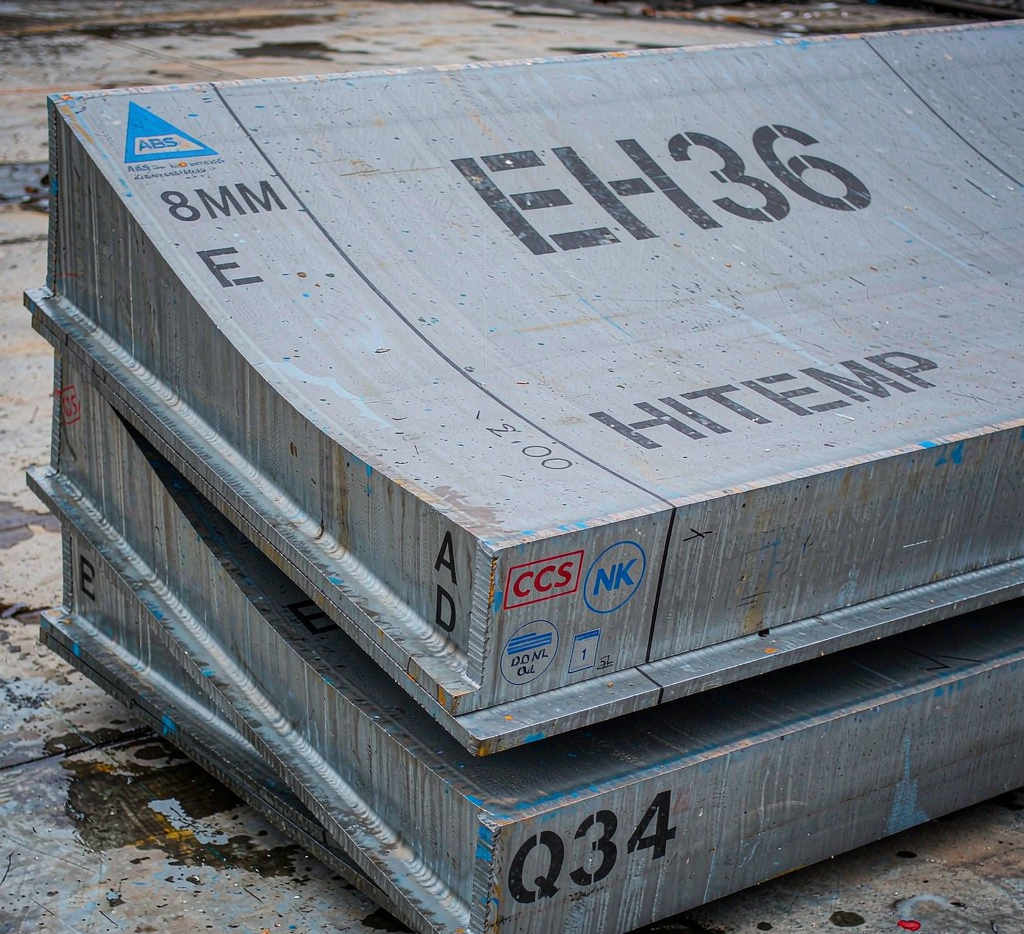
Ship plate produced under ABS / LR / DNV / BV / CCS / KR / RINA must be stamped (or laser-marked) with the Class Society’s mark at the mill. The stamp certifies that:
- The plate is produced by a Class-approved mill
- The plate has been tested per Class rules (chemistry, mechanical, Charpy)
- The inspector witnessed the heat-treatment and final tests
- The plate is traceable back to the slab and rolling batch
The stamp position depends on the Class: ABS and LR stamp at one end of each plate, DNV stamps two corners, BV stamps the corner near the heat number. Each plate carries a unique stamp number on the certificate.
8. Welding and Fabrication
Ship plate is welded by SMAW, GMAW, FCAW, GTAW and SAW. Class-approved welding consumables matching or slightly undermatching the parent plate yield are used:
- Ship plate Grade A / B: low-hydrogen electrodes AWS E7018 / E7016-1, wire ER70S-6 / EH14
- Ship plate AH32 / DH32: low-alloy electrodes E7018 / E7018-N, wire ER70S-G
- Ship plate AH36 / DH36 / EH36: E8018-C1 / E8018-C3, wire ER80S-G, with low-hydrogen discipline and 100 deg;C preheat for heavy sections
TMCP ship plate has very good weldability at low CEV (typically 0.36 to 0.40). For Arctic-class structures, low-temperature PWHT may be requested, but most Class rules allow welding without PWHT up to 50 mm thickness on E-grade.
9. Quality Assurance
Carbon steel ship plate is supplied with the following QA documentation:
- EN 10204 3.1 or 3.2 mill test certificate
- Class Society certificate of compliance (stamp witness)
- Charpy impact testing at three specimens per heat (Class-controlled)
- Ultrasonic testing per Class rules for heavy plates (>50 mm)
- Surface inspection report
For higher class notations (ice class, polar class), additional testing is required: through-thickness tensile (z-direction) to E60 or E80, drop-weight testing, CTOD fracture-mechanics testing per BS 7910 / API 579.
10. Applications
- Merchant ship hulls: bulker, container vessel, tanker, RoRo, general cargo
- Ship superstructure: deckhouses, bridges, accommodation blocks
- Ship bulkheads, longitudinal and transverse frames
- Offshore platform jacket and topside deck plate
- Working deck, harbor fender, jetty structure
- Bridge structure over water
11. Frequently Asked Questions
Q1: What is the difference between ASTM A131 Grade A and Grade B?
Grade A is as-rolled and does not require Charpy testing. Grade B is supplied in the normalized condition and requires 27 J Charpy at 0 deg;C. For new builds, almost all hull plates are at least Grade B to meet Class rules.
Q2: Can I get a single Class-Society stamp across multiple mills?
Yes, but each mill must be individually approved by the Class. Huaxia-Steel works with Class-approved mills; specify the target Class in your RFQ.
Q3: What is the minimum thickness for AH36 plate?
ASTM A131 specifies AH36 from 6 mm thickness upward. Below 6 mm, the spec defaults to Grade A or B. Thicker production is unconstrained but pricing rises above 80 mm due to limited mill capacity.
Q4: Are TMCP and normalized plate the same price?
TMCP plate is typically 5 to 8 percent cheaper than normalized plate of the same strength because TMCP eliminates a furnace cycle. Availability is wider from Chinese mills.
Q5: What if I need ASTM A131 plate but no Class stamp?
Non-stamp A131 plate is used for non-Class vessels such as inland barges, fishing boats, and one-off repairs. Delivery with mill 3.1 MTC is faster than Class-stamp plate.
Q6: How are ship plates protected against corrosion during sea transit?
Plate for export is normally shop-primer coated with anti-corrosive primer 20 to 30 microns, applied to SA 2.5 surface. This protects the plate during 6 to 12 month shipping plus 3 to 6 month yard storage before construction.
12. Conclusion
Carbon steel ship plate is grade-controlled, Class Society stamped, and Charpy-tested. Specify Grade A / B / D / E for general hull, higher-strength AH32 / DH32 / EH32 / AH36 / DH36 / EH36 for high-tensile, FH / EH40 for ice-class. Confirm thickness range, width and the target Class with the mill before order. Huaxia-Steel ships EN 10204 3.1 / 3.2 MTC, Class stamped, prompt delivery.
13. Get a Quote from Huaxia-Steel
Huaxia-Steel supplies factory-direct carbon steel ship plate per ASTM A131 / GB 712 with ABS / LR / DNV / BV / CCS stamping from approved Chinese mills. Thicknesses 4 to 100 mm, width up to 4,500 mm, length to 18,000 mm. Shop-primer coating and mill witnessed testing available on request. Send your spec, vessel class and dimensions for a quotation within 24 hours.