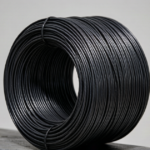
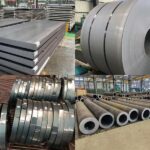
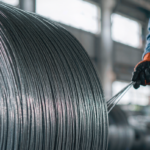
Carbon steel wire nails are the highest-volume hardware commodity in the steel export trade: bright, galvanized or coated nails drawn from low-carbon wire rod and cut, pointed and headed in one continuous forming line. From furniture frames and pallets to framing carpentry and packaging crates, wire nails move in container quantities — tens of tons per order — and the difference between a professional supplier and a spot trader shows up in shank consistency, coating weight certificates and carton packing accuracy. Huaxia-Steel supplies carbon steel wire nails factory direct: BWG 4–16 gauges, lengths 25–150 mm, smooth, screw, ring and annular shanks, bright / electro-galvanized / hot-dip galvanized finishes, 20–25 kg cartons or 1 kg retail boxes on export pallets, with coating weight test reports per shipment.
Product Overview

A wire nail is cold-formed from low-carbon steel wire (typically SAE 1006–1015 chemistry, drawn to the target gauge): the wire feed passes through dies that cut the point, upset the head, and shear the nail to length in a single stroke. Shank, point geometry and head diameter are the three quality variables. The shank must be straight and round with consistent diameter (±0.02–0.04 mm depending on gauge); the point — usually diamond, sometimes chisel for hard wood — must be centered and symmetric so the nail drives without bending; the head must be flat, concentric and sized to the gauge so it does not pull through or split surface fibers. These seem like trivial tolerances until an automatic nailing gun is feeding 60 nails a minute — then shank wobble and off-center points become jam rates, and jam rates become the buyer’s real quality metric.
Low-carbon chemistry is what makes nails formable and cheap: 0.10 percent max carbon gives the ductility for cold heading and the mild bending tolerance during driving. Corrosion protection is layered on by finish: bright (uncoated) nails for interior dry use; electro-galvanized for interior-to-sheltered exterior; hot-dip galvanized for exterior and treated-timber service. Coating weight — not appearance — determines service life, so professional orders specify grams per square meter and request test certificates rather than trusting a shiny look.
Specification Table
| Parameter | Range | Notes |
|---|---|---|
| Length | 25 – 150 mm (1″–6″) | common: 25, 32, 38, 50, 63, 75, 100, 125, 150 mm |
| Gauge (BWG) | BWG 4 – BWG 16 | diameter 1.65–6.05 mm; pairs with length per market convention |
| Shank types | smooth, screw (spiral), ring (annular), barbed | ring/screw shanks add 30–200% withdrawal resistance |
| Point | diamond standard; chisel optional | centered, symmetric, no burr |
| Head | flat, countersunk checkered optional | head diameter ≈ 2–2.5 × shank diameter |
| Wire chemistry | SAE 1006–1015 (C ≤ 0.15) | low carbon for cold forming |
| Finish | bright, electro-GI (5–15 g/m²), hot-dip GI (≥ 50–70 g/m²), colored vinyl | coating weight certified per order |
| Packing | 20–25 kg bulk carton; 1 kg / 5 kg poly bags; boxes on pallet | carton weight tolerance ±1–2% professionally packed |
| Standards | ASTM F1667 (nails), SAE J82, DIN 1151, BS 1202, GB/T 346 | declare the target standard on the PO |
Finish Options and Corrosion Performance
| Finish | Coating weight | Typical service | Notes |
|---|---|---|---|
| Bright | none (oil wiped) | interior dry: furniture, crates, pallets | lowest cost; will rust in humidity — pack with VCI |
| Electro-galvanized | 5–15 g/m² | interior to sheltered exterior | uniform thin coat; no thread-filling |
| Hot-dip galvanized | ≥ 50–70 g/m² (class) | exterior framing, fencing, treated timber | required with CCA/ACQ treated wood; heavier coat on ring shanks |
| Vinyl / colored coated | paint film over zinc | decorative and camouflage finishes | color matched per customer panel |
| Mechanical galvanized | 35–75 g/m² | uniform coating without embrittlement | premium option for consistent coverage |
The classic failure in nail importing is a hot-dip requirement silently filled with electro-plated goods: the cartons look similar until the fence rusts in eighteen months. Close the loophole by writing the coating class and minimum g/m² into the order and requiring the coating weight test report with each shipment — a two-minute check that protects a multi-year reputation.
Shank Types and Holding Power
- Smooth shank: the default — lowest cost, easiest driving, baseline withdrawal resistance for general construction.
- Screw (spiral) shank: helical rolled shank that rotates as it drives, giving ~30–60 percent higher withdrawal resistance with reduced splitting — the framing and pallet industry favorite.
- Ring (annular) shank: concentric rings that lock into wood fibers, delivering 100–200 percent higher withdrawal resistance — specified for siding, decking, pallets in humid service and gypsum board.
- Barbed shank: lighter deformations for packaging nails where a small holding gain matters more than drive smoothness.
Withdrawal resistance scales with shank surface area and wood density — a 100 mm ring-shank nail in softwood holds roughly double its smooth-shank twin. For engineered packaging and export pallets (ISPM 15 compliant crates), ring shanks are the professional default wherever the crate sees multiple handling cycles.
Manufacturing Standards
- ASTM F1667 — the US nailed-fastener standard: dimensions, bending yield strength, finish classes for construction nails.
- SAE J82 — general-purpose metric inch fastener wire nails and brads: hardness and dimension conventions.
- BS 1202 — British standard nails: the Commonwealth market’s dimensional reference (Part 1 steel smooth round).
- DIN 1151 / DIN 1152 — German round wire nails: European market references.
- GB/T 346 — Chinese general-purpose round nails, the domestic production baseline.
Gauge-and-length pairings differ by market convention (US penny sizes, BWG, metric), so a clean purchase order states both the metric dimensions and the target standard — that single line prevents most first-shipment disputes.
Quality Assurance
Our nail QA runs on four gates. Incoming wire rod is checked for chemistry and drawing consistency. In-process, sample nails from each line hour are gauged for shank diameter, head diameter, point symmetry and length. Finished goods run a bend test (90° bend without fracture at the shank), drive tests in standard timber at set penetration depth, and salt spray or coating-weight verification for galvanized lots per ASTM B117/A153 class. Finally, packing accuracy is verified by carton weighing — a 25 kg carton within ±1 percent is the professional norm, and underweight cartons are the cheapest way to lose a repeat customer. Each shipment carries a test report covering coating weight, bend results and packing statistics; third-party inspection (SGS/BV) is welcomed for container stuffing supervision and carton sampling.
Packaging and Shipping
- Bulk: 20 or 25 kg poly-lined cartons (moisture barrier), cartons strapped and stacked on fumigation-free plywood pallets, stretch-wrapped.
- Retail: 1 kg / 5 kg poly bags or printed boxes, cartonized, private label artwork supported.
- Container efficiency: a 20 ft container carries roughly 24–26 tons palletized; carton-count and pallet-plan optimization available at quotation.
- Moisture control: VCI or desiccant added for bright-nail shipments to humid destinations; galvanized goods double-bagged.
Lead time is 15–25 days for standard gauge/length mixes at container quantity, with mixed-size consolidation and FOB/CFR/CIF terms to your port.
Nail Size Selection by Application
Length selection follows the fastening rule of thumb of two-thirds penetration into the base member, adjusted by timber density: hard, dense species take shorter nails with ring shanks, while soft framing lumber takes longer smooth shanks at speed. Gauge follows load — heavy structural framing at BWG 8–11, general packaging at BWG 12–13, fine interior work at BWG 14–16. When customers migrate between gauge systems, we re-map the full size list to metric diameters and flag any non-standard pairs before production, at no cost.
| Application | Typical size | Recommended shank / finish |
|---|---|---|
| Wooden pallets & crates | 50–90 mm | screw or ring shank, bright or electro-GI |
| House framing | 75–100 mm | smooth or screw shank, electro-GI or bright per climate |
| Fencing & exterior | 50–100 mm | ring shank, hot-dip galvanized (A153 class) |
| Furniture & interior joinery | 25–50 mm | smooth shank, bright or colored vinyl |
| Roofing / shingles | 25–32 mm | ring shank, electro-GI, wide or checkered head |
| Concrete formwork | 75–125 mm | smooth shank, bright, double head optional |
| Scaffolding & packing | 100–150 mm | smooth shank, bright, heavy gauge (BWG 4–7) |
Mixed-size container programs are our standard offering: consolidate 3–6 popular sizes per container with per-size carton counts confirmed at stuffing, and adjust the mix between repeat shipments as your market data develops.
Retail-branded programs (printed boxes, header cards, barcode labels) are supported from 5,000 cartons per size per order — artwork files in AI/PDF are all we need to start the proof cycle.
FAQ
What does BWG mean on nail specifications?
Birmingham Wire Gauge — the diameter scale traditionally used for wire nails (BWG 16 ≈ 1.65 mm up to BWG 4 ≈ 6.05 mm). Orders should always state the metric diameter alongside the gauge, because gauge conventions vary between markets and a BWG-only order is a classic source of wrong-gauge shipments.
Which nails should I use with treated timber?
Hot-dip galvanized (or stainless) only. Copper-based preservatives (ACQ/CA) corrode bare and electro-plated steel rapidly — a bright nail in ACQ lumber can lose half its cross-section in a few wet seasons. Specify hot-dip galvanized per ASTM A153 class and require the coating certificate.
How much stronger is a ring shank nail?
Withdrawal resistance in wood typically doubles versus the same smooth-shank nail, with the gain concentrated in repeated-load and humidity-cycling conditions. Ring shanks cost 10–20 percent more and drive slightly slower — the standard trade for pallets, siding and structural sheathing.
What is the typical container loading for wire nails?
About 24–26 tons in a 20 ft container palletized, and up to ~27 tons floor-loaded where pallets are omitted. Nail cargo is dense, so weight — not volume — fills the box; accurate carton weights and pallet plans matter more than with bulky goods.
Need carbon steel wire nails in bulk cartons with certified coating weights, bend-test reports and tight packing tolerances? Send your gauge/length mix, finish and monthly volume — Huaxia-Steel replies with pricing, pallet plan and lead time within 24 hours.