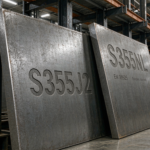
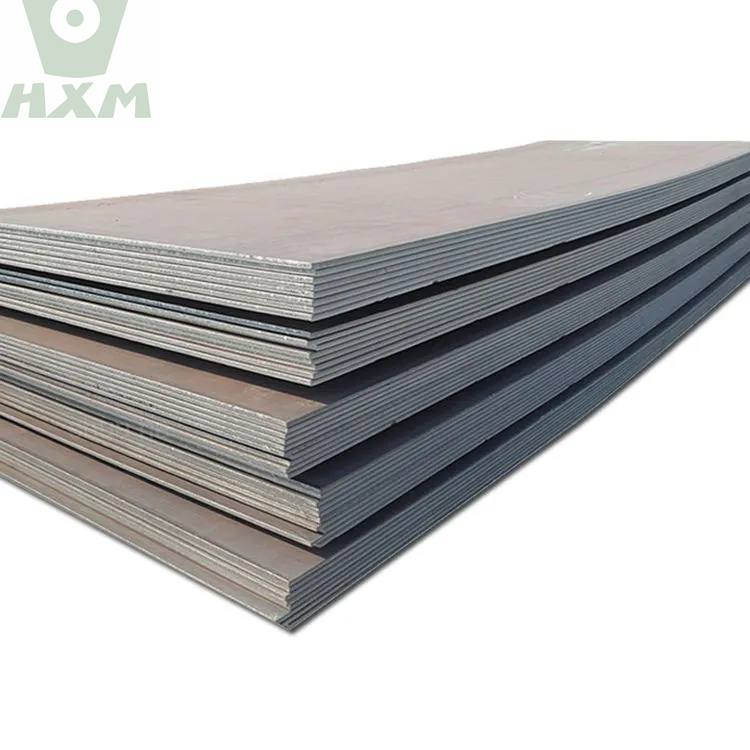
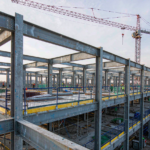
S355J2 structural steel plate is the workhorse of European-grade structural steel for cold climates: a fine-grained non-alloy steel to EN 10025-2 with 355 MPa minimum yield in thin sections and guaranteed 27 J Charpy impact energy at −20 °C. It is the grade engineers specify when S235JR no longer carries the load and S355J0’s 0 °C impact rating is not enough — bridges, crane structures, offshore support frames, heavy equipment chassis and buildings in Northern and Eastern Europe, Canada-adjacent projects and mountain regions. Huaxia-Steel supplies S355J2 plate from audited Chinese partner mills with EN 10204 3.1 certificates, normalized or thermomechanically rolled delivery, and cut-to-size service for direct fabrication.
Product Overview
S355J2 (1.0577) is delivered as-rolled (+AR), normalized (+N) or thermomechanically rolled (+M) depending on thickness and impact requirements. The “J2” suffix guarantees 27 J longitudinal Charpy energy at −20 °C (transverse values are reduced to 16 J minimum per the standard). Compared with S355JR (+20 °C) and S355J0 (0 °C), the J2 grade adds low-temperature toughness through lower carbon-equivalent chemistry and, in thicker sections, fine-grain aluminium-killed practice. The grade welds without preheat up to moderate thickness (CEV typically 0.35–0.43 depending on thickness class), forms well, and is available with Z-quality (Z15/Z25/Z35) through-thickness properties for welded node plates.
- Standard: EN 10025-2:2019 (S355J2, material number 1.0577).
- Delivery condition: +AR, +N or +M; normalized or normalized rolled for Charpy compliance in heavy sections.
- Impact test: 27 J longitudinal at −20 °C (KV transverse 16 J), three specimens per test unit.
- Z-quality option: Z15/Z25/Z35 per EN 10164 for heavily welded nodes.
- Supply range: thickness 3–250 mm, width up to 3200 mm, length up to 12000 mm (longer by arrangement).
Specifications: Dimensions, Weight and Tolerance
| Parameter | Range / Value |
|---|---|
| Thickness | 3–100 mm standard stock; 100–250 mm on request |
| Width | 1500 / 2000 / 2200 / 2500 / 3000 / 3200 mm |
| Length | 6000 / 12000 mm standard; cut-to-length ±5 mm |
| Theoretical weight | 7.85 kg/m² per mm thickness (e.g., 20 mm plate = 157 kg/m²) |
| Thickness tolerance | EN 10029 Class A/B/C/D on request; mill standard Class B typical |
| Flatness | EN 10029, steel type L (norm.) |
| Surface | Mill finish / shot blasted Sa 2.5 + primer on request |
| Cut-to-size | Flame or plasma cutting, beveling, drilling available |
Weight calculation for ordering and freight planning: W (kg) = length (m) × width (m) × thickness (mm) × 7.85. A 12 m × 2 m × 20 mm plate weighs 3.76 t; a 20 ft container accepts about 25–26 t of plate on cradles, so plan plate counts against container payload and road limits at destination.
Chemical Composition (Heat Analysis, EN 10025-2)
| Element | ≤16 mm | 16–40 mm | >40 mm |
|---|---|---|---|
| C | ≤ 0.20% | ≤ 0.20% | ≤ 0.22% |
| Si | ≤ 0.55% | ≤ 0.55% | ≤ 0.55% |
| Mn | ≤ 1.60% | ≤ 1.60% | ≤ 1.60% |
| P | ≤ 0.025% | ≤ 0.025% | ≤ 0.025% |
| S | ≤ 0.025% | ≤ 0.025% | ≤ 0.025% |
| CEV (max) | 0.44% | 0.44% | 0.45% |
The low phosphorus and sulfur limits (0.025%) — tighter than S235JR’s — are what give J2 its transverse toughness and weld metal cleanliness. For Z-quality plates, additional sulfur restriction (≤0.010% for Z25/Z35) and through-thickness reduction-of-area testing per EN 10164 apply.
Mechanical Properties (Transverse Values in Brackets)
| Property | ≤16 mm | >16–40 mm | >40–100 mm | >100–150 mm |
|---|---|---|---|---|
| Min yield (MPa) | 355 | 345 | 335 | 295 |
| Tensile (MPa) | 470–630 | 470–630 | 470–630 | 450–600 |
| Min elongation A5 | 21% (19%) | 21% (19%) | 21% (19%) | 19% (18%) |
| KV min at −20 °C (J) | 27 (16) | 27 (16) | 27 (16) | 27 (16) |
Manufacturing Standards and Delivery Condition
- Governing standard: EN 10025-2:2019 for chemistry and mechanical properties; plate dimensions to EN 10029 and EN 10051 (strip).
- Hot rolling: continuously cast slabs reheated and rolled; heavy gauge (≥ 40 mm) normally normalized rolled or normalized after rolling for fine grain and Charpy compliance.
- Impact testing frequency: per test unit as defined in EN 10025-2; testing at −20 °C is mandatory for the J2 suffix and appears on the 3.1 certificate.
- UT testing to EN 10160 (Level S1/E2 typical) or ASTM A578 Level B on request for pressure-adjacent or heavy weldment applications.
- Certification: EN 10204 3.1 standard; 3.2 (third-party witnessed) available for project material.
Equivalent Grades and Substitution Notes
| Standard | Grade | Note |
|---|---|---|
| EN 10025-2 | S355J2 (1.0577) | Reference grade, −20 °C impact |
| GB/T 1591 | Q355D | Closest Chinese equivalent, −20 °C impact |
| ASTM | A572 Gr50 (with A6) | Strength match; no −20 °C Charpy unless ordered |
| JIS G3106 | SM490A/B | Strength match; JIS impact temperature differs |
Substitution caution: A572 Gr50 is strength-equivalent but its Charpy is optional; for projects under EN 1090 or Eurocode certification, only EN 10025-2 material with full traceability is acceptable without project-specific approval. Q355D dual-certified to S355J2 is commonly available from Chinese mills and is the most economical route when a project references both standards — confirm the dual certification is printed on the 3.1 certificate.
Applications
- Bridge girders and structural frames in cold climates (Eurocode EN 1993 projects).
- Crane booms, slew rings supports and heavy equipment chassis.
- Offshore support structures, quay walls, dock fender systems.
- Storage tank shells and wind tower internals where low-temperature toughness is specified.
- Machine bases, press frames and welded heavy fabrications with −20 °C service exposure.
Quality Assurance and Inspection
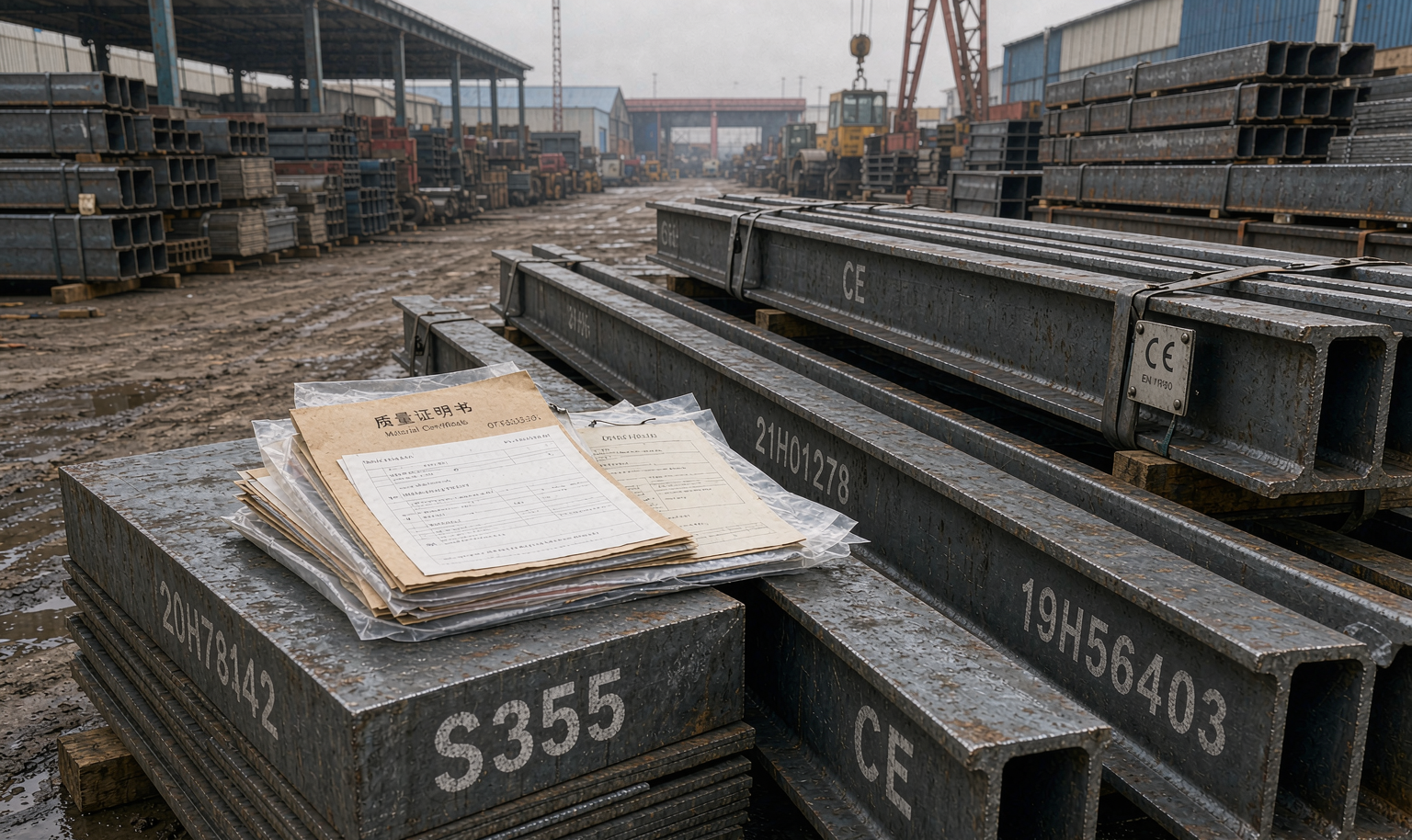
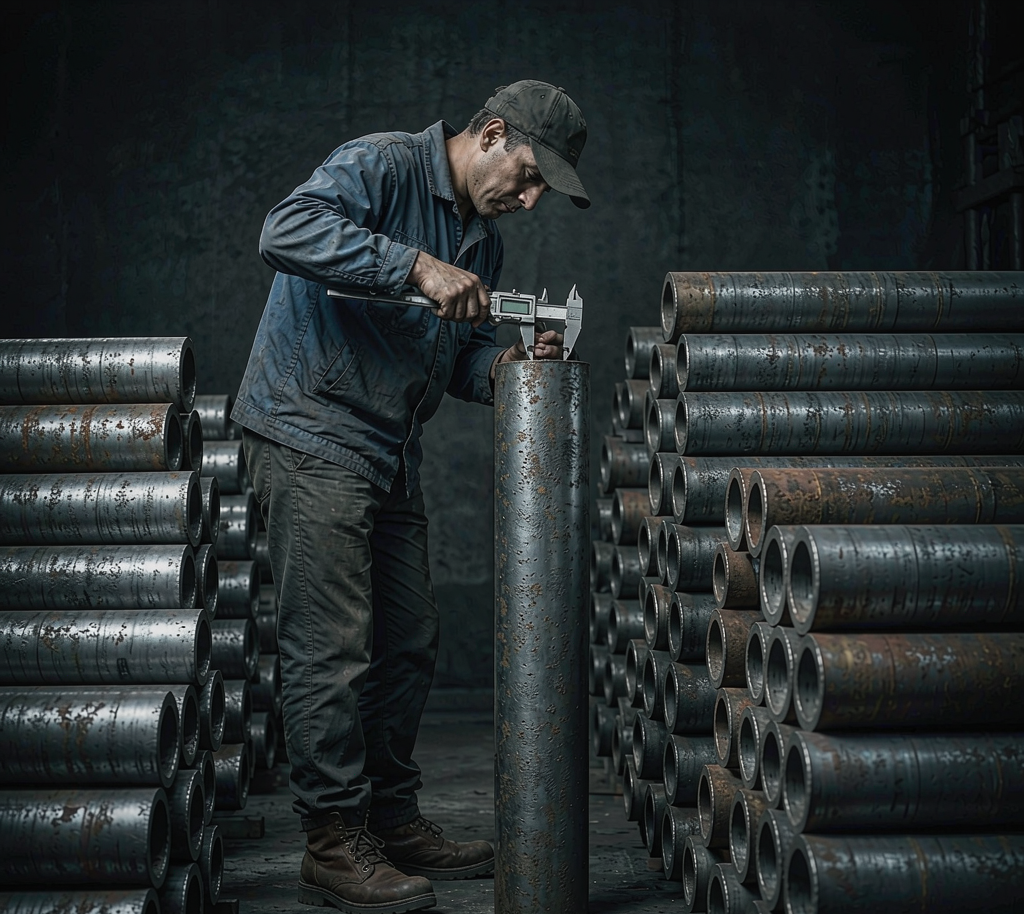
Every plate ships with an EN 10204 3.1 certificate showing heat chemistry, tensile results, −20 °C Charpy values and delivery condition, with heat numbers stenciled on the plate surface per EN 10025-2 marking rules. Our standard pre-shipment workflow includes thickness verification against the ordered tolerance class, surface and edge condition check, dimension and diagonal measurement, and certificate-to-marking traceability audit. Third-party inspection (SGS, BV, TUV, Lloyd’s) is welcomed and can witness Charpy tests at the mill laboratory. For Z-quality and UT-tested orders, UT maps and EN 10164 certificates are attached to the shipment dossier. Photos of marking and test specimen setup are provided before loading — ask for them with your order confirmation.
Packing and Shipping
Plates are packed in seaworthy export bundles on timber cradles or in containers on wooden skids, with steel strapping, edge protectors, and VCI paper or oiling on request to prevent transit rust on blasted surfaces. Each bundle carries a tag with heat number, size, grade and bundle weight matching the packing list; container shipments include dunnage plans to respect 26 t payload limits and destination road restrictions. Documents issued: commercial invoice, packing list, 3.1 certificates, and — where required — COO, CE (EN 1090) documentation for EU construction projects, and SGS/BV inspection certificates.
Corrosion Protection and Surface Preparation
S355J2 is not a weathering steel; it needs a protective system in exposed service. Standard export options are mill finish (scale intact), shot blasted to Sa 2.5 with shop primer (typically 15–25 µm epoxy), or full paint system to the project specification. Shot blasting before fabrication is worth specifying when the plate will be welded — it removes scale, exposes surface defects before you invest welding hours, and gives the primer a proper anchor profile. In buried or splash-zone service, use a coating system specified to ISO 12944 with the correct corrosivity category rather than generic shop primer; the cost difference is small compared with remediation.
Welding and Fabrication Guidance
S355J2 welds readily by SMAW, GMAW, FCAW and SAW. With CEV typically 0.35–0.44, no preheat is needed for combined thicknesses under roughly 25 mm at normal ambient temperature with low-hydrogen consumables; above that, apply 50–125 °C preheat depending on thickness, restraint and hydrogen level, and keep interpass temperature in the 100–200 °C band for normalized material. Recommended consumables: E7018 for SMAW or ER70S-6 / E71T-1 for GMAW/FCAW, matched to the 470–630 MPa tensile window. Use heat input in the 1.0–2.5 kJ/mm range — too low invites hard HAZ microstructures, too high degrades the fine-grain structure that delivers the −20 °C toughness you paid for.
- Cut edges: plasma and flame cut edges are hardened locally; grind 1–2 mm before welding critical joints or qualify the procedure with cut-edge specimens.
- Cold forming: minimum inside bend radius of about 1.0–1.5 × thickness transverse to rolling direction; below that, qualify by bend test.
- Post-weld heat treatment: rarely required for carbon-manganese steel of this strength level; when specified, stress relieve at 580–620 °C and confirm impact properties after PWHT.
- Galvanizing: possible, but heavy sections and high-silicon heats produce thick coatings — request silicon-controlled heats if the plate will be hot dip galvanized.
Ordering Checklist
- Grade and standard: S355J2, EN 10025-2:2019, material number 1.0577.
- Dimensions: thickness × width × length, with piece quantities rather than total weight.
- Tolerance class: EN 10029 Class B (standard) or tighter; state flatness requirement if plates feed automated cutting.
- Delivery condition: +AR, +N or +M — confirm against your Charpy and thickness combination.
- Impact: −20 °C, 27 J longitudinal (16 J transverse); state test direction if transverse values govern.
- Supplementary: Z15/Z25/Z35 per EN 10164, UT per EN 10160 or ASTM A578 level.
- Certification: EN 10204 3.1 standard, 3.2 if the project requires witnessed testing.
- Services: cut-to-size, beveling, drilling, shot blasting and primer.
- Inspection: PSI scope, third-party agency, rejection criteria agreed in writing.
- Commercial: Incoterm, port, validity, payment terms, lead time and LD clause.
Why Buy S355J2 From Huaxia-Steel
- Factory-direct pricing from audited partner mills, with one certificate chain per heat.
- Cut-to-size and beveling service so plates arrive fabrication-ready.
- Mandatory −20 °C Charpy on every J2 order — not an optional extra.
- EN 10204 3.1 (or 3.2) certificates, heat-number traceability, PSI support.
- Quotation within 24 hours, firm validity, FOB/CIF/DDP flexible terms.
Send your plate schedule (sizes, tolerance class, Z-quality or UT requirements) to our sales team for a same-day quotation, or request a sample certificate to review test reporting format before you commit the order.