How to Source Carbon Steel from China — Factory Audit, Quality Inspection & Shipping Guide
How to Source Carbon Steel from China — Factory Audit, Quality Inspection & Shipping Guide
China produces over 1 billion metric tons of crude steel annually — more than half of global output. For carbon steel buyers worldwide, Chinese mills offer competitive pricing, massive production capacity, and increasingly sophisticated quality control. But sourcing from China also presents unique challenges: language barriers, quality variability, logistics complexity, and trade compliance risks.
This guide provides a step-by-step sourcing framework — from identifying qualified mills and conducting factory audits, through quality inspection during production, to shipping and customs clearance — so you can buy carbon steel from China with confidence.
1. Understanding China’s Carbon Steel Production Landscape
Not all Chinese steel mills are equal. The industry divides roughly into three tiers:
Tier
Examples
Capacity
Export Readiness
Tier 1: State-owned giants
Baowu, Ansteel, Shougang, HBIS
30–100+ million tons/year
Full export departments, CE/API/DNV certified, experienced with L/C and international contracts
Tier 2: Large private mills
Shagang, Rizhao Steel, Fangda, Jianlong
10–30 million tons/year
Dedicated export teams, most international certifications available, competitive pricing
Tier 3: Regional/specialized mills
Various provincial mills
1–10 million tons/year
Variable export capability; may require a trading company intermediary; can offer niche products at aggressive prices
For most carbon steel buyers, Tier 2 mills offer the best value — international-standard quality at 8–15% below Tier 1 pricing, with faster decision-making and more flexible MOQs.
2. Step 1 — Pre-Qualify Suppliers Before You Send an RFQ
Before issuing a request for quotation, verify that each candidate supplier meets basic eligibility criteria. This eliminates the 60–70% of mills that cannot actually deliver to your requirements:
Export license: Does the mill hold a valid import-export license? Chinese steel mills must register with MOFCOM. Request the license number and verify it online.
Production capacity for your product: A mill making primarily rebar and wire rod cannot necessarily produce quality hot-rolled plate or seamless pipe. Ask for a detailed product list with maximum dimensions, grade range, and monthly capacity per product line.
International certifications: ISO 9001 is the baseline. Depending on your market, also verify CE (EU CPR), API (oil & gas), ABS/DNV/Lloyd’s (marine), or JIS (Japan). Certification is only valid if the scope of certification includes your specific product.
Export track record: Request references — at least three export clients in your region or a neighboring market. Contact them. A mill that cannot provide export references is either inexperienced or hiding problems.
Financial stability: Chinese corporate registration records (available through Qichacha or Tianyancha) reveal legal disputes, ownership changes, and capital status. A history of unpaid supplier lawsuits is a red flag.
3. Step 2 — The Factory Audit: What to Inspect On-Site
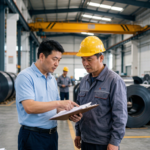
A factory audit is the single most valuable investment in your sourcing process. Spend 1–2 days on-site and inspect these six areas systematically:
3.1 Raw Material Management
Walk the scrap yard (for EAF mills) or raw material storage (for BOF mills). Look for: segregation of grades (is HSLA scrap mixed with general scrap?), covered storage for alloys and fluxes, and traceability systems linking incoming materials to heat numbers. Mills that dump everything into one pile cannot produce consistent chemistry.
3.2 Melting and Casting
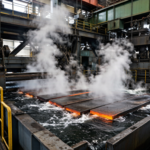
Verify: ladle furnace (LF) capacity — does it exist and is it used for your grade? Vacuum degassing availability (VD/RH) if your grade requires low hydrogen or nitrogen. Continuous caster condition — check for visible cracks, oscillation marks, or breakout patches on the slab/bloom/billet yard. For plates, electromagnetic stirring (EMS) at the caster significantly improves centerline soundness.
3.3 Rolling Mill Condition
Inspect roll condition (worn rolls produce poor surface and off-gauge product), descaling system effectiveness (inadequate descaling = scale pits embedded in the surface), and hot-leveler/flattening equipment for plates. Ask about the mill’s gauge control system — AGC (automatic gauge control) is standard; older manual mills will struggle with tight thickness tolerances.
3.4 Laboratory and Testing
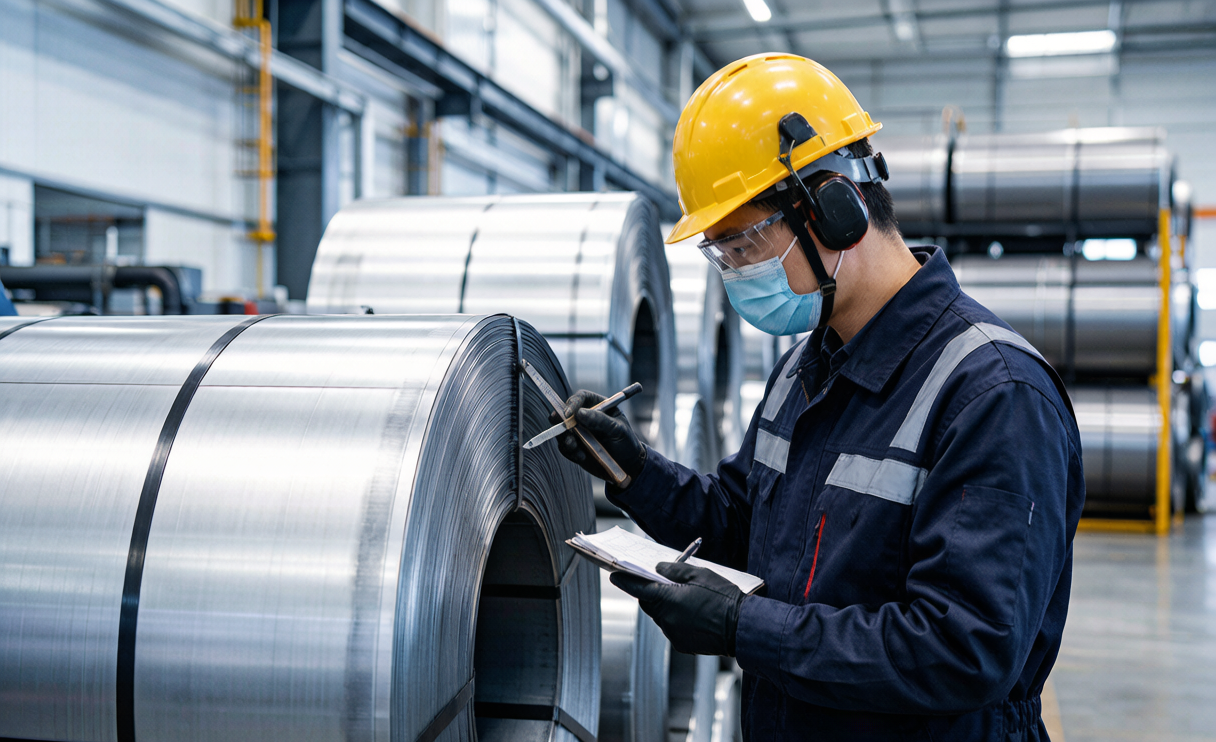
The laboratory tells you more about a mill’s quality commitment than any certificate on the wall. Check: OES spectrometer — how recently calibrated? Universal testing machine — capacity sufficient for your thickest product? Impact tester — can it reach your required test temperature? Does the lab retain test coupons and have a sample management system? If the lab is dirty, disorganized, or missing basic equipment, quality results are unreliable.
3.5 Finished Product Yard
Walk the finished goods yard and inspect: marking quality (heat numbers legible and matching the test certificates?), storage practices (are plates stored flat with dunnage, or stacked directly on dirt?), rust condition (light surface rust is normal for hot-rolled; heavy pitting indicates long storage), and handling damage (crane hook marks, fork truck dents — these indicate poor handling practices).
3.6 Documentation and Traceability
Pick a random heat number from the yard, then ask the QA manager to produce the complete documentation trail: ladle analysis → product analysis → rolling record → mechanical test report → inspection release. If this takes more than 15 minutes, the traceability system is inadequate.
4. Step 3 — Quality Inspection During Production
Even after a successful factory audit, production inspection protects your specific order. There are three inspection points:
4.1 Pre-Production Inspection (PPI)
Before the mill starts your heat: verify that raw materials match the agreed grade specification, review the planned rolling schedule and heat treatment parameters, confirm that testing equipment has current calibration, and agree on sampling locations and frequency. This 2–3 hour meeting prevents most quality disputes before they start.
4.2 During Production Inspection (DPI)
When your heat is being produced: witness ladle sampling (or take your own sample for independent analysis), observe rolling parameters (finishing temperature, coiling temperature, cooling rate), check initial dimensions on the first piece off the mill, and verify that online testing (UT, surface inspection) is active and recording. If anything deviates from the agreed parameters, stop production immediately — don’t wait for the entire heat to be rolled.
4.3 Pre-Shipment Inspection (PSI)
Before the steel leaves the mill: verify all mechanical test results against the standard and your purchase specification, perform dimensional checks on a statistical sample (AQL 2.5 or tighter), check surface quality and marking on every piece if possible, and compare the actual quantity against the packing list. Any non-conformity found during PSI is the mill’s responsibility to correct — after shipment, it becomes much harder to resolve.
Correct HS code classification is critical — a wrong code can mean rejected customs entry, penalties, or unexpected anti-dumping duties. Common carbon steel HS codes:
Product
HS Code (China Export)
Hot-rolled plate (600mm+ wide)
7208.51–7208.90
Hot-rolled coil
7208.10–7208.39
Cold-rolled sheet/coil
7209.16–7209.90
Hot-rolled bars & rods
7213–7215
Structural sections (I-beam, channel, angle)
7216.31–7216.50
Seamless pipe & tube
7304.19–7304.39
Welded pipe & tube
7306.30–7306.50
5.2 Shipping Methods
FCL (Full Container Load): For small quantities (up to 25 tons per 20ft, 28 tons per 40ft). More expensive per ton than bulk but suitable for trial orders and small-batch supply. Breakbulk: For 500–50,000+ tons. The most economical per-ton freight cost for structural steel, plates, and pipes. Requires port handling equipment at destination. RO-RO: For coils and bundled products that can be forklift-handled. Faster loading/unloading than breakbulk.
5.3 Customs Documentation
A complete export documentation package includes: commercial invoice, packing list (with heat numbers), bill of lading, certificate of origin (Form E for ASEAN, Form F for Chile, etc.), mill test certificates (EN 10204 3.1 or equivalent), fumigation certificate (if wooden pallets/crating are used), and insurance certificate (if CIF terms). Missing any one of these can delay customs clearance by days or weeks.
6. Payment Terms and Risk Management
International steel trade uses these payment structures, in order of increasing buyer risk:
Method
Buyer Risk
When to Use
L/C at sight (irrevocable)
Lowest
First order with a new mill; any order above $200,000
L/C 60/90 days
Low
Established relationships; improves cash flow
T/T 30% advance + 70% against B/L copy
Moderate
Repeat orders with audited mills; orders below $100,000
T/T 100% against B/L copy
Moderate-high
Trusted, long-term relationships only
T/T advance payment
Highest
Avoid unless absolutely necessary; if unavoidable, limit to 10–20%
Rule of thumb: For first-time orders with any Chinese mill, use an irrevocable L/C at sight. The modest bank charges ($500–1,500) are cheap insurance against the risk of non-delivery or substandard product.
7. Red Flags: Warning Signs When Sourcing from China
Huaxia-Steel’s procurement team flags these warning signs during supplier evaluation:
Reluctance to accept factory audit: A legitimate mill proud of its quality will welcome an audit. If a mill refuses or makes excuses, walk away.
Certificate photos, not originals: Ask for the original certification body and certificate number. Verify directly with the issuing body (TUV, SGS, BV, DNV, ABS) — don’t rely on photos that could be from any mill.
Prices significantly below market: If the price is 10%+ below the going rate for equivalent quality, the steel is almost certainly off-grade, re-rolled from obsolete scrap, or produced with shortcuts (missed heat treatment, fake test reports).
Vague delivery promises: “Ship within 30 days” with no production schedule, no heat allocation, no rolling slot confirmation. Professional mills give a production plan with specific dates.
No export track record in your region: A mill that has never shipped to your country doesn’t understand your port procedures, documentation requirements, or local standards enforcement. First shipments have a high probability of customs delays.
8. Working with a Steel Trading Company vs. Direct Mill Sourcing
For buyers purchasing less than 500 tons per order, working through a reputable steel trading company often delivers better overall value than direct mill sourcing — even though the unit price may be 3–5% higher. The trading company provides: consolidated logistics (mixing products from multiple mills into one shipment), quality screening (they absorb the risk of a bad batch, not you), documentation handling (export docs, certificate of origin, legalization), and market intelligence (which mills are currently producing good quality for your specific grade).
Frequently Asked Questions
What is the typical MOQ for carbon steel from China?
Tier 1 mills typically require 500–1,000 tons minimum per order. Tier 2 mills may accept 100–300 tons, and some specialized mills will produce as little as 50 tons — at a premium of $30–50/ton for small lots. For orders under 100 tons, a trading company is usually the most practical route.
How long does it take from order to delivery?
Typical lead times: 4–6 weeks production (standard grades, mill schedule permitting) + 2–4 weeks ocean freight (China to Middle East/SE Asia) + 1 week customs and inland transport. Total: 7–11 weeks. Add 2–3 weeks for quenched-and-tempered or normalized grades, and 3–4 additional weeks during Chinese New Year (Jan–Feb).
Can I trust Chinese mill test certificates?
From Tier 1 and reputable Tier 2 mills, yes — their export business depends on accurate certification, and falsifying test reports in international trade carries severe legal consequences. However, from unknown small mills or through unvetted trading companies, falsified MTRs are a known problem. Third-party inspection (SGS, Bureau Veritas, Intertek) eliminates this risk for a cost of $1,500–3,000 per shipment.
What about anti-dumping duties on Chinese steel?
As of 2026, the EU, USA, Canada, India, and several other countries maintain anti-dumping or countervailing duties on specific Chinese steel products. Before ordering, check the trade remedy database of your destination country. In some cases, sourcing specific grades (e.g., alloy-added grades that fall outside the AD scope) or using a non-Chinese mill of origin can avoid these duties.
How do I handle a quality dispute after delivery?
First, document everything: photos, independent test results (from a local accredited lab), and a detailed description of the non-conformity. Notify the mill or trading company in writing within the claim period specified in your contract (typically 30–60 days after arrival). If the dispute involves an L/C, notify your bank immediately. For significant claims above $50,000, engage a steel industry expert witness — their report carries weight in international arbitration.
Start Your China Carbon Steel Sourcing Journey
Huaxia-Steel bridges the gap between international buyers and China’s best carbon steel mills. We conduct factory audits, manage quality inspection during production, and handle all export documentation — so you get certified, traceable carbon steel delivered to your port without the headaches of direct sourcing.
Contact our sourcing team with your grade, dimensions, quantity, and destination port. We’ll provide a competitive quotation within 24 hours, backed by mill audit reports and sample certifications.
If you require further information about our metal sheet products or architectural projects, please don’t hesitate to leave your contact details and message here.
Our team of experts will respond within 24 hours to continue the discussion and provide you with any additional information you requires.