Carbon Steel Quenching and Tempering vs Normalizing and Tempering Compared
Heat treatment is where heat becomes strength. Two processes dominate the carbon steel plate and bar market: quenching and tempering (Q&T) and normalizing and tempering (N&T). They look similar on a certificate, but the steel inside behaves very differently – and the mill price, lead time, and downstream performance swing on that difference.
This guide explains both heat-treatment routes, when to pick each, and how to specify them cleanly in your RFQ.
1. Why Heat Treatment Routes Matter
As-rolled carbon steel plate has uneven grain size, residual stress from rolling, and inconsistent mechanical properties across thickness. Heat treatment refines the grain, reduces the residual stress, and tunes the balance of strength and toughness. The choice between Q&T and N&T decides:
- Strength level achievable for a given chemistry
- Toughness in low-temperature or impact duty
- Plate flatness and dimensional stability
- Through-thickness uniformity of mechanical properties
- Mill price and lead time
2. What Is Quenching and Tempering (Q&T)?
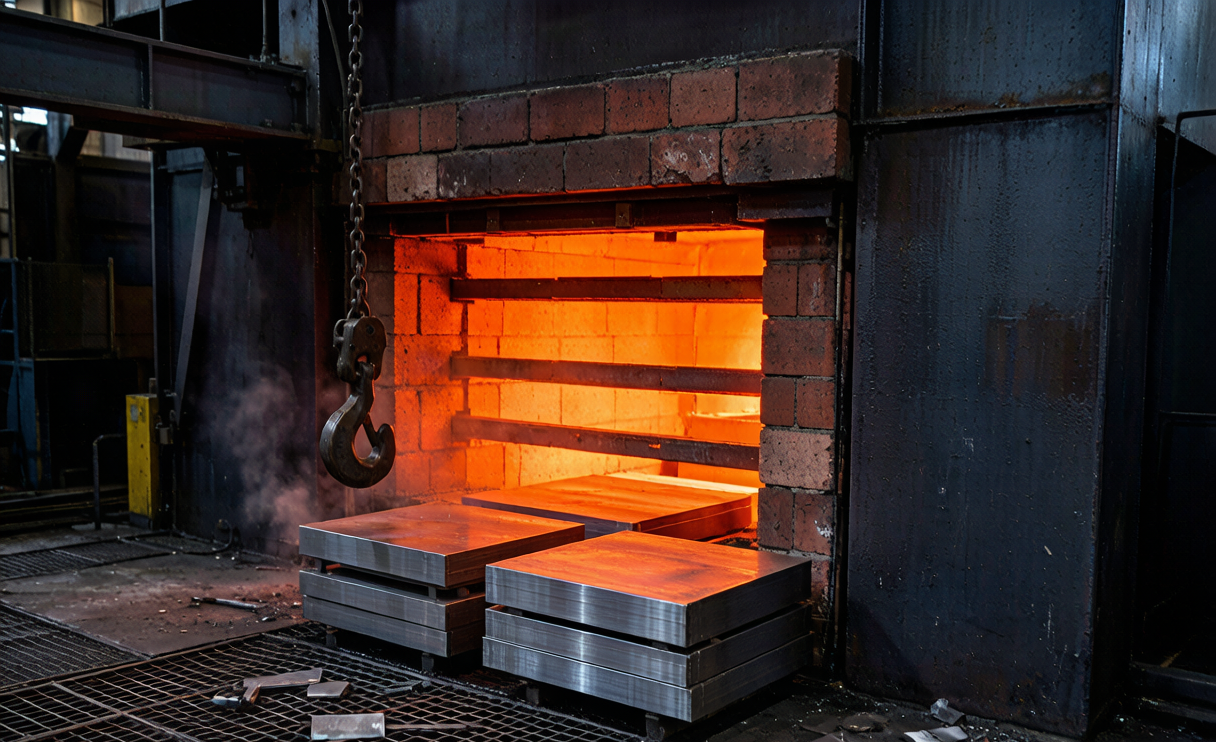
Q&T is a two-step heat treatment. The steel is first austenitized at 880-950 degrees C (uniform temperature within the transformation range) and then rapidly cooled (quenched) in water, oil, or polymer to form a hardened martensitic or bainitic microstructure. The hardened steel is then tempered at 550-680 degrees C to bring toughness back and to set the final strength.
- Step 1 – Austenitize: Heat uniformly to 880-950 degrees C, hold for a time proportional to thickness.
- Step 2 – Quench: Rapid cool in water (low carbon), oil, or polymer (medium/high carbon). Plates are typically quenched on a roller-convection line or a water curtain.
- Step 3 – Temper: Reheat to 550-680 degrees C, hold, then air cool. The tempering temperature sets the final hardness and toughness.
3. What Is Normalizing and Tempering (N&T)?
N&T also has two heating stages but uses air cooling instead of rapid quench between them. The steel is austenitized at 880-920 degrees C, then air cooled to room temperature to refine the grain (normalizing). The second tempering step at 550-680 degrees C relieves the residual stress and slightly toughens the matrix.
- Step 1 – Austenitize: Heat uniformly to 880-920 degrees C, hold for a time proportional to thickness.
- Step 2 – Air cool: Cool in still air. The result is a uniform fine-grained ferrite-pearlite structure.
- Step 3 – Temper: Reheat to 550-680 degrees C, hold, then air cool.
4. Microstructural Difference
| Property | Q&T steel | N&T steel |
|---|---|---|
| Primary microstructure | Tempered martensite / bainite | Fine-grained ferrite + pearlite |
| Grain size | Very fine (ASTM 8-12) | Fine (ASTM 6-9) |
| Hardness distribution | Uniform through thickness | Uniform through thickness for normal sizes |
| Residual stress | Lower (martensite tempered back) | Low (austenite to ferrite air cool without quench) |
| Yield strength gain vs as-rolled | 40-80% improvement possible | 15-25% improvement |
5. Mechanical Properties Comparison
| Property (typical carbon steel plate, 25 mm) | As-rolled | N&T | Q&T |
|---|---|---|---|
| Tensile strength | 490 MPa | 560 MPa | 650 MPa |
| Yield strength | 270 MPa | 340 MPa | 450 MPa |
| Elongation in 50 mm | 26% | 25% | 22% |
| Charpy at -20 degrees C | 40 J typical | 60 J typical | 100 J typical |
| Reduction of area | 55% | 55% | 50% |
Q&T delivers the highest strength and toughness for the same chemistry. N&T sits between as-rolled and Q&T, with better strength than as-rolled without the distortion and cost penalty of a quench.
6. Quenching Medium and Distortion Risk
| Quench medium | Cooling rate | Typical use | Distortion risk |
|---|---|---|---|
| Water | Very fast | Low-carbon plate under 25 mm | High – may bow plate |
| Oil | Moderate | Alloy and medium-carbon plate | Moderate |
| Polymer (PAG) | Adjustable | Carbon and low-alloy plate | Lower than water |
| Air (no quench) | Slow | Normalizing route | Minimal |
N&T avoids the quench step entirely, so distortion is much lower. This is a major reason plates that require close dimensional tolerance often choose N&T.
7. Applications by Heat Treatment Route
- Q&T plate: Pressure vessels, armor plate, high-strength structural members, mining equipment, quenched plate for bridges and high-rise buildings, hydropower penstocks, offshore jacket leg joints.
- N&T plate: Pressure vessels for moderate and low temperatures, normalized boiler plates, structural plate for bridges, gear blanks and forged rings requiring heat-treatment, machinery frames and housings.
8. Cost and Lead Time Comparison in 2026
On Chinese mill markets in mid-2026, the surcharge for heat treatment varies widely by heat-treatment route and thickness:
- As-rolled plate: baseline USD 540-620 per tonne FOB for A572 Gr.50 equivalent.
- N&T plate: adds USD 60-120 per tonne for the normalizing furnace + temper cycle.
- Q&T plate: adds USD 150-280 per tonne for the quench line + temper cycle.
Q&T plate requires a quench line, which only the larger Chinese mills (Baosteel, Shougang, Nanjing Iron, Hebei mills) operate. Lead time for Q&T plate is 4-6 weeks; N&T plate is typically 2-4 weeks.
9. Specification Examples
| Specification | Heat-treatment route | Typical grade |
|---|---|---|
| ASTM A516 Gr.70 (default) | As-rolled or normalized | Pressure vessel plate |
| ASTM A537 Cl.1 | Normalized (mandatory) | Pressure vessel plate |
| ASTM A537 Cl.2 | Q&T (mandatory) | Pressure vessel plate |
| ASTM A572 Gr.50 | As-rolled (default) | Structural plate |
| ASTM A633 Gr. E | Normalized | Low-temp structural plate |
| EN 10028-3 P355NL2 | Normalized | Pressure vessel plate |
| EN 10028-3 P460QL1 / QL2 | Q&T | Pressure vessel plate |
| GB/T 16270 Q690D | Q&T | High-strength plate |
10. Inspection and Quality Tests
Heat-treated plate is verified through:
- Mechanical testing: Tensile, yield, elongation (per ASTM A370 or EN ISO 6892).
- Charpy impact: Tested at the specified temperature (typically -20 degrees C or -46 degrees C) for low-temperature duty.
- Hardness survey: Through-thickness Brinell or Vickers measurements confirm uniform response.
- Ultrasonic testing: Per ASTM A578 or EN 10160 to detect internal defects.
- Metallographic examination: Grain size and microstructure per ASTM E112.
Both Q&T and N&T plate must meet the same mechanical property envelope; the tests, however, often reveal different failure modes if a mill process is drifting.
11. How to Specify in an RFQ
- Define the standard and grade (for example, “ASTM A537 Class 2”).
- State the heat treatment route (“Q&T”, “N&T”, or “as-rolled”).
- Define the test temperature for Charpy (for example, “-46 degrees C at 27 J minimum”).
- Specify the through-thickness requirement (full thickness or quarter thickness).
- Add any supplementary tests (drop-weight tear, strain-aged, hydrogen-induced cracking).
- Specify the MTC per EN 10204 3.1 with the heat-treatment cycle on the certificate.
FAQ
Is Q&T stronger than N&T?
Yes. Q&T steel typically has 25-40 percent higher yield strength than N&T steel for the same chemistry, because of martensitic microstructural refinement.
Why pick N&T over Q&T?
N&T avoids the quench distortion, is cheaper, and is suitable when the required strength is in the 340-460 MPa range rather than the 450-690 MPa range.
Does Q&T plate warp more?
Yes – the rapid quench introduces thermal gradient stress that bows the plate unless it is followed by a press straightening operation.
Which is better for low-temperature service?
Both work, but Q&T plate typically delivers higher Charpy at a given test temperature than N&T plate. Specify Q&T for cryogenic and arctic applications where impact performance dominates.
Are the costs always higher for Q&T?
Yes. The quench step requires additional furnace, water/oil tanks, press straighteners, and energy. Expect USD 150-280 per tonne extra in mid-2026 Chinese mill pricing.
Conclusion
The Q&T vs N&T choice is about how much strength you need and how much distortion you can tolerate. Q&T delivers the highest strength and toughness, at the cost of mill energy and plate flatness. N&T delivers a useful strength lift without the quench penalty. Match the heat-treatment route to the service duty – and always state it explicitly in the RFQ to avoid the mill defaulting to as-rolled.
Buying heat-treated carbon steel plate from China? Huaxia-Steel supplies normalized, Q&T, and as-rolled plate from leading Chinese mills with EN 10204 3.1 certificates, through-thickness testing, and third-party inspection. Send the standard, grade, thickness, and heat-treatment requirement, and we will deliver a tailored offer within two working days.
Related Images