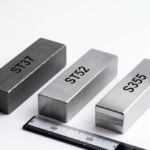
S355J2 vs S355NL Carbon Steel Plate: Which EN 10025 Grade Should You Specify?
Source S355J2 and S355NL Plate from Huaxia Steel
Huaxia Steel supplies EN 10025 S355J2 and S355NL plate in thicknesses 5 – 200 mm from Chinese mills with EN 10204 3.1 / 3.2 certification, DNV / ABS / LR / BV classification support, and on-demand third-party inspection. Send your drawing or RFQ and we will return a factory-direct quotation within 24 hours.
Yes — most mills can deliver plate marked “S355J2 / S355NL” when the heat meets both EN 10025-2 and EN 10025-3 requirements. This is common for offshore projects and saves inventory. The certificate will list both designations.
Procurement Tips: How to Specify S355J2 and S355NL on Your RFQ
When you issue a request for quotation for S355J2 or S355NL plate, four items drive the price differential and on-time delivery: (1) nominal thickness and width, (2) Charpy impact test temperature and minimum energy, (3) third-party inspection scope, and (4) supplementary requirements such as ultrasonic test, Z-direction performance or normalized rolling condition. Always state the standard reference (EN 10025-2 for S355J2, EN 10025-3 for S355NL) so the mill knows which delivery condition is mandatory. The most common RFQ mistakes are silent omissions: a buyer writes “S355 plate” without the sub-grade letter and then receives S355JR at a slightly lower price; later the structural engineer rejects the lot because the Charpy at -20 °C cannot be demonstrated.
If the application is a low-temperature pressure vessel, bridge component, wind-tower flange or offshore node, specify EN 10025-3 S355NL with Charpy at -50 °C ≥ 27 J as the mandatory impact requirement, and request normalized rolling (N) rather than normalized (N) in the data sheet. The normalized-rolling route gives a finer grain and tighter through-thickness ductility than the standard normalized route. Mills charge a 3 – 5% premium for the N delivery condition plus normalized-rolling; it is worth it for thick plate above 40 mm.
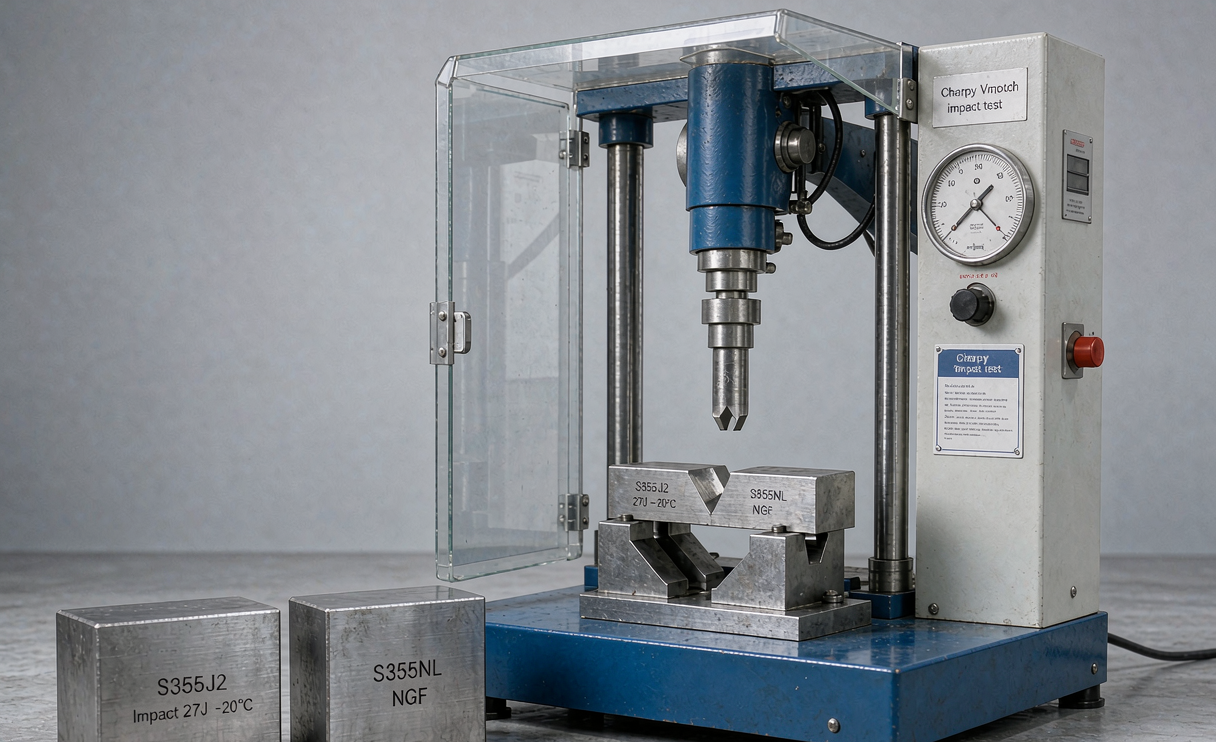
For S355J2 specified under EN 10025-2, the mandatory Charpy is 27 J at -20 °C. If the engineering spec is “structural steel for moderate-cold regions”, -20 °C is the right test; if the spec is “inland bridge in tropical climate”, S355JR with 27 J at +20 °C is sufficient and saves roughly 3 – 4% per ton. Always ask the mill for the option of a “dual certification” — EN 10025-2 S355J2 and JIS G3106 SM490A, for example — at no extra cost, so you can ship the same heat to customers who reference different standards.
Welding Notes for S355J2 and S355NL Plate
Both S355J2 and S355NL are readily weldable by SMAW, GMAW, FCAW and SAW with the usual carbon-steel practice: preheat to 100 – 150 °C when the combined thickness exceeds 30 mm, the carbon equivalent (CEV) is above 0.45%, or the ambient temperature is below 5 °C. For S355NL, the typical CEV is 0.38 – 0.43% depending on the heat; for S355J2 it is 0.40 – 0.45%. Use a low-hydrogen electrode (EN ISO 2560-A E 46 5 B 12 H10 or AWS E7018-1) for the S355J2 and S355NL routes, and avoid cellulosic (E6010 / E7010) for thick plate above 25 mm because they drive hydrogen into the heat-affected zone. The interpass temperature should stay below 250 °C for both grades to keep the HAZ grain size fine and the Charpy at -20 °C well above 27 J.
For thick-plate S355NL above 50 mm, consider normalizing the entire fabricated assembly at 900 – 940 °C if the welding heat input exceeded 2.5 kJ/mm in any pass. This post-weld normalizing restores the through-thickness grain structure that the welding heat disturbed. The cost of post-weld normalizing adds roughly 6 – 9% to the fabrication cost but is the only way to guarantee the -50 °C Charpy in heavy sections. For S355J2, post-weld normalizing is rarely needed; a stress-relief anneal at 600 °C is usually sufficient for dimensional stability.
Frequently Asked Questions
Q: Can I use S355J2 in place of S355NL if the design temperature is -30 °C? A: Generally no. S355J2 is impact-tested only to -20 °C (27 J minimum). If the lowest design temperature is -30 °C or below, S355NL (impact-tested to -50 °C) is the safer choice. Some engineers accept S355J2 down to -30 °C with a derating factor on the allowable stress, but this is unusual and should be approved by the responsible structural engineer in writing.
Q: Is S355NL always more expensive than S355J2? A: Yes, but the gap has narrowed. As of 2026 the typical price difference is 4 – 7% per ton in the 10 – 50 mm thickness range, driven by the extra normalized-rolling pass and the additional Charpy testing at -50 °C. Above 50 mm thickness, the gap can widen to 10% because S355NL is more often produced in lower volume.
Q: Does S355NL require third-party inspection? A: For most non-classed applications, EN 10204 3.1 mill certificate is sufficient. For offshore, wind tower, pressure vessel or bridge applications, EN 10204 3.2 with classification society witness (DNV / ABS / LR / BV / TÜV) is mandatory. We can arrange 3.2 certificates at our mill for any S355NL order above 20 tons.
Source S355J2 and S355NL Plate from Huaxia Steel
Huaxia Steel supplies EN 10025 S355J2 and S355NL plate in thicknesses 5 – 200 mm from Chinese mills with EN 10204 3.1 / 3.2 certification, DNV / ABS / LR / BV classification support, and on-demand third-party inspection. Send your drawing or RFQ and we will return a factory-direct quotation within 24 hours.
No. A572 Grade 50 is the closest American structural grade by yield (345 MPa minimum), but it is not produced to the same fine-grain practice and has a less stringent low-temperature impact requirement. For equivalent low-temperature performance, look at ASTM A633 Grade E or A709 Grade 50W.
Q2: Can I dual-cert S355J2 and S355NL?
Yes — most mills can deliver plate marked “S355J2 / S355NL” when the heat meets both EN 10025-2 and EN 10025-3 requirements. This is common for offshore projects and saves inventory. The certificate will list both designations.
Q3: Is S355J2 suitable for galvanizing?
Yes. S355J2 with silicon below 0.30% and phosphorus below 0.025% (typical for batch hot-dip galvanizing) produces good coating adhesion. For continuously galvanized structural sections, specify the silicon-plus-phosphorus “Sandelin” curve band on the certificate.
Q4: What inspection documents come with EN 10025 plate?
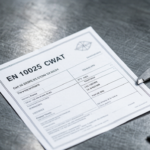
Standard is EN 10204 3.1 issued by the mill’s quality department. For pressure equipment or classed projects, request 3.2 certification with third-party witnessing (BV, SGS, TÜV, DNV). Each plate is marked with heat number, grade, plate number, and CE marking where applicable.
Procurement Tips: How to Specify S355J2 and S355NL on Your RFQ
When you issue a request for quotation for S355J2 or S355NL plate, four items drive the price differential and on-time delivery: (1) nominal thickness and width, (2) Charpy impact test temperature and minimum energy, (3) third-party inspection scope, and (4) supplementary requirements such as ultrasonic test, Z-direction performance or normalized rolling condition. Always state the standard reference (EN 10025-2 for S355J2, EN 10025-3 for S355NL) so the mill knows which delivery condition is mandatory. The most common RFQ mistakes are silent omissions: a buyer writes “S355 plate” without the sub-grade letter and then receives S355JR at a slightly lower price; later the structural engineer rejects the lot because the Charpy at -20 °C cannot be demonstrated.
If the application is a low-temperature pressure vessel, bridge component, wind-tower flange or offshore node, specify EN 10025-3 S355NL with Charpy at -50 °C ≥ 27 J as the mandatory impact requirement, and request normalized rolling (N) rather than normalized (N) in the data sheet. The normalized-rolling route gives a finer grain and tighter through-thickness ductility than the standard normalized route. Mills charge a 3 – 5% premium for the N delivery condition plus normalized-rolling; it is worth it for thick plate above 40 mm.
For S355J2 specified under EN 10025-2, the mandatory Charpy is 27 J at -20 °C. If the engineering spec is “structural steel for moderate-cold regions”, -20 °C is the right test; if the spec is “inland bridge in tropical climate”, S355JR with 27 J at +20 °C is sufficient and saves roughly 3 – 4% per ton. Always ask the mill for the option of a “dual certification” — EN 10025-2 S355J2 and JIS G3106 SM490A, for example — at no extra cost, so you can ship the same heat to customers who reference different standards.
Welding Notes for S355J2 and S355NL Plate
Both S355J2 and S355NL are readily weldable by SMAW, GMAW, FCAW and SAW with the usual carbon-steel practice: preheat to 100 – 150 °C when the combined thickness exceeds 30 mm, the carbon equivalent (CEV) is above 0.45%, or the ambient temperature is below 5 °C. For S355NL, the typical CEV is 0.38 – 0.43% depending on the heat; for S355J2 it is 0.40 – 0.45%. Use a low-hydrogen electrode (EN ISO 2560-A E 46 5 B 12 H10 or AWS E7018-1) for the S355J2 and S355NL routes, and avoid cellulosic (E6010 / E7010) for thick plate above 25 mm because they drive hydrogen into the heat-affected zone. The interpass temperature should stay below 250 °C for both grades to keep the HAZ grain size fine and the Charpy at -20 °C well above 27 J.
For thick-plate S355NL above 50 mm, consider normalizing the entire fabricated assembly at 900 – 940 °C if the welding heat input exceeded 2.5 kJ/mm in any pass. This post-weld normalizing restores the through-thickness grain structure that the welding heat disturbed. The cost of post-weld normalizing adds roughly 6 – 9% to the fabrication cost but is the only way to guarantee the -50 °C Charpy in heavy sections. For S355J2, post-weld normalizing is rarely needed; a stress-relief anneal at 600 °C is usually sufficient for dimensional stability.
Frequently Asked Questions
Q: Can I use S355J2 in place of S355NL if the design temperature is -30 °C? A: Generally no. S355J2 is impact-tested only to -20 °C (27 J minimum). If the lowest design temperature is -30 °C or below, S355NL (impact-tested to -50 °C) is the safer choice. Some engineers accept S355J2 down to -30 °C with a derating factor on the allowable stress, but this is unusual and should be approved by the responsible structural engineer in writing.
Q: Is S355NL always more expensive than S355J2? A: Yes, but the gap has narrowed. As of 2026 the typical price difference is 4 – 7% per ton in the 10 – 50 mm thickness range, driven by the extra normalized-rolling pass and the additional Charpy testing at -50 °C. Above 50 mm thickness, the gap can widen to 10% because S355NL is more often produced in lower volume.
Q: Does S355NL require third-party inspection? A: For most non-classed applications, EN 10204 3.1 mill certificate is sufficient. For offshore, wind tower, pressure vessel or bridge applications, EN 10204 3.2 with classification society witness (DNV / ABS / LR / BV / TÜV) is mandatory. We can arrange 3.2 certificates at our mill for any S355NL order above 20 tons.
Source S355J2 and S355NL Plate from Huaxia Steel
Huaxia Steel supplies EN 10025 S355J2 and S355NL plate in thicknesses 5 – 200 mm from Chinese mills with EN 10204 3.1 / 3.2 certification, DNV / ABS / LR / BV classification support, and on-demand third-party inspection. Send your drawing or RFQ and we will return a factory-direct quotation within 24 hours.
Frequently Asked Questions
Q1: Is S355NL the same as ASTM A572 Grade 50?
No. A572 Grade 50 is the closest American structural grade by yield (345 MPa minimum), but it is not produced to the same fine-grain practice and has a less stringent low-temperature impact requirement. For equivalent low-temperature performance, look at ASTM A633 Grade E or A709 Grade 50W.
Q2: Can I dual-cert S355J2 and S355NL?
Yes — most mills can deliver plate marked “S355J2 / S355NL” when the heat meets both EN 10025-2 and EN 10025-3 requirements. This is common for offshore projects and saves inventory. The certificate will list both designations.
Q3: Is S355J2 suitable for galvanizing?
Yes. S355J2 with silicon below 0.30% and phosphorus below 0.025% (typical for batch hot-dip galvanizing) produces good coating adhesion. For continuously galvanized structural sections, specify the silicon-plus-phosphorus “Sandelin” curve band on the certificate.
Q4: What inspection documents come with EN 10025 plate?
Standard is EN 10204 3.1 issued by the mill’s quality department. For pressure equipment or classed projects, request 3.2 certification with third-party witnessing (BV, SGS, TÜV, DNV). Each plate is marked with heat number, grade, plate number, and CE marking where applicable.
Procurement Tips: How to Specify S355J2 and S355NL on Your RFQ
When you issue a request for quotation for S355J2 or S355NL plate, four items drive the price differential and on-time delivery: (1) nominal thickness and width, (2) Charpy impact test temperature and minimum energy, (3) third-party inspection scope, and (4) supplementary requirements such as ultrasonic test, Z-direction performance or normalized rolling condition. Always state the standard reference (EN 10025-2 for S355J2, EN 10025-3 for S355NL) so the mill knows which delivery condition is mandatory. The most common RFQ mistakes are silent omissions: a buyer writes “S355 plate” without the sub-grade letter and then receives S355JR at a slightly lower price; later the structural engineer rejects the lot because the Charpy at -20 °C cannot be demonstrated.
If the application is a low-temperature pressure vessel, bridge component, wind-tower flange or offshore node, specify EN 10025-3 S355NL with Charpy at -50 °C ≥ 27 J as the mandatory impact requirement, and request normalized rolling (N) rather than normalized (N) in the data sheet. The normalized-rolling route gives a finer grain and tighter through-thickness ductility than the standard normalized route. Mills charge a 3 – 5% premium for the N delivery condition plus normalized-rolling; it is worth it for thick plate above 40 mm.
For S355J2 specified under EN 10025-2, the mandatory Charpy is 27 J at -20 °C. If the engineering spec is “structural steel for moderate-cold regions”, -20 °C is the right test; if the spec is “inland bridge in tropical climate”, S355JR with 27 J at +20 °C is sufficient and saves roughly 3 – 4% per ton. Always ask the mill for the option of a “dual certification” — EN 10025-2 S355J2 and JIS G3106 SM490A, for example — at no extra cost, so you can ship the same heat to customers who reference different standards.
Welding Notes for S355J2 and S355NL Plate
Both S355J2 and S355NL are readily weldable by SMAW, GMAW, FCAW and SAW with the usual carbon-steel practice: preheat to 100 – 150 °C when the combined thickness exceeds 30 mm, the carbon equivalent (CEV) is above 0.45%, or the ambient temperature is below 5 °C. For S355NL, the typical CEV is 0.38 – 0.43% depending on the heat; for S355J2 it is 0.40 – 0.45%. Use a low-hydrogen electrode (EN ISO 2560-A E 46 5 B 12 H10 or AWS E7018-1) for the S355J2 and S355NL routes, and avoid cellulosic (E6010 / E7010) for thick plate above 25 mm because they drive hydrogen into the heat-affected zone. The interpass temperature should stay below 250 °C for both grades to keep the HAZ grain size fine and the Charpy at -20 °C well above 27 J.
For thick-plate S355NL above 50 mm, consider normalizing the entire fabricated assembly at 900 – 940 °C if the welding heat input exceeded 2.5 kJ/mm in any pass. This post-weld normalizing restores the through-thickness grain structure that the welding heat disturbed. The cost of post-weld normalizing adds roughly 6 – 9% to the fabrication cost but is the only way to guarantee the -50 °C Charpy in heavy sections. For S355J2, post-weld normalizing is rarely needed; a stress-relief anneal at 600 °C is usually sufficient for dimensional stability.
Frequently Asked Questions
Q: Can I use S355J2 in place of S355NL if the design temperature is -30 °C? A: Generally no. S355J2 is impact-tested only to -20 °C (27 J minimum). If the lowest design temperature is -30 °C or below, S355NL (impact-tested to -50 °C) is the safer choice. Some engineers accept S355J2 down to -30 °C with a derating factor on the allowable stress, but this is unusual and should be approved by the responsible structural engineer in writing.
Q: Is S355NL always more expensive than S355J2? A: Yes, but the gap has narrowed. As of 2026 the typical price difference is 4 – 7% per ton in the 10 – 50 mm thickness range, driven by the extra normalized-rolling pass and the additional Charpy testing at -50 °C. Above 50 mm thickness, the gap can widen to 10% because S355NL is more often produced in lower volume.
Q: Does S355NL require third-party inspection? A: For most non-classed applications, EN 10204 3.1 mill certificate is sufficient. For offshore, wind tower, pressure vessel or bridge applications, EN 10204 3.2 with classification society witness (DNV / ABS / LR / BV / TÜV) is mandatory. We can arrange 3.2 certificates at our mill for any S355NL order above 20 tons.
Source S355J2 and S355NL Plate from Huaxia Steel
Huaxia Steel supplies EN 10025 S355J2 and S355NL plate in thicknesses 5 – 200 mm from Chinese mills with EN 10204 3.1 / 3.2 certification, DNV / ABS / LR / BV classification support, and on-demand third-party inspection. Send your drawing or RFQ and we will return a factory-direct quotation within 24 hours.
A few real-world tips from European plate procurement:
Always ask for the delivery condition in writing — “normalized” for S355NL, “normalized-rolled” or “normalized” for S355J2. Mill test certificates often abbreviate these as “N” or “AR” (as-rolled), which can mislead.
For offshore or classed projects, request EN 10204 3.2 with explicit witnessing by the classification society. Standard 3.1 mill certification is sufficient only for general building applications.
If your project allows either grade, dual-certifying as “S355J2 / S355NL” gives your inventory team maximum flexibility and avoids the cost of stocking two separate heat batches.
For plate above 80 mm, the normalized-rolled condition is rarely available — most mills will normalize in the furnace regardless. Specify “normalized” rather than “normalized-rolled” for thick plate.
Always check the through-thickness tensile property (Z-direction) for plates used in thick welded joints — S355NL typically meets Z35 with reduced sulphur, S355J2 may require a separate Z-grade order.
Frequently Asked Questions
Q1: Is S355NL the same as ASTM A572 Grade 50?
No. A572 Grade 50 is the closest American structural grade by yield (345 MPa minimum), but it is not produced to the same fine-grain practice and has a less stringent low-temperature impact requirement. For equivalent low-temperature performance, look at ASTM A633 Grade E or A709 Grade 50W.
Q2: Can I dual-cert S355J2 and S355NL?
Yes — most mills can deliver plate marked “S355J2 / S355NL” when the heat meets both EN 10025-2 and EN 10025-3 requirements. This is common for offshore projects and saves inventory. The certificate will list both designations.
Q3: Is S355J2 suitable for galvanizing?
Yes. S355J2 with silicon below 0.30% and phosphorus below 0.025% (typical for batch hot-dip galvanizing) produces good coating adhesion. For continuously galvanized structural sections, specify the silicon-plus-phosphorus “Sandelin” curve band on the certificate.
Q4: What inspection documents come with EN 10025 plate?
Standard is EN 10204 3.1 issued by the mill’s quality department. For pressure equipment or classed projects, request 3.2 certification with third-party witnessing (BV, SGS, TÜV, DNV). Each plate is marked with heat number, grade, plate number, and CE marking where applicable.
Procurement Tips: How to Specify S355J2 and S355NL on Your RFQ
When you issue a request for quotation for S355J2 or S355NL plate, four items drive the price differential and on-time delivery: (1) nominal thickness and width, (2) Charpy impact test temperature and minimum energy, (3) third-party inspection scope, and (4) supplementary requirements such as ultrasonic test, Z-direction performance or normalized rolling condition. Always state the standard reference (EN 10025-2 for S355J2, EN 10025-3 for S355NL) so the mill knows which delivery condition is mandatory. The most common RFQ mistakes are silent omissions: a buyer writes “S355 plate” without the sub-grade letter and then receives S355JR at a slightly lower price; later the structural engineer rejects the lot because the Charpy at -20 °C cannot be demonstrated.
If the application is a low-temperature pressure vessel, bridge component, wind-tower flange or offshore node, specify EN 10025-3 S355NL with Charpy at -50 °C ≥ 27 J as the mandatory impact requirement, and request normalized rolling (N) rather than normalized (N) in the data sheet. The normalized-rolling route gives a finer grain and tighter through-thickness ductility than the standard normalized route. Mills charge a 3 – 5% premium for the N delivery condition plus normalized-rolling; it is worth it for thick plate above 40 mm.
For S355J2 specified under EN 10025-2, the mandatory Charpy is 27 J at -20 °C. If the engineering spec is “structural steel for moderate-cold regions”, -20 °C is the right test; if the spec is “inland bridge in tropical climate”, S355JR with 27 J at +20 °C is sufficient and saves roughly 3 – 4% per ton. Always ask the mill for the option of a “dual certification” — EN 10025-2 S355J2 and JIS G3106 SM490A, for example — at no extra cost, so you can ship the same heat to customers who reference different standards.
Welding Notes for S355J2 and S355NL Plate
Both S355J2 and S355NL are readily weldable by SMAW, GMAW, FCAW and SAW with the usual carbon-steel practice: preheat to 100 – 150 °C when the combined thickness exceeds 30 mm, the carbon equivalent (CEV) is above 0.45%, or the ambient temperature is below 5 °C. For S355NL, the typical CEV is 0.38 – 0.43% depending on the heat; for S355J2 it is 0.40 – 0.45%. Use a low-hydrogen electrode (EN ISO 2560-A E 46 5 B 12 H10 or AWS E7018-1) for the S355J2 and S355NL routes, and avoid cellulosic (E6010 / E7010) for thick plate above 25 mm because they drive hydrogen into the heat-affected zone. The interpass temperature should stay below 250 °C for both grades to keep the HAZ grain size fine and the Charpy at -20 °C well above 27 J.
For thick-plate S355NL above 50 mm, consider normalizing the entire fabricated assembly at 900 – 940 °C if the welding heat input exceeded 2.5 kJ/mm in any pass. This post-weld normalizing restores the through-thickness grain structure that the welding heat disturbed. The cost of post-weld normalizing adds roughly 6 – 9% to the fabrication cost but is the only way to guarantee the -50 °C Charpy in heavy sections. For S355J2, post-weld normalizing is rarely needed; a stress-relief anneal at 600 °C is usually sufficient for dimensional stability.
Frequently Asked Questions
Q: Can I use S355J2 in place of S355NL if the design temperature is -30 °C? A: Generally no. S355J2 is impact-tested only to -20 °C (27 J minimum). If the lowest design temperature is -30 °C or below, S355NL (impact-tested to -50 °C) is the safer choice. Some engineers accept S355J2 down to -30 °C with a derating factor on the allowable stress, but this is unusual and should be approved by the responsible structural engineer in writing.
Q: Is S355NL always more expensive than S355J2? A: Yes, but the gap has narrowed. As of 2026 the typical price difference is 4 – 7% per ton in the 10 – 50 mm thickness range, driven by the extra normalized-rolling pass and the additional Charpy testing at -50 °C. Above 50 mm thickness, the gap can widen to 10% because S355NL is more often produced in lower volume.
Q: Does S355NL require third-party inspection? A: For most non-classed applications, EN 10204 3.1 mill certificate is sufficient. For offshore, wind tower, pressure vessel or bridge applications, EN 10204 3.2 with classification society witness (DNV / ABS / LR / BV / TÜV) is mandatory. We can arrange 3.2 certificates at our mill for any S355NL order above 20 tons.
Source S355J2 and S355NL Plate from Huaxia Steel
Huaxia Steel supplies EN 10025 S355J2 and S355NL plate in thicknesses 5 – 200 mm from Chinese mills with EN 10204 3.1 / 3.2 certification, DNV / ABS / LR / BV classification support, and on-demand third-party inspection. Send your drawing or RFQ and we will return a factory-direct quotation within 24 hours.
Specify S355J2 if your service temperature is above -20 °C, plate thickness is below 50 mm, and your execution class is EN 1090-2 EXC1 or EXC2.
Specify S355NL if the service temperature is between -20 °C and -50 °C, plate thickness is above 50 mm, or your project is classed (offshore, pressure vessel, arctic).
For low-temperature service below -50 °C, you may need S355ML (thermo-mechanically rolled) or a fully killed fine-grain steel with extra-low CEV.
9. Practical Procurement Tips
A few real-world tips from European plate procurement:
Always ask for the delivery condition in writing — “normalized” for S355NL, “normalized-rolled” or “normalized” for S355J2. Mill test certificates often abbreviate these as “N” or “AR” (as-rolled), which can mislead.
For offshore or classed projects, request EN 10204 3.2 with explicit witnessing by the classification society. Standard 3.1 mill certification is sufficient only for general building applications.
If your project allows either grade, dual-certifying as “S355J2 / S355NL” gives your inventory team maximum flexibility and avoids the cost of stocking two separate heat batches.
For plate above 80 mm, the normalized-rolled condition is rarely available — most mills will normalize in the furnace regardless. Specify “normalized” rather than “normalized-rolled” for thick plate.
Always check the through-thickness tensile property (Z-direction) for plates used in thick welded joints — S355NL typically meets Z35 with reduced sulphur, S355J2 may require a separate Z-grade order.
Frequently Asked Questions
Q1: Is S355NL the same as ASTM A572 Grade 50?
No. A572 Grade 50 is the closest American structural grade by yield (345 MPa minimum), but it is not produced to the same fine-grain practice and has a less stringent low-temperature impact requirement. For equivalent low-temperature performance, look at ASTM A633 Grade E or A709 Grade 50W.
Q2: Can I dual-cert S355J2 and S355NL?
Yes — most mills can deliver plate marked “S355J2 / S355NL” when the heat meets both EN 10025-2 and EN 10025-3 requirements. This is common for offshore projects and saves inventory. The certificate will list both designations.
Q3: Is S355J2 suitable for galvanizing?
Yes. S355J2 with silicon below 0.30% and phosphorus below 0.025% (typical for batch hot-dip galvanizing) produces good coating adhesion. For continuously galvanized structural sections, specify the silicon-plus-phosphorus “Sandelin” curve band on the certificate.
Q4: What inspection documents come with EN 10025 plate?
Standard is EN 10204 3.1 issued by the mill’s quality department. For pressure equipment or classed projects, request 3.2 certification with third-party witnessing (BV, SGS, TÜV, DNV). Each plate is marked with heat number, grade, plate number, and CE marking where applicable.
Procurement Tips: How to Specify S355J2 and S355NL on Your RFQ
When you issue a request for quotation for S355J2 or S355NL plate, four items drive the price differential and on-time delivery: (1) nominal thickness and width, (2) Charpy impact test temperature and minimum energy, (3) third-party inspection scope, and (4) supplementary requirements such as ultrasonic test, Z-direction performance or normalized rolling condition. Always state the standard reference (EN 10025-2 for S355J2, EN 10025-3 for S355NL) so the mill knows which delivery condition is mandatory. The most common RFQ mistakes are silent omissions: a buyer writes “S355 plate” without the sub-grade letter and then receives S355JR at a slightly lower price; later the structural engineer rejects the lot because the Charpy at -20 °C cannot be demonstrated.
If the application is a low-temperature pressure vessel, bridge component, wind-tower flange or offshore node, specify EN 10025-3 S355NL with Charpy at -50 °C ≥ 27 J as the mandatory impact requirement, and request normalized rolling (N) rather than normalized (N) in the data sheet. The normalized-rolling route gives a finer grain and tighter through-thickness ductility than the standard normalized route. Mills charge a 3 – 5% premium for the N delivery condition plus normalized-rolling; it is worth it for thick plate above 40 mm.
For S355J2 specified under EN 10025-2, the mandatory Charpy is 27 J at -20 °C. If the engineering spec is “structural steel for moderate-cold regions”, -20 °C is the right test; if the spec is “inland bridge in tropical climate”, S355JR with 27 J at +20 °C is sufficient and saves roughly 3 – 4% per ton. Always ask the mill for the option of a “dual certification” — EN 10025-2 S355J2 and JIS G3106 SM490A, for example — at no extra cost, so you can ship the same heat to customers who reference different standards.
Welding Notes for S355J2 and S355NL Plate
Both S355J2 and S355NL are readily weldable by SMAW, GMAW, FCAW and SAW with the usual carbon-steel practice: preheat to 100 – 150 °C when the combined thickness exceeds 30 mm, the carbon equivalent (CEV) is above 0.45%, or the ambient temperature is below 5 °C. For S355NL, the typical CEV is 0.38 – 0.43% depending on the heat; for S355J2 it is 0.40 – 0.45%. Use a low-hydrogen electrode (EN ISO 2560-A E 46 5 B 12 H10 or AWS E7018-1) for the S355J2 and S355NL routes, and avoid cellulosic (E6010 / E7010) for thick plate above 25 mm because they drive hydrogen into the heat-affected zone. The interpass temperature should stay below 250 °C for both grades to keep the HAZ grain size fine and the Charpy at -20 °C well above 27 J.
For thick-plate S355NL above 50 mm, consider normalizing the entire fabricated assembly at 900 – 940 °C if the welding heat input exceeded 2.5 kJ/mm in any pass. This post-weld normalizing restores the through-thickness grain structure that the welding heat disturbed. The cost of post-weld normalizing adds roughly 6 – 9% to the fabrication cost but is the only way to guarantee the -50 °C Charpy in heavy sections. For S355J2, post-weld normalizing is rarely needed; a stress-relief anneal at 600 °C is usually sufficient for dimensional stability.
Frequently Asked Questions
Q: Can I use S355J2 in place of S355NL if the design temperature is -30 °C? A: Generally no. S355J2 is impact-tested only to -20 °C (27 J minimum). If the lowest design temperature is -30 °C or below, S355NL (impact-tested to -50 °C) is the safer choice. Some engineers accept S355J2 down to -30 °C with a derating factor on the allowable stress, but this is unusual and should be approved by the responsible structural engineer in writing.
Q: Is S355NL always more expensive than S355J2? A: Yes, but the gap has narrowed. As of 2026 the typical price difference is 4 – 7% per ton in the 10 – 50 mm thickness range, driven by the extra normalized-rolling pass and the additional Charpy testing at -50 °C. Above 50 mm thickness, the gap can widen to 10% because S355NL is more often produced in lower volume.
Q: Does S355NL require third-party inspection? A: For most non-classed applications, EN 10204 3.1 mill certificate is sufficient. For offshore, wind tower, pressure vessel or bridge applications, EN 10204 3.2 with classification society witness (DNV / ABS / LR / BV / TÜV) is mandatory. We can arrange 3.2 certificates at our mill for any S355NL order above 20 tons.
Source S355J2 and S355NL Plate from Huaxia Steel
Huaxia Steel supplies EN 10025 S355J2 and S355NL plate in thicknesses 5 – 200 mm from Chinese mills with EN 10204 3.1 / 3.2 certification, DNV / ABS / LR / BV classification support, and on-demand third-party inspection. Send your drawing or RFQ and we will return a factory-direct quotation within 24 hours.
S355NL typically costs 10 – 18% more than S355J2 at the same plate thickness. The premium reflects the additional normalizing furnace step, tighter chemistry, lower test temperature and lower mill yield. For a 50 mm plate quotation, expect S355NL to land at $620 – $720 per ton CFR compared with $530 – $620 for S355J2 (rates vary monthly with scrap and energy costs).
8. How to Choose
Specify S355J2 if your service temperature is above -20 °C, plate thickness is below 50 mm, and your execution class is EN 1090-2 EXC1 or EXC2.
Specify S355NL if the service temperature is between -20 °C and -50 °C, plate thickness is above 50 mm, or your project is classed (offshore, pressure vessel, arctic).
For low-temperature service below -50 °C, you may need S355ML (thermo-mechanically rolled) or a fully killed fine-grain steel with extra-low CEV.
9. Practical Procurement Tips
A few real-world tips from European plate procurement:
Always ask for the delivery condition in writing — “normalized” for S355NL, “normalized-rolled” or “normalized” for S355J2. Mill test certificates often abbreviate these as “N” or “AR” (as-rolled), which can mislead.
For offshore or classed projects, request EN 10204 3.2 with explicit witnessing by the classification society. Standard 3.1 mill certification is sufficient only for general building applications.
If your project allows either grade, dual-certifying as “S355J2 / S355NL” gives your inventory team maximum flexibility and avoids the cost of stocking two separate heat batches.
For plate above 80 mm, the normalized-rolled condition is rarely available — most mills will normalize in the furnace regardless. Specify “normalized” rather than “normalized-rolled” for thick plate.
Always check the through-thickness tensile property (Z-direction) for plates used in thick welded joints — S355NL typically meets Z35 with reduced sulphur, S355J2 may require a separate Z-grade order.
Frequently Asked Questions
Q1: Is S355NL the same as ASTM A572 Grade 50?
No. A572 Grade 50 is the closest American structural grade by yield (345 MPa minimum), but it is not produced to the same fine-grain practice and has a less stringent low-temperature impact requirement. For equivalent low-temperature performance, look at ASTM A633 Grade E or A709 Grade 50W.
Q2: Can I dual-cert S355J2 and S355NL?
Yes — most mills can deliver plate marked “S355J2 / S355NL” when the heat meets both EN 10025-2 and EN 10025-3 requirements. This is common for offshore projects and saves inventory. The certificate will list both designations.
Q3: Is S355J2 suitable for galvanizing?
Yes. S355J2 with silicon below 0.30% and phosphorus below 0.025% (typical for batch hot-dip galvanizing) produces good coating adhesion. For continuously galvanized structural sections, specify the silicon-plus-phosphorus “Sandelin” curve band on the certificate.
Q4: What inspection documents come with EN 10025 plate?
Standard is EN 10204 3.1 issued by the mill’s quality department. For pressure equipment or classed projects, request 3.2 certification with third-party witnessing (BV, SGS, TÜV, DNV). Each plate is marked with heat number, grade, plate number, and CE marking where applicable.
Procurement Tips: How to Specify S355J2 and S355NL on Your RFQ
When you issue a request for quotation for S355J2 or S355NL plate, four items drive the price differential and on-time delivery: (1) nominal thickness and width, (2) Charpy impact test temperature and minimum energy, (3) third-party inspection scope, and (4) supplementary requirements such as ultrasonic test, Z-direction performance or normalized rolling condition. Always state the standard reference (EN 10025-2 for S355J2, EN 10025-3 for S355NL) so the mill knows which delivery condition is mandatory. The most common RFQ mistakes are silent omissions: a buyer writes “S355 plate” without the sub-grade letter and then receives S355JR at a slightly lower price; later the structural engineer rejects the lot because the Charpy at -20 °C cannot be demonstrated.
If the application is a low-temperature pressure vessel, bridge component, wind-tower flange or offshore node, specify EN 10025-3 S355NL with Charpy at -50 °C ≥ 27 J as the mandatory impact requirement, and request normalized rolling (N) rather than normalized (N) in the data sheet. The normalized-rolling route gives a finer grain and tighter through-thickness ductility than the standard normalized route. Mills charge a 3 – 5% premium for the N delivery condition plus normalized-rolling; it is worth it for thick plate above 40 mm.
For S355J2 specified under EN 10025-2, the mandatory Charpy is 27 J at -20 °C. If the engineering spec is “structural steel for moderate-cold regions”, -20 °C is the right test; if the spec is “inland bridge in tropical climate”, S355JR with 27 J at +20 °C is sufficient and saves roughly 3 – 4% per ton. Always ask the mill for the option of a “dual certification” — EN 10025-2 S355J2 and JIS G3106 SM490A, for example — at no extra cost, so you can ship the same heat to customers who reference different standards.
Welding Notes for S355J2 and S355NL Plate
Both S355J2 and S355NL are readily weldable by SMAW, GMAW, FCAW and SAW with the usual carbon-steel practice: preheat to 100 – 150 °C when the combined thickness exceeds 30 mm, the carbon equivalent (CEV) is above 0.45%, or the ambient temperature is below 5 °C. For S355NL, the typical CEV is 0.38 – 0.43% depending on the heat; for S355J2 it is 0.40 – 0.45%. Use a low-hydrogen electrode (EN ISO 2560-A E 46 5 B 12 H10 or AWS E7018-1) for the S355J2 and S355NL routes, and avoid cellulosic (E6010 / E7010) for thick plate above 25 mm because they drive hydrogen into the heat-affected zone. The interpass temperature should stay below 250 °C for both grades to keep the HAZ grain size fine and the Charpy at -20 °C well above 27 J.
For thick-plate S355NL above 50 mm, consider normalizing the entire fabricated assembly at 900 – 940 °C if the welding heat input exceeded 2.5 kJ/mm in any pass. This post-weld normalizing restores the through-thickness grain structure that the welding heat disturbed. The cost of post-weld normalizing adds roughly 6 – 9% to the fabrication cost but is the only way to guarantee the -50 °C Charpy in heavy sections. For S355J2, post-weld normalizing is rarely needed; a stress-relief anneal at 600 °C is usually sufficient for dimensional stability.
Frequently Asked Questions
Q: Can I use S355J2 in place of S355NL if the design temperature is -30 °C? A: Generally no. S355J2 is impact-tested only to -20 °C (27 J minimum). If the lowest design temperature is -30 °C or below, S355NL (impact-tested to -50 °C) is the safer choice. Some engineers accept S355J2 down to -30 °C with a derating factor on the allowable stress, but this is unusual and should be approved by the responsible structural engineer in writing.
Q: Is S355NL always more expensive than S355J2? A: Yes, but the gap has narrowed. As of 2026 the typical price difference is 4 – 7% per ton in the 10 – 50 mm thickness range, driven by the extra normalized-rolling pass and the additional Charpy testing at -50 °C. Above 50 mm thickness, the gap can widen to 10% because S355NL is more often produced in lower volume.
Q: Does S355NL require third-party inspection? A: For most non-classed applications, EN 10204 3.1 mill certificate is sufficient. For offshore, wind tower, pressure vessel or bridge applications, EN 10204 3.2 with classification society witness (DNV / ABS / LR / BV / TÜV) is mandatory. We can arrange 3.2 certificates at our mill for any S355NL order above 20 tons.
Source S355J2 and S355NL Plate from Huaxia Steel
Huaxia Steel supplies EN 10025 S355J2 and S355NL plate in thicknesses 5 – 200 mm from Chinese mills with EN 10204 3.1 / 3.2 certification, DNV / ABS / LR / BV classification support, and on-demand third-party inspection. Send your drawing or RFQ and we will return a factory-direct quotation within 24 hours.
For combined thickness up to 30 mm, pre-heat to 50 – 75 °C for S355J2.
For combined thickness 30 – 60 mm, pre-heat to 100 – 150 °C.
For S355NL thick plate (above 50 mm) or low-hydrogen requirements, use basic-coated low-hydrogen electrodes (EN ISO 2560-A E 50 4 B or AWS E7018).
Both grades can be hot-formed (above 700 °C) and stress-relief annealed. S355NL tolerates higher post-weld heat input without grain coarsening because of its finer starting grain.
6. Typical Applications
S355J2 is the workhorse grade for:
Building frames and high-rise structural members in temperate climates.
Bridges in mild climates (design temperatures above -20 °C).
Industrial buildings, warehouses, factory sheds.
Earth-moving equipment frames and truck chassis.
General fabricated plate components for the machinery industry.
S355NL is preferred for:
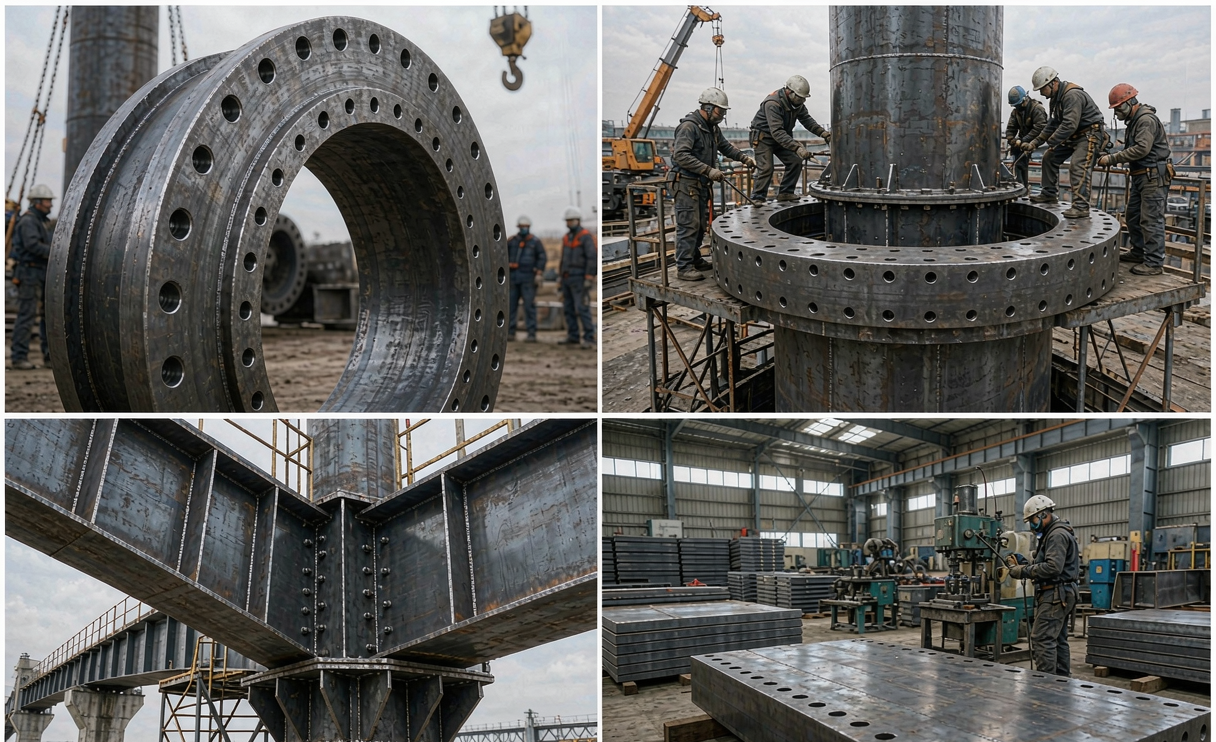
Wind turbine towers and flange rings, especially offshore (DNV GL, EN 1090-2 EXC3/4 execution class).
Arctic and sub-arctic bridges, harbours and infrastructure.
Offshore platform leg and brace plate (DNV, ABS, LR classed).
Pressure equipment shells for low-temperature service (PED 2014/68/EU).
Heavy transport frames and rail wagon bogies for cold-climate operation.
7. Cost Difference
S355NL typically costs 10 – 18% more than S355J2 at the same plate thickness. The premium reflects the additional normalizing furnace step, tighter chemistry, lower test temperature and lower mill yield. For a 50 mm plate quotation, expect S355NL to land at $620 – $720 per ton CFR compared with $530 – $620 for S355J2 (rates vary monthly with scrap and energy costs).
8. How to Choose
Specify S355J2 if your service temperature is above -20 °C, plate thickness is below 50 mm, and your execution class is EN 1090-2 EXC1 or EXC2.
Specify S355NL if the service temperature is between -20 °C and -50 °C, plate thickness is above 50 mm, or your project is classed (offshore, pressure vessel, arctic).
For low-temperature service below -50 °C, you may need S355ML (thermo-mechanically rolled) or a fully killed fine-grain steel with extra-low CEV.
9. Practical Procurement Tips
A few real-world tips from European plate procurement:
Always ask for the delivery condition in writing — “normalized” for S355NL, “normalized-rolled” or “normalized” for S355J2. Mill test certificates often abbreviate these as “N” or “AR” (as-rolled), which can mislead.
For offshore or classed projects, request EN 10204 3.2 with explicit witnessing by the classification society. Standard 3.1 mill certification is sufficient only for general building applications.
If your project allows either grade, dual-certifying as “S355J2 / S355NL” gives your inventory team maximum flexibility and avoids the cost of stocking two separate heat batches.
For plate above 80 mm, the normalized-rolled condition is rarely available — most mills will normalize in the furnace regardless. Specify “normalized” rather than “normalized-rolled” for thick plate.
Always check the through-thickness tensile property (Z-direction) for plates used in thick welded joints — S355NL typically meets Z35 with reduced sulphur, S355J2 may require a separate Z-grade order.
Frequently Asked Questions
Q1: Is S355NL the same as ASTM A572 Grade 50?
No. A572 Grade 50 is the closest American structural grade by yield (345 MPa minimum), but it is not produced to the same fine-grain practice and has a less stringent low-temperature impact requirement. For equivalent low-temperature performance, look at ASTM A633 Grade E or A709 Grade 50W.
Q2: Can I dual-cert S355J2 and S355NL?
Yes — most mills can deliver plate marked “S355J2 / S355NL” when the heat meets both EN 10025-2 and EN 10025-3 requirements. This is common for offshore projects and saves inventory. The certificate will list both designations.
Q3: Is S355J2 suitable for galvanizing?
Yes. S355J2 with silicon below 0.30% and phosphorus below 0.025% (typical for batch hot-dip galvanizing) produces good coating adhesion. For continuously galvanized structural sections, specify the silicon-plus-phosphorus “Sandelin” curve band on the certificate.
Q4: What inspection documents come with EN 10025 plate?
Standard is EN 10204 3.1 issued by the mill’s quality department. For pressure equipment or classed projects, request 3.2 certification with third-party witnessing (BV, SGS, TÜV, DNV). Each plate is marked with heat number, grade, plate number, and CE marking where applicable.
Procurement Tips: How to Specify S355J2 and S355NL on Your RFQ
When you issue a request for quotation for S355J2 or S355NL plate, four items drive the price differential and on-time delivery: (1) nominal thickness and width, (2) Charpy impact test temperature and minimum energy, (3) third-party inspection scope, and (4) supplementary requirements such as ultrasonic test, Z-direction performance or normalized rolling condition. Always state the standard reference (EN 10025-2 for S355J2, EN 10025-3 for S355NL) so the mill knows which delivery condition is mandatory. The most common RFQ mistakes are silent omissions: a buyer writes “S355 plate” without the sub-grade letter and then receives S355JR at a slightly lower price; later the structural engineer rejects the lot because the Charpy at -20 °C cannot be demonstrated.
If the application is a low-temperature pressure vessel, bridge component, wind-tower flange or offshore node, specify EN 10025-3 S355NL with Charpy at -50 °C ≥ 27 J as the mandatory impact requirement, and request normalized rolling (N) rather than normalized (N) in the data sheet. The normalized-rolling route gives a finer grain and tighter through-thickness ductility than the standard normalized route. Mills charge a 3 – 5% premium for the N delivery condition plus normalized-rolling; it is worth it for thick plate above 40 mm.
For S355J2 specified under EN 10025-2, the mandatory Charpy is 27 J at -20 °C. If the engineering spec is “structural steel for moderate-cold regions”, -20 °C is the right test; if the spec is “inland bridge in tropical climate”, S355JR with 27 J at +20 °C is sufficient and saves roughly 3 – 4% per ton. Always ask the mill for the option of a “dual certification” — EN 10025-2 S355J2 and JIS G3106 SM490A, for example — at no extra cost, so you can ship the same heat to customers who reference different standards.
Welding Notes for S355J2 and S355NL Plate
Both S355J2 and S355NL are readily weldable by SMAW, GMAW, FCAW and SAW with the usual carbon-steel practice: preheat to 100 – 150 °C when the combined thickness exceeds 30 mm, the carbon equivalent (CEV) is above 0.45%, or the ambient temperature is below 5 °C. For S355NL, the typical CEV is 0.38 – 0.43% depending on the heat; for S355J2 it is 0.40 – 0.45%. Use a low-hydrogen electrode (EN ISO 2560-A E 46 5 B 12 H10 or AWS E7018-1) for the S355J2 and S355NL routes, and avoid cellulosic (E6010 / E7010) for thick plate above 25 mm because they drive hydrogen into the heat-affected zone. The interpass temperature should stay below 250 °C for both grades to keep the HAZ grain size fine and the Charpy at -20 °C well above 27 J.
For thick-plate S355NL above 50 mm, consider normalizing the entire fabricated assembly at 900 – 940 °C if the welding heat input exceeded 2.5 kJ/mm in any pass. This post-weld normalizing restores the through-thickness grain structure that the welding heat disturbed. The cost of post-weld normalizing adds roughly 6 – 9% to the fabrication cost but is the only way to guarantee the -50 °C Charpy in heavy sections. For S355J2, post-weld normalizing is rarely needed; a stress-relief anneal at 600 °C is usually sufficient for dimensional stability.
Frequently Asked Questions
Q: Can I use S355J2 in place of S355NL if the design temperature is -30 °C? A: Generally no. S355J2 is impact-tested only to -20 °C (27 J minimum). If the lowest design temperature is -30 °C or below, S355NL (impact-tested to -50 °C) is the safer choice. Some engineers accept S355J2 down to -30 °C with a derating factor on the allowable stress, but this is unusual and should be approved by the responsible structural engineer in writing.
Q: Is S355NL always more expensive than S355J2? A: Yes, but the gap has narrowed. As of 2026 the typical price difference is 4 – 7% per ton in the 10 – 50 mm thickness range, driven by the extra normalized-rolling pass and the additional Charpy testing at -50 °C. Above 50 mm thickness, the gap can widen to 10% because S355NL is more often produced in lower volume.
Q: Does S355NL require third-party inspection? A: For most non-classed applications, EN 10204 3.1 mill certificate is sufficient. For offshore, wind tower, pressure vessel or bridge applications, EN 10204 3.2 with classification society witness (DNV / ABS / LR / BV / TÜV) is mandatory. We can arrange 3.2 certificates at our mill for any S355NL order above 20 tons.
Source S355J2 and S355NL Plate from Huaxia Steel
Huaxia Steel supplies EN 10025 S355J2 and S355NL plate in thicknesses 5 – 200 mm from Chinese mills with EN 10204 3.1 / 3.2 certification, DNV / ABS / LR / BV classification support, and on-demand third-party inspection. Send your drawing or RFQ and we will return a factory-direct quotation within 24 hours.
For plate up to 16 mm, the minimum mechanical properties are essentially the same — that is the point of unifying them under S355. As thickness increases, the minimum yield drops slightly but remains identical between the two grades.
Property
S355J2
S355NL
Yield strength (t ≤ 16 mm)
≥ 355 MPa
≥ 355 MPa
Yield strength (16 < t ≤ 40 mm)
≥ 345 MPa
≥ 345 MPa
Tensile strength
470 – 630 MPa
470 – 630 MPa
Elongation (A5)
≥ 22%
≥ 22%
Charpy V-notch (longitudinal)
27 J @ -20 °C
27 J @ -50 °C
Where the grades truly diverge is the impact test temperature. S355NL guarantees 27 J at -50 °C, which is 30 °C colder than the S355J2 requirement. For offshore wind, arctic pipelines, polar vessels and cold-climate bridges, only S355NL is acceptable.
4. Delivery Condition and Microstructure
This is the technical detail most procurement teams overlook, and it has real consequences for fabrication.
S355J2 — delivered in the normalized-rolled (N) condition under EN 10025-2. Normalized rolling uses a tight temperature window during rolling to refine grain without a separate furnace normalizing step. This is faster and cheaper, but limits plate thickness to about 80 mm in practice. Above that, mills usually recommend a true normalized condition.
S355NL — must be delivered in the normalized (N) condition per EN 10025-3. The plate is reheated to about 900 °C after rolling and air-cooled in a separate operation. This guarantees a uniform fine-grain ferritic-pearlitic microstructure even in heavy plate (up to 250 mm and beyond).
In practice, S355NL is more consistent in heavy plate because the normalization step resets the grain structure. For thick wind-tower flange plate, offshore leg plate and pressure-vessel shells, this consistency is non-negotiable.
5. Weldability
Both grades have similar carbon equivalent values and are considered readily weldable by all conventional processes (SMAW, GMAW, FCAW, SAW). Standard pre-heat and interpass guidelines apply:
For combined thickness up to 30 mm, pre-heat to 50 – 75 °C for S355J2.
For combined thickness 30 – 60 mm, pre-heat to 100 – 150 °C.
For S355NL thick plate (above 50 mm) or low-hydrogen requirements, use basic-coated low-hydrogen electrodes (EN ISO 2560-A E 50 4 B or AWS E7018).
Both grades can be hot-formed (above 700 °C) and stress-relief annealed. S355NL tolerates higher post-weld heat input without grain coarsening because of its finer starting grain.
6. Typical Applications
S355J2 is the workhorse grade for:
Building frames and high-rise structural members in temperate climates.
Bridges in mild climates (design temperatures above -20 °C).
Industrial buildings, warehouses, factory sheds.
Earth-moving equipment frames and truck chassis.
General fabricated plate components for the machinery industry.
S355NL is preferred for:
Wind turbine towers and flange rings, especially offshore (DNV GL, EN 1090-2 EXC3/4 execution class).
Arctic and sub-arctic bridges, harbours and infrastructure.
Offshore platform leg and brace plate (DNV, ABS, LR classed).
Pressure equipment shells for low-temperature service (PED 2014/68/EU).
Heavy transport frames and rail wagon bogies for cold-climate operation.
7. Cost Difference
S355NL typically costs 10 – 18% more than S355J2 at the same plate thickness. The premium reflects the additional normalizing furnace step, tighter chemistry, lower test temperature and lower mill yield. For a 50 mm plate quotation, expect S355NL to land at $620 – $720 per ton CFR compared with $530 – $620 for S355J2 (rates vary monthly with scrap and energy costs).
8. How to Choose
Specify S355J2 if your service temperature is above -20 °C, plate thickness is below 50 mm, and your execution class is EN 1090-2 EXC1 or EXC2.
Specify S355NL if the service temperature is between -20 °C and -50 °C, plate thickness is above 50 mm, or your project is classed (offshore, pressure vessel, arctic).
For low-temperature service below -50 °C, you may need S355ML (thermo-mechanically rolled) or a fully killed fine-grain steel with extra-low CEV.
9. Practical Procurement Tips
A few real-world tips from European plate procurement:
Always ask for the delivery condition in writing — “normalized” for S355NL, “normalized-rolled” or “normalized” for S355J2. Mill test certificates often abbreviate these as “N” or “AR” (as-rolled), which can mislead.
For offshore or classed projects, request EN 10204 3.2 with explicit witnessing by the classification society. Standard 3.1 mill certification is sufficient only for general building applications.
If your project allows either grade, dual-certifying as “S355J2 / S355NL” gives your inventory team maximum flexibility and avoids the cost of stocking two separate heat batches.
For plate above 80 mm, the normalized-rolled condition is rarely available — most mills will normalize in the furnace regardless. Specify “normalized” rather than “normalized-rolled” for thick plate.
Always check the through-thickness tensile property (Z-direction) for plates used in thick welded joints — S355NL typically meets Z35 with reduced sulphur, S355J2 may require a separate Z-grade order.
Frequently Asked Questions
Q1: Is S355NL the same as ASTM A572 Grade 50?
No. A572 Grade 50 is the closest American structural grade by yield (345 MPa minimum), but it is not produced to the same fine-grain practice and has a less stringent low-temperature impact requirement. For equivalent low-temperature performance, look at ASTM A633 Grade E or A709 Grade 50W.
Q2: Can I dual-cert S355J2 and S355NL?
Yes — most mills can deliver plate marked “S355J2 / S355NL” when the heat meets both EN 10025-2 and EN 10025-3 requirements. This is common for offshore projects and saves inventory. The certificate will list both designations.
Q3: Is S355J2 suitable for galvanizing?
Yes. S355J2 with silicon below 0.30% and phosphorus below 0.025% (typical for batch hot-dip galvanizing) produces good coating adhesion. For continuously galvanized structural sections, specify the silicon-plus-phosphorus “Sandelin” curve band on the certificate.
Q4: What inspection documents come with EN 10025 plate?
Standard is EN 10204 3.1 issued by the mill’s quality department. For pressure equipment or classed projects, request 3.2 certification with third-party witnessing (BV, SGS, TÜV, DNV). Each plate is marked with heat number, grade, plate number, and CE marking where applicable.
Procurement Tips: How to Specify S355J2 and S355NL on Your RFQ
When you issue a request for quotation for S355J2 or S355NL plate, four items drive the price differential and on-time delivery: (1) nominal thickness and width, (2) Charpy impact test temperature and minimum energy, (3) third-party inspection scope, and (4) supplementary requirements such as ultrasonic test, Z-direction performance or normalized rolling condition. Always state the standard reference (EN 10025-2 for S355J2, EN 10025-3 for S355NL) so the mill knows which delivery condition is mandatory. The most common RFQ mistakes are silent omissions: a buyer writes “S355 plate” without the sub-grade letter and then receives S355JR at a slightly lower price; later the structural engineer rejects the lot because the Charpy at -20 °C cannot be demonstrated.
If the application is a low-temperature pressure vessel, bridge component, wind-tower flange or offshore node, specify EN 10025-3 S355NL with Charpy at -50 °C ≥ 27 J as the mandatory impact requirement, and request normalized rolling (N) rather than normalized (N) in the data sheet. The normalized-rolling route gives a finer grain and tighter through-thickness ductility than the standard normalized route. Mills charge a 3 – 5% premium for the N delivery condition plus normalized-rolling; it is worth it for thick plate above 40 mm.
For S355J2 specified under EN 10025-2, the mandatory Charpy is 27 J at -20 °C. If the engineering spec is “structural steel for moderate-cold regions”, -20 °C is the right test; if the spec is “inland bridge in tropical climate”, S355JR with 27 J at +20 °C is sufficient and saves roughly 3 – 4% per ton. Always ask the mill for the option of a “dual certification” — EN 10025-2 S355J2 and JIS G3106 SM490A, for example — at no extra cost, so you can ship the same heat to customers who reference different standards.
Welding Notes for S355J2 and S355NL Plate
Both S355J2 and S355NL are readily weldable by SMAW, GMAW, FCAW and SAW with the usual carbon-steel practice: preheat to 100 – 150 °C when the combined thickness exceeds 30 mm, the carbon equivalent (CEV) is above 0.45%, or the ambient temperature is below 5 °C. For S355NL, the typical CEV is 0.38 – 0.43% depending on the heat; for S355J2 it is 0.40 – 0.45%. Use a low-hydrogen electrode (EN ISO 2560-A E 46 5 B 12 H10 or AWS E7018-1) for the S355J2 and S355NL routes, and avoid cellulosic (E6010 / E7010) for thick plate above 25 mm because they drive hydrogen into the heat-affected zone. The interpass temperature should stay below 250 °C for both grades to keep the HAZ grain size fine and the Charpy at -20 °C well above 27 J.
For thick-plate S355NL above 50 mm, consider normalizing the entire fabricated assembly at 900 – 940 °C if the welding heat input exceeded 2.5 kJ/mm in any pass. This post-weld normalizing restores the through-thickness grain structure that the welding heat disturbed. The cost of post-weld normalizing adds roughly 6 – 9% to the fabrication cost but is the only way to guarantee the -50 °C Charpy in heavy sections. For S355J2, post-weld normalizing is rarely needed; a stress-relief anneal at 600 °C is usually sufficient for dimensional stability.
Frequently Asked Questions
Q: Can I use S355J2 in place of S355NL if the design temperature is -30 °C? A: Generally no. S355J2 is impact-tested only to -20 °C (27 J minimum). If the lowest design temperature is -30 °C or below, S355NL (impact-tested to -50 °C) is the safer choice. Some engineers accept S355J2 down to -30 °C with a derating factor on the allowable stress, but this is unusual and should be approved by the responsible structural engineer in writing.
Q: Is S355NL always more expensive than S355J2? A: Yes, but the gap has narrowed. As of 2026 the typical price difference is 4 – 7% per ton in the 10 – 50 mm thickness range, driven by the extra normalized-rolling pass and the additional Charpy testing at -50 °C. Above 50 mm thickness, the gap can widen to 10% because S355NL is more often produced in lower volume.
Q: Does S355NL require third-party inspection? A: For most non-classed applications, EN 10204 3.1 mill certificate is sufficient. For offshore, wind tower, pressure vessel or bridge applications, EN 10204 3.2 with classification society witness (DNV / ABS / LR / BV / TÜV) is mandatory. We can arrange 3.2 certificates at our mill for any S355NL order above 20 tons.
Source S355J2 and S355NL Plate from Huaxia Steel
Huaxia Steel supplies EN 10025 S355J2 and S355NL plate in thicknesses 5 – 200 mm from Chinese mills with EN 10204 3.1 / 3.2 certification, DNV / ABS / LR / BV classification support, and on-demand third-party inspection. Send your drawing or RFQ and we will return a factory-direct quotation within 24 hours.
The two grades live in different parts of the EN 10025 family. S355J2 is part 2 (normalized / normalized-rolled non-alloy), while S355NL is part 3 (normalized fine-grain weldable). Selecting between them is mainly a question of required toughness, plate thickness, welding tonnage and the delivery condition you want from the mill.
2. Chemical Composition Comparison
The chemistry limits below are taken from EN 10025-2:2019 and EN 10025-3:2019 for plate up to 16 mm. Note that S355NL requires tighter limits on carbon equivalent and grain-refining elements because of the lower service temperature.
Element
S355J2 (max %)
S355NL (max %)
C
0.20 (≤ 16 mm)
0.18
Si
0.55
0.50
Mn
1.60
0.90 – 1.65
P
0.030
0.025
S
0.030
0.020
Nb
—
0.05
V
—
0.10
Ti
—
0.04
Al (total)
—
0.02 min
CEV (max, t ≤ 16 mm)
0.45
0.45
CEV (max, 16 < t ≤ 40 mm)
0.47
0.47
S355NL is intentionally alloyed with small additions of niobium, vanadium and titanium, plus a minimum aluminium content for grain refinement. The result is a finer austenite grain size and improved toughness at low temperature, but the same carbon-equivalent value at typical plate thickness. Weldability is comparable.
3. Mechanical Properties
For plate up to 16 mm, the minimum mechanical properties are essentially the same — that is the point of unifying them under S355. As thickness increases, the minimum yield drops slightly but remains identical between the two grades.
Property
S355J2
S355NL
Yield strength (t ≤ 16 mm)
≥ 355 MPa
≥ 355 MPa
Yield strength (16 < t ≤ 40 mm)
≥ 345 MPa
≥ 345 MPa
Tensile strength
470 – 630 MPa
470 – 630 MPa
Elongation (A5)
≥ 22%
≥ 22%
Charpy V-notch (longitudinal)
27 J @ -20 °C
27 J @ -50 °C
Where the grades truly diverge is the impact test temperature. S355NL guarantees 27 J at -50 °C, which is 30 °C colder than the S355J2 requirement. For offshore wind, arctic pipelines, polar vessels and cold-climate bridges, only S355NL is acceptable.
4. Delivery Condition and Microstructure
This is the technical detail most procurement teams overlook, and it has real consequences for fabrication.
S355J2 — delivered in the normalized-rolled (N) condition under EN 10025-2. Normalized rolling uses a tight temperature window during rolling to refine grain without a separate furnace normalizing step. This is faster and cheaper, but limits plate thickness to about 80 mm in practice. Above that, mills usually recommend a true normalized condition.
S355NL — must be delivered in the normalized (N) condition per EN 10025-3. The plate is reheated to about 900 °C after rolling and air-cooled in a separate operation. This guarantees a uniform fine-grain ferritic-pearlitic microstructure even in heavy plate (up to 250 mm and beyond).
In practice, S355NL is more consistent in heavy plate because the normalization step resets the grain structure. For thick wind-tower flange plate, offshore leg plate and pressure-vessel shells, this consistency is non-negotiable.
5. Weldability
Both grades have similar carbon equivalent values and are considered readily weldable by all conventional processes (SMAW, GMAW, FCAW, SAW). Standard pre-heat and interpass guidelines apply:
For combined thickness up to 30 mm, pre-heat to 50 – 75 °C for S355J2.
For combined thickness 30 – 60 mm, pre-heat to 100 – 150 °C.
For S355NL thick plate (above 50 mm) or low-hydrogen requirements, use basic-coated low-hydrogen electrodes (EN ISO 2560-A E 50 4 B or AWS E7018).
Both grades can be hot-formed (above 700 °C) and stress-relief annealed. S355NL tolerates higher post-weld heat input without grain coarsening because of its finer starting grain.
6. Typical Applications
S355J2 is the workhorse grade for:
Building frames and high-rise structural members in temperate climates.
Bridges in mild climates (design temperatures above -20 °C).
Industrial buildings, warehouses, factory sheds.
Earth-moving equipment frames and truck chassis.
General fabricated plate components for the machinery industry.
S355NL is preferred for:
Wind turbine towers and flange rings, especially offshore (DNV GL, EN 1090-2 EXC3/4 execution class).
Arctic and sub-arctic bridges, harbours and infrastructure.
Offshore platform leg and brace plate (DNV, ABS, LR classed).
Pressure equipment shells for low-temperature service (PED 2014/68/EU).
Heavy transport frames and rail wagon bogies for cold-climate operation.
7. Cost Difference
S355NL typically costs 10 – 18% more than S355J2 at the same plate thickness. The premium reflects the additional normalizing furnace step, tighter chemistry, lower test temperature and lower mill yield. For a 50 mm plate quotation, expect S355NL to land at $620 – $720 per ton CFR compared with $530 – $620 for S355J2 (rates vary monthly with scrap and energy costs).
8. How to Choose
Specify S355J2 if your service temperature is above -20 °C, plate thickness is below 50 mm, and your execution class is EN 1090-2 EXC1 or EXC2.
Specify S355NL if the service temperature is between -20 °C and -50 °C, plate thickness is above 50 mm, or your project is classed (offshore, pressure vessel, arctic).
For low-temperature service below -50 °C, you may need S355ML (thermo-mechanically rolled) or a fully killed fine-grain steel with extra-low CEV.
9. Practical Procurement Tips
A few real-world tips from European plate procurement:
Always ask for the delivery condition in writing — “normalized” for S355NL, “normalized-rolled” or “normalized” for S355J2. Mill test certificates often abbreviate these as “N” or “AR” (as-rolled), which can mislead.
For offshore or classed projects, request EN 10204 3.2 with explicit witnessing by the classification society. Standard 3.1 mill certification is sufficient only for general building applications.
If your project allows either grade, dual-certifying as “S355J2 / S355NL” gives your inventory team maximum flexibility and avoids the cost of stocking two separate heat batches.
For plate above 80 mm, the normalized-rolled condition is rarely available — most mills will normalize in the furnace regardless. Specify “normalized” rather than “normalized-rolled” for thick plate.
Always check the through-thickness tensile property (Z-direction) for plates used in thick welded joints — S355NL typically meets Z35 with reduced sulphur, S355J2 may require a separate Z-grade order.
Frequently Asked Questions
Q1: Is S355NL the same as ASTM A572 Grade 50?
No. A572 Grade 50 is the closest American structural grade by yield (345 MPa minimum), but it is not produced to the same fine-grain practice and has a less stringent low-temperature impact requirement. For equivalent low-temperature performance, look at ASTM A633 Grade E or A709 Grade 50W.
Q2: Can I dual-cert S355J2 and S355NL?
Yes — most mills can deliver plate marked “S355J2 / S355NL” when the heat meets both EN 10025-2 and EN 10025-3 requirements. This is common for offshore projects and saves inventory. The certificate will list both designations.
Q3: Is S355J2 suitable for galvanizing?
Yes. S355J2 with silicon below 0.30% and phosphorus below 0.025% (typical for batch hot-dip galvanizing) produces good coating adhesion. For continuously galvanized structural sections, specify the silicon-plus-phosphorus “Sandelin” curve band on the certificate.
Q4: What inspection documents come with EN 10025 plate?
Standard is EN 10204 3.1 issued by the mill’s quality department. For pressure equipment or classed projects, request 3.2 certification with third-party witnessing (BV, SGS, TÜV, DNV). Each plate is marked with heat number, grade, plate number, and CE marking where applicable.
Procurement Tips: How to Specify S355J2 and S355NL on Your RFQ
When you issue a request for quotation for S355J2 or S355NL plate, four items drive the price differential and on-time delivery: (1) nominal thickness and width, (2) Charpy impact test temperature and minimum energy, (3) third-party inspection scope, and (4) supplementary requirements such as ultrasonic test, Z-direction performance or normalized rolling condition. Always state the standard reference (EN 10025-2 for S355J2, EN 10025-3 for S355NL) so the mill knows which delivery condition is mandatory. The most common RFQ mistakes are silent omissions: a buyer writes “S355 plate” without the sub-grade letter and then receives S355JR at a slightly lower price; later the structural engineer rejects the lot because the Charpy at -20 °C cannot be demonstrated.
If the application is a low-temperature pressure vessel, bridge component, wind-tower flange or offshore node, specify EN 10025-3 S355NL with Charpy at -50 °C ≥ 27 J as the mandatory impact requirement, and request normalized rolling (N) rather than normalized (N) in the data sheet. The normalized-rolling route gives a finer grain and tighter through-thickness ductility than the standard normalized route. Mills charge a 3 – 5% premium for the N delivery condition plus normalized-rolling; it is worth it for thick plate above 40 mm.
For S355J2 specified under EN 10025-2, the mandatory Charpy is 27 J at -20 °C. If the engineering spec is “structural steel for moderate-cold regions”, -20 °C is the right test; if the spec is “inland bridge in tropical climate”, S355JR with 27 J at +20 °C is sufficient and saves roughly 3 – 4% per ton. Always ask the mill for the option of a “dual certification” — EN 10025-2 S355J2 and JIS G3106 SM490A, for example — at no extra cost, so you can ship the same heat to customers who reference different standards.
Welding Notes for S355J2 and S355NL Plate
Both S355J2 and S355NL are readily weldable by SMAW, GMAW, FCAW and SAW with the usual carbon-steel practice: preheat to 100 – 150 °C when the combined thickness exceeds 30 mm, the carbon equivalent (CEV) is above 0.45%, or the ambient temperature is below 5 °C. For S355NL, the typical CEV is 0.38 – 0.43% depending on the heat; for S355J2 it is 0.40 – 0.45%. Use a low-hydrogen electrode (EN ISO 2560-A E 46 5 B 12 H10 or AWS E7018-1) for the S355J2 and S355NL routes, and avoid cellulosic (E6010 / E7010) for thick plate above 25 mm because they drive hydrogen into the heat-affected zone. The interpass temperature should stay below 250 °C for both grades to keep the HAZ grain size fine and the Charpy at -20 °C well above 27 J.
For thick-plate S355NL above 50 mm, consider normalizing the entire fabricated assembly at 900 – 940 °C if the welding heat input exceeded 2.5 kJ/mm in any pass. This post-weld normalizing restores the through-thickness grain structure that the welding heat disturbed. The cost of post-weld normalizing adds roughly 6 – 9% to the fabrication cost but is the only way to guarantee the -50 °C Charpy in heavy sections. For S355J2, post-weld normalizing is rarely needed; a stress-relief anneal at 600 °C is usually sufficient for dimensional stability.
Frequently Asked Questions
Q: Can I use S355J2 in place of S355NL if the design temperature is -30 °C? A: Generally no. S355J2 is impact-tested only to -20 °C (27 J minimum). If the lowest design temperature is -30 °C or below, S355NL (impact-tested to -50 °C) is the safer choice. Some engineers accept S355J2 down to -30 °C with a derating factor on the allowable stress, but this is unusual and should be approved by the responsible structural engineer in writing.
Q: Is S355NL always more expensive than S355J2? A: Yes, but the gap has narrowed. As of 2026 the typical price difference is 4 – 7% per ton in the 10 – 50 mm thickness range, driven by the extra normalized-rolling pass and the additional Charpy testing at -50 °C. Above 50 mm thickness, the gap can widen to 10% because S355NL is more often produced in lower volume.
Q: Does S355NL require third-party inspection? A: For most non-classed applications, EN 10204 3.1 mill certificate is sufficient. For offshore, wind tower, pressure vessel or bridge applications, EN 10204 3.2 with classification society witness (DNV / ABS / LR / BV / TÜV) is mandatory. We can arrange 3.2 certificates at our mill for any S355NL order above 20 tons.
Source S355J2 and S355NL Plate from Huaxia Steel
Huaxia Steel supplies EN 10025 S355J2 and S355NL plate in thicknesses 5 – 200 mm from Chinese mills with EN 10204 3.1 / 3.2 certification, DNV / ABS / LR / BV classification support, and on-demand third-party inspection. Send your drawing or RFQ and we will return a factory-direct quotation within 24 hours.
S355J2 vs S355NL Carbon Steel Plate: Which EN 10025 Grade Should You Specify?
Walk into any European structural or pressure-vessel procurement office and you will see two grades dominate the plate quotation: S355J2 and S355NL. Both carry the same 355 MPa minimum yield strength, both are produced to EN 10025-2 / EN 10025-3, and both look interchangeable on a mill test certificate. Yet the letters J2 and NL mean very different things for toughness, delivery condition, weldability and price. Specifying the wrong one is a common cause of rejected tenders, project delays and disputes at the port of discharge. This guide breaks down the chemistry, the delivery condition, the impact requirement and the real-world application of each grade so you can put the right code on your RFQ the first time.
1. What Are S355J2 and S355NL?
Both grades are fine-grain structural steels with a minimum yield strength of 355 MPa for thicknesses up to 16 mm. They sit at the top of the non-alloy structural steel family and are the European standard for bridges, buildings, offshore structures, wind towers, pressure equipment and heavy transport frames.
The grade designation follows the EN 10025 naming convention:
S = structural steel
355 = minimum yield strength in MPa for t ≤ 16 mm
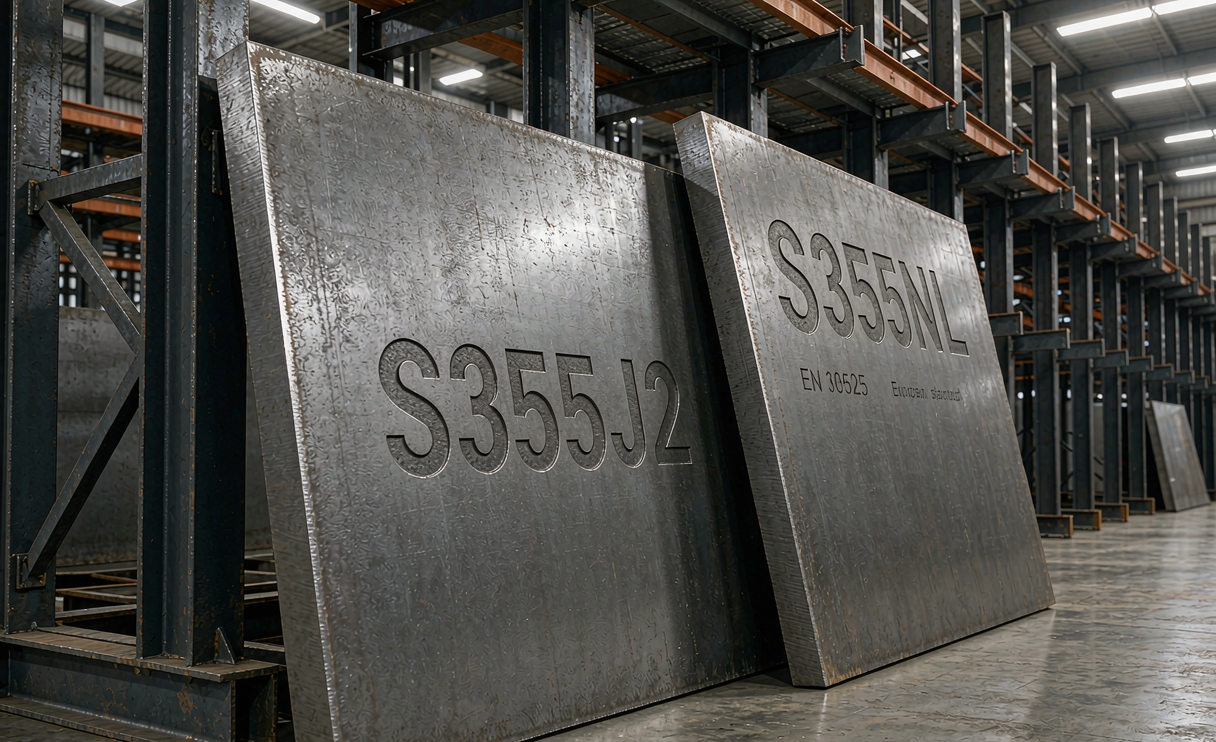
J2 = Charpy V-notch impact ≥ 27 J at -20 °C (delivered in the normalized or normalized-rolled condition under EN 10025-2)
NL = normalized fine-grain steel, Charpy V-notch impact ≥ 27 J at -50 °C (delivered in the normalized condition under EN 10025-3)
The two grades live in different parts of the EN 10025 family. S355J2 is part 2 (normalized / normalized-rolled non-alloy), while S355NL is part 3 (normalized fine-grain weldable). Selecting between them is mainly a question of required toughness, plate thickness, welding tonnage and the delivery condition you want from the mill.
2. Chemical Composition Comparison
The chemistry limits below are taken from EN 10025-2:2019 and EN 10025-3:2019 for plate up to 16 mm. Note that S355NL requires tighter limits on carbon equivalent and grain-refining elements because of the lower service temperature.
Element
S355J2 (max %)
S355NL (max %)
C
0.20 (≤ 16 mm)
0.18
Si
0.55
0.50
Mn
1.60
0.90 – 1.65
P
0.030
0.025
S
0.030
0.020
Nb
—
0.05
V
—
0.10
Ti
—
0.04
Al (total)
—
0.02 min
CEV (max, t ≤ 16 mm)
0.45
0.45
CEV (max, 16 < t ≤ 40 mm)
0.47
0.47
S355NL is intentionally alloyed with small additions of niobium, vanadium and titanium, plus a minimum aluminium content for grain refinement. The result is a finer austenite grain size and improved toughness at low temperature, but the same carbon-equivalent value at typical plate thickness. Weldability is comparable.
3. Mechanical Properties
For plate up to 16 mm, the minimum mechanical properties are essentially the same — that is the point of unifying them under S355. As thickness increases, the minimum yield drops slightly but remains identical between the two grades.
Property
S355J2
S355NL
Yield strength (t ≤ 16 mm)
≥ 355 MPa
≥ 355 MPa
Yield strength (16 < t ≤ 40 mm)
≥ 345 MPa
≥ 345 MPa
Tensile strength
470 – 630 MPa
470 – 630 MPa
Elongation (A5)
≥ 22%
≥ 22%
Charpy V-notch (longitudinal)
27 J @ -20 °C
27 J @ -50 °C
Where the grades truly diverge is the impact test temperature. S355NL guarantees 27 J at -50 °C, which is 30 °C colder than the S355J2 requirement. For offshore wind, arctic pipelines, polar vessels and cold-climate bridges, only S355NL is acceptable.
4. Delivery Condition and Microstructure
This is the technical detail most procurement teams overlook, and it has real consequences for fabrication.
S355J2 — delivered in the normalized-rolled (N) condition under EN 10025-2. Normalized rolling uses a tight temperature window during rolling to refine grain without a separate furnace normalizing step. This is faster and cheaper, but limits plate thickness to about 80 mm in practice. Above that, mills usually recommend a true normalized condition.
S355NL — must be delivered in the normalized (N) condition per EN 10025-3. The plate is reheated to about 900 °C after rolling and air-cooled in a separate operation. This guarantees a uniform fine-grain ferritic-pearlitic microstructure even in heavy plate (up to 250 mm and beyond).
In practice, S355NL is more consistent in heavy plate because the normalization step resets the grain structure. For thick wind-tower flange plate, offshore leg plate and pressure-vessel shells, this consistency is non-negotiable.
5. Weldability
Both grades have similar carbon equivalent values and are considered readily weldable by all conventional processes (SMAW, GMAW, FCAW, SAW). Standard pre-heat and interpass guidelines apply:
For combined thickness up to 30 mm, pre-heat to 50 – 75 °C for S355J2.
For combined thickness 30 – 60 mm, pre-heat to 100 – 150 °C.
For S355NL thick plate (above 50 mm) or low-hydrogen requirements, use basic-coated low-hydrogen electrodes (EN ISO 2560-A E 50 4 B or AWS E7018).
Both grades can be hot-formed (above 700 °C) and stress-relief annealed. S355NL tolerates higher post-weld heat input without grain coarsening because of its finer starting grain.
6. Typical Applications
S355J2 is the workhorse grade for:
Building frames and high-rise structural members in temperate climates.
Bridges in mild climates (design temperatures above -20 °C).
Industrial buildings, warehouses, factory sheds.
Earth-moving equipment frames and truck chassis.
General fabricated plate components for the machinery industry.
S355NL is preferred for:
Wind turbine towers and flange rings, especially offshore (DNV GL, EN 1090-2 EXC3/4 execution class).
Arctic and sub-arctic bridges, harbours and infrastructure.
Offshore platform leg and brace plate (DNV, ABS, LR classed).
Pressure equipment shells for low-temperature service (PED 2014/68/EU).
Heavy transport frames and rail wagon bogies for cold-climate operation.
7. Cost Difference
S355NL typically costs 10 – 18% more than S355J2 at the same plate thickness. The premium reflects the additional normalizing furnace step, tighter chemistry, lower test temperature and lower mill yield. For a 50 mm plate quotation, expect S355NL to land at $620 – $720 per ton CFR compared with $530 – $620 for S355J2 (rates vary monthly with scrap and energy costs).
8. How to Choose
Specify S355J2 if your service temperature is above -20 °C, plate thickness is below 50 mm, and your execution class is EN 1090-2 EXC1 or EXC2.
Specify S355NL if the service temperature is between -20 °C and -50 °C, plate thickness is above 50 mm, or your project is classed (offshore, pressure vessel, arctic).
For low-temperature service below -50 °C, you may need S355ML (thermo-mechanically rolled) or a fully killed fine-grain steel with extra-low CEV.
9. Practical Procurement Tips
A few real-world tips from European plate procurement:
Always ask for the delivery condition in writing — “normalized” for S355NL, “normalized-rolled” or “normalized” for S355J2. Mill test certificates often abbreviate these as “N” or “AR” (as-rolled), which can mislead.
For offshore or classed projects, request EN 10204 3.2 with explicit witnessing by the classification society. Standard 3.1 mill certification is sufficient only for general building applications.
If your project allows either grade, dual-certifying as “S355J2 / S355NL” gives your inventory team maximum flexibility and avoids the cost of stocking two separate heat batches.
For plate above 80 mm, the normalized-rolled condition is rarely available — most mills will normalize in the furnace regardless. Specify “normalized” rather than “normalized-rolled” for thick plate.
Always check the through-thickness tensile property (Z-direction) for plates used in thick welded joints — S355NL typically meets Z35 with reduced sulphur, S355J2 may require a separate Z-grade order.
Frequently Asked Questions
Q1: Is S355NL the same as ASTM A572 Grade 50?
No. A572 Grade 50 is the closest American structural grade by yield (345 MPa minimum), but it is not produced to the same fine-grain practice and has a less stringent low-temperature impact requirement. For equivalent low-temperature performance, look at ASTM A633 Grade E or A709 Grade 50W.
Q2: Can I dual-cert S355J2 and S355NL?
Yes — most mills can deliver plate marked “S355J2 / S355NL” when the heat meets both EN 10025-2 and EN 10025-3 requirements. This is common for offshore projects and saves inventory. The certificate will list both designations.
Q3: Is S355J2 suitable for galvanizing?
Yes. S355J2 with silicon below 0.30% and phosphorus below 0.025% (typical for batch hot-dip galvanizing) produces good coating adhesion. For continuously galvanized structural sections, specify the silicon-plus-phosphorus “Sandelin” curve band on the certificate.
Q4: What inspection documents come with EN 10025 plate?
Standard is EN 10204 3.1 issued by the mill’s quality department. For pressure equipment or classed projects, request 3.2 certification with third-party witnessing (BV, SGS, TÜV, DNV). Each plate is marked with heat number, grade, plate number, and CE marking where applicable.
Procurement Tips: How to Specify S355J2 and S355NL on Your RFQ
When you issue a request for quotation for S355J2 or S355NL plate, four items drive the price differential and on-time delivery: (1) nominal thickness and width, (2) Charpy impact test temperature and minimum energy, (3) third-party inspection scope, and (4) supplementary requirements such as ultrasonic test, Z-direction performance or normalized rolling condition. Always state the standard reference (EN 10025-2 for S355J2, EN 10025-3 for S355NL) so the mill knows which delivery condition is mandatory. The most common RFQ mistakes are silent omissions: a buyer writes “S355 plate” without the sub-grade letter and then receives S355JR at a slightly lower price; later the structural engineer rejects the lot because the Charpy at -20 °C cannot be demonstrated.
If the application is a low-temperature pressure vessel, bridge component, wind-tower flange or offshore node, specify EN 10025-3 S355NL with Charpy at -50 °C ≥ 27 J as the mandatory impact requirement, and request normalized rolling (N) rather than normalized (N) in the data sheet. The normalized-rolling route gives a finer grain and tighter through-thickness ductility than the standard normalized route. Mills charge a 3 – 5% premium for the N delivery condition plus normalized-rolling; it is worth it for thick plate above 40 mm.
For S355J2 specified under EN 10025-2, the mandatory Charpy is 27 J at -20 °C. If the engineering spec is “structural steel for moderate-cold regions”, -20 °C is the right test; if the spec is “inland bridge in tropical climate”, S355JR with 27 J at +20 °C is sufficient and saves roughly 3 – 4% per ton. Always ask the mill for the option of a “dual certification” — EN 10025-2 S355J2 and JIS G3106 SM490A, for example — at no extra cost, so you can ship the same heat to customers who reference different standards.
Welding Notes for S355J2 and S355NL Plate
Both S355J2 and S355NL are readily weldable by SMAW, GMAW, FCAW and SAW with the usual carbon-steel practice: preheat to 100 – 150 °C when the combined thickness exceeds 30 mm, the carbon equivalent (CEV) is above 0.45%, or the ambient temperature is below 5 °C. For S355NL, the typical CEV is 0.38 – 0.43% depending on the heat; for S355J2 it is 0.40 – 0.45%. Use a low-hydrogen electrode (EN ISO 2560-A E 46 5 B 12 H10 or AWS E7018-1) for the S355J2 and S355NL routes, and avoid cellulosic (E6010 / E7010) for thick plate above 25 mm because they drive hydrogen into the heat-affected zone. The interpass temperature should stay below 250 °C for both grades to keep the HAZ grain size fine and the Charpy at -20 °C well above 27 J.
For thick-plate S355NL above 50 mm, consider normalizing the entire fabricated assembly at 900 – 940 °C if the welding heat input exceeded 2.5 kJ/mm in any pass. This post-weld normalizing restores the through-thickness grain structure that the welding heat disturbed. The cost of post-weld normalizing adds roughly 6 – 9% to the fabrication cost but is the only way to guarantee the -50 °C Charpy in heavy sections. For S355J2, post-weld normalizing is rarely needed; a stress-relief anneal at 600 °C is usually sufficient for dimensional stability.
Frequently Asked Questions
Q: Can I use S355J2 in place of S355NL if the design temperature is -30 °C? A: Generally no. S355J2 is impact-tested only to -20 °C (27 J minimum). If the lowest design temperature is -30 °C or below, S355NL (impact-tested to -50 °C) is the safer choice. Some engineers accept S355J2 down to -30 °C with a derating factor on the allowable stress, but this is unusual and should be approved by the responsible structural engineer in writing.
Q: Is S355NL always more expensive than S355J2? A: Yes, but the gap has narrowed. As of 2026 the typical price difference is 4 – 7% per ton in the 10 – 50 mm thickness range, driven by the extra normalized-rolling pass and the additional Charpy testing at -50 °C. Above 50 mm thickness, the gap can widen to 10% because S355NL is more often produced in lower volume.
Q: Does S355NL require third-party inspection? A: For most non-classed applications, EN 10204 3.1 mill certificate is sufficient. For offshore, wind tower, pressure vessel or bridge applications, EN 10204 3.2 with classification society witness (DNV / ABS / LR / BV / TÜV) is mandatory. We can arrange 3.2 certificates at our mill for any S355NL order above 20 tons.
Source S355J2 and S355NL Plate from Huaxia Steel
Huaxia Steel supplies EN 10025 S355J2 and S355NL plate in thicknesses 5 – 200 mm from Chinese mills with EN 10204 3.1 / 3.2 certification, DNV / ABS / LR / BV classification support, and on-demand third-party inspection. Send your drawing or RFQ and we will return a factory-direct quotation within 24 hours.
If you require further information about our metal sheet products or architectural projects, please don’t hesitate to leave your contact details and message here.
Our team of experts will respond within 24 hours to continue the discussion and provide you with any additional information you requires.