ASTM A333 Grade 1 vs Grade 3 vs Grade 6 Low Temperature Carbon Steel Pipe
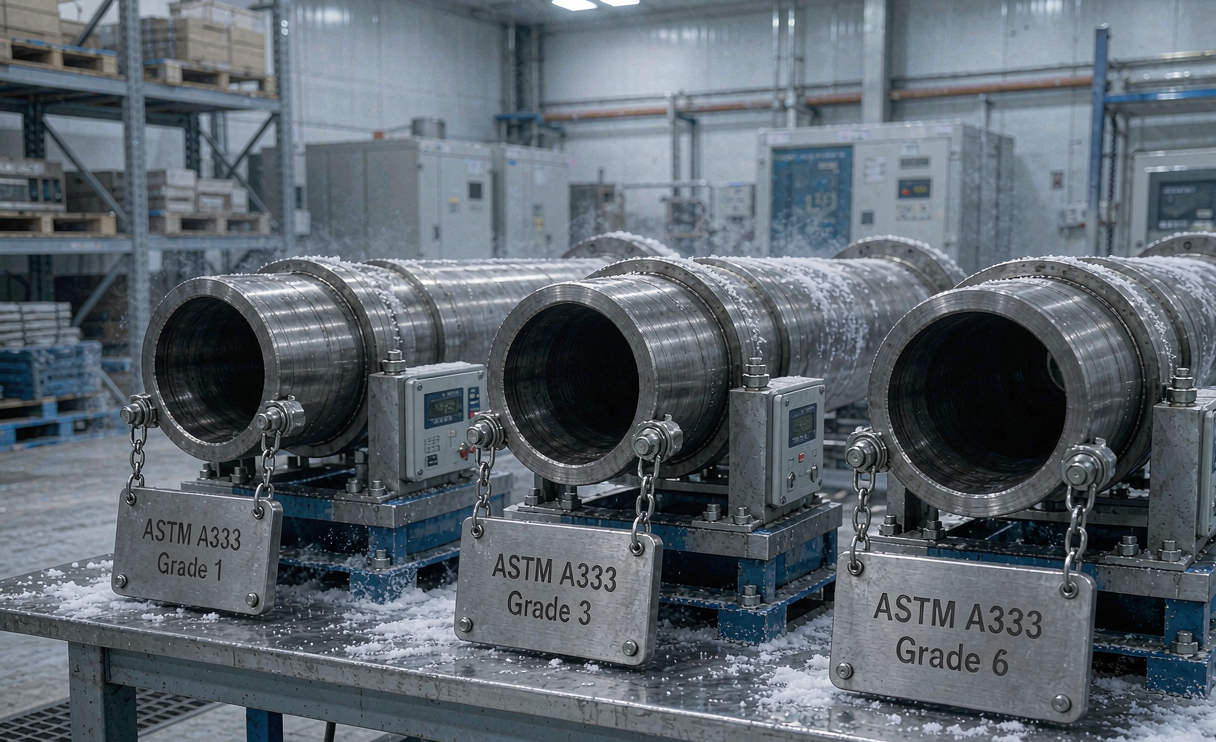
When pipelines run through arctic regions, LNG terminals, refrigeration skids or winterized chemical plants, ordinary ASTM A53 or A106 pipe can shatter under sudden impact at sub-zero service temperatures. ASTM A333 Grade 1, Grade 3 and Grade 6 are the three carbon-steel grades engineered for low-temperature service, each with a distinct impact-test temperature and chemistry envelope. Choosing the right grade at the design stage avoids costly rework, brittle fracture and unplanned shutdowns.
This guide compares the three grades head-to-head on chemistry, mechanical properties, impact requirements, manufacturing route, weldability and field application. Whether you source line pipe, process pipe or structural pipe for a cold-climate project, the same selection rules apply: confirm the lowest design temperature, verify the impact-test coupon location, and request Charpy V-notch data on the mill certificate.
1. What is ASTM A333 and Why It Matters
ASTM A333 / A333M is the standard specification for seamless and welded carbon and alloy steel pipe intended for use at low temperatures. The standard defines nine grades (Grade 1 through Grade 11) covering carbon, carbon-manganese, 3.5%Ni, 9%Ni and austenitic stainless steels. Procurement teams focus on Grade 1, Grade 3 and Grade 6 because these three grades deliver reliable toughness for the -20°F to -150°F (-29°C to -101°C) range used in oil & gas, LNG, petrochemical and ammonia refrigeration service.
The key difference between grades is the impact-test temperature, which directly correlates with the lowest expected service temperature. Higher numbers do not mean higher strength — they mean better low-temperature toughness, achieved through tighter chemistry, normalised heat-treatment and finer-grain practice.
2. Chemical Composition Comparison
The table below shows the typical chemical composition limits specified in ASTM A333 for the three grades. Manganese is intentionally boosted in Grade 3 and Grade 6 to improve hardenability and grain refinement, which in turn improves Charpy impact energy at sub-zero temperatures.
| Element | Grade 1 (%) | Grade 3 (%) | Grade 6 (%) |
|---|---|---|---|
| Carbon (C), max | 0.30 | 0.19 | 0.30 |
| Manganese (Mn) | 0.40 – 1.06 | 0.31 – 0.64 | 0.29 – 1.06 |
| Phosphorus (P), max | 0.025 | 0.025 | 0.025 |
| Sulfur (S), max | 0.025 | 0.025 | 0.025 |
| Silicon (Si), min | — | 0.18 | 0.10 |
| Nickel (Ni) | — | 3.18 – 3.82 | — |
Notice that Grade 3 contains 3.18–3.82% Nickel — this is the most visible chemical difference and the main cost driver. Grade 6 achieves its low-temperature toughness without nickel, which keeps it more affordable for moderate low-temperature service.
3. Mechanical Properties and Impact Requirements
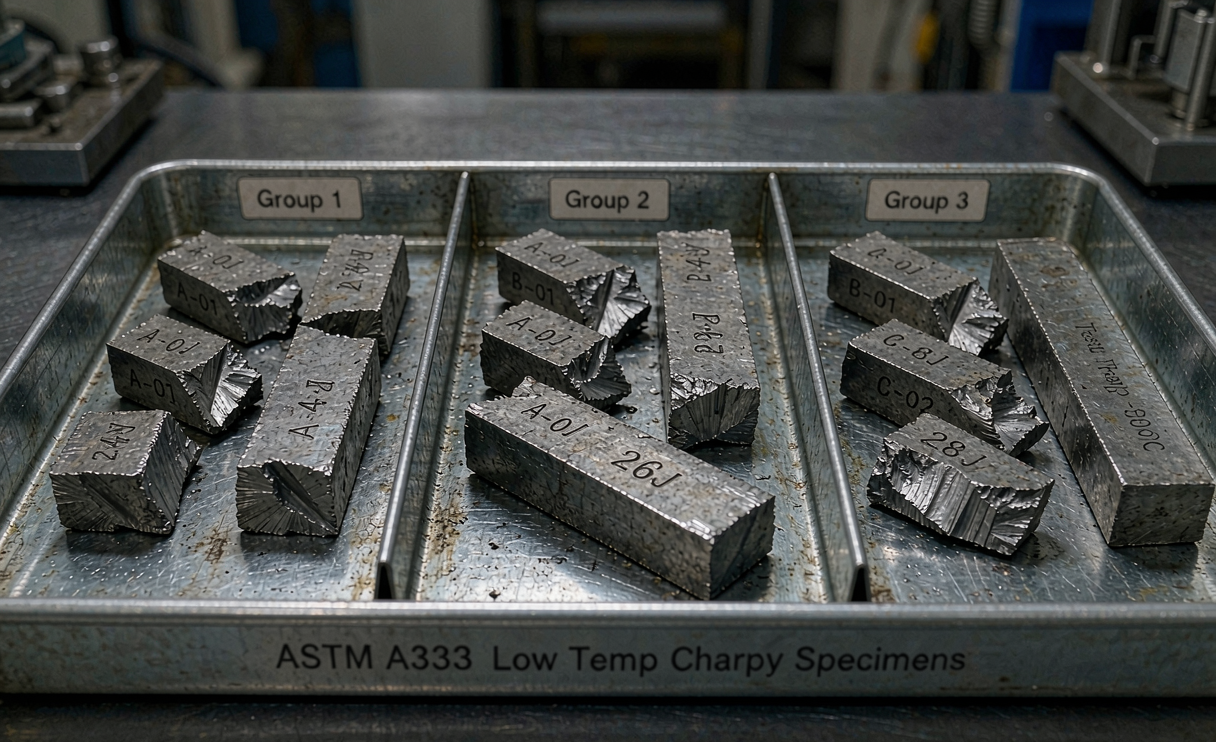
All three grades share similar tensile strength, but the impact-test temperature and minimum absorbed energy are very different. The table below summarises the mandatory Charpy V-notch requirements per ASTM A333.
| Property | Grade 1 | Grade 3 | Grade 6 |
|---|---|---|---|
| Tensile strength, min | 55 ksi (380 MPa) | 65 ksi (450 MPa) | 60 ksi (415 MPa) |
| Yield strength, min | 30 ksi (205 MPa) | 35 ksi (240 MPa) | 35 ksi (240 MPa) |
| Elongation in 2 in., min | 25% (long.) / 20% (trans.) | 22% (long.) / 16% (trans.) | 25% (long.) / 20% (trans.) |
| Charpy test temperature | −50°F (−46°C) | −150°F (−101°C) | −50°F (−46°C) |
| Charpy min avg energy (3 specimens) | 13 ft·lbf (18 J) | 13 ft·lbf (18 J) | 13 ft·lbf (18 J) |
| Charpy min single specimen | 10 ft·lbf (14 J) | 10 ft·lbf (14 J) | 10 ft·lbf (14 J) |
The 100°F difference between Grade 3 and Grade 6 / Grade 1 is decisive. If your pipeline operates below −50°F (−46°C), Grade 3 with 3.5%Ni is the only practical carbon-steel option. If the lowest service temperature stays between −20°F and −50°F, Grade 6 or Grade 1 will deliver adequate toughness at lower cost.
4. Manufacturing Process and Heat Treatment
ASTM A333 permits seamless or welded (ERW, LSAW or SSAW) manufacture. In practice, low-temperature service piping below 24 inch NPS is almost always seamless, while large-diameter transmission lines are usually LSAW. After forming, all three grades must receive a normalizing heat treatment at 1550–1700°F (845–925°C) followed by air cooling, unless the finished pipe is hot-formed at a temperature above the upper transformation point and air cooled in a manner that produces equivalent normalised properties.
Normalising refines the grain structure, dissolves residual carbides, and improves notch toughness. For Grade 3 with nickel, the normalizing soak time must be long enough to fully transform the microstructure. After normalizing, the pipe is cooled in still air to room temperature and then tested.
5. Welding and Fabrication
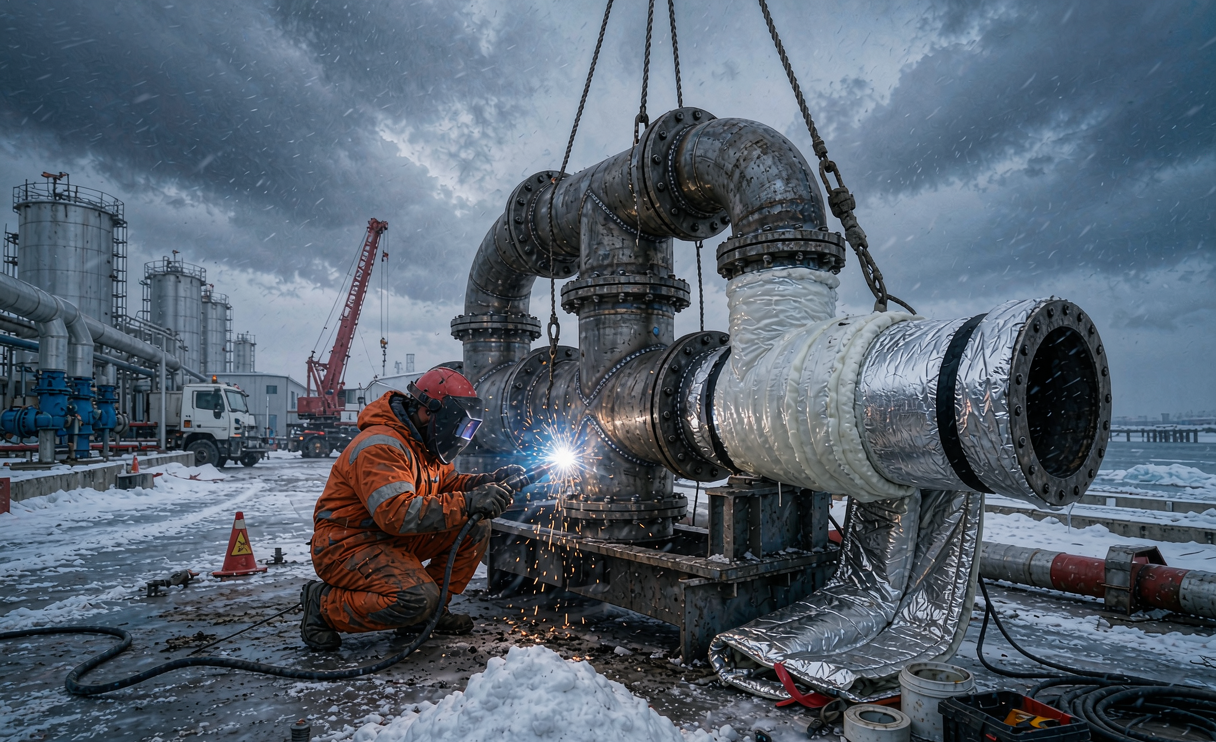
All three grades can be welded using standard SMAW, GMAW, FCAW and GTAW processes. For Grade 3, low-hydrogen welding consumables (E7018-C2L or equivalent) and a 150°F minimum preheat on heavier walls are recommended to avoid hydrogen-assisted cracking and to maintain the nickel chemistry in the weld zone. Grade 1 and Grade 6 accept standard E6010/E7018 cellulosic and low-hydrogen stick electrodes.
Post-weld heat treatment (PWHT) is generally not required for low-temperature carbon steel pipe and may actually reduce notch toughness if the soak temperature exceeds the tempering range. For critical low-temp service, follow ASME B31.3 and project-specific weld procedure specifications (WPS) qualified per ASME Section IX.
6. Applications and Selection Guide
Use the following quick-reference table to select the right grade for your service temperature range.
| Service Temperature Range | Recommended Grade | Typical Application |
|---|---|---|
| 0°F to −50°F (−18°C to −46°C) | Grade 1 or Grade 6 | Refrigeration, cold-storage, ethylene plants, light hydrocarbon |
| −50°F to −100°F (−46°C to −73°C) | Grade 6 (with PWHT review) | Ammonia plants, CO2 pipelines, LPG terminals |
| −100°F to −150°F (−73°C to −101°C) | Grade 3 (3.5%Ni) | LNG pre-cooling, ethylene storage, arctic gathering lines |
| Below −150°F (−101°C) | A333 Grade 8 (9%Ni) or austenitic stainless | Main LNG piping, liquid nitrogen |
7. Inspection and Mill Certificate Requirements
When procuring A333 pipe, always specify EN 10204 Type 3.1 or 3.2 mill test certificate and require the following on the certificate:
- Heat analysis with actual C, Mn, P, S, Si, Ni values
- Product analysis (check analysis) for at least C, Mn, P, S
- Tensile test results (per ASTM A370)
- Charpy V-notch test at the required temperature with full size specimen energy in ft·lbf
- Hardness test on the weld seam and HAZ for welded pipe
- Hydrostatic test result or NDE in lieu of hydrostatic
- Heat-treatment record confirming normalising temperature and soak time
For critical service, request witnessed testing by a third-party inspection agency such as SGS, BV, TUV or Intertek. The inspector verifies impact-test specimen location, sub-size correction factors (for 2/3 or 1/2 size Charpy bars), and acceptance per ASTM A333 Table 1.
8. Frequently Asked Questions
Can ASTM A333 Grade 1 pipe be used for LNG service?
No. LNG service typically operates at −162°C (−260°F). Only A333 Grade 8 (9%Ni) or austenitic stainless steel (304L/316L) is suitable for true LNG service. Grade 3 with 3.5%Ni is limited to about −101°C and is used in LNG pre-cooling or ethylene service.
Is ERW A333 pipe acceptable for low-temperature service?
Yes, provided the weld seam and HAZ pass Charpy V-notch testing at the required temperature. ERW A333 pipe is widely used for small-diameter refrigeration lines. For critical service, many engineers specify seamless pipe only, even though the standard permits both.
What is the difference between ASTM A333 Grade 1 and Grade 6?
Both share the same −50°F impact requirement, but Grade 6 must be normalised and is more tightly controlled on chemistry and grain size. Grade 1 has no silicon minimum and tolerates a wider carbon range. In practice, Grade 6 is the more reliable choice when low-temperature performance is critical.
How does A333 compare to API 5L for low-temperature pipelines?
API 5L is the dominant standard for transmission pipelines, while A333 is the default for low-temperature process piping. Both can carry the same fluids. API 5L PSL2 can specify Charpy requirements down to −60°C, and the latest API 5L 46th edition supports low-temperature sour service — verify with the project specification which standard controls.
Need ASTM A333 Grade 1, Grade 3 or Grade 6 pipe for an arctic or low-temperature project? Huaxia Steel supplies seamless and welded A333 pipe in sizes 1/2" to 26", with full Charpy V-notch testing witnessed by SGS / BV / TUV and EN 10204 3.1 / 3.2 certificates. Email [email protected] with your size, schedule, quantity and impact-test temperature, and we will reply with a mill-direct quotation within 24 hours.