Q235 vs SS400 Carbon Steel: Equivalent Grades Compared for Buyers
Introduction: Two Names, One Practical Question
Q235 and SS400 are the two most widely quoted general-purpose structural carbon steels in Asian export trade. Q235 comes from the Chinese standard GB/T 700; SS400 comes from the Japanese standard JIS G3101. Buyers sourcing from Chinese and Japanese mills, or substituting between them, run into the same question again and again: are they the same steel, and can I swap one for the other on a bill of materials?
The short answer is that they are functionally equivalent for most structural applications, but they are not identical on paper. The differences lie in how each standard defines carbon, manganese, and tensile strength, and in how mills deliver the material. Specifying without understanding these gaps can lead to rejected inspection, failed equivalence claims, or a more expensive purchase than necessary.
1. Standard Background: GB/T 700 vs JIS G3101
Q235 is defined by China’s GB/T 700 “Carbon Structural Steels”, which classifies steel by yield strength into grades Q195, Q215, Q235, and Q275. Q235 itself has four subcategories — Q235A, B, C, D — that differ mainly in impact temperature and deoxidation practice. SS400 is defined by Japan’s JIS G3101 “Rolled Steels for General Structure”, a single grade without yield-based subcategories, where the “400” refers to a minimum tensile strength of 400 MPa.
Because SS400 is defined by tensile strength and Q235 by yield strength, a direct like-for-like comparison always needs both numbers. A mill quoting only “SS400” is telling you the tensile floor; a mill quoting only “Q235B” is telling you the yield floor. Both matter for structural design.
2. Chemical Composition Comparison
Element
Q235B (GB/T 700)
SS400 (JIS G3101)
Carbon (C)
≤ 0.20% (thickness ≤ 16 mm)
— (not specified as a maximum)
Silicon (Si)
≤ 0.35%
—
Manganese (Mn)
≤ 1.40%
—
Phosphorus (P)
≤ 0.045%
≤ 0.050%
Sulfur (S)
≤ 0.045%
≤ 0.050%
Carbon Equivalent (CEV)
Typically 0.27 – 0.35
Typically 0.27 – 0.35
The biggest documentation difference is that JIS G3101 does not set a maximum carbon or manganese content for SS400; it controls chemistry only through phosphorus and sulfur limits and a carbon-equivalent guideline for thicker sections. GB/T 700, by contrast, caps carbon and manganese. In practice, the two materials land in the same chemistry window, which is why equivalence is usually accepted.
3. Mechanical Properties Comparison
Property
Q235B
SS400
Yield strength (≤ 16 mm)
≥ 235 MPa
≥ 245 MPa (thickness ≤ 16 mm)
Tensile strength
370 – 500 MPa
400 – 510 MPa
Elongation
≥ 26%
≥ 17 – 21% (varies by thickness)
Impact test
20°C for B; 0°C for C; −20°C for D
Not required by base standard
SS400’s minimum yield is slightly higher, while Q235B’s minimum elongation is more generous. For the vast majority of building and machinery frames, either grade satisfies the design. The deciding factor is usually the project’s specified standard, local code acceptance, and whether low-temperature impact testing is required.
4. Delivery Forms and Availability
Both grades are available in the same long and flat product families:
Hot rolled plate and sheet (1.2 – 25.4 mm typical)
Hot rolled coil
Sections: I-beam, H-beam, channel, angle
Round, square, flat, and hexagonal bar
Structural pipe and tube
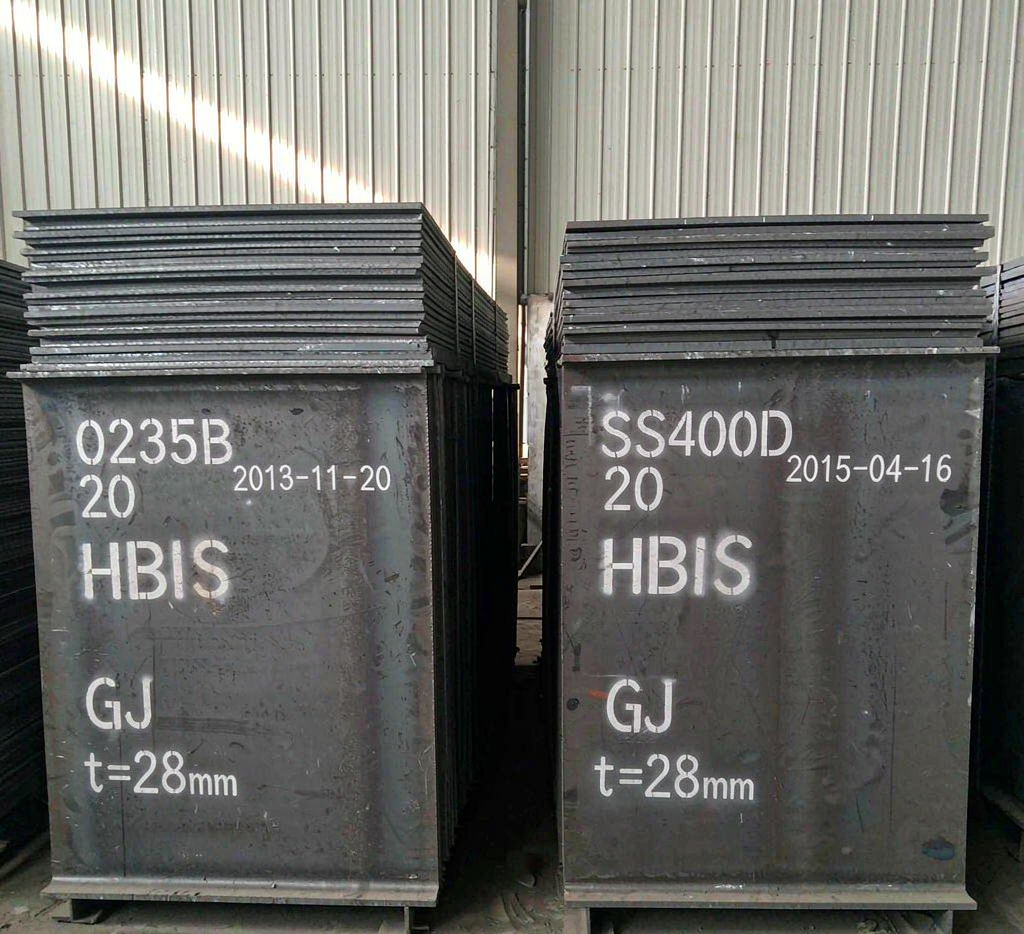
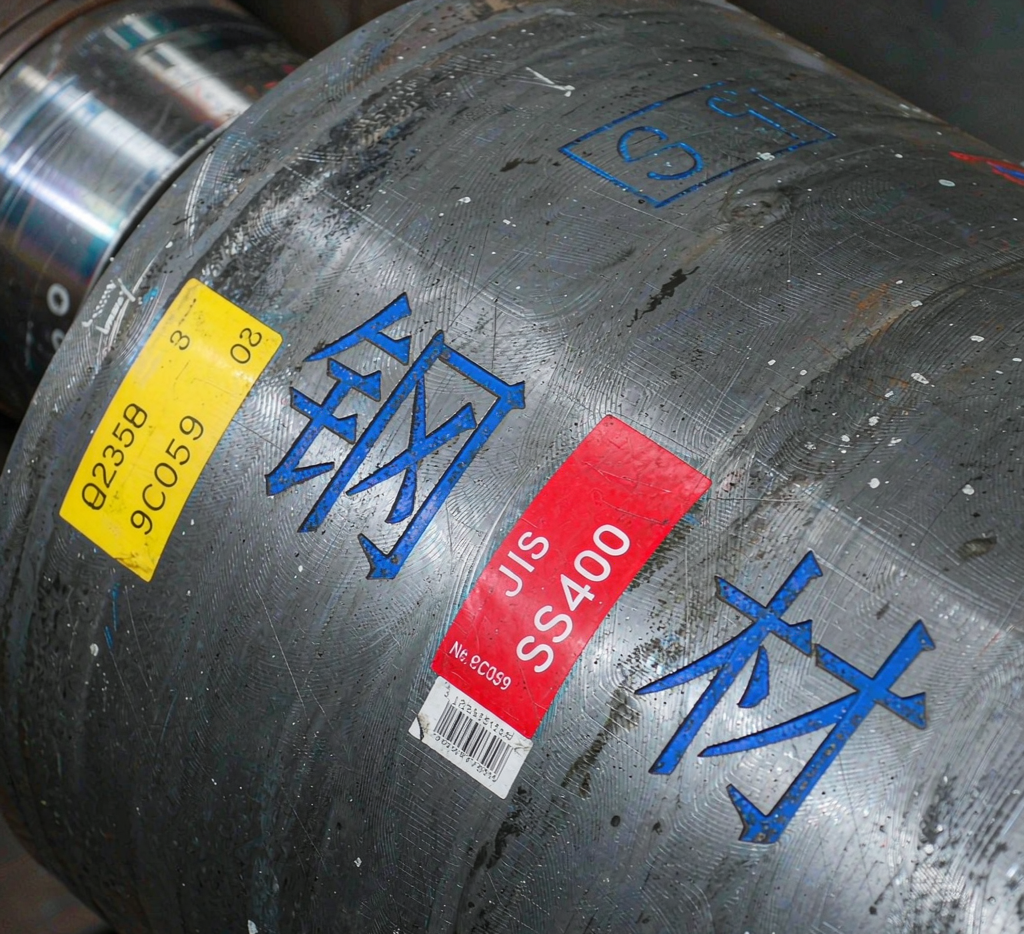
Chinese mills tend to stock Q235B as the default general grade and can dual-certify to SS400 on request. Japanese and Korean mills quote SS400 natively. When a project calls for SS400 but delivery is from China, ask the mill to issue an MTC that states both grade designations and the controlling standard.
5. Weldability and Fabrication
Both Q235B and SS400 are low-carbon, highly weldable steels. With carbon equivalent around 0.30 and phosphorus/sulfur held low, they weld cleanly with common processes (SMAW, GMAW, FCAW, SAW) using mild steel consumables such as E6013 or E7018. Preheat is generally not required below about 25 mm thickness.
The main fabrication caution is shared by both: avoid excessive heat input that coarsens the grain, and control distortion on thin sections. Neither grade is intended for through-hardening; post-weld heat treatment is rarely needed for structural assemblies.
6. Surface and Corrosion Protection
Neither grade includes alloying for corrosion resistance. Both arrive with mill scale and rust if unprotected. For outdoor or humid-climate service, plan for shot blasting and coating, or specify hot-dip galvanizing. Galvanized SS400 and galvanized Q235B perform identically in the field.
7. Price and Sourcing
In export markets, Q235B and SS400 trade at nearly the same base price, with SS400 from Japan/Korea typically carrying a small premium for brand and lead time. Chinese Q235B dual-certified to SS400 is often the most cost-effective route for projects that merely need the SS400 designation on paper. Watch for “SS400” offers priced far below the Q235B market — that usually signals thinner sections or relaxed chemistry.
8. Application Selection Guide
Application
Recommendation
Reason
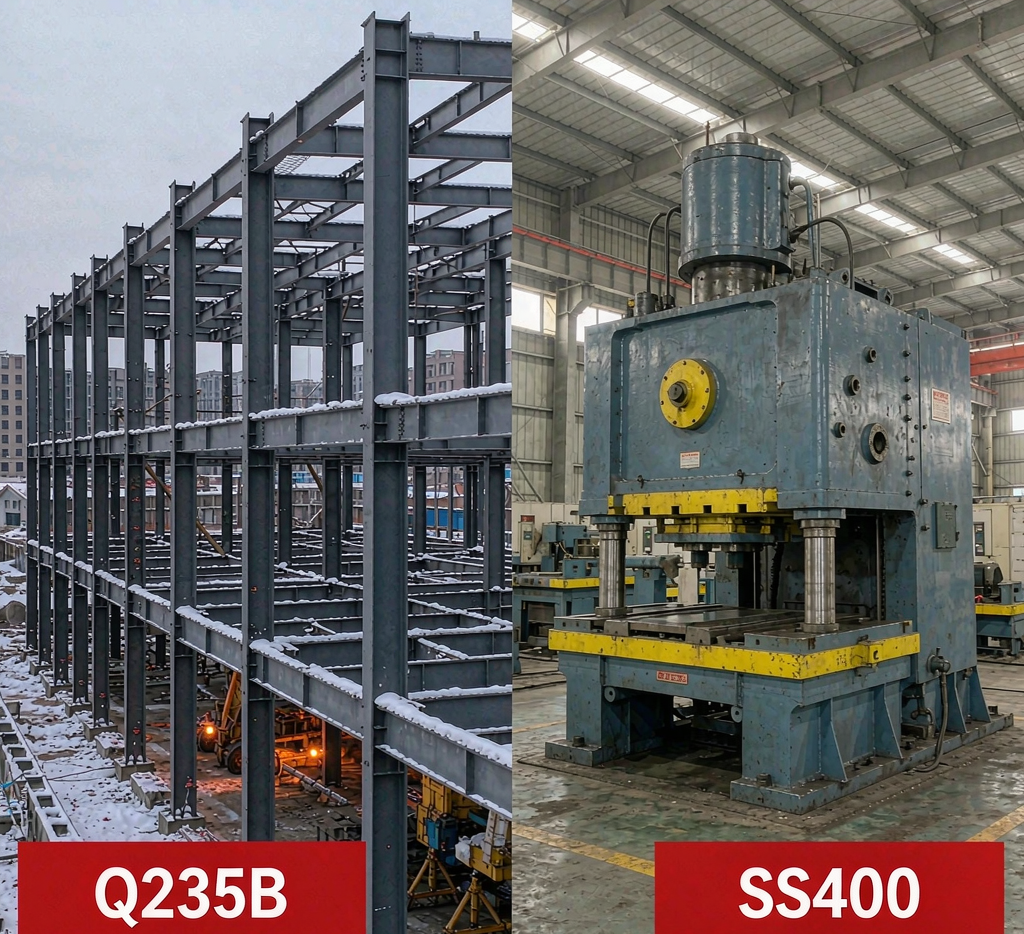
Building frames, warehouses
Either, per local code
Equivalent structural performance
Machinery bases and brackets
Q235B
Lower cost, easy availability
Projects specifying JIS
SS400 (or Q235B dual-cert)
Standard acceptance
Low-temperature service
Q235C/D
Impact-tested subcategories
General welding structures
Either
Both weld easily
9. Buyer Verification Checklist
Confirm the controlling standard and grade on the MTC (GB/T 700 or JIS G3101).
Check yield and tensile values against the design requirement, not just the grade name.
For cold climates, request impact test temperature and choose Q235C/D if needed.
Verify dimensions, tolerances, and surface condition on arrival.
If substituting, document the equivalence decision for the project file.
Frequently Asked Questions
1. Is Q235 the same as SS400?
They are functionally equivalent for most structural uses and share the same chemistry window, but they are defined by different standards (GB/T 700 vs JIS G3101) with different ways of stating strength. They are interchangeable only when the project accepts either designation and the MTC supports the claim.
2. Which is stronger, Q235 or SS400?
SS400 has a slightly higher minimum yield (245 MPa vs 235 MPa for thin sections) and a minimum tensile of 400 MPa. Q235B has a more generous elongation minimum. In real structures the difference is negligible; design code and standard acceptance usually decide.
3. Can I substitute Q235 for SS400 on a JIS project?
Often yes, if you obtain an MTC showing Q235 meets or exceeds the SS400 mechanical requirements and the project engineer accepts the substitution. Request dual certification to avoid disputes at inspection.
4. Does SS400 need impact testing?
The base JIS G3101 SS400 does not require impact testing. If your project needs low-temperature toughness, specify the requirement explicitly or use Q235C/D, which include impact tests at defined temperatures.
5. Why is SS400 sometimes more expensive?
SS400 from Japanese or Korean mills carries a brand and logistics premium. Chinese Q235B dual-certified to SS400 is usually cheaper and widely available, which is why many buyers source Q235B for SS400-designated projects.
Conclusion
Q235 and SS400 are two names for essentially the same general-purpose structural carbon steel. The practical rule: match the grade to the project’s specified standard, confirm mechanical values on the MTC, and document any substitution. For most buyers, Chinese Q235B dual-certified to SS400 is the lowest-risk, lowest-cost path.
If you require further information about our metal sheet products or architectural projects, please don’t hesitate to leave your contact details and message here.
Our team of experts will respond within 24 hours to continue the discussion and provide you with any additional information you requires.