The ASTM A123 galvanizing standard is the North American specification for hot-dip galvanized (zinc) coatings on iron and steel products, and it is the acceptance document behind most structural steel, fastener assemblies and fabricated carbon steel exported to the US and Canada. Yet a surprising share of coating disputes trace back to buyers and inspectors reading it loosely — quoting coating thickness grades that do not apply to the product category, or rejecting galvanized fabrications for surface features that A123 explicitly permits. This guide explains what ASTM A123 covers, the coating thickness grades by material category, how minimum average coating requirements work, what surface appearances are acceptable, and how galvanized fabrications need to be designed before they reach the kettle.
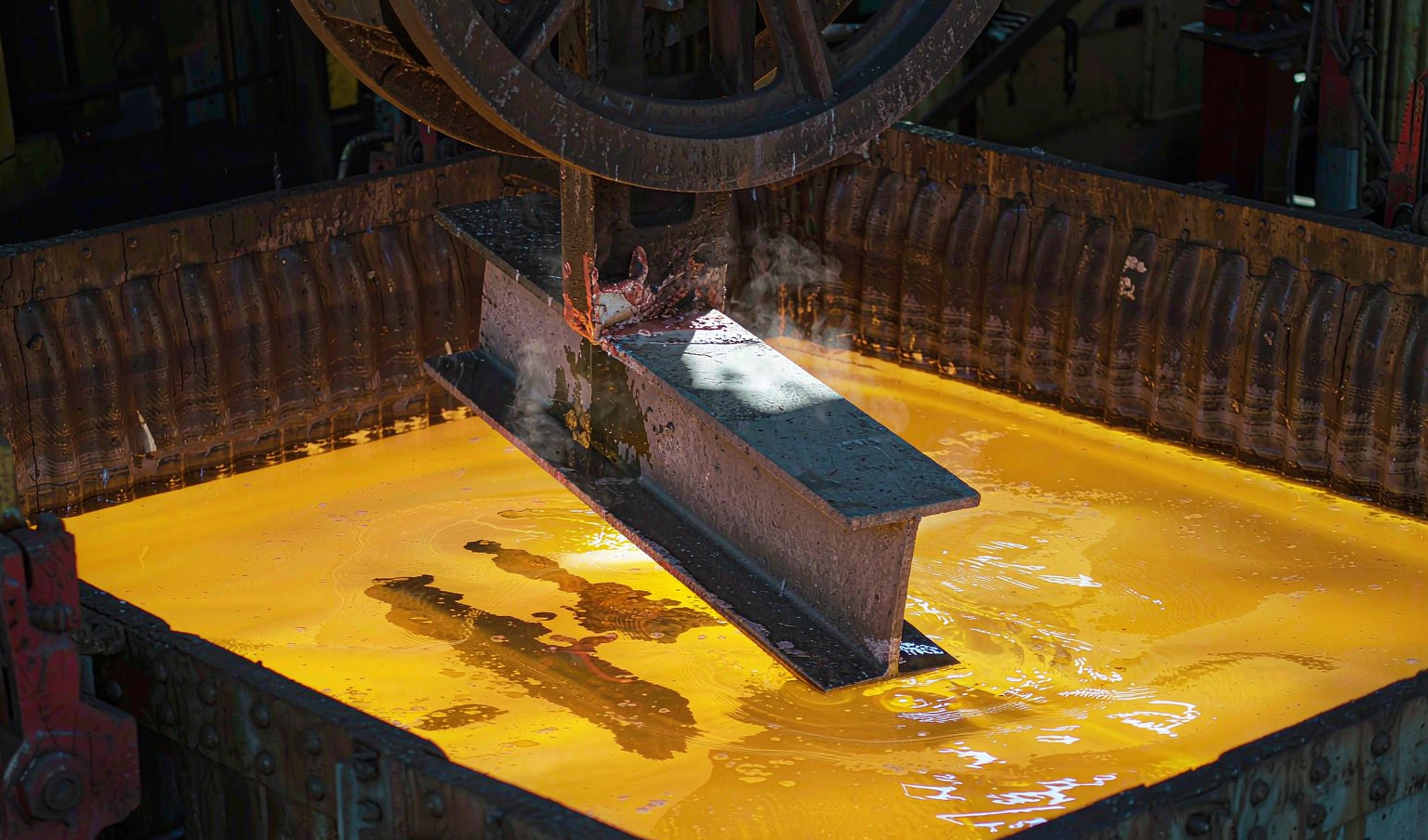
Steel sections entering the molten zinc kettle for hot-dip galvanizing
What ASTM A123 Covers — and What It Does Not
ASTM A123/A123M — full title “Standard Specification for Zinc (Hot-Dip Galvanized) Coatings on Iron and Steel Products” — applies to zinc coatings applied by dipping fabricated and unfabricated steel assemblies in a molten zinc bath. Covered product categories include structural shapes and plates, strip and bar, pipe and tubing (non-threaded), wire and hardware/fabricated assemblies. It is the standard for galvanized beams, channels, angles, handrail assemblies, transmission structures and similar items.
Three related standards are frequently confused with it. ASTM A153 covers hot-dip galvanizing of hardware — small fasteners and miscellaneous items such as bolts, nuts, washers and threaded parts, which are centrifuged after dipping to remove excess zinc. ASTM A653 covers continuously galvanized sheet (steel coil galvanized on a continuous line), a completely different process with its own coating designations like G90. ASTM F2329 covers zinc coating on carbon and alloy steel threaded fasteners specifically. If your RFQ says “galvanized per A123” for bolts, that is technically the wrong standard — A153/F2329 is the correct reference, and a good supplier will flag it.
Coating Thickness Grades by Material Category
The core of A123 is its coating thickness table. Requirements are expressed as minimum average coating thickness (in micrometers or mils) for each material category, and the grade required depends on the steel’s thickness — thicker steel sections develop heavier zinc coatings in the same dipping cycle. The principal categories and values for steel are:
Material category (steel thickness)
Min. avg. coating thickness (μm)
Typical oz/ft²
Structural shapes and plates ≥ 6 mm (1/4 in+)
100
3.0
Structural shapes and plates 3–6 mm
85
2.6
Structural shapes and plates 1.5–3 mm
65
2.0
Strip and bar ≥ 6 mm
85
2.6
Pipe and tubing 6 mm+ wall
85
2.6
Pipe and tubing 3–6 mm wall
75
2.3
Wire 4.5 mm and over
75
2.3
Wire 1.9–4.5 mm
50
1.5
Fasteners (per A153, reference)
40–75 by size
—
Two reading rules that prevent most disputes. First, these are average values per specimen and per batch, not per-point minimums — a single spot at 80 μm on a structural member is not a rejection. Second, the grade follows the material category the item belongs to, not whichever row an inspector prefers. Inspectors measuring a bar product against the structural-shape requirement will generate false failures.
Weight vs Thickness: Why A123 Moved to Thickness
Older specifications and many tender documents still quote zinc coating weight (oz/ft² or g/m²), historically measured by stripping the coating and weighing the loss. Modern A123 expresses requirements in magnetic thickness gauge readings — faster, non-destructive and traceable to ASTM E376 practice. The relationship between the two depends on coating density (roughly 7.1 g/cm³ for galvanized alloy layers), so 100 μm corresponds to about 3.0 oz/ft². When a buyer’s document quotes weight and the mill certificate quotes thickness, convert before comparing — do not let a unit mismatch turn into a claim.
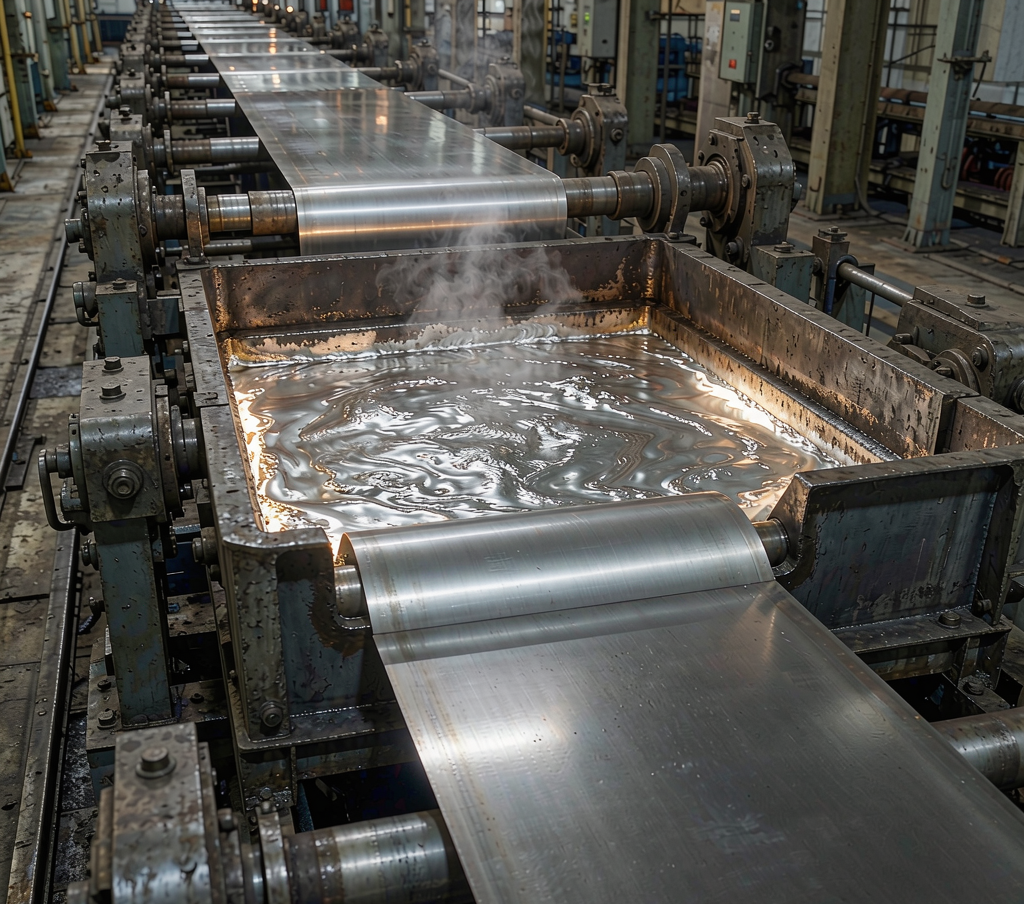
Hot-dip galvanized steel with the characteristic spangled zinc surface
Surface Appearance: What Is Acceptable Under A123
A123 is deliberately tolerant on appearance. The coating must be continuous, reasonably smooth and free of gross defects — uncoated areas, flux inclusions, lumps that interfere with the intended use, ash or dross inclusions, blisters, black spots and acid pools. But the standard explicitly permits a list of surface features that inexperienced inspectors reject: flux staining, spangle variation, light zinc runs and drips that do not affect function, roughness where the base steel has heavy silicon content (reactive steel produces gray, matte coatings), surface roughness from the base material, and drainage drips on the underside of members. Heavy silicon-bearing steels (above about 0.05 % Si) commonly galvanize to a gray matte finish with slightly thicker, sometimes rougher coatings — fully compliant, just not shiny.
The one condition A123 does not tolerate is bare metal. Uncoated spots must be repaired — either by re-dipping the piece or by zinc-rich paint or zinc thermal spray per the repair provisions — with the repair area not exceeding 0.5 % of the surface area, or 4 % on the exterior of pipe, and each repair spot within 25 mm in any direction.
Designing Fabrications for the Kettle
Most A123 quality problems on fabricated assemblies are designed in before the steel ever ships to the galvanizer. Three design areas dominate:
Vent and drain holes: hollow fabrications (handrail, box sections, tube assemblies) need vent holes to let air escape and molten zinc to circulate and drain. Undersized or missing vents cause internal uncoated areas, trapped flux, and — worst case — explosion of trapped moisture in the kettle.
Fit and clearance: overlapping surfaces less than about 3 mm apart trap flux and pick up zinc bridges; design welds to be fully sealed or gaps wide enough to drain.
Welding consumables and residues: silicon-rich weld metal galvanizes differently and weld slag must be removed; heavy grinding residues cause black spots.
Embrittlement controls: cold-worked steel (bent parts, sheared edges) with high strength should be stress relieved before galvanizing or processed per the embrittlement precautions in the standard — a rare but real failure mode on hard spring-steel fabrications.
Inspection and Testing Under A123
Standard A123 acceptance testing is straightforward: visual inspection for continuity and defects, plus coating thickness measurement with a magnetic gauge per the sampling plan — each inspection lot (material from the same heat, galvanized in the same cycle, of the same category) is sampled at defined numbers of specimens and readings. Certificates of conformance state the coating meets the specified grade. If your contract adds a third-party inspection clause, agree in advance which categories apply and the sampling plan, because inspectors applying non-A123 sampling rules are the most common source of disputes on galvanized export orders. Additional tests — adhesion, bend tests, weight by stripping — exist but are not required for routine acceptance.
Durability Expectations: How Long Does A123 Coating Last?
Zinc corrodes sacrificially, so coating life is a function of coating thickness and environment. In rural/low-pollution atmospheres, a 100 μm structural coating routinely serves 70+ years before maintenance; in industrial or severe marine environments, expect 20–35 years. The corrosion allowance is roughly 1–2 μm per year in moderate atmospheres. For projects where an additional barrier is required, duplex systems (galvanizing plus powder or paint topcoat) extend service life substantially and are increasingly specified for coastal infrastructure.
A123 vs EN ISO 1461: Choosing the Right Reference for Export Projects
Buyers shipping galvanized steel to both American and European destinations frequently need to work under both systems, and the differences are mostly administrative rather than metallurgical. EN ISO 1461 expresses requirements as minimum average coating mass (g/m²) by reference steel thickness, uses a similar lot-based sampling plan, and shares the same repair-area philosophy (0.5 % limit, same repair methods). In practice, a coating that passes A123’s structural category of 100 μm comfortably satisfies ISO 1461’s requirement for equivalent steel thickness (85 μm for steel ≥ 6 mm), and vice versa for most categories. The differences that matter: ISO 1461 imposes stricter appearance language around lumps and flux residues, includes explicit requirements for test methods and renalding of sampling, and European tender documents frequently add EN 1090 execution requirements on top. For a project that could go either way, the practical approach is to galvanize to the heavier requirement of the two and certify against the standard named in the contract — dual-certified coating reports are routine from experienced galvanizers.
What Drives Galvanizing Cost
Galvanizing is priced by weight of steel processed, but the cost per tonne is dominated by handling, not zinc. Long or awkward fabrications that require double-dipping or special jigging cost substantially more than compact items; hollow sections that need extra venting take longer kettle cycles; and reactive steels (high silicon) consume more zinc per unit surface and can trigger surcharges. Three levers reduce cost without touching quality: design fabrications to fit within common kettle dimensions (many galvanizers list their kettle length — frequently 7–15 m — on their websites), standardize hole sizes so the galvanizer can use existing jigs, and specify zinc coating grades realistically rather than defaulting to the heaviest category. Over-specifying 140 μm where the category table says 100 μm adds cost and risks brittle, flaky coatings on thinner members — heavier is not always better.
Transport, Storage and Handling of Galvanized Steel
Zinc survives sea freight well but hates trapped moisture. The classic transit defect — white rust (wet storage stain) — forms when bundled galvanized surfaces stay wet for days with no air circulation. It is cosmetic in its early stages and does not consume meaningful coating thickness, but it triggers inspection arguments on arrival and is entirely preventable: pack bundles with timber spacers to admit air, avoid covering loads with non-breathable tarpaulins while condensation is likely, and apply a chromate or oil passivation for long voyages when specified. On site, store galvanized steel sloped so water drains, on timber above standing water, and avoid direct ground contact. If white rust appears, assess it honestly: wipe with a damp cloth — if the underlying zinc shows as sound and continuous, the coating is intact and the stain will weather away in service.
Common Arrival-Inspection Scenarios and the Correct Response
Knowing what A123 actually says turns arrival disputes into quick resolutions. The four scenarios below account for the overwhelming majority of galvanized-steel inspection arguments.
White rust (wet storage stain). Fuzzy white deposits in bundle contact areas after a long voyage. Response: wipe test — if the zinc underneath is continuous, the coating meets A123 and the stain weathers off in service. Prevention: air-spacing in packing, agreed in the order.
Gray matte finish on some pieces. Reactive steel (silicon-bearing) chemistry, not a defect. A123 judges thickness and continuity; color is not a criterion. Rejecting on appearance alone is not supportable under the standard.
Local thickness readings below the table value. A123 sets minimum averages per specimen and per lot with defined sampling. A single low reading is not a failure — calculate the specimen and lot averages per the standard’s procedure before declaring non-conformance.
Small bare spots. Permitted if within the repair-area limits and properly repaired with zinc-rich paint or thermal spray. Check the repair size rules rather than rejecting the piece outright.
The parallel lesson for buyers: put the inspection protocol — who samples, which gauge, which categories — into the purchase order itself. Inspectors improvising non-standard sampling are the largest single source of false rejections on galvanized export lots, and a PO clause costs nothing while the dispute costs weeks.
Specification Language You Can Paste Into a PO
Vague coating requirements produce vague results. The following clause structure — adaptable per project — closes the gaps that cause most disputes:
“Hot-dip galvanize after fabrication in accordance with ASTM A123/A123M, latest edition.”
“Material category per A123 Table 1 for structural shapes/plate [or as applicable], minimum average coating thickness 100 μm [per category].”
“Coating thickness verified by magnetic gauge per A123 sampling; certificate of conformance plus coating thickness report to accompany shipment.”
“Vent and drain holes per the galvanizer’s requirements and the design drawings; locations subject to engineer’s approval.”
“Bare spot repair per A123 repair provisions; total repaired area not to exceed 0.5 % of surface.”
“Bolts, nuts and threaded hardware galvanized per ASTM A153 [or F2329], not A123.”
“Packing to prevent wet storage stain: timber air-spacing between bundle faces; no non-breathable full covers.”
One sentence of specification at PO stage routinely saves a week of claim correspondence — and gives any third-party inspector an unambiguous basis to work from.
Finally, keep the certification chain proportionate to the risk. For standard structural packages, a galvanizer’s certificate of conformance plus coating thickness report is sufficient; for infrastructure and EPC tenders, add third-party witnessed thickness sampling and a documented inspection release before shipment. What matters is that the chain matches the contract — an over-inspected garden fence and an under-inspected transmission tower are both failures of specification, in opposite directions. Write the inspection scope into the PO alongside the coating clause, and the arriving steel will be judged by the standard you actually bought, not by whatever interpretation arrives on the dock that morning.
Frequently Asked Questions
What is the difference between ASTM A123 and A153? A123 applies to hot-dip galvanized products and fabricated assemblies — structural shapes, plate, pipe, wire, hardware assemblies. A153 applies to small fasteners and hardware items that are centrifuged (spun) after dipping to remove excess zinc from threads. Bolts, nuts and threaded parts should reference A153 or F2329.
What thickness of zinc coating does A123 require? It depends on the material category and steel thickness. Structural shapes and plates 6 mm and thicker require a minimum average of 100 μm (3.0 oz/ft²); lighter categories require 50–85 μm. Always read the value against the correct category row.
Is a gray, matte galvanized finish a defect? No. Reactive steels with higher silicon content develop gray matte coatings that are fully compliant and often thicker than shiny spangled coatings. A123 judges continuity, thickness and function — not shine.
Can small uncoated areas be repaired? Yes. A123 permits repair of bare spots by zinc-rich paint, zinc thermal spray or re-dipping, provided the total repair area stays within 0.5 % of the surface area and individual repairs are small enough to blend properly.
Does ASTM A123 apply to galvanized sheet? No — continuously galvanized steel sheet is covered by ASTM A653 (with designations like G60, G90). Ordering “A123 sheet” signals unfamiliarity; A653 is the correct standard for coil and sheet products.
Source Hot-Dip Galvanized Carbon Steel to ASTM A123
Huaxia-Steel supplies hot-dip galvanized structural sections, plate, pipe and fabricated assemblies to ASTM A123/A123M with coating thickness verification and certificates of conformance, plus export packing engineered for zinc-coated surfaces.
If you require further information about our metal sheet products or architectural projects, please don’t hesitate to leave your contact details and message here.
Our team of experts will respond within 24 hours to continue the discussion and provide you with any additional information you requires.