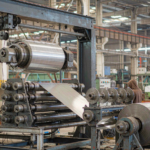
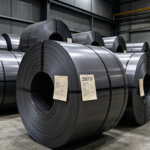
Expanded metal is sheet steel slit and stretched into a rigid, open diamond mesh — one continuous piece of metal with no welds and no weaving, so it cannot unravel, and every strand carries load. Huaxia-Steel supplies carbon steel expanded metal sheets and coils factory direct: raised (standard) and flattened types, SWD/LWD from 8 × 18 mm up to 100 × 200 mm, thicknesses 0.5 to 8.0 mm, plain, galvanized or PVC-coated. Grating, plaster reinforcement, fencing, machine guards and walkway panels ship worldwide with per-order dimensional reports and seaworthy packing.
Product Overview

Expanded metal starts as a solid carbon steel sheet or coil. A row of staggered slits is punched across the sheet, and the material is stretched so each slit opens into a diamond-shaped opening while the metal between slits rotates to form strands. The result is a self-supporting grid that is stronger per kilogram than the original sheet: the stretching work-hardens the strands, and the open area (typically 40 to 80 percent) cuts weight dramatically while keeping load paths continuous. Because there are no joints, expanded metal has no weak point at a weld or a weave crossing — the reason it outlasts welded mesh in walkway grating and resists unraveling when cut in the field.
Two product types exist. Raised (standard) expanded metal leaves the strands offset above and below the sheet plane, giving a three-dimensional profile with excellent slip resistance — the choice for walkways, stair treads and platform flooring. Flattened expanded metal is passed through a rolling operation after expanding, producing a flat, smooth sheet with a thinner overall profile — the choice for fencing, plaster base, battery grids, filters and decorative panels where a flush surface matters. We produce both types on semi-continuous lines and offer mesh in sheets (1,220 × 2,440 mm is the export standard) or in rolls for light gauges.
Specification Table

| Parameter | Range | Notes |
|---|---|---|
| Base thickness | 0.5 – 8.0 mm | sheet 0.5–3 mm for light mesh; 3–8 mm for heavy grating |
| Short way of diamond (SWD) | 8 – 100 mm | opening size measured across the short diagonal |
| Long way of diamond (LWD) | 18 – 200 mm | LWD is directional — load orientation on walkways follows LWD |
| Strand width | 1.0 – 10 mm | wider strands = higher load capacity and lower open area |
| Sheet size | 1,000 × 2,000 to 1,500 × 3,600 mm | 1,220 × 2,440 mm standard; rolls for gauges under 1.5 mm |
| Open area | 40 – 80 % | function of SWD, LWD and strand width |
| Type | raised / flattened | raised for anti-slip flooring; flattened for fencing and plaster base |
| Finish | self-color (oiled), hot-dip galvanized, PVC coated | galvanizing per EN ISO 1461 / ASTM A123 after expanding |
| Weight | 2.0 – 40 kg/m² | depends on thickness, mesh size and strand width |
When specifying, always give SWD, LWD, base thickness and strand width — mesh marketed only by “opening size” varies widely between suppliers because the same opening can carry different strand widths and therefore different load capacity. If you have a competitor sample, send it; we measure and match all four dimensions plus finish, and return a first-article sheet with a dimensional report before production.
Materials and Manufacturing Standards
Substrate is low-carbon steel sheet and coil to Q235B / S235JR (typical for fencing, reinforcement and general mesh) or higher-strength grades where grating spans demand it. Manufacturing follows the recognized international references for expanded metal: ASTM F1267 (metal, expanded, steel — the common US spec for light and heavy mesh), NEMA and CS-202 references for walkway products, and EN ISO 1461 / ASTM A123 for post-expanding hot-dip galvanizing. Strand formation work-hardens the steel, raising yield by roughly 10 to 30 percent over the base sheet — a free strength bonus that spec sheets frequently ignore, and one reason expanded metal grating carries impressive loads for its weight.
- Material certificates: EN 10204 3.1 MTC per heat for the base coil; dimensional report per batch (SWD, LWD, strand width, thickness, sheet dimensions, weight per m²).
- Galvanizing after expanding ensures every cut edge and strand surface is coated — a decisive advantage over welded mesh, whose weld points and cut wires often show rust first.
- PVC coating (common colors green RAL 6005, black, grey) at 0.4 to 0.8 mm over galvanized substrate for fencing and architectural mesh.
Applications
- Walkways, platforms and stair treads: raised heavy-gauge mesh with LWD across the span direction; slip resistance comes from the raised strand profile at no extra cost.
- Plaster and render reinforcement: light flattened mesh behind renders and screeds, especially on masonry and refurbishment work.
- Fencing and partitions: flattened mesh panels for industrial fences, cage enclosures, warehouse divides — vandal-resistant because there are no joints to pry open.
- Machine guarding and safety screens: rigid open guards around rotating equipment that keep visibility while stopping hand access.
- Filtration, grilles and decorative panels: architectural facades, sunscreens, speaker grilles and barbecue grids in flattened or custom-designed mesh.
- Battery grids, catalyst carriers and ceiling tiles: light expanded foil and sheet products in flattened form.
Load guidance for walkway selection: a common heavy walkway mesh (SWD 30 mm, LWD 75 mm, 4.5 mm base thickness, raised) spans roughly 600 to 900 mm between supports under a 5 kN/m² service load with acceptable deflection; lighter meshes span 300 to 500 mm. Final span tables depend on strand width and orientation — request our span table sheet for the exact mesh you are quoting, and note that load capacity drops sharply when LWD runs parallel to the span instead of across it.
Quality Assurance
Quality control on expanded metal is dimensional before it is anything else. Our batch inspection measures SWD and LWD at five positions per sheet, strand width and thickness with calipers, and sheet flatness (bow limit typically 0.5 percent of length for flattened mesh). We check for the two classic defects: torn strands (from worn knife dies — visible as ragged edges under 10× magnification) and uneven opening (from mis-set feed, visible as diamond rows of varying width). Zinc-coated batches get coating thickness checks per EN ISO 1461 acceptance tables, and PVC-coated batches get adhesion cross-hatch tests. Every export order ships with a dimensional report and photos of the actual production mesh, not stock photos — ask for them at the RFQ stage and any serious supplier should agree without hesitation.
Packing and Shipping
Sheets ship nested in bundles of 50 to 200 with edge protectors and steel banding on timber cradles; rolls ship individually wrapped with cardboard cores and end discs. Galvanized and PVC-coated mesh is separated by paper interleaving so the coatings do not mark each other in transit. A 20-foot container loads roughly 8 to 14 tons depending on mesh weight; a 40-foot high cube up to 22 tons of light mesh. Each bundle is tagged with mesh designation, sheet count, dimensions and finish, matched to the packing list one-to-one — and because expanded metal is dimension-stable and rust-protected, it stores outdoors under cover for months without degradation, an advantage over welded wire mesh on slow-moving projects.
Why Buy Expanded Metal From Huaxia-Steel
- Factory direct from coil to finished mesh — consistent strand width and die control across repeat orders.
- Both raised and flattened types, from 0.5 mm reinforcement mesh to 8 mm grating, in one supply contract.
- Match-to-sample service with first-article dimensional report before production.
- Post-expanding hot-dip galvanizing — every strand and edge coated, no hidden bare steel.
- Mixed-container loads with grating, fencing, wire mesh and fasteners for turnkey site supply.
Cutting, Forming and Fabrication Notes
Expanded metal fabricates like sheet with a few adjustments. Cutting: guillotines cut flattened mesh cleanly; raised mesh cuts best with the diamond rows oriented so the blades meet strands rather than openings, or with plasma/laser for irregular shapes. Forming: mesh can be rolled into cylinders for ducting and guards, folded into trays and cages, and U-edged for stair treads — the work-hardened strands remember their shape, so over-bending cracks them at tight radii; keep inside radii at or above 2T for heavy mesh. Fixing: sheets are bolted with J-clips, G-clips or saddle fasteners into support frames, or welded by seam welding the strand crossings on jigs. Design walkway spans with the LWD across the span direction and provide edge trim to stop strand pull-out at openings — these two details fix most installation problems before they start.
Frequently Asked Questions
What is the difference between raised and flattened expanded metal?
Raised expanded metal keeps the strands offset above and below the sheet plane — three-dimensional, more rigid per weight, and naturally slip-resistant, so it is used for walkways and treads. Flattened expanded metal is rolled flat after expanding — smooth, thinner overall, and used for fencing, plaster base, filters and decorative panels where a flush surface is needed.
How is expanded metal sized and specified?
By four dimensions: short way of diamond (SWD), long way of diamond (LWD), base thickness and strand width, plus sheet size, type and finish. Never order on opening size alone — two meshes with the same opening can differ by 50 percent in load capacity depending on strand width.
Can expanded metal be galvanized after expanding?
Yes, and it should be. Hot-dip galvanizing after expanding coats every strand surface and every edge produced by the slitting process. Pre-galvanized sheet that is expanded afterwards exposes bare steel on every strand edge — visibly inferior and quicker to rust, especially outdoors.
What is the MOQ and lead time?
Standard meshes ship from stock or short production in 15 to 25 days with MOQ around 1 to 3 tons per size; custom mesh (special dies, oversized sheets) requires tooling preparation and 30 to 45 days. Mixed sizes can combine into one container to meet minimums.
Need expanded metal sheets matched to your exact SWD/LWD/strand spec, galvanized and export-packed? Send the mesh designation or a sample description — factory-direct quote with dimensional report within 24 hours.