ASTM A36 vs S235JR vs SS400 — Carbon Steel Grades Comparison 2026
ASTM A36 vs S235JR vs SS400 — Carbon Steel Grades Comparison
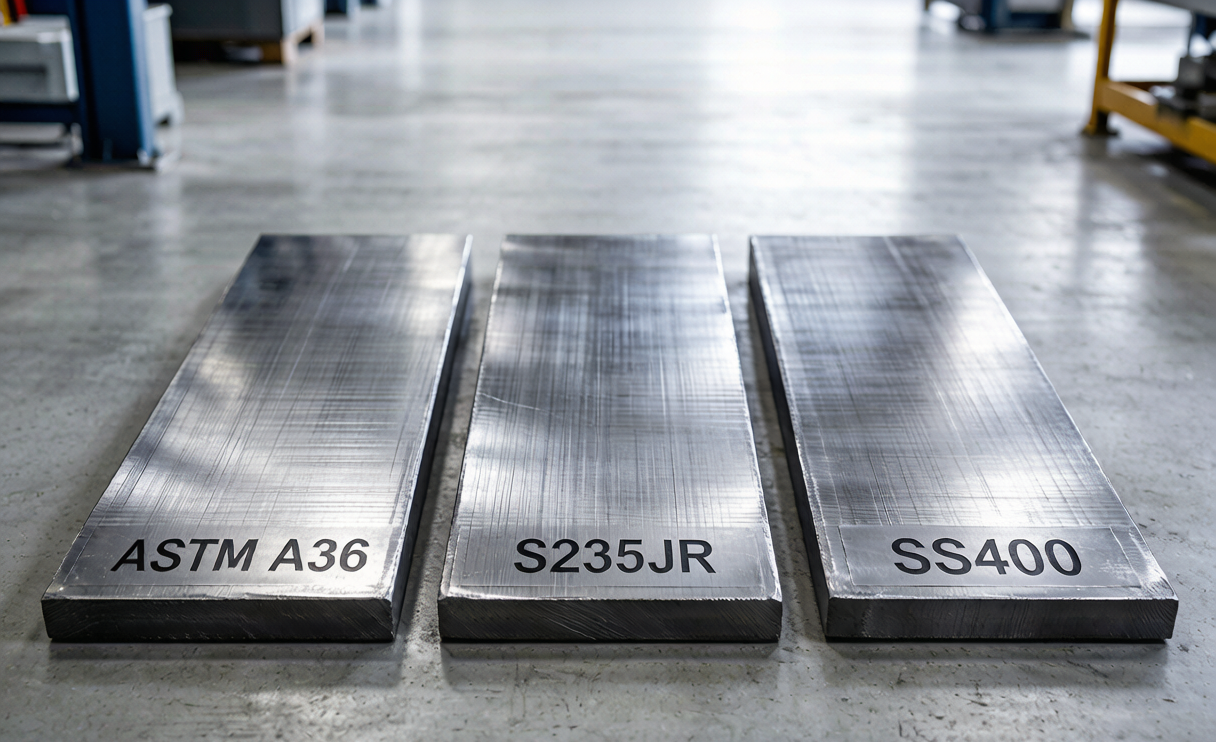
When sourcing carbon structural steel for international projects, three grade designations appear most frequently: ASTM A36 (American), S235JR (European), and SS400 (Japanese). While all three are general-purpose mild carbon steels with comparable yield strengths around 235–250 MPa, the subtle differences in chemical composition, mechanical properties, and manufacturing tolerances can significantly impact your project’s compliance, cost, and performance.
This comprehensive comparison breaks down each grade side by side, covering chemical requirements, mechanical properties, welding behavior, dimensional tolerances, regional availability, and price factors — so you can make an informed sourcing decision whether you’re buying for construction, machinery, or general fabrication.
1. Quick Reference: ASTM A36, S235JR, SS400 at a Glance
Property
ASTM A36
S235JR
SS400
Standard
ASTM A36/A36M
EN 10025-2
JIS G3101
Region
USA / Americas
Europe / EU
Japan / Asia
Min. Yield Strength
250 MPa (36 ksi)
235 MPa
245 MPa (thickness ≤16mm)
Tensile Strength
400–550 MPa
360–510 MPa
400–510 MPa
Elongation (min)
20% (200mm) / 23% (50mm)
26% (longitudinal)
17% (thickness ≤5mm) to 21% (>16mm)
Carbon max
0.26%
0.17% (nominal)
— (not specified)
Manganese max
—
1.40%
—
Phosphorus max
0.04%
0.035%
0.050%
Sulfur max
0.05%
0.035%
0.050%
Weldability
Excellent
Excellent
Good (CE ≤0.44%)
Common Forms
Plate, bar, shape, sheet
Plate, section, bar, sheet
Plate, sheet, bar, section
2. Chemical Composition: Where the Differences Matter
Chemical composition is the foundation of every steel grade. While all three are classified as mild carbon steels, their chemistry limits reflect different regional philosophies about steelmaking and intended applications.
2.1 Carbon Content Limits
ASTM A36 sets a straightforward upper limit of 0.26% carbon for plates and shapes regardless of thickness. This relatively generous ceiling gives mills flexibility in scrap-based EAF production, which dominates US steelmaking.
S235JR takes a different approach — EN 10025-2 specifies the carbon limit through a ladle analysis ceiling that varies by thickness: 0.17% for sections ≤16mm, rising to 0.20% for thicker sections. This is tighter than A36 and reflects the European preference for cleaner steel with predictable welding behavior.
SS400 does not specify a carbon maximum at all in JIS G3101. Instead, the standard relies on a carbon equivalent (CE) calculation to ensure weldability, typically keeping CE ≤0.44%. This performance-based approach is common in Japanese standards.
2.2 Phosphorus and Sulfur — The Cleanliness Indicators
S235JR enforces the strictest limits at 0.035% max for both phosphorus and sulfur. ASTM A36 allows up to 0.04% P and 0.05% S — reflecting the higher sulfur tolerance of American continuous casting practices. SS400 permits up to 0.050% for both elements, the most lenient of the three.
Why does this matter? Higher phosphorus increases strength but reduces ductility and can cause cold shortness. Elevated sulfur improves machinability but degrades welding quality and hot workability. If your project involves extensive welding or cold forming, S235JR’s tighter chemistry offers a measurable advantage.
3. Mechanical Properties: Yield, Tensile, and Elongation Compared
3.1 Yield Strength — The Design Baseline
For structural design, yield strength is the critical parameter. Here’s how they compare across thickness ranges:
Thickness Range
ASTM A36
S235JR
SS400
≤16 mm
250 MPa
235 MPa
245 MPa
16–40 mm
250 MPa
225 MPa
235 MPa
40–63 mm
250 MPa
215 MPa
215 MPa
63–80 mm
250 MPa
215 MPa
215 MPa
80–100 mm
250 MPa
215 MPa
215 MPa
100+ mm
220 MPa (plates)
195 MPa (100–150mm)
—
ASTM A36 stands out by maintaining 250 MPa yield strength across almost all thicknesses — a significant advantage for heavy-section applications. Both S235JR and SS400 apply thickness-dependent reductions to their yield strength values, which is more common internationally.
3.2 Tensile Strength Range
ASTM A36: 400–550 MPa — the widest range, reflecting the variety of production routes in US mills.
S235JR: 360–510 MPa — narrower, more predictable range preferred in European design codes.
SS400: 400–510 MPa — combines a higher floor with the tighter ceiling, offering the most consistent upper range.
3.3 Elongation — Ductility Under Load
S235JR leads with a minimum elongation of 26% (longitudinal) — the highest of the three, confirming its excellent formability. ASTM A36 requires 20–23% depending on the gauge length used. SS400 ranges from 17% to 21% depending on thickness, making it the least ductile in thin sections.
4. Welding Performance and Carbon Equivalent
All three grades are considered readily weldable using standard arc welding processes (SMAW, GMAW, FCAW, SAW). However, the carbon equivalent (CE) value provides a more nuanced picture:
ASTM A36: CE typically 0.30–0.38% for thicknesses ≤25mm. Preheating (50–150°C) recommended above 25mm.
S235JR: CE typically 0.24–0.35%. The lower carbon ceiling means preheating is rarely needed below 40mm, reducing welding costs.
SS400: CE ≤0.44% per JIS G3101. In practice, most heats fall between 0.30–0.40%, comparable to A36.
For structural welding in cold climates or thick sections, S235JR offers the best risk profile. For general fabrication and repair welding, all three grades perform similarly with proper procedures.
5. Dimensional Tolerances and Surface Quality
Tolerance standards differ markedly between the three systems, which can cause surprises in multi-standard projects:
Aspect
ASTM A36
S235JR
SS400
Thickness tolerance
ASTM A6/A6M
EN 10029 (plates), EN 10034 (sections)
JIS G3193 (plates), JIS G3192 (sections)
Flatness
1/2 ASTM A6 commercial
EN 10029 Class N
Per JIS G3193
Surface
Mill finish, no specific requirement
EN 10163-2 Class A/B
Mill finish
Camber & sweep
ASTM A6 limits
EN 10034 limits
JIS G3192 limits
European EN standards tend to be the most prescriptive, with clear surface quality classes and repair limits. ASTM and JIS rely more on buyer-seller agreements for surface quality — so if you need guaranteed cosmetic standards, specify EN 10163 explicitly in your purchase order.
6. Price Comparison and Regional Availability
Pricing is driven by regional supply-demand dynamics, not by grade differences alone:
ASTM A36: Most economical in North and South American markets. US domestic mills produce enormous volumes, keeping ex-works prices low. For export buyers, additional freight and tariffs can erode the base price advantage.
S235JR: Price-competitive across Europe, the Middle East, and North Africa. European overcapacity has kept prices under pressure, making S235JR an attractive option for Mediterranean-region projects.
SS400: Dominates Asian markets with highly competitive pricing from Chinese, Korean, and Japanese mills. For buyers in Southeast Asia, the Middle East, and Africa, SS400 ex-China often delivers the lowest landed cost.
As of 2026, the price spread between equivalent products in these three grades is typically within 5–8% when comparing similar mill origins and delivery terms. The larger cost driver is logistics — shipping, duties, and inland transport.
7. How to Choose: Decision Matrix by Application
Application Scenario
Recommended Grade
Reason
Building construction (North America)
ASTM A36
Code compliance, engineer familiarity
Building construction (Europe/Middle East)
S235JR
Eurocode compatibility, CE marking
Building construction (Asia/Africa)
SS400 or ASTM A36
Availability and cost
Heavy welded structures
S235JR
Lower carbon reduces cracking risk
Cold-formed sections
S235JR
Higher elongation, better formability
General machinery frames
Any — choose by cost
All three adequate for non-critical parts
Shipbuilding (non-classed)
ASTM A36 or SS400
Commonly accepted by yards
Pressure vessels
None — use SA 516 Gr.60/70
These are structural, not pressure grades
8. Certification and Mill Test Reports (MTR)
All three grades require mill test reports, but the certification approach differs:
ASTM A36: Requires MTR per ASTM A6. Certification type (2.1, 2.2, 3.1, 3.2 per EN 10204) must be specified separately.
S235JR: EN 10204 Type 2.2 (test report) is standard. Type 3.1 (inspection certificate) or 3.2 (with third-party verification) available on request.
SS400: JIS G0404-based inspection certificate. Third-party inspection (Class A, B, C per JIS Q 1011) can be arranged.
When ordering for export, always specify your required certification level in the purchase contract. Chinese mills producing SS400 routinely provide EN 10204 3.1 certificates when requested, at minimal extra cost.
Frequently Asked Questions
Can ASTM A36 directly substitute for S235JR?
In most structural applications, yes. ASTM A36 has slightly higher yield strength (250 vs 235 MPa), so it generally exceeds S235JR’s minimum requirements. However, for CE-marked products under the Construction Products Regulation (CPR) in the EU, S235JR with the appropriate certification is mandatory — A36 does not comply with CPR.
Is SS400 the same as ASTM A36?
They are similar but not identical. SS400 has a slightly lower yield strength minimum for thin sections (245 vs 250 MPa) and different chemical philosophy (no carbon max specified). In practice, many Chinese mills produce a dual-certified product that meets both A36 and SS400 requirements simultaneously — ask your supplier for a dual-grade certificate.
Which grade is best for galvanizing?
All three galvanize well due to their silicon content (typically ≤0.30%). S235JR with its lower carbon and tighter chemistry control produces the most uniform zinc coating. If galvanizing is critical, specify a silicon range of 0.15–0.25% to optimize coating thickness and adhesion.
Does grade choice affect import duties?
Generally no — duties are based on product form (plate, section, bar) and HS Code, not the specific grade designation. However, some countries have anti-dumping duties that reference specific grades. Always check your destination country’s trade remedy legislation before ordering.
What if my project requires dual compliance (e.g., A36 + S235JR)?
Many mills, especially in China, can produce steel that meets both specifications simultaneously. Request a “dual certified” product with both ASTM and EN test results on the MTR. There may be a small premium (typically $15–30/ton) for dual testing.
Get Expert Help with Carbon Steel Sourcing
At Huaxia-Steel, we stock and supply ASTM A36, S235JR, and SS400 in plates, sheets, bars, and structural sections — all with full mill certification and optional third-party inspection. Our team can help you navigate grade selection, dual certification, and export logistics to ensure your project gets the right steel at the right price.
If you require further information about our metal sheet products or architectural projects, please don’t hesitate to leave your contact details and message here.
Our team of experts will respond within 24 hours to continue the discussion and provide you with any additional information you requires.