ASTM A516 vs A515 Boiler Quality Plate: Chemistry, Mechanical, Selection
ASTM A516 vs A515 Boiler Quality Plate: Chemistry, Mechanical, Selection
ASTM A516 and ASTM A515 are the two most common carbon steel plate specifications supplied for boiler and pressure vessel service in North America. Both are normalized fine-grain plate products with similar nominal chemistry, but they differ in low-temperature impact testing, intended service, and procurement cost. Choosing the wrong one leads to over-budget orders, failed Charpy tests, or worse – in-service brittle fracture. This guide compares chemistry, mechanical properties, impact testing, applications, traceability and EN 10204 MTC requirements side by side so that buyers, EPC engineers and procurement managers can select the correct grade on the first RFQ.
1. Standard Scope and History
ASTM A516 / A516M is titled “Standard Specification for Pressure Vessel Plates, Carbon Steel, for Moderate- and Lower-Temperature Service”. The current revision covers four grades ordered by increasing notch toughness: Grade 55 (yield 207 MPa), Grade 60 (yield 220 MPa), Grade 65 (yield 240 MPa), and Grade 70 (yield 260 MPa). Each grade is supplied in the normalized condition unless otherwise specified. A516 was introduced in the 1960s as the dedicated pressure vessel plate, replacing the older A201 and A285 plates for many services.
ASTM A515 / A515M is titled “Standard Specification for Pressure Vessel Plates, Carbon Steel, for Intermediate- and High-Temperature Service”. A515 carries three grades: Grade 60, Grade 65, and Grade 70 – each with the same nominal yield as A516 but without mandatory Charpy testing at low temperature. A515 was originally used for refinery and boiler applications at elevated temperatures, where creep rather than notch toughness is the limiting property.
In practice, the modern A516 has largely displaced A515 for new construction. A515 remains specified for high-temperature refinery and boiler drums in plants designed to ASME Section I (Power Boilers) rather than Section VIII (Unfired Pressure Vessels). Always confirm the service code and design code when one of these plates is ordered.
2. Chemical Composition Compared
Element (percent)
A516 Gr.55
A516 Gr.60
A516 Gr.65
A516 Gr.70
A515 Gr.60
A515 Gr.65
A515 Gr.70
Carbon (C, max)
0.18
0.21
0.24
0.27
0.24
0.28
0.31
Manganese (Mn, 12.5 mm and under)
0.60-0.90
0.60-0.90
0.85-1.20
0.85-1.20
0.85-1.20
0.85-1.20
0.85-1.20
Manganese (Mn, over 12.5 mm)
0.85-1.20
0.85-1.20
0.85-1.20
0.85-1.20
0.85-1.20
0.85-1.20
0.85-1.20
Phosphorus (P, max)
0.025
0.025
0.025
0.025
0.035
0.035
0.035
Sulfur (S, max)
0.025
0.025
0.025
0.025
0.035
0.035
0.035
Silicon (Si)
0.15-0.40
0.15-0.40
0.15-0.40
0.15-0.40
0.15-0.40
0.15-0.40
0.15-0.40
The compositional trend shows A516 has tighter controls on phosphorus and sulfur (each capped at 0.025 percent vs 0.035 percent in A515) and lower maximum carbon in the lower grades. Both specifications allow ladle deoxidation chemistry to achieve the Si level, and both rely on aluminum grain refinement in the normalized plate.
3. Mechanical Properties and Charpy Impact
Property
A516 Gr.55
A516 Gr.60
A516 Gr.65
A516 Gr.70
A515 Gr.60
A515 Gr.65
A515 Gr.70
Tensile Strength (MPa)
380-485
415-550
450-585
485-620
415-550
450-585
485-620
Yield Strength, min (MPa)
205
220
240
260
220
240
260
Elongation 200 mm, min (percent)
23
21
19
17
21
19
17
Charpy @ -46 deg;C (J, min)
20
20
20
20
not required
not required
not required
The decisive difference is the Charpy impact requirement. A516 carries a mandatory minimum 20 J at -46 deg;C (approx -50 deg;F) in all four grades, sub-size test specimens being normalized per ASME SA-20. A515 has no mandatory Charpy test. In real practice, A515 is often impact-tested by mutual agreement when the application temperature is borderline, but legally the spec allows shipping without impact data.
4. Delivery Condition
Both A516 and A515 are supplied in the normalized condition by default. Normalizing consists of heating the plate to 900 to 925 deg;C, soaking to equalize temperature, and cooling in still air. The grain refinement improves notch toughness and gives A516 its edge in cold-service performance.
For very heavy plates (typically above 100 mm), the heat treater may apply accelerated cooling (ac) and tempering to achieve the required properties, with the condition noted on the MTC as “normalized and tempered” or “quenched and tempered”. Buyers should confirm with the mill that the mill is set up to perform normalizing in-house – some service centers only stock as-rolled plates and rely on subcontractors for normalization.
5. Size Range
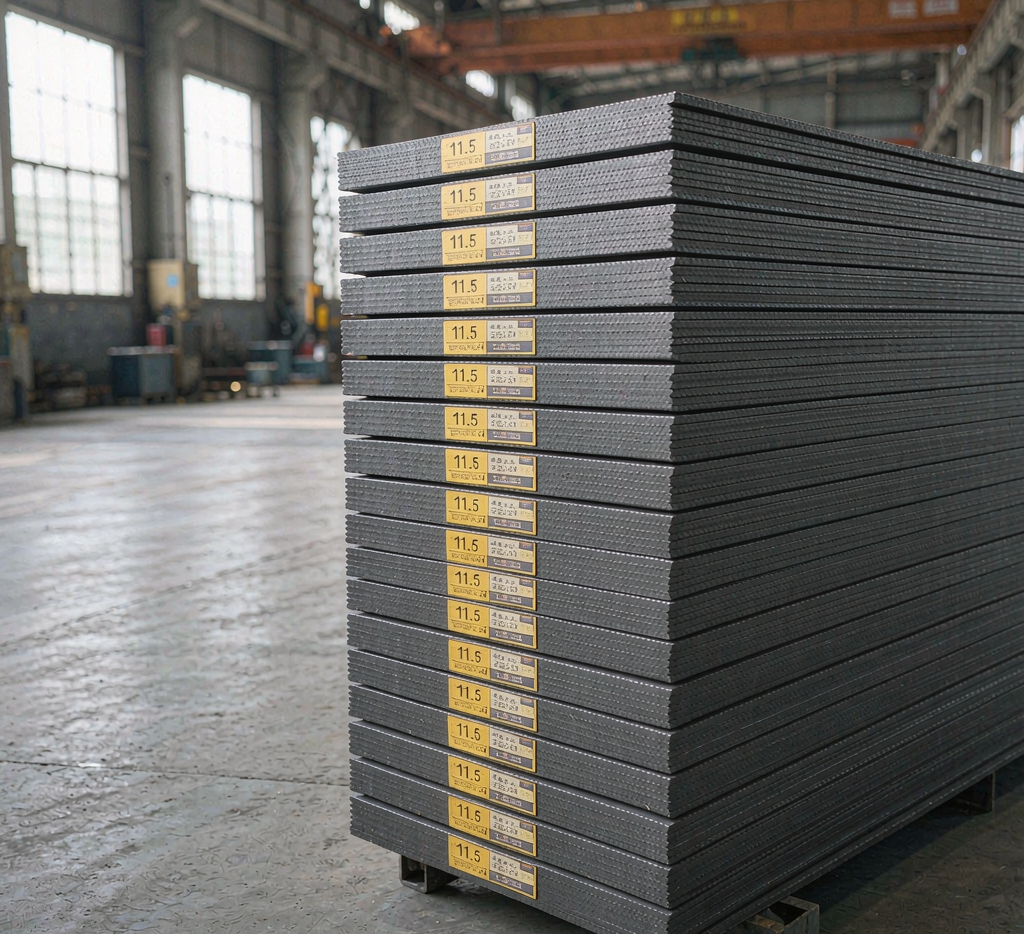
Both A516 and A515 plates are produced from 3 mm (1/8 in.) to 200 mm (8 in.) thickness. Width ranges from 1,500 mm up to 4,000 mm depending on the mill, and length up to 18,000 mm. ASTM A6 governs plate dimensional tolerances (thickness, width, length, flatness, edge) for both specifications. Plates heavier than 100 mm are typically produced by forging or by heavy-slab rolling and may require longer lead times.
6. Applications
ASTM A516 is widely used for:
Unfired pressure vessels per ASME Section VIII Division 1 and 2
LNG storage tank shells (in conjunction with 9 percent Ni inner tank)
Ammonia, LPG, and CO2 storage tanks
Hydrocarbon separators, drums, and columns at moderate to low temperature
Boiler drums and steam drums at sub-zero plant locations
Pipeline pig receivers and low-temperature process equipment
ASTM A515 is commonly specified for:
Boiler and steam drums per ASME Section I (Power Boilers)
Refinery process vessels at elevated temperature service up to 425 deg;C
Coal-fired boiler air and flue gas ducts
Heat exchanger tube sheets and channels
High-temperature headers and piping components
7. Welding and Fabrication
Both A516 and A515 are readily weldable by SMAW, GMAW, FCAW, GTAW, and SAW. The lower maximum carbon and tighter CEV of A516 Gr.55 to Gr.65 allow welding without preheat at thicknesses up to 25 mm with standard E7018 / ER70S-6 consumables. For heavy restraint welds or service below 0 deg;C, the buyer should preheat to 75 to 150 deg;C and select low-hydrogen consumables.
For A515 Gr.70, the 0.31 percent maximum carbon is at the upper end of standard weldability and a preheat of 100 to 175 deg;C plus low-hydrogen consumables is recommended for thicknesses above 16 mm. Post-weld heat treatment (PWHT) at 595 to 650 deg;C for one hour per 25 mm thickness is required by ASME for many Code fabrication cases using these higher carbon plates.
8. Cost and Lead Time
A515 plate is generally lower in price because the spec is simpler to certify. A516 plate commands a premium of 5 to 15 percent over A515 of the same grade, reflecting the extra normalizing cost and mandatory Charpy testing. Lead times are similar at 4 to 8 weeks for standard sizes from stock-holding mills, increasing to 12 to 16 weeks for very heavy plates produced to order. Mills in China, Korea, Japan, Germany and Italy all export A516 to North American pressure vessel fabricators; A515 export is much less common and most are produced by US-based mills.
9. EN 10204 MTC Requirements
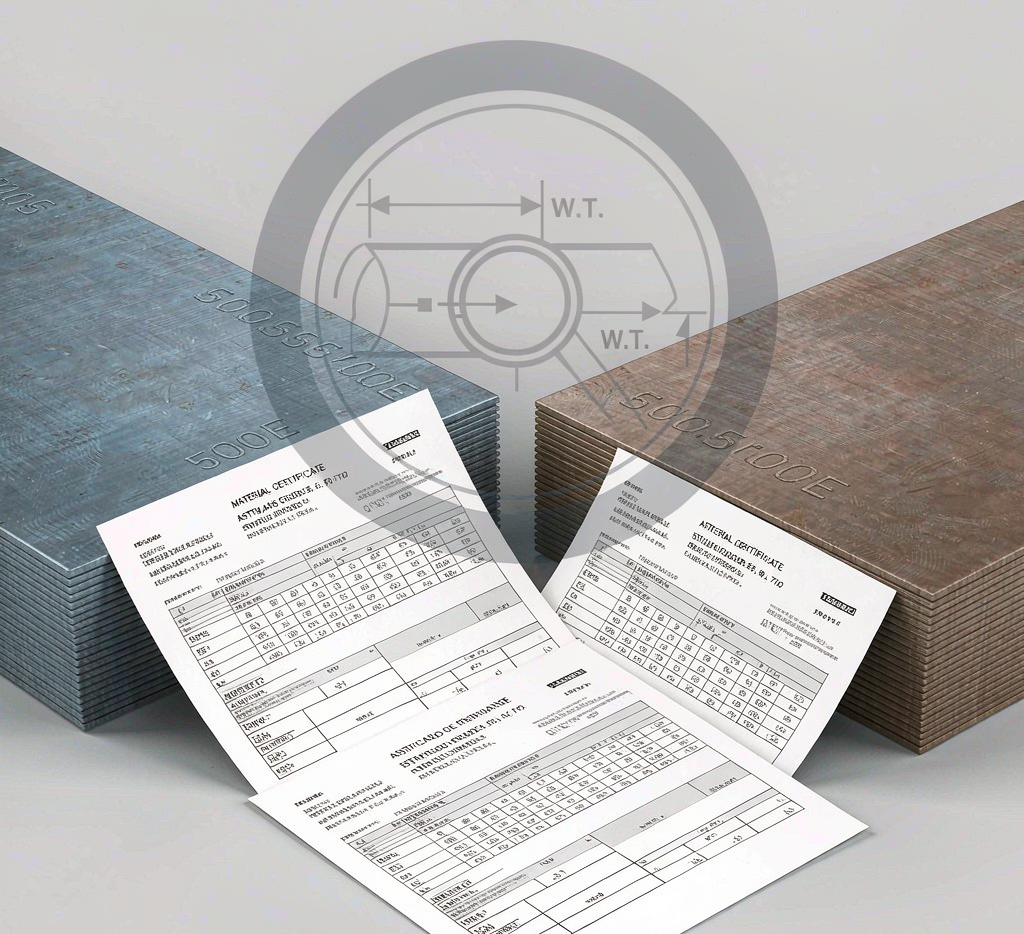
Pressure vessel fabricators under ASME Section VIII or Section I require a 3.1 mill test certificate per EN 10204 (or a corresponding Certificate of Test in ASTM A6 format). The certificate must include:
Heat number, plate number, and traceability to the slab
Ladle chemical analysis with all specified elements
Mechanical test results including tensile, elongation, and Charpy (where ordered)
Normalized heat treatment record and furnace identity
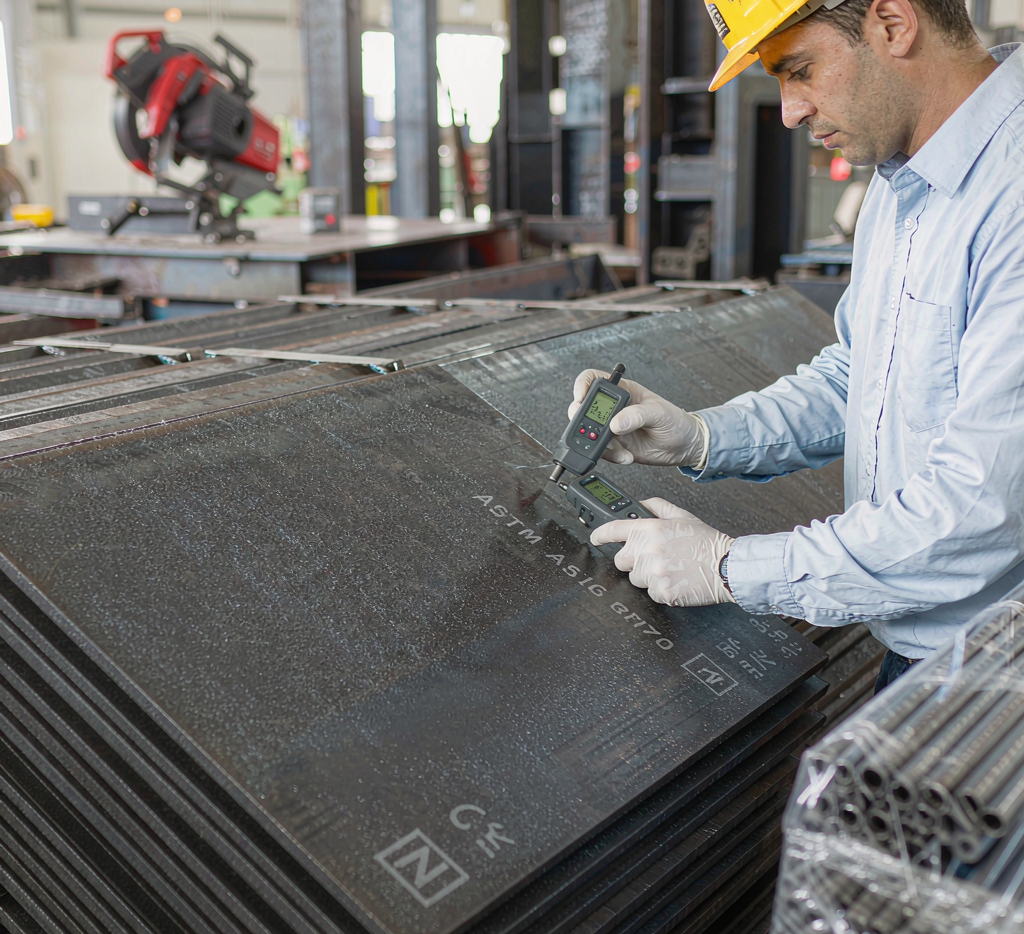
Surface inspection and dimensional tolerances per ASTM A6
For service with third-party inspection by ABS, BV, DNV, LR or TUV, a 3.2 certificate is typically required with the inspector’s signature on the MTC. Some EPCs demand a witnessed Charpy test for A516 and an in-house Charpy or drop-weight test for A515 even when not strictly mandated.
10. Selection Decision Flow
For a typical pressure vessel RFQ, the selection between A516 and A515 is driven by four questions:
What is the MDMT (minimum design metal temperature)? Below -29 deg;C (-20 deg;F) – specify A516. Above 0 deg;C – either is acceptable; A515 may save cost.
Which ASME code applies? Section I (Power Boilers) – A515 is sometimes still specified. Section VIII (Unfired) – A516 is the default.
Is Charpy testing required for fitness-for-service? If yes – order A516 directly to avoid negotiation.
Is third-party certification required? 3.2 MTC is available for either, but A515 export stock is much thinner.
11. Cross Reference Summary
ASTM Grade
EN 10028-2 (Pressure)
JIS G3119 (Boiler)
GB 713 (Boiler)
A516 Gr.55
P265GH
SGV410
Q245R
A516 Gr.60
P265GH
SGV450
Q245R
A516 Gr.65
P295GH
SGV450
Q345R
A516 Gr.70
P355GH
SGV480
Q345R
A515 Gr.60
P265GH
SGV450
Q245R
A515 Gr.65
P295GH
SGV450
Q345R
A515 Gr.70
P355GH
SGV480
Q345R
12. Frequently Asked Questions
Q1: Can A515 be supplied with Charpy impact data on request? Yes. Most mills can supply A515 with supplementary Charpy testing at any temperature agreed in the order. The certification line on the MTC will state the test temperature and values. However, the spec itself does not require this test and a buyer should not assume it unless the requirement is written into the purchase order.
Q2: Are A516 and A515 plate used interchangeably in the field? Not for low-temperature service. Many fabricators accept A515 for ambient and slightly elevated-temperature work, but the spec does not enforce any minimum Charpy and the responsibility shifts to the engineer-of-record. For new construction, always order to A516 and bypass the document risk.
Q3: What is the typical price premium for A516 over A515 at Gr.70? For comparable thickness and size, A516 Gr.70 plate is roughly 8 to 12 percent more expensive than A515 Gr.70 plate. The premium widens to 15 percent for heavy plates that must be ordered specially for normalizing capacity.
Q4: How are A516 plates laser or plasma-cut for vessel fabrication? Both A516 and A515 laser and plasma cut cleanly with standard equipment. Preheating is not required for thicknesses up to 25 mm. After cutting, grinding to remove the HAZ and magnetic-particle inspection of the cut edge is recommended per ASME fabrication codes.
Q5: Is A516 available in coil form? A516 is a plate specification and is not produced in coil. For coil product, the comparable specs are ASTM A841 (TMCP plate for moderate and low temperature) or API 2H for offshore platform plate.
13. Conclusion
ASTM A516 and ASTM A515 plates overlap in tensile strength, but A516 is the more modern specification with mandatory low-temperature Charpy testing, tighter chemistry control and a normalized delivery condition. Specify A516 by default for new low- and ambient-temperature pressure vessels. Specify A515 only when the design code or end-user specification explicitly requires it, such as Section I boiler work or refinery high-temperature drums. Confirm the MTC format with the mill up-front and lock the Charpy test temperature on the purchase order to avoid downstream disputes.
14. Get a Quote from Huaxia-Steel
Huaxia-Steel supplies factory-direct ASTM A516 Gr.55, Gr.60, Gr.65, Gr.70 plate and ASTM A515 Gr.60, Gr.65, Gr.70 plate from approved Chinese mills with EN 10204 3.1 or 3.2 MTC. Thickness 3 to 200 mm, width up to 4,000 mm, length up to 18,000 mm. ABS, BV, DNV, LR, CCS witnessed third-party inspection available. Send your drawing, design code and Charpy temperature to our export team for a fast RFQ response within 24 hours.
If you require further information about our metal sheet products or architectural projects, please don’t hesitate to leave your contact details and message here.
Our team of experts will respond within 24 hours to continue the discussion and provide you with any additional information you requires.