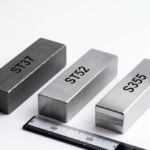
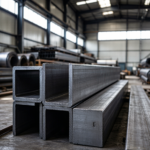
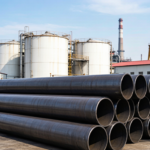
DIN 17100 St37 / St44 / St52 / St60 Carbon Steel Grades: A Legacy Comparison
DIN 17100 was the German national standard for “Steels for General Structural Purposes” — unalloyed quality steels with yield strengths from 185 MPa (St33) up to 360 MPa (St70). It was first issued in 1957 and revised several times. The standard classified steel by a “guaranteed minimum yield strength” expressed in kgf/mm², hence the St numbers (St37 = minimum yield 37 kgf/mm² ≈ 363 MPa at the time of writing). When Germany joined the European standardization effort, DIN 17100 was withdrawn in July 2004 and replaced by the harmonized EN 10025-2 (non-alloy structural steels). Some mills still mark plate and bar with both the DIN and EN designations for legacy contracts.
2. Mechanical Properties of St37, St44, St52 and St60
The table below summarises the typical mechanical properties as published in the last (1980) revision of DIN 17100. Note that the numbers are slightly more conservative than the equivalent EN 10025-2 grades — the European standardisation tightened quality control and allowed tighter mill practices.
Grade (DIN 17100)
Yield (MPa, t ≤ 16 mm)
Tensile (MPa)
Elongation (%)
EN 10025-2 Equivalent
St37-2
≥ 235
360 – 510
≥ 25
S235JR
St44-2
≥ 275
410 – 540
≥ 22
S275JR
St44-3
≥ 275
410 – 540
≥ 22
S275JO
St52-3
≥ 345
490 – 630
≥ 22
S355JO / S355J2
St60-2
≥ 335
590 – 710
≥ 16
(no direct EN grade — use E295 or S355JR +1)
St70-2
≥ 365
690 – 900
≥ 11
E360
The most common cross-references an importer needs:
St37-2 ↔ S235JR (EN 10025-2)
St44-2 / St44-3 ↔ S275JR / S275JO
St52-3 ↔ S355JO / S355J2
St60-2 ↔ E295 (EN 10025-2, “engineering steel”) or S355JR with over-strength
3. Chemical Composition Comparison
DIN 17100 used a “ladle analysis” system, with separate limits for the product analysis. The table below shows the typical ladle-analysis limits (mass percent).
Element (max %)
St37-2
St44-2
St52-3
St60-2
C
0.17
0.21
0.20
0.23
Si
—
—
0.55
—
Mn
—
—
1.60
—
P
0.050
0.050
0.045
0.050
S
0.050
0.050
0.045
0.050
N
0.009
0.009
0.009
0.009
St52-3 is the most tightly controlled of the family. The deliberate manganese addition (up to 1.60%) gives it higher strength than St37 without sacrificing weldability. St60-2 has the highest carbon content of the group, which limits weldability and makes it more suitable for mechanical engineering than for general welded structures.
5. St52-3 — The Most Widely Specified Grade
Of the four, St52-3 deserves the most attention because it is still quoted on thousands of current RFQs from German-speaking markets. It defined a 345 MPa minimum yield, 490 – 630 MPa tensile range, 22% minimum elongation, and an impact guarantee of 27 J at 0 °C. The “3” suffix meant it was suitable for cold forming and welding.
Modern replacement: EN 10025-2 S355J2 (27 J at -20 °C) or S355JO (27 J at 0 °C, the direct temperature match). The two are interchangeable for almost all static and dynamic load cases. If your drawing says “St52-3 nach DIN 17100”, the simplest modern specification is S355J2 or S355JO per EN 10025-2.
6. Welding Notes for the St-Series
St37-2 and St44-3 weld easily with conventional electrodes (E6013 / E7018). St52-3 welds readily when the carbon equivalent is below 0.45%, with a 50 – 100 °C pre-heat for thick plate. St60-2 requires a pre-heat of 150 – 200 °C and post-weld stress relief for critical components. For mixed welding between St grades (for example a St60-2 shaft welded into a St52-3 frame), use the more demanding grade’s procedure.
7. Sourcing DIN 17100 Grades Today
Although the standard is withdrawn, Chinese, Indian and Turkish mills still produce the equivalent grades for export markets. The most reliable approach when you need to replace a vintage St-series part:
Order to the EN equivalent — St37-2 as S235JR, St44-3 as S275JO, St52-3 as S355J2, St60-2 as E295.
Request an EN 10204 3.1 mill certificate listing the EN designation, the chemical analysis, mechanical properties, impact test results and CE marking.
Where the original drawing strictly says “St52-3”, add a note to the certificate: “Equivalent to DIN 17100 St52-3 (withdrawn standard)” so the receiving inspector can verify the legacy reference.
For German-speaking customers, some mills will mark the plate or bar with both the EN grade and the DIN grade in parentheses — request this when ordering.
8. Common Mistakes When Specifying the St-Series
Asking for “St37” without the “-2” or “-3” suffix — the base grade is too loose to qualify for many modern welds.
Equating St52-3 with ASTM A572 Gr.50 by name only — the chemistry and impact guarantee are different. A572 Gr.50 has no Charpy requirement at all by default.
Buying St60-2 and welding it with the same procedure as St37 — almost guaranteed to crack in the HAZ.
Accepting “DIN 17100” certificate wording on a 2020+ delivery without checking that the actual chemistry meets EN 10025-2 — some mills still print the old standard for legacy customers without performing the EN-required tests.
Storing St37 / St44 / St52 plate in coastal conditions without primer — mill scale is not corrosion protection.
Common Mistakes When Specifying the DIN 17100 St-Series
The single most common mistake is requesting “St52” without the quality class letter. A “St52” without -3 can mean St52-3, St52-4 or St52-4 (the latter two are uncommon but still in some legacy prints). The default of most Chinese mills exporting to Europe is St52-3 — a fine choice for general structural use with Charpy at -20 °C ≥ 27 J. If the part will see -40 °C or higher impact loads, request St52-4 or St52-3N with normalized rolling and Charpy at -40 °C ≥ 27 J. Always repeat the quality class letter on the PO.
A second mistake is omitting the deoxidation practice. DIN 17100 distinguishes U (rimmed, not deoxidized), R (killed, fully deoxidized) and RR (special-killed, fine-grain treated). The modern EN 10025 successor grades (S235 / S275 / S355) are all fully killed with fine-grain practice, so the U / R / RR code no longer exists. If your engineering drawing still says “St37-2 U” you are probably looking at a print from before 1993; ask the engineering office to update it to EN 10025-2 S235JR to avoid the mill quoting on an obsolete route.
A third mistake is mixing DIN 17100 and EN 10025-2 chemical tolerances. The two systems use slightly different manganese ranges for S235 / S275 / S355. EN 10025-2:2019 allows Mn up to 1.40% in S275 and S355, while the legacy DIN 17100 St44-3 / St52-3 capped Mn at 1.20%. The mill test certificate (EN 10204 3.1) will always follow the standard you write on the PO. If you write “S275JR to EN 10025-2” you get the modern Mn range; if you write “St44-3 to DIN 17100” the mill will hold the tighter range and may charge a small premium.
Heat Treatment, Forming & Welding Notes for the St-Series
Hot forming of St37 / St44 / St52 is performed at 880 – 1050 °C; the lower the carbon, the wider the hot-working window. St37 can be hot-bent at 850 °C without cracking; St52-3 needs to stay above 900 °C to avoid working in the two-phase austenite-plus-ferrite region, which produces a coarse duplex grain after cooling. Cold forming of St44-3 and St52-3 plate above 16 mm requires a minimum bend radius of 3 × thickness for St52-3 and 2 × thickness for St44-3; tighter radii need a stress-relief at 600 °C after forming. St37 cold-forms to 1.5 × thickness radius without issue for thicknesses up to 20 mm.
Welding of the St-series uses standard carbon-steel practice. St37 and St44-3 weld with cellulosic (E6010 / E7010) or low-hydrogen (E7018) electrodes without preheat for thicknesses up to 20 mm. St52-3 above 20 mm requires preheat to 100 °C and low-hydrogen electrodes. St60 and St70 require preheat to 150 °C and post-weld stress relief at 600 °C. The CEV of St52-3 is around 0.40 – 0.45%; of St60 around 0.50 – 0.55%; of St70 above 0.60%. The modern EN 10025-2 S355J2 with controlled Mn and micro-alloying has a CEV of 0.38 – 0.42%, slightly better than the legacy St52-3, which is why mills no longer recommend the DIN 17100 designation for new designs.
Normalizing of St52-3 and St60 is performed at 900 – 940 °C with 30 minutes soak time per 25 mm thickness, then air cool. Stress-relief annealing is at 600 – 650 °C for 1 hour per 25 mm. St37 and St44 are rarely normalized because the carbon content is too low to benefit. If the engineering spec requires normalized condition, always specify it on the PO; the mill will then add 4 – 7% to the price and 2 – 3 weeks to the delivery time.
How to Convert Old DIN 17100 References on Legacy Drawings
If you are updating a 1980s German engineering drawing that references St37, St44, St52, St60 or St70, here is the modern EN 10025 equivalent to use on the new revision: St37-2 → S235JR, St44-2 → S275JR, St44-3 → S275J2, St52-3 → S355J2, St60-2 → E295, St70-2 → E335. The mechanical properties match within 5 – 10 MPa in yield and tensile strength; the Charpy requirement is met or exceeded by the EN 10025 grade. Update the standard reference and the grade designation on the drawing title block, and add a revision note: “Re-designated to EN 10025-2:2019; original DIN 17100 grade StXX-X superseded.”
For plate above 16 mm, the modern EN 10025-2 grade also gives you the option of +N (normalized rolling) or +AR (as-rolled) delivery condition. DIN 17100 only had the as-rolled route, so the normalized-rolling option is a free upgrade on the EN side and gives finer grain. The MTC will be issued to EN 10204 3.1 by the mill and will reference EN 10025-2:2019. If the customer still asks for a DIN 17100 certificate, the mill can issue a dual-reference MTC (EN 10025-2 / DIN 17100) on request at no extra charge, but the chemistry and mechanical values will follow the EN standard.
Source EN 10025 / DIN 17100 Equivalent Plate from Huaxia Steel
Huaxia Steel supplies modern EN 10025 equivalents of St37, St44, St52 and St60 — including S235JR, S275JR, S355J2 and E295 plate, sheet and sections — with EN 10204 3.1 / 3.2 certification and dual DIN/EN marking on request. Tell us our grade, thickness and quantity, and we will return a factory-direct quotation within 24 hours.
1. What Is DIN 17100?
DIN 17100 was the German national standard for “Steels for General Structural Purposes” — unalloyed quality steels with yield strengths from 185 MPa (St33) up to 360 MPa (St70). It was first issued in 1957 and revised several times. The standard classified steel by a “guaranteed minimum yield strength” expressed in kgf/mm², hence the St numbers (St37 = minimum yield 37 kgf/mm² ≈ 363 MPa at the time of writing). When Germany joined the European standardization effort, DIN 17100 was withdrawn in July 2004 and replaced by the harmonized EN 10025-2 (non-alloy structural steels). Some mills still mark plate and bar with both the DIN and EN designations for legacy contracts.
2. Mechanical Properties of St37, St44, St52 and St60
The table below summarises the typical mechanical properties as published in the last (1980) revision of DIN 17100. Note that the numbers are slightly more conservative than the equivalent EN 10025-2 grades — the European standardisation tightened quality control and allowed tighter mill practices.
Grade (DIN 17100)
Yield (MPa, t ≤ 16 mm)
Tensile (MPa)
Elongation (%)
EN 10025-2 Equivalent
St37-2
≥ 235
360 – 510
≥ 25
S235JR
St44-2
≥ 275
410 – 540
≥ 22
S275JR
St44-3
≥ 275
410 – 540
≥ 22
S275JO
St52-3
≥ 345
490 – 630
≥ 22
S355JO / S355J2
St60-2
≥ 335
590 – 710
≥ 16
(no direct EN grade — use E295 or S355JR +1)
St70-2
≥ 365
690 – 900
≥ 11
E360
The most common cross-references an importer needs:
St37-2 ↔ S235JR (EN 10025-2)
St44-2 / St44-3 ↔ S275JR / S275JO
St52-3 ↔ S355JO / S355J2
St60-2 ↔ E295 (EN 10025-2, “engineering steel”) or S355JR with over-strength
3. Chemical Composition Comparison
DIN 17100 used a “ladle analysis” system, with separate limits for the product analysis. The table below shows the typical ladle-analysis limits (mass percent).
Element (max %)
St37-2
St44-2
St52-3
St60-2
C
0.17
0.21
0.20
0.23
Si
—
—
0.55
—
Mn
—
—
1.60
—
P
0.050
0.050
0.045
0.050
S
0.050
0.050
0.045
0.050
N
0.009
0.009
0.009
0.009
St52-3 is the most tightly controlled of the family. The deliberate manganese addition (up to 1.60%) gives it higher strength than St37 without sacrificing weldability. St60-2 has the highest carbon content of the group, which limits weldability and makes it more suitable for mechanical engineering than for general welded structures.
5. St52-3 — The Most Widely Specified Grade
Of the four, St52-3 deserves the most attention because it is still quoted on thousands of current RFQs from German-speaking markets. It defined a 345 MPa minimum yield, 490 – 630 MPa tensile range, 22% minimum elongation, and an impact guarantee of 27 J at 0 °C. The “3” suffix meant it was suitable for cold forming and welding.
Modern replacement: EN 10025-2 S355J2 (27 J at -20 °C) or S355JO (27 J at 0 °C, the direct temperature match). The two are interchangeable for almost all static and dynamic load cases. If your drawing says “St52-3 nach DIN 17100”, the simplest modern specification is S355J2 or S355JO per EN 10025-2.
6. Welding Notes for the St-Series
St37-2 and St44-3 weld easily with conventional electrodes (E6013 / E7018). St52-3 welds readily when the carbon equivalent is below 0.45%, with a 50 – 100 °C pre-heat for thick plate. St60-2 requires a pre-heat of 150 – 200 °C and post-weld stress relief for critical components. For mixed welding between St grades (for example a St60-2 shaft welded into a St52-3 frame), use the more demanding grade’s procedure.
7. Sourcing DIN 17100 Grades Today
Although the standard is withdrawn, Chinese, Indian and Turkish mills still produce the equivalent grades for export markets. The most reliable approach when you need to replace a vintage St-series part:
Order to the EN equivalent — St37-2 as S235JR, St44-3 as S275JO, St52-3 as S355J2, St60-2 as E295.
Request an EN 10204 3.1 mill certificate listing the EN designation, the chemical analysis, mechanical properties, impact test results and CE marking.
Where the original drawing strictly says “St52-3”, add a note to the certificate: “Equivalent to DIN 17100 St52-3 (withdrawn standard)” so the receiving inspector can verify the legacy reference.
For German-speaking customers, some mills will mark the plate or bar with both the EN grade and the DIN grade in parentheses — request this when ordering.
8. Common Mistakes When Specifying the St-Series
Asking for “St37” without the “-2” or “-3” suffix — the base grade is too loose to qualify for many modern welds.
Equating St52-3 with ASTM A572 Gr.50 by name only — the chemistry and impact guarantee are different. A572 Gr.50 has no Charpy requirement at all by default.
Buying St60-2 and welding it with the same procedure as St37 — almost guaranteed to crack in the HAZ.
Accepting “DIN 17100” certificate wording on a 2020+ delivery without checking that the actual chemistry meets EN 10025-2 — some mills still print the old standard for legacy customers without performing the EN-required tests.
Storing St37 / St44 / St52 plate in coastal conditions without primer — mill scale is not corrosion protection.
Common Mistakes When Specifying the DIN 17100 St-Series
The single most common mistake is requesting “St52” without the quality class letter. A “St52” without -3 can mean St52-3, St52-4 or St52-4 (the latter two are uncommon but still in some legacy prints). The default of most Chinese mills exporting to Europe is St52-3 — a fine choice for general structural use with Charpy at -20 °C ≥ 27 J. If the part will see -40 °C or higher impact loads, request St52-4 or St52-3N with normalized rolling and Charpy at -40 °C ≥ 27 J. Always repeat the quality class letter on the PO.
A second mistake is omitting the deoxidation practice. DIN 17100 distinguishes U (rimmed, not deoxidized), R (killed, fully deoxidized) and RR (special-killed, fine-grain treated). The modern EN 10025 successor grades (S235 / S275 / S355) are all fully killed with fine-grain practice, so the U / R / RR code no longer exists. If your engineering drawing still says “St37-2 U” you are probably looking at a print from before 1993; ask the engineering office to update it to EN 10025-2 S235JR to avoid the mill quoting on an obsolete route.
A third mistake is mixing DIN 17100 and EN 10025-2 chemical tolerances. The two systems use slightly different manganese ranges for S235 / S275 / S355. EN 10025-2:2019 allows Mn up to 1.40% in S275 and S355, while the legacy DIN 17100 St44-3 / St52-3 capped Mn at 1.20%. The mill test certificate (EN 10204 3.1) will always follow the standard you write on the PO. If you write “S275JR to EN 10025-2” you get the modern Mn range; if you write “St44-3 to DIN 17100” the mill will hold the tighter range and may charge a small premium.
Heat Treatment, Forming & Welding Notes for the St-Series
Hot forming of St37 / St44 / St52 is performed at 880 – 1050 °C; the lower the carbon, the wider the hot-working window. St37 can be hot-bent at 850 °C without cracking; St52-3 needs to stay above 900 °C to avoid working in the two-phase austenite-plus-ferrite region, which produces a coarse duplex grain after cooling. Cold forming of St44-3 and St52-3 plate above 16 mm requires a minimum bend radius of 3 × thickness for St52-3 and 2 × thickness for St44-3; tighter radii need a stress-relief at 600 °C after forming. St37 cold-forms to 1.5 × thickness radius without issue for thicknesses up to 20 mm.
Welding of the St-series uses standard carbon-steel practice. St37 and St44-3 weld with cellulosic (E6010 / E7010) or low-hydrogen (E7018) electrodes without preheat for thicknesses up to 20 mm. St52-3 above 20 mm requires preheat to 100 °C and low-hydrogen electrodes. St60 and St70 require preheat to 150 °C and post-weld stress relief at 600 °C. The CEV of St52-3 is around 0.40 – 0.45%; of St60 around 0.50 – 0.55%; of St70 above 0.60%. The modern EN 10025-2 S355J2 with controlled Mn and micro-alloying has a CEV of 0.38 – 0.42%, slightly better than the legacy St52-3, which is why mills no longer recommend the DIN 17100 designation for new designs.
Normalizing of St52-3 and St60 is performed at 900 – 940 °C with 30 minutes soak time per 25 mm thickness, then air cool. Stress-relief annealing is at 600 – 650 °C for 1 hour per 25 mm. St37 and St44 are rarely normalized because the carbon content is too low to benefit. If the engineering spec requires normalized condition, always specify it on the PO; the mill will then add 4 – 7% to the price and 2 – 3 weeks to the delivery time.
How to Convert Old DIN 17100 References on Legacy Drawings
If you are updating a 1980s German engineering drawing that references St37, St44, St52, St60 or St70, here is the modern EN 10025 equivalent to use on the new revision: St37-2 → S235JR, St44-2 → S275JR, St44-3 → S275J2, St52-3 → S355J2, St60-2 → E295, St70-2 → E335. The mechanical properties match within 5 – 10 MPa in yield and tensile strength; the Charpy requirement is met or exceeded by the EN 10025 grade. Update the standard reference and the grade designation on the drawing title block, and add a revision note: “Re-designated to EN 10025-2:2019; original DIN 17100 grade StXX-X superseded.”
For plate above 16 mm, the modern EN 10025-2 grade also gives you the option of +N (normalized rolling) or +AR (as-rolled) delivery condition. DIN 17100 only had the as-rolled route, so the normalized-rolling option is a free upgrade on the EN side and gives finer grain. The MTC will be issued to EN 10204 3.1 by the mill and will reference EN 10025-2:2019. If the customer still asks for a DIN 17100 certificate, the mill can issue a dual-reference MTC (EN 10025-2 / DIN 17100) on request at no extra charge, but the chemistry and mechanical values will follow the EN standard.
Source EN 10025 / DIN 17100 Equivalent Plate from Huaxia Steel
Huaxia Steel supplies modern EN 10025 equivalents of St37, St44, St52 and St60 — including S235JR, S275JR, S355J2 and E295 plate, sheet and sections — with EN 10204 3.1 / 3.2 certification and dual DIN/EN marking on request. Tell us our grade, thickness and quantity, and we will return a factory-direct quotation within 24 hours.
1. What Is DIN 17100?
DIN 17100 was the German national standard for “Steels for General Structural Purposes” — unalloyed quality steels with yield strengths from 185 MPa (St33) up to 360 MPa (St70). It was first issued in 1957 and revised several times. The standard classified steel by a “guaranteed minimum yield strength” expressed in kgf/mm², hence the St numbers (St37 = minimum yield 37 kgf/mm² ≈ 363 MPa at the time of writing). When Germany joined the European standardization effort, DIN 17100 was withdrawn in July 2004 and replaced by the harmonized EN 10025-2 (non-alloy structural steels). Some mills still mark plate and bar with both the DIN and EN designations for legacy contracts.
2. Mechanical Properties of St37, St44, St52 and St60
The table below summarises the typical mechanical properties as published in the last (1980) revision of DIN 17100. Note that the numbers are slightly more conservative than the equivalent EN 10025-2 grades — the European standardisation tightened quality control and allowed tighter mill practices.
Grade (DIN 17100)
Yield (MPa, t ≤ 16 mm)
Tensile (MPa)
Elongation (%)
EN 10025-2 Equivalent
St37-2
≥ 235
360 – 510
≥ 25
S235JR
St44-2
≥ 275
410 – 540
≥ 22
S275JR
St44-3
≥ 275
410 – 540
≥ 22
S275JO
St52-3
≥ 345
490 – 630
≥ 22
S355JO / S355J2
St60-2
≥ 335
590 – 710
≥ 16
(no direct EN grade — use E295 or S355JR +1)
St70-2
≥ 365
690 – 900
≥ 11
E360
The most common cross-references an importer needs:
St37-2 ↔ S235JR (EN 10025-2)
St44-2 / St44-3 ↔ S275JR / S275JO
St52-3 ↔ S355JO / S355J2
St60-2 ↔ E295 (EN 10025-2, “engineering steel”) or S355JR with over-strength
3. Chemical Composition Comparison
DIN 17100 used a “ladle analysis” system, with separate limits for the product analysis. The table below shows the typical ladle-analysis limits (mass percent).
Element (max %)
St37-2
St44-2
St52-3
St60-2
C
0.17
0.21
0.20
0.23
Si
—
—
0.55
—
Mn
—
—
1.60
—
P
0.050
0.050
0.045
0.050
S
0.050
0.050
0.045
0.050
N
0.009
0.009
0.009
0.009
St52-3 is the most tightly controlled of the family. The deliberate manganese addition (up to 1.60%) gives it higher strength than St37 without sacrificing weldability. St60-2 has the highest carbon content of the group, which limits weldability and makes it more suitable for mechanical engineering than for general welded structures.
4. St37, St44, St52 and St60 in Practice
Although DIN 17100 was officially withdrawn in 2004, each grade still has its place in industry:
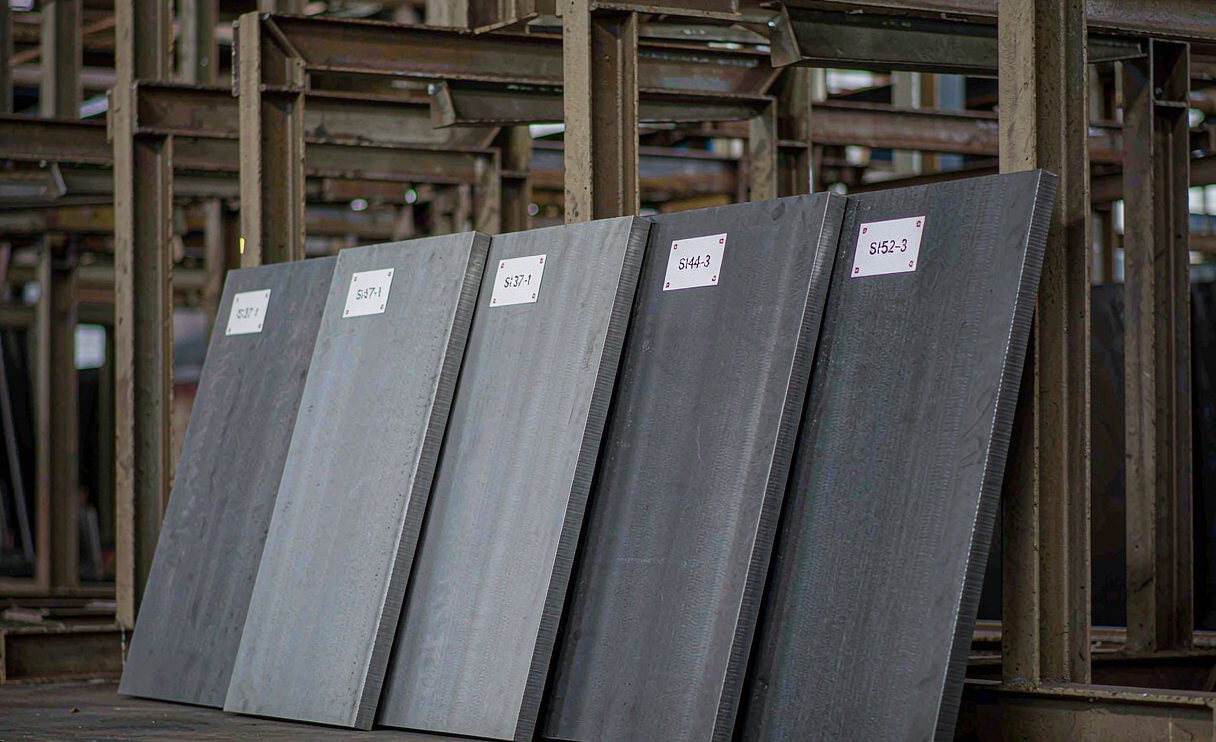
St37-2 was used for general welded structures, light building frames, conveyor supports, agricultural machinery and brackets. Today you will see it on legacy machine tools, German-built industrial cranes, and older shipyard drawings. Modern equivalent: S235JR.
St44-2 / St44-3 was used for higher-loaded welded structures, truck chassis and railway wagons. The -3 suffix (St44-3) guaranteed impact toughness at 0 °C. Modern equivalent: S275JR / S275JO.
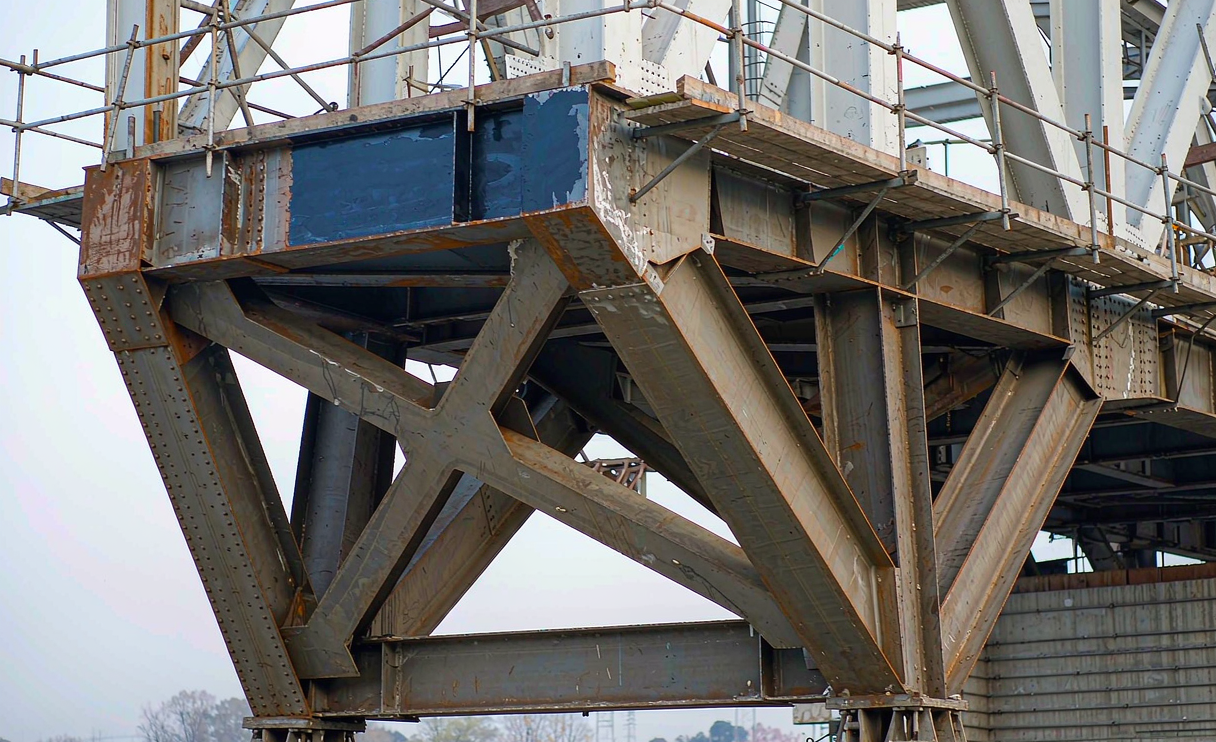
St52-3 was the standard grade for high-strength welded structures: bridges, mobile cranes, earth-moving equipment and pressure-vessel parts. Its 345 MPa yield and 22% elongation made it the German workhorse for decades. Modern equivalent: S355J2 (or S355JO for ambient-temperature service).
St60-2 was used for high-strength components where welding is limited: shafts, axles, gears, machine frames and engineering parts. Modern equivalent: E295 for engineering use, or S355J2 when welding is required.
5. St52-3 — The Most Widely Specified Grade
Of the four, St52-3 deserves the most attention because it is still quoted on thousands of current RFQs from German-speaking markets. It defined a 345 MPa minimum yield, 490 – 630 MPa tensile range, 22% minimum elongation, and an impact guarantee of 27 J at 0 °C. The “3” suffix meant it was suitable for cold forming and welding.
Modern replacement: EN 10025-2 S355J2 (27 J at -20 °C) or S355JO (27 J at 0 °C, the direct temperature match). The two are interchangeable for almost all static and dynamic load cases. If your drawing says “St52-3 nach DIN 17100”, the simplest modern specification is S355J2 or S355JO per EN 10025-2.
6. Welding Notes for the St-Series
St37-2 and St44-3 weld easily with conventional electrodes (E6013 / E7018). St52-3 welds readily when the carbon equivalent is below 0.45%, with a 50 – 100 °C pre-heat for thick plate. St60-2 requires a pre-heat of 150 – 200 °C and post-weld stress relief for critical components. For mixed welding between St grades (for example a St60-2 shaft welded into a St52-3 frame), use the more demanding grade’s procedure.
7. Sourcing DIN 17100 Grades Today
Although the standard is withdrawn, Chinese, Indian and Turkish mills still produce the equivalent grades for export markets. The most reliable approach when you need to replace a vintage St-series part:
Order to the EN equivalent — St37-2 as S235JR, St44-3 as S275JO, St52-3 as S355J2, St60-2 as E295.
Request an EN 10204 3.1 mill certificate listing the EN designation, the chemical analysis, mechanical properties, impact test results and CE marking.
Where the original drawing strictly says “St52-3”, add a note to the certificate: “Equivalent to DIN 17100 St52-3 (withdrawn standard)” so the receiving inspector can verify the legacy reference.
For German-speaking customers, some mills will mark the plate or bar with both the EN grade and the DIN grade in parentheses — request this when ordering.
8. Common Mistakes When Specifying the St-Series
Asking for “St37” without the “-2” or “-3” suffix — the base grade is too loose to qualify for many modern welds.
Equating St52-3 with ASTM A572 Gr.50 by name only — the chemistry and impact guarantee are different. A572 Gr.50 has no Charpy requirement at all by default.
Buying St60-2 and welding it with the same procedure as St37 — almost guaranteed to crack in the HAZ.
Accepting “DIN 17100” certificate wording on a 2020+ delivery without checking that the actual chemistry meets EN 10025-2 — some mills still print the old standard for legacy customers without performing the EN-required tests.
Storing St37 / St44 / St52 plate in coastal conditions without primer — mill scale is not corrosion protection.
Frequently Asked Questions
Q1: Is DIN 17100 still valid?
No, DIN 17100 was withdrawn in July 2004. The current standard is EN 10025-2 (non-alloy structural steels) plus EN 10025-3 (normalized fine-grain) and EN 10025-4 (thermomechanically rolled). Mills may continue to mark products with the DIN 17100 grade designation for legacy contracts, but the certificate should always be issued to the current EN 10025 series.
Q2: Is St37 the same as A36?
Functionally yes. St37-2 has a minimum yield of 235 MPa, very close to ASTM A36 (250 MPa). The chemistry is broadly comparable, with similar carbon, manganese and trace-element limits. They are accepted as equivalents for most general welded structural applications. For a stricter comparison, A36 has tighter phosphorus limits (0.030% max).
Q3: Can St60-2 be welded?
With precautions. St60-2 has higher carbon content than St37 or St52, so it requires pre-heating (150 – 250 °C depending on thickness), low-hydrogen electrodes (E7018 or equivalent), and a post-weld stress relief for critical applications. For heavy welded fabrications, it is usually better to substitute S355J2.
Q4: What about St33?
St33 was the lowest-strength grade in DIN 17100, with a minimum yield of only 185 MPa. It was widely used for simple brackets, light framing and non-structural parts. There is no direct EN 10025 equivalent; for modern procurement use S235JR or DC01 (for cold-formed parts).
Common Mistakes When Specifying the DIN 17100 St-Series
The single most common mistake is requesting “St52” without the quality class letter. A “St52” without -3 can mean St52-3, St52-4 or St52-4 (the latter two are uncommon but still in some legacy prints). The default of most Chinese mills exporting to Europe is St52-3 — a fine choice for general structural use with Charpy at -20 °C ≥ 27 J. If the part will see -40 °C or higher impact loads, request St52-4 or St52-3N with normalized rolling and Charpy at -40 °C ≥ 27 J. Always repeat the quality class letter on the PO.
A second mistake is omitting the deoxidation practice. DIN 17100 distinguishes U (rimmed, not deoxidized), R (killed, fully deoxidized) and RR (special-killed, fine-grain treated). The modern EN 10025 successor grades (S235 / S275 / S355) are all fully killed with fine-grain practice, so the U / R / RR code no longer exists. If your engineering drawing still says “St37-2 U” you are probably looking at a print from before 1993; ask the engineering office to update it to EN 10025-2 S235JR to avoid the mill quoting on an obsolete route.
A third mistake is mixing DIN 17100 and EN 10025-2 chemical tolerances. The two systems use slightly different manganese ranges for S235 / S275 / S355. EN 10025-2:2019 allows Mn up to 1.40% in S275 and S355, while the legacy DIN 17100 St44-3 / St52-3 capped Mn at 1.20%. The mill test certificate (EN 10204 3.1) will always follow the standard you write on the PO. If you write “S275JR to EN 10025-2” you get the modern Mn range; if you write “St44-3 to DIN 17100” the mill will hold the tighter range and may charge a small premium.
Heat Treatment, Forming & Welding Notes for the St-Series
Hot forming of St37 / St44 / St52 is performed at 880 – 1050 °C; the lower the carbon, the wider the hot-working window. St37 can be hot-bent at 850 °C without cracking; St52-3 needs to stay above 900 °C to avoid working in the two-phase austenite-plus-ferrite region, which produces a coarse duplex grain after cooling. Cold forming of St44-3 and St52-3 plate above 16 mm requires a minimum bend radius of 3 × thickness for St52-3 and 2 × thickness for St44-3; tighter radii need a stress-relief at 600 °C after forming. St37 cold-forms to 1.5 × thickness radius without issue for thicknesses up to 20 mm.
Welding of the St-series uses standard carbon-steel practice. St37 and St44-3 weld with cellulosic (E6010 / E7010) or low-hydrogen (E7018) electrodes without preheat for thicknesses up to 20 mm. St52-3 above 20 mm requires preheat to 100 °C and low-hydrogen electrodes. St60 and St70 require preheat to 150 °C and post-weld stress relief at 600 °C. The CEV of St52-3 is around 0.40 – 0.45%; of St60 around 0.50 – 0.55%; of St70 above 0.60%. The modern EN 10025-2 S355J2 with controlled Mn and micro-alloying has a CEV of 0.38 – 0.42%, slightly better than the legacy St52-3, which is why mills no longer recommend the DIN 17100 designation for new designs.
Normalizing of St52-3 and St60 is performed at 900 – 940 °C with 30 minutes soak time per 25 mm thickness, then air cool. Stress-relief annealing is at 600 – 650 °C for 1 hour per 25 mm. St37 and St44 are rarely normalized because the carbon content is too low to benefit. If the engineering spec requires normalized condition, always specify it on the PO; the mill will then add 4 – 7% to the price and 2 – 3 weeks to the delivery time.
How to Convert Old DIN 17100 References on Legacy Drawings
If you are updating a 1980s German engineering drawing that references St37, St44, St52, St60 or St70, here is the modern EN 10025 equivalent to use on the new revision: St37-2 → S235JR, St44-2 → S275JR, St44-3 → S275J2, St52-3 → S355J2, St60-2 → E295, St70-2 → E335. The mechanical properties match within 5 – 10 MPa in yield and tensile strength; the Charpy requirement is met or exceeded by the EN 10025 grade. Update the standard reference and the grade designation on the drawing title block, and add a revision note: “Re-designated to EN 10025-2:2019; original DIN 17100 grade StXX-X superseded.”
For plate above 16 mm, the modern EN 10025-2 grade also gives you the option of +N (normalized rolling) or +AR (as-rolled) delivery condition. DIN 17100 only had the as-rolled route, so the normalized-rolling option is a free upgrade on the EN side and gives finer grain. The MTC will be issued to EN 10204 3.1 by the mill and will reference EN 10025-2:2019. If the customer still asks for a DIN 17100 certificate, the mill can issue a dual-reference MTC (EN 10025-2 / DIN 17100) on request at no extra charge, but the chemistry and mechanical values will follow the EN standard.
Source EN 10025 / DIN 17100 Equivalent Plate from Huaxia Steel
Huaxia Steel supplies modern EN 10025 equivalents of St37, St44, St52 and St60 — including S235JR, S275JR, S355J2 and E295 plate, sheet and sections — with EN 10204 3.1 / 3.2 certification and dual DIN/EN marking on request. Tell us our grade, thickness and quantity, and we will return a factory-direct quotation within 24 hours.
If you have ever ordered German-made structural steel, repaired vintage industrial equipment, or read an old European engineering drawing, you have met the St-series designation: St37, St44, St52 and St60. These grades were defined by the German standard DIN 17100 between 1957 and the early 2000s, and they still appear on thousands of nameplates, drawings, technical specifications and even some current steel-mill catalogues. Since 2004 they have been superseded by the European EN 10025 series, but DIN 17100 grades are not extinct — they are still produced for replacement-parts, retrofit and heritage machinery markets, particularly across Germany, Austria, Switzerland, the Netherlands and Italy. Understanding the relationship between St37 / St44 / St52 / St60 and their EN successors is essential for any importer, distributor or maintenance engineer working with older European equipment.
1. What Is DIN 17100?
DIN 17100 was the German national standard for “Steels for General Structural Purposes” — unalloyed quality steels with yield strengths from 185 MPa (St33) up to 360 MPa (St70). It was first issued in 1957 and revised several times. The standard classified steel by a “guaranteed minimum yield strength” expressed in kgf/mm², hence the St numbers (St37 = minimum yield 37 kgf/mm² ≈ 363 MPa at the time of writing). When Germany joined the European standardization effort, DIN 17100 was withdrawn in July 2004 and replaced by the harmonized EN 10025-2 (non-alloy structural steels). Some mills still mark plate and bar with both the DIN and EN designations for legacy contracts.
2. Mechanical Properties of St37, St44, St52 and St60
The table below summarises the typical mechanical properties as published in the last (1980) revision of DIN 17100. Note that the numbers are slightly more conservative than the equivalent EN 10025-2 grades — the European standardisation tightened quality control and allowed tighter mill practices.
Grade (DIN 17100)
Yield (MPa, t ≤ 16 mm)
Tensile (MPa)
Elongation (%)
EN 10025-2 Equivalent
St37-2
≥ 235
360 – 510
≥ 25
S235JR
St44-2
≥ 275
410 – 540
≥ 22
S275JR
St44-3
≥ 275
410 – 540
≥ 22
S275JO
St52-3
≥ 345
490 – 630
≥ 22
S355JO / S355J2
St60-2
≥ 335
590 – 710
≥ 16
(no direct EN grade — use E295 or S355JR +1)
St70-2
≥ 365
690 – 900
≥ 11
E360
The most common cross-references an importer needs:
St37-2 ↔ S235JR (EN 10025-2)
St44-2 / St44-3 ↔ S275JR / S275JO
St52-3 ↔ S355JO / S355J2
St60-2 ↔ E295 (EN 10025-2, “engineering steel”) or S355JR with over-strength
3. Chemical Composition Comparison
DIN 17100 used a “ladle analysis” system, with separate limits for the product analysis. The table below shows the typical ladle-analysis limits (mass percent).
Element (max %)
St37-2
St44-2
St52-3
St60-2
C
0.17
0.21
0.20
0.23
Si
—
—
0.55
—
Mn
—
—
1.60
—
P
0.050
0.050
0.045
0.050
S
0.050
0.050
0.045
0.050
N
0.009
0.009
0.009
0.009
St52-3 is the most tightly controlled of the family. The deliberate manganese addition (up to 1.60%) gives it higher strength than St37 without sacrificing weldability. St60-2 has the highest carbon content of the group, which limits weldability and makes it more suitable for mechanical engineering than for general welded structures.
4. St37, St44, St52 and St60 in Practice
Although DIN 17100 was officially withdrawn in 2004, each grade still has its place in industry:
St37-2 was used for general welded structures, light building frames, conveyor supports, agricultural machinery and brackets. Today you will see it on legacy machine tools, German-built industrial cranes, and older shipyard drawings. Modern equivalent: S235JR.
St44-2 / St44-3 was used for higher-loaded welded structures, truck chassis and railway wagons. The -3 suffix (St44-3) guaranteed impact toughness at 0 °C. Modern equivalent: S275JR / S275JO.
St52-3 was the standard grade for high-strength welded structures: bridges, mobile cranes, earth-moving equipment and pressure-vessel parts. Its 345 MPa yield and 22% elongation made it the German workhorse for decades. Modern equivalent: S355J2 (or S355JO for ambient-temperature service).
St60-2 was used for high-strength components where welding is limited: shafts, axles, gears, machine frames and engineering parts. Modern equivalent: E295 for engineering use, or S355J2 when welding is required.
5. St52-3 — The Most Widely Specified Grade
Of the four, St52-3 deserves the most attention because it is still quoted on thousands of current RFQs from German-speaking markets. It defined a 345 MPa minimum yield, 490 – 630 MPa tensile range, 22% minimum elongation, and an impact guarantee of 27 J at 0 °C. The “3” suffix meant it was suitable for cold forming and welding.
Modern replacement: EN 10025-2 S355J2 (27 J at -20 °C) or S355JO (27 J at 0 °C, the direct temperature match). The two are interchangeable for almost all static and dynamic load cases. If your drawing says “St52-3 nach DIN 17100”, the simplest modern specification is S355J2 or S355JO per EN 10025-2.
6. Welding Notes for the St-Series
St37-2 and St44-3 weld easily with conventional electrodes (E6013 / E7018). St52-3 welds readily when the carbon equivalent is below 0.45%, with a 50 – 100 °C pre-heat for thick plate. St60-2 requires a pre-heat of 150 – 200 °C and post-weld stress relief for critical components. For mixed welding between St grades (for example a St60-2 shaft welded into a St52-3 frame), use the more demanding grade’s procedure.
7. Sourcing DIN 17100 Grades Today
Although the standard is withdrawn, Chinese, Indian and Turkish mills still produce the equivalent grades for export markets. The most reliable approach when you need to replace a vintage St-series part:
Order to the EN equivalent — St37-2 as S235JR, St44-3 as S275JO, St52-3 as S355J2, St60-2 as E295.
Request an EN 10204 3.1 mill certificate listing the EN designation, the chemical analysis, mechanical properties, impact test results and CE marking.
Where the original drawing strictly says “St52-3”, add a note to the certificate: “Equivalent to DIN 17100 St52-3 (withdrawn standard)” so the receiving inspector can verify the legacy reference.
For German-speaking customers, some mills will mark the plate or bar with both the EN grade and the DIN grade in parentheses — request this when ordering.
8. Common Mistakes When Specifying the St-Series
Asking for “St37” without the “-2” or “-3” suffix — the base grade is too loose to qualify for many modern welds.
Equating St52-3 with ASTM A572 Gr.50 by name only — the chemistry and impact guarantee are different. A572 Gr.50 has no Charpy requirement at all by default.
Buying St60-2 and welding it with the same procedure as St37 — almost guaranteed to crack in the HAZ.
Accepting “DIN 17100” certificate wording on a 2020+ delivery without checking that the actual chemistry meets EN 10025-2 — some mills still print the old standard for legacy customers without performing the EN-required tests.
Storing St37 / St44 / St52 plate in coastal conditions without primer — mill scale is not corrosion protection.
Frequently Asked Questions
Q1: Is DIN 17100 still valid?
No, DIN 17100 was withdrawn in July 2004. The current standard is EN 10025-2 (non-alloy structural steels) plus EN 10025-3 (normalized fine-grain) and EN 10025-4 (thermomechanically rolled). Mills may continue to mark products with the DIN 17100 grade designation for legacy contracts, but the certificate should always be issued to the current EN 10025 series.
Q2: Is St37 the same as A36?
Functionally yes. St37-2 has a minimum yield of 235 MPa, very close to ASTM A36 (250 MPa). The chemistry is broadly comparable, with similar carbon, manganese and trace-element limits. They are accepted as equivalents for most general welded structural applications. For a stricter comparison, A36 has tighter phosphorus limits (0.030% max).
Q3: Can St60-2 be welded?
With precautions. St60-2 has higher carbon content than St37 or St52, so it requires pre-heating (150 – 250 °C depending on thickness), low-hydrogen electrodes (E7018 or equivalent), and a post-weld stress relief for critical applications. For heavy welded fabrications, it is usually better to substitute S355J2.
Q4: What about St33?
St33 was the lowest-strength grade in DIN 17100, with a minimum yield of only 185 MPa. It was widely used for simple brackets, light framing and non-structural parts. There is no direct EN 10025 equivalent; for modern procurement use S235JR or DC01 (for cold-formed parts).
Common Mistakes When Specifying the DIN 17100 St-Series
The single most common mistake is requesting “St52” without the quality class letter. A “St52” without -3 can mean St52-3, St52-4 or St52-4 (the latter two are uncommon but still in some legacy prints). The default of most Chinese mills exporting to Europe is St52-3 — a fine choice for general structural use with Charpy at -20 °C ≥ 27 J. If the part will see -40 °C or higher impact loads, request St52-4 or St52-3N with normalized rolling and Charpy at -40 °C ≥ 27 J. Always repeat the quality class letter on the PO.
A second mistake is omitting the deoxidation practice. DIN 17100 distinguishes U (rimmed, not deoxidized), R (killed, fully deoxidized) and RR (special-killed, fine-grain treated). The modern EN 10025 successor grades (S235 / S275 / S355) are all fully killed with fine-grain practice, so the U / R / RR code no longer exists. If your engineering drawing still says “St37-2 U” you are probably looking at a print from before 1993; ask the engineering office to update it to EN 10025-2 S235JR to avoid the mill quoting on an obsolete route.
A third mistake is mixing DIN 17100 and EN 10025-2 chemical tolerances. The two systems use slightly different manganese ranges for S235 / S275 / S355. EN 10025-2:2019 allows Mn up to 1.40% in S275 and S355, while the legacy DIN 17100 St44-3 / St52-3 capped Mn at 1.20%. The mill test certificate (EN 10204 3.1) will always follow the standard you write on the PO. If you write “S275JR to EN 10025-2” you get the modern Mn range; if you write “St44-3 to DIN 17100” the mill will hold the tighter range and may charge a small premium.
Heat Treatment, Forming & Welding Notes for the St-Series
Hot forming of St37 / St44 / St52 is performed at 880 – 1050 °C; the lower the carbon, the wider the hot-working window. St37 can be hot-bent at 850 °C without cracking; St52-3 needs to stay above 900 °C to avoid working in the two-phase austenite-plus-ferrite region, which produces a coarse duplex grain after cooling. Cold forming of St44-3 and St52-3 plate above 16 mm requires a minimum bend radius of 3 × thickness for St52-3 and 2 × thickness for St44-3; tighter radii need a stress-relief at 600 °C after forming. St37 cold-forms to 1.5 × thickness radius without issue for thicknesses up to 20 mm.
Welding of the St-series uses standard carbon-steel practice. St37 and St44-3 weld with cellulosic (E6010 / E7010) or low-hydrogen (E7018) electrodes without preheat for thicknesses up to 20 mm. St52-3 above 20 mm requires preheat to 100 °C and low-hydrogen electrodes. St60 and St70 require preheat to 150 °C and post-weld stress relief at 600 °C. The CEV of St52-3 is around 0.40 – 0.45%; of St60 around 0.50 – 0.55%; of St70 above 0.60%. The modern EN 10025-2 S355J2 with controlled Mn and micro-alloying has a CEV of 0.38 – 0.42%, slightly better than the legacy St52-3, which is why mills no longer recommend the DIN 17100 designation for new designs.
Normalizing of St52-3 and St60 is performed at 900 – 940 °C with 30 minutes soak time per 25 mm thickness, then air cool. Stress-relief annealing is at 600 – 650 °C for 1 hour per 25 mm. St37 and St44 are rarely normalized because the carbon content is too low to benefit. If the engineering spec requires normalized condition, always specify it on the PO; the mill will then add 4 – 7% to the price and 2 – 3 weeks to the delivery time.
How to Convert Old DIN 17100 References on Legacy Drawings
If you are updating a 1980s German engineering drawing that references St37, St44, St52, St60 or St70, here is the modern EN 10025 equivalent to use on the new revision: St37-2 → S235JR, St44-2 → S275JR, St44-3 → S275J2, St52-3 → S355J2, St60-2 → E295, St70-2 → E335. The mechanical properties match within 5 – 10 MPa in yield and tensile strength; the Charpy requirement is met or exceeded by the EN 10025 grade. Update the standard reference and the grade designation on the drawing title block, and add a revision note: “Re-designated to EN 10025-2:2019; original DIN 17100 grade StXX-X superseded.”
For plate above 16 mm, the modern EN 10025-2 grade also gives you the option of +N (normalized rolling) or +AR (as-rolled) delivery condition. DIN 17100 only had the as-rolled route, so the normalized-rolling option is a free upgrade on the EN side and gives finer grain. The MTC will be issued to EN 10204 3.1 by the mill and will reference EN 10025-2:2019. If the customer still asks for a DIN 17100 certificate, the mill can issue a dual-reference MTC (EN 10025-2 / DIN 17100) on request at no extra charge, but the chemistry and mechanical values will follow the EN standard.
Source EN 10025 / DIN 17100 Equivalent Plate from Huaxia Steel
Huaxia Steel supplies modern EN 10025 equivalents of St37, St44, St52 and St60 — including S235JR, S275JR, S355J2 and E295 plate, sheet and sections — with EN 10204 3.1 / 3.2 certification and dual DIN/EN marking on request. Tell us our grade, thickness and quantity, and we will return a factory-direct quotation within 24 hours.
DIN 17100 was the German national standard for “Steels for General Structural Purposes” — unalloyed quality steels with yield strengths from 185 MPa (St33) up to 360 MPa (St70). It was first issued in 1957 and revised several times. The standard classified steel by a “guaranteed minimum yield strength” expressed in kgf/mm², hence the St numbers (St37 = minimum yield 37 kgf/mm² ≈ 363 MPa at the time of writing). When Germany joined the European standardization effort, DIN 17100 was withdrawn in July 2004 and replaced by the harmonized EN 10025-2 (non-alloy structural steels). Some mills still mark plate and bar with both the DIN and EN designations for legacy contracts.
2. Mechanical Properties of St37, St44, St52 and St60
The table below summarises the typical mechanical properties as published in the last (1980) revision of DIN 17100. Note that the numbers are slightly more conservative than the equivalent EN 10025-2 grades — the European standardisation tightened quality control and allowed tighter mill practices.
Grade (DIN 17100)
Yield (MPa, t ≤ 16 mm)
Tensile (MPa)
Elongation (%)
EN 10025-2 Equivalent
St37-2
≥ 235
360 – 510
≥ 25
S235JR
St44-2
≥ 275
410 – 540
≥ 22
S275JR
St44-3
≥ 275
410 – 540
≥ 22
S275JO
St52-3
≥ 345
490 – 630
≥ 22
S355JO / S355J2
St60-2
≥ 335
590 – 710
≥ 16
(no direct EN grade — use E295 or S355JR +1)
St70-2
≥ 365
690 – 900
≥ 11
E360
The most common cross-references an importer needs:
St37-2 ↔ S235JR (EN 10025-2)
St44-2 / St44-3 ↔ S275JR / S275JO
St52-3 ↔ S355JO / S355J2
St60-2 ↔ E295 (EN 10025-2, “engineering steel”) or S355JR with over-strength
3. Chemical Composition Comparison
DIN 17100 used a “ladle analysis” system, with separate limits for the product analysis. The table below shows the typical ladle-analysis limits (mass percent).
Element (max %)
St37-2
St44-2
St52-3
St60-2
C
0.17
0.21
0.20
0.23
Si
—
—
0.55
—
Mn
—
—
1.60
—
P
0.050
0.050
0.045
0.050
S
0.050
0.050
0.045
0.050
N
0.009
0.009
0.009
0.009
St52-3 is the most tightly controlled of the family. The deliberate manganese addition (up to 1.60%) gives it higher strength than St37 without sacrificing weldability. St60-2 has the highest carbon content of the group, which limits weldability and makes it more suitable for mechanical engineering than for general welded structures.
5. St52-3 — The Most Widely Specified Grade
Of the four, St52-3 deserves the most attention because it is still quoted on thousands of current RFQs from German-speaking markets. It defined a 345 MPa minimum yield, 490 – 630 MPa tensile range, 22% minimum elongation, and an impact guarantee of 27 J at 0 °C. The “3” suffix meant it was suitable for cold forming and welding.
Modern replacement: EN 10025-2 S355J2 (27 J at -20 °C) or S355JO (27 J at 0 °C, the direct temperature match). The two are interchangeable for almost all static and dynamic load cases. If your drawing says “St52-3 nach DIN 17100”, the simplest modern specification is S355J2 or S355JO per EN 10025-2.
6. Welding Notes for the St-Series
St37-2 and St44-3 weld easily with conventional electrodes (E6013 / E7018). St52-3 welds readily when the carbon equivalent is below 0.45%, with a 50 – 100 °C pre-heat for thick plate. St60-2 requires a pre-heat of 150 – 200 °C and post-weld stress relief for critical components. For mixed welding between St grades (for example a St60-2 shaft welded into a St52-3 frame), use the more demanding grade’s procedure.
7. Sourcing DIN 17100 Grades Today
Although the standard is withdrawn, Chinese, Indian and Turkish mills still produce the equivalent grades for export markets. The most reliable approach when you need to replace a vintage St-series part:
Order to the EN equivalent — St37-2 as S235JR, St44-3 as S275JO, St52-3 as S355J2, St60-2 as E295.
Request an EN 10204 3.1 mill certificate listing the EN designation, the chemical analysis, mechanical properties, impact test results and CE marking.
Where the original drawing strictly says “St52-3”, add a note to the certificate: “Equivalent to DIN 17100 St52-3 (withdrawn standard)” so the receiving inspector can verify the legacy reference.
For German-speaking customers, some mills will mark the plate or bar with both the EN grade and the DIN grade in parentheses — request this when ordering.
8. Common Mistakes When Specifying the St-Series
Asking for “St37” without the “-2” or “-3” suffix — the base grade is too loose to qualify for many modern welds.
Equating St52-3 with ASTM A572 Gr.50 by name only — the chemistry and impact guarantee are different. A572 Gr.50 has no Charpy requirement at all by default.
Buying St60-2 and welding it with the same procedure as St37 — almost guaranteed to crack in the HAZ.
Accepting “DIN 17100” certificate wording on a 2020+ delivery without checking that the actual chemistry meets EN 10025-2 — some mills still print the old standard for legacy customers without performing the EN-required tests.
Storing St37 / St44 / St52 plate in coastal conditions without primer — mill scale is not corrosion protection.
Common Mistakes When Specifying the DIN 17100 St-Series
The single most common mistake is requesting “St52” without the quality class letter. A “St52” without -3 can mean St52-3, St52-4 or St52-4 (the latter two are uncommon but still in some legacy prints). The default of most Chinese mills exporting to Europe is St52-3 — a fine choice for general structural use with Charpy at -20 °C ≥ 27 J. If the part will see -40 °C or higher impact loads, request St52-4 or St52-3N with normalized rolling and Charpy at -40 °C ≥ 27 J. Always repeat the quality class letter on the PO.
A second mistake is omitting the deoxidation practice. DIN 17100 distinguishes U (rimmed, not deoxidized), R (killed, fully deoxidized) and RR (special-killed, fine-grain treated). The modern EN 10025 successor grades (S235 / S275 / S355) are all fully killed with fine-grain practice, so the U / R / RR code no longer exists. If your engineering drawing still says “St37-2 U” you are probably looking at a print from before 1993; ask the engineering office to update it to EN 10025-2 S235JR to avoid the mill quoting on an obsolete route.
A third mistake is mixing DIN 17100 and EN 10025-2 chemical tolerances. The two systems use slightly different manganese ranges for S235 / S275 / S355. EN 10025-2:2019 allows Mn up to 1.40% in S275 and S355, while the legacy DIN 17100 St44-3 / St52-3 capped Mn at 1.20%. The mill test certificate (EN 10204 3.1) will always follow the standard you write on the PO. If you write “S275JR to EN 10025-2” you get the modern Mn range; if you write “St44-3 to DIN 17100” the mill will hold the tighter range and may charge a small premium.
Heat Treatment, Forming & Welding Notes for the St-Series
Hot forming of St37 / St44 / St52 is performed at 880 – 1050 °C; the lower the carbon, the wider the hot-working window. St37 can be hot-bent at 850 °C without cracking; St52-3 needs to stay above 900 °C to avoid working in the two-phase austenite-plus-ferrite region, which produces a coarse duplex grain after cooling. Cold forming of St44-3 and St52-3 plate above 16 mm requires a minimum bend radius of 3 × thickness for St52-3 and 2 × thickness for St44-3; tighter radii need a stress-relief at 600 °C after forming. St37 cold-forms to 1.5 × thickness radius without issue for thicknesses up to 20 mm.
Welding of the St-series uses standard carbon-steel practice. St37 and St44-3 weld with cellulosic (E6010 / E7010) or low-hydrogen (E7018) electrodes without preheat for thicknesses up to 20 mm. St52-3 above 20 mm requires preheat to 100 °C and low-hydrogen electrodes. St60 and St70 require preheat to 150 °C and post-weld stress relief at 600 °C. The CEV of St52-3 is around 0.40 – 0.45%; of St60 around 0.50 – 0.55%; of St70 above 0.60%. The modern EN 10025-2 S355J2 with controlled Mn and micro-alloying has a CEV of 0.38 – 0.42%, slightly better than the legacy St52-3, which is why mills no longer recommend the DIN 17100 designation for new designs.
Normalizing of St52-3 and St60 is performed at 900 – 940 °C with 30 minutes soak time per 25 mm thickness, then air cool. Stress-relief annealing is at 600 – 650 °C for 1 hour per 25 mm. St37 and St44 are rarely normalized because the carbon content is too low to benefit. If the engineering spec requires normalized condition, always specify it on the PO; the mill will then add 4 – 7% to the price and 2 – 3 weeks to the delivery time.
How to Convert Old DIN 17100 References on Legacy Drawings
If you are updating a 1980s German engineering drawing that references St37, St44, St52, St60 or St70, here is the modern EN 10025 equivalent to use on the new revision: St37-2 → S235JR, St44-2 → S275JR, St44-3 → S275J2, St52-3 → S355J2, St60-2 → E295, St70-2 → E335. The mechanical properties match within 5 – 10 MPa in yield and tensile strength; the Charpy requirement is met or exceeded by the EN 10025 grade. Update the standard reference and the grade designation on the drawing title block, and add a revision note: “Re-designated to EN 10025-2:2019; original DIN 17100 grade StXX-X superseded.”
For plate above 16 mm, the modern EN 10025-2 grade also gives you the option of +N (normalized rolling) or +AR (as-rolled) delivery condition. DIN 17100 only had the as-rolled route, so the normalized-rolling option is a free upgrade on the EN side and gives finer grain. The MTC will be issued to EN 10204 3.1 by the mill and will reference EN 10025-2:2019. If the customer still asks for a DIN 17100 certificate, the mill can issue a dual-reference MTC (EN 10025-2 / DIN 17100) on request at no extra charge, but the chemistry and mechanical values will follow the EN standard.
Source EN 10025 / DIN 17100 Equivalent Plate from Huaxia Steel
Huaxia Steel supplies modern EN 10025 equivalents of St37, St44, St52 and St60 — including S235JR, S275JR, S355J2 and E295 plate, sheet and sections — with EN 10204 3.1 / 3.2 certification and dual DIN/EN marking on request. Tell us our grade, thickness and quantity, and we will return a factory-direct quotation within 24 hours.
1. What Is DIN 17100?
DIN 17100 was the German national standard for “Steels for General Structural Purposes” — unalloyed quality steels with yield strengths from 185 MPa (St33) up to 360 MPa (St70). It was first issued in 1957 and revised several times. The standard classified steel by a “guaranteed minimum yield strength” expressed in kgf/mm², hence the St numbers (St37 = minimum yield 37 kgf/mm² ≈ 363 MPa at the time of writing). When Germany joined the European standardization effort, DIN 17100 was withdrawn in July 2004 and replaced by the harmonized EN 10025-2 (non-alloy structural steels). Some mills still mark plate and bar with both the DIN and EN designations for legacy contracts.
2. Mechanical Properties of St37, St44, St52 and St60
The table below summarises the typical mechanical properties as published in the last (1980) revision of DIN 17100. Note that the numbers are slightly more conservative than the equivalent EN 10025-2 grades — the European standardisation tightened quality control and allowed tighter mill practices.
Grade (DIN 17100)
Yield (MPa, t ≤ 16 mm)
Tensile (MPa)
Elongation (%)
EN 10025-2 Equivalent
St37-2
≥ 235
360 – 510
≥ 25
S235JR
St44-2
≥ 275
410 – 540
≥ 22
S275JR
St44-3
≥ 275
410 – 540
≥ 22
S275JO
St52-3
≥ 345
490 – 630
≥ 22
S355JO / S355J2
St60-2
≥ 335
590 – 710
≥ 16
(no direct EN grade — use E295 or S355JR +1)
St70-2
≥ 365
690 – 900
≥ 11
E360
The most common cross-references an importer needs:
St37-2 ↔ S235JR (EN 10025-2)
St44-2 / St44-3 ↔ S275JR / S275JO
St52-3 ↔ S355JO / S355J2
St60-2 ↔ E295 (EN 10025-2, “engineering steel”) or S355JR with over-strength
3. Chemical Composition Comparison
DIN 17100 used a “ladle analysis” system, with separate limits for the product analysis. The table below shows the typical ladle-analysis limits (mass percent).
Element (max %)
St37-2
St44-2
St52-3
St60-2
C
0.17
0.21
0.20
0.23
Si
—
—
0.55
—
Mn
—
—
1.60
—
P
0.050
0.050
0.045
0.050
S
0.050
0.050
0.045
0.050
N
0.009
0.009
0.009
0.009
St52-3 is the most tightly controlled of the family. The deliberate manganese addition (up to 1.60%) gives it higher strength than St37 without sacrificing weldability. St60-2 has the highest carbon content of the group, which limits weldability and makes it more suitable for mechanical engineering than for general welded structures.
5. St52-3 — The Most Widely Specified Grade
Of the four, St52-3 deserves the most attention because it is still quoted on thousands of current RFQs from German-speaking markets. It defined a 345 MPa minimum yield, 490 – 630 MPa tensile range, 22% minimum elongation, and an impact guarantee of 27 J at 0 °C. The “3” suffix meant it was suitable for cold forming and welding.
Modern replacement: EN 10025-2 S355J2 (27 J at -20 °C) or S355JO (27 J at 0 °C, the direct temperature match). The two are interchangeable for almost all static and dynamic load cases. If your drawing says “St52-3 nach DIN 17100”, the simplest modern specification is S355J2 or S355JO per EN 10025-2.
6. Welding Notes for the St-Series
St37-2 and St44-3 weld easily with conventional electrodes (E6013 / E7018). St52-3 welds readily when the carbon equivalent is below 0.45%, with a 50 – 100 °C pre-heat for thick plate. St60-2 requires a pre-heat of 150 – 200 °C and post-weld stress relief for critical components. For mixed welding between St grades (for example a St60-2 shaft welded into a St52-3 frame), use the more demanding grade’s procedure.
7. Sourcing DIN 17100 Grades Today
Although the standard is withdrawn, Chinese, Indian and Turkish mills still produce the equivalent grades for export markets. The most reliable approach when you need to replace a vintage St-series part:
Order to the EN equivalent — St37-2 as S235JR, St44-3 as S275JO, St52-3 as S355J2, St60-2 as E295.
Request an EN 10204 3.1 mill certificate listing the EN designation, the chemical analysis, mechanical properties, impact test results and CE marking.
Where the original drawing strictly says “St52-3”, add a note to the certificate: “Equivalent to DIN 17100 St52-3 (withdrawn standard)” so the receiving inspector can verify the legacy reference.
For German-speaking customers, some mills will mark the plate or bar with both the EN grade and the DIN grade in parentheses — request this when ordering.
8. Common Mistakes When Specifying the St-Series
Asking for “St37” without the “-2” or “-3” suffix — the base grade is too loose to qualify for many modern welds.
Equating St52-3 with ASTM A572 Gr.50 by name only — the chemistry and impact guarantee are different. A572 Gr.50 has no Charpy requirement at all by default.
Buying St60-2 and welding it with the same procedure as St37 — almost guaranteed to crack in the HAZ.
Accepting “DIN 17100” certificate wording on a 2020+ delivery without checking that the actual chemistry meets EN 10025-2 — some mills still print the old standard for legacy customers without performing the EN-required tests.
Storing St37 / St44 / St52 plate in coastal conditions without primer — mill scale is not corrosion protection.
Common Mistakes When Specifying the DIN 17100 St-Series
The single most common mistake is requesting “St52” without the quality class letter. A “St52” without -3 can mean St52-3, St52-4 or St52-4 (the latter two are uncommon but still in some legacy prints). The default of most Chinese mills exporting to Europe is St52-3 — a fine choice for general structural use with Charpy at -20 °C ≥ 27 J. If the part will see -40 °C or higher impact loads, request St52-4 or St52-3N with normalized rolling and Charpy at -40 °C ≥ 27 J. Always repeat the quality class letter on the PO.
A second mistake is omitting the deoxidation practice. DIN 17100 distinguishes U (rimmed, not deoxidized), R (killed, fully deoxidized) and RR (special-killed, fine-grain treated). The modern EN 10025 successor grades (S235 / S275 / S355) are all fully killed with fine-grain practice, so the U / R / RR code no longer exists. If your engineering drawing still says “St37-2 U” you are probably looking at a print from before 1993; ask the engineering office to update it to EN 10025-2 S235JR to avoid the mill quoting on an obsolete route.
A third mistake is mixing DIN 17100 and EN 10025-2 chemical tolerances. The two systems use slightly different manganese ranges for S235 / S275 / S355. EN 10025-2:2019 allows Mn up to 1.40% in S275 and S355, while the legacy DIN 17100 St44-3 / St52-3 capped Mn at 1.20%. The mill test certificate (EN 10204 3.1) will always follow the standard you write on the PO. If you write “S275JR to EN 10025-2” you get the modern Mn range; if you write “St44-3 to DIN 17100” the mill will hold the tighter range and may charge a small premium.
Heat Treatment, Forming & Welding Notes for the St-Series
Hot forming of St37 / St44 / St52 is performed at 880 – 1050 °C; the lower the carbon, the wider the hot-working window. St37 can be hot-bent at 850 °C without cracking; St52-3 needs to stay above 900 °C to avoid working in the two-phase austenite-plus-ferrite region, which produces a coarse duplex grain after cooling. Cold forming of St44-3 and St52-3 plate above 16 mm requires a minimum bend radius of 3 × thickness for St52-3 and 2 × thickness for St44-3; tighter radii need a stress-relief at 600 °C after forming. St37 cold-forms to 1.5 × thickness radius without issue for thicknesses up to 20 mm.
Welding of the St-series uses standard carbon-steel practice. St37 and St44-3 weld with cellulosic (E6010 / E7010) or low-hydrogen (E7018) electrodes without preheat for thicknesses up to 20 mm. St52-3 above 20 mm requires preheat to 100 °C and low-hydrogen electrodes. St60 and St70 require preheat to 150 °C and post-weld stress relief at 600 °C. The CEV of St52-3 is around 0.40 – 0.45%; of St60 around 0.50 – 0.55%; of St70 above 0.60%. The modern EN 10025-2 S355J2 with controlled Mn and micro-alloying has a CEV of 0.38 – 0.42%, slightly better than the legacy St52-3, which is why mills no longer recommend the DIN 17100 designation for new designs.
Normalizing of St52-3 and St60 is performed at 900 – 940 °C with 30 minutes soak time per 25 mm thickness, then air cool. Stress-relief annealing is at 600 – 650 °C for 1 hour per 25 mm. St37 and St44 are rarely normalized because the carbon content is too low to benefit. If the engineering spec requires normalized condition, always specify it on the PO; the mill will then add 4 – 7% to the price and 2 – 3 weeks to the delivery time.
How to Convert Old DIN 17100 References on Legacy Drawings
If you are updating a 1980s German engineering drawing that references St37, St44, St52, St60 or St70, here is the modern EN 10025 equivalent to use on the new revision: St37-2 → S235JR, St44-2 → S275JR, St44-3 → S275J2, St52-3 → S355J2, St60-2 → E295, St70-2 → E335. The mechanical properties match within 5 – 10 MPa in yield and tensile strength; the Charpy requirement is met or exceeded by the EN 10025 grade. Update the standard reference and the grade designation on the drawing title block, and add a revision note: “Re-designated to EN 10025-2:2019; original DIN 17100 grade StXX-X superseded.”
For plate above 16 mm, the modern EN 10025-2 grade also gives you the option of +N (normalized rolling) or +AR (as-rolled) delivery condition. DIN 17100 only had the as-rolled route, so the normalized-rolling option is a free upgrade on the EN side and gives finer grain. The MTC will be issued to EN 10204 3.1 by the mill and will reference EN 10025-2:2019. If the customer still asks for a DIN 17100 certificate, the mill can issue a dual-reference MTC (EN 10025-2 / DIN 17100) on request at no extra charge, but the chemistry and mechanical values will follow the EN standard.
Source EN 10025 / DIN 17100 Equivalent Plate from Huaxia Steel
Huaxia Steel supplies modern EN 10025 equivalents of St37, St44, St52 and St60 — including S235JR, S275JR, S355J2 and E295 plate, sheet and sections — with EN 10204 3.1 / 3.2 certification and dual DIN/EN marking on request. Tell us our grade, thickness and quantity, and we will return a factory-direct quotation within 24 hours.
1. What Is DIN 17100?
DIN 17100 was the German national standard for “Steels for General Structural Purposes” — unalloyed quality steels with yield strengths from 185 MPa (St33) up to 360 MPa (St70). It was first issued in 1957 and revised several times. The standard classified steel by a “guaranteed minimum yield strength” expressed in kgf/mm², hence the St numbers (St37 = minimum yield 37 kgf/mm² ≈ 363 MPa at the time of writing). When Germany joined the European standardization effort, DIN 17100 was withdrawn in July 2004 and replaced by the harmonized EN 10025-2 (non-alloy structural steels). Some mills still mark plate and bar with both the DIN and EN designations for legacy contracts.
2. Mechanical Properties of St37, St44, St52 and St60
The table below summarises the typical mechanical properties as published in the last (1980) revision of DIN 17100. Note that the numbers are slightly more conservative than the equivalent EN 10025-2 grades — the European standardisation tightened quality control and allowed tighter mill practices.
Grade (DIN 17100)
Yield (MPa, t ≤ 16 mm)
Tensile (MPa)
Elongation (%)
EN 10025-2 Equivalent
St37-2
≥ 235
360 – 510
≥ 25
S235JR
St44-2
≥ 275
410 – 540
≥ 22
S275JR
St44-3
≥ 275
410 – 540
≥ 22
S275JO
St52-3
≥ 345
490 – 630
≥ 22
S355JO / S355J2
St60-2
≥ 335
590 – 710
≥ 16
(no direct EN grade — use E295 or S355JR +1)
St70-2
≥ 365
690 – 900
≥ 11
E360
The most common cross-references an importer needs:
St37-2 ↔ S235JR (EN 10025-2)
St44-2 / St44-3 ↔ S275JR / S275JO
St52-3 ↔ S355JO / S355J2
St60-2 ↔ E295 (EN 10025-2, “engineering steel”) or S355JR with over-strength
3. Chemical Composition Comparison
DIN 17100 used a “ladle analysis” system, with separate limits for the product analysis. The table below shows the typical ladle-analysis limits (mass percent).
Element (max %)
St37-2
St44-2
St52-3
St60-2
C
0.17
0.21
0.20
0.23
Si
—
—
0.55
—
Mn
—
—
1.60
—
P
0.050
0.050
0.045
0.050
S
0.050
0.050
0.045
0.050
N
0.009
0.009
0.009
0.009
St52-3 is the most tightly controlled of the family. The deliberate manganese addition (up to 1.60%) gives it higher strength than St37 without sacrificing weldability. St60-2 has the highest carbon content of the group, which limits weldability and makes it more suitable for mechanical engineering than for general welded structures.
4. St37, St44, St52 and St60 in Practice
Although DIN 17100 was officially withdrawn in 2004, each grade still has its place in industry:
St37-2 was used for general welded structures, light building frames, conveyor supports, agricultural machinery and brackets. Today you will see it on legacy machine tools, German-built industrial cranes, and older shipyard drawings. Modern equivalent: S235JR.
St44-2 / St44-3 was used for higher-loaded welded structures, truck chassis and railway wagons. The -3 suffix (St44-3) guaranteed impact toughness at 0 °C. Modern equivalent: S275JR / S275JO.
St52-3 was the standard grade for high-strength welded structures: bridges, mobile cranes, earth-moving equipment and pressure-vessel parts. Its 345 MPa yield and 22% elongation made it the German workhorse for decades. Modern equivalent: S355J2 (or S355JO for ambient-temperature service).
St60-2 was used for high-strength components where welding is limited: shafts, axles, gears, machine frames and engineering parts. Modern equivalent: E295 for engineering use, or S355J2 when welding is required.
5. St52-3 — The Most Widely Specified Grade
Of the four, St52-3 deserves the most attention because it is still quoted on thousands of current RFQs from German-speaking markets. It defined a 345 MPa minimum yield, 490 – 630 MPa tensile range, 22% minimum elongation, and an impact guarantee of 27 J at 0 °C. The “3” suffix meant it was suitable for cold forming and welding.
Modern replacement: EN 10025-2 S355J2 (27 J at -20 °C) or S355JO (27 J at 0 °C, the direct temperature match). The two are interchangeable for almost all static and dynamic load cases. If your drawing says “St52-3 nach DIN 17100”, the simplest modern specification is S355J2 or S355JO per EN 10025-2.
6. Welding Notes for the St-Series
St37-2 and St44-3 weld easily with conventional electrodes (E6013 / E7018). St52-3 welds readily when the carbon equivalent is below 0.45%, with a 50 – 100 °C pre-heat for thick plate. St60-2 requires a pre-heat of 150 – 200 °C and post-weld stress relief for critical components. For mixed welding between St grades (for example a St60-2 shaft welded into a St52-3 frame), use the more demanding grade’s procedure.
7. Sourcing DIN 17100 Grades Today
Although the standard is withdrawn, Chinese, Indian and Turkish mills still produce the equivalent grades for export markets. The most reliable approach when you need to replace a vintage St-series part:
Order to the EN equivalent — St37-2 as S235JR, St44-3 as S275JO, St52-3 as S355J2, St60-2 as E295.
Request an EN 10204 3.1 mill certificate listing the EN designation, the chemical analysis, mechanical properties, impact test results and CE marking.
Where the original drawing strictly says “St52-3”, add a note to the certificate: “Equivalent to DIN 17100 St52-3 (withdrawn standard)” so the receiving inspector can verify the legacy reference.
For German-speaking customers, some mills will mark the plate or bar with both the EN grade and the DIN grade in parentheses — request this when ordering.
8. Common Mistakes When Specifying the St-Series
Asking for “St37” without the “-2” or “-3” suffix — the base grade is too loose to qualify for many modern welds.
Equating St52-3 with ASTM A572 Gr.50 by name only — the chemistry and impact guarantee are different. A572 Gr.50 has no Charpy requirement at all by default.
Buying St60-2 and welding it with the same procedure as St37 — almost guaranteed to crack in the HAZ.
Accepting “DIN 17100” certificate wording on a 2020+ delivery without checking that the actual chemistry meets EN 10025-2 — some mills still print the old standard for legacy customers without performing the EN-required tests.
Storing St37 / St44 / St52 plate in coastal conditions without primer — mill scale is not corrosion protection.
Frequently Asked Questions
Q1: Is DIN 17100 still valid?
No, DIN 17100 was withdrawn in July 2004. The current standard is EN 10025-2 (non-alloy structural steels) plus EN 10025-3 (normalized fine-grain) and EN 10025-4 (thermomechanically rolled). Mills may continue to mark products with the DIN 17100 grade designation for legacy contracts, but the certificate should always be issued to the current EN 10025 series.
Q2: Is St37 the same as A36?
Functionally yes. St37-2 has a minimum yield of 235 MPa, very close to ASTM A36 (250 MPa). The chemistry is broadly comparable, with similar carbon, manganese and trace-element limits. They are accepted as equivalents for most general welded structural applications. For a stricter comparison, A36 has tighter phosphorus limits (0.030% max).
Q3: Can St60-2 be welded?
With precautions. St60-2 has higher carbon content than St37 or St52, so it requires pre-heating (150 – 250 °C depending on thickness), low-hydrogen electrodes (E7018 or equivalent), and a post-weld stress relief for critical applications. For heavy welded fabrications, it is usually better to substitute S355J2.
Q4: What about St33?
St33 was the lowest-strength grade in DIN 17100, with a minimum yield of only 185 MPa. It was widely used for simple brackets, light framing and non-structural parts. There is no direct EN 10025 equivalent; for modern procurement use S235JR or DC01 (for cold-formed parts).
Common Mistakes When Specifying the DIN 17100 St-Series
The single most common mistake is requesting “St52” without the quality class letter. A “St52” without -3 can mean St52-3, St52-4 or St52-4 (the latter two are uncommon but still in some legacy prints). The default of most Chinese mills exporting to Europe is St52-3 — a fine choice for general structural use with Charpy at -20 °C ≥ 27 J. If the part will see -40 °C or higher impact loads, request St52-4 or St52-3N with normalized rolling and Charpy at -40 °C ≥ 27 J. Always repeat the quality class letter on the PO.
A second mistake is omitting the deoxidation practice. DIN 17100 distinguishes U (rimmed, not deoxidized), R (killed, fully deoxidized) and RR (special-killed, fine-grain treated). The modern EN 10025 successor grades (S235 / S275 / S355) are all fully killed with fine-grain practice, so the U / R / RR code no longer exists. If your engineering drawing still says “St37-2 U” you are probably looking at a print from before 1993; ask the engineering office to update it to EN 10025-2 S235JR to avoid the mill quoting on an obsolete route.
A third mistake is mixing DIN 17100 and EN 10025-2 chemical tolerances. The two systems use slightly different manganese ranges for S235 / S275 / S355. EN 10025-2:2019 allows Mn up to 1.40% in S275 and S355, while the legacy DIN 17100 St44-3 / St52-3 capped Mn at 1.20%. The mill test certificate (EN 10204 3.1) will always follow the standard you write on the PO. If you write “S275JR to EN 10025-2” you get the modern Mn range; if you write “St44-3 to DIN 17100” the mill will hold the tighter range and may charge a small premium.
Heat Treatment, Forming & Welding Notes for the St-Series
Hot forming of St37 / St44 / St52 is performed at 880 – 1050 °C; the lower the carbon, the wider the hot-working window. St37 can be hot-bent at 850 °C without cracking; St52-3 needs to stay above 900 °C to avoid working in the two-phase austenite-plus-ferrite region, which produces a coarse duplex grain after cooling. Cold forming of St44-3 and St52-3 plate above 16 mm requires a minimum bend radius of 3 × thickness for St52-3 and 2 × thickness for St44-3; tighter radii need a stress-relief at 600 °C after forming. St37 cold-forms to 1.5 × thickness radius without issue for thicknesses up to 20 mm.
Welding of the St-series uses standard carbon-steel practice. St37 and St44-3 weld with cellulosic (E6010 / E7010) or low-hydrogen (E7018) electrodes without preheat for thicknesses up to 20 mm. St52-3 above 20 mm requires preheat to 100 °C and low-hydrogen electrodes. St60 and St70 require preheat to 150 °C and post-weld stress relief at 600 °C. The CEV of St52-3 is around 0.40 – 0.45%; of St60 around 0.50 – 0.55%; of St70 above 0.60%. The modern EN 10025-2 S355J2 with controlled Mn and micro-alloying has a CEV of 0.38 – 0.42%, slightly better than the legacy St52-3, which is why mills no longer recommend the DIN 17100 designation for new designs.
Normalizing of St52-3 and St60 is performed at 900 – 940 °C with 30 minutes soak time per 25 mm thickness, then air cool. Stress-relief annealing is at 600 – 650 °C for 1 hour per 25 mm. St37 and St44 are rarely normalized because the carbon content is too low to benefit. If the engineering spec requires normalized condition, always specify it on the PO; the mill will then add 4 – 7% to the price and 2 – 3 weeks to the delivery time.
How to Convert Old DIN 17100 References on Legacy Drawings
If you are updating a 1980s German engineering drawing that references St37, St44, St52, St60 or St70, here is the modern EN 10025 equivalent to use on the new revision: St37-2 → S235JR, St44-2 → S275JR, St44-3 → S275J2, St52-3 → S355J2, St60-2 → E295, St70-2 → E335. The mechanical properties match within 5 – 10 MPa in yield and tensile strength; the Charpy requirement is met or exceeded by the EN 10025 grade. Update the standard reference and the grade designation on the drawing title block, and add a revision note: “Re-designated to EN 10025-2:2019; original DIN 17100 grade StXX-X superseded.”
For plate above 16 mm, the modern EN 10025-2 grade also gives you the option of +N (normalized rolling) or +AR (as-rolled) delivery condition. DIN 17100 only had the as-rolled route, so the normalized-rolling option is a free upgrade on the EN side and gives finer grain. The MTC will be issued to EN 10204 3.1 by the mill and will reference EN 10025-2:2019. If the customer still asks for a DIN 17100 certificate, the mill can issue a dual-reference MTC (EN 10025-2 / DIN 17100) on request at no extra charge, but the chemistry and mechanical values will follow the EN standard.
Source EN 10025 / DIN 17100 Equivalent Plate from Huaxia Steel
Huaxia Steel supplies modern EN 10025 equivalents of St37, St44, St52 and St60 — including S235JR, S275JR, S355J2 and E295 plate, sheet and sections — with EN 10204 3.1 / 3.2 certification and dual DIN/EN marking on request. Tell us our grade, thickness and quantity, and we will return a factory-direct quotation within 24 hours.
If you have ever ordered German-made structural steel, repaired vintage industrial equipment, or read an old European engineering drawing, you have met the St-series designation: St37, St44, St52 and St60. These grades were defined by the German standard DIN 17100 between 1957 and the early 2000s, and they still appear on thousands of nameplates, drawings, technical specifications and even some current steel-mill catalogues. Since 2004 they have been superseded by the European EN 10025 series, but DIN 17100 grades are not extinct — they are still produced for replacement-parts, retrofit and heritage machinery markets, particularly across Germany, Austria, Switzerland, the Netherlands and Italy. Understanding the relationship between St37 / St44 / St52 / St60 and their EN successors is essential for any importer, distributor or maintenance engineer working with older European equipment.
1. What Is DIN 17100?
DIN 17100 was the German national standard for “Steels for General Structural Purposes” — unalloyed quality steels with yield strengths from 185 MPa (St33) up to 360 MPa (St70). It was first issued in 1957 and revised several times. The standard classified steel by a “guaranteed minimum yield strength” expressed in kgf/mm², hence the St numbers (St37 = minimum yield 37 kgf/mm² ≈ 363 MPa at the time of writing). When Germany joined the European standardization effort, DIN 17100 was withdrawn in July 2004 and replaced by the harmonized EN 10025-2 (non-alloy structural steels). Some mills still mark plate and bar with both the DIN and EN designations for legacy contracts.
2. Mechanical Properties of St37, St44, St52 and St60
The table below summarises the typical mechanical properties as published in the last (1980) revision of DIN 17100. Note that the numbers are slightly more conservative than the equivalent EN 10025-2 grades — the European standardisation tightened quality control and allowed tighter mill practices.
Grade (DIN 17100)
Yield (MPa, t ≤ 16 mm)
Tensile (MPa)
Elongation (%)
EN 10025-2 Equivalent
St37-2
≥ 235
360 – 510
≥ 25
S235JR
St44-2
≥ 275
410 – 540
≥ 22
S275JR
St44-3
≥ 275
410 – 540
≥ 22
S275JO
St52-3
≥ 345
490 – 630
≥ 22
S355JO / S355J2
St60-2
≥ 335
590 – 710
≥ 16
(no direct EN grade — use E295 or S355JR +1)
St70-2
≥ 365
690 – 900
≥ 11
E360
The most common cross-references an importer needs:
St37-2 ↔ S235JR (EN 10025-2)
St44-2 / St44-3 ↔ S275JR / S275JO
St52-3 ↔ S355JO / S355J2
St60-2 ↔ E295 (EN 10025-2, “engineering steel”) or S355JR with over-strength
3. Chemical Composition Comparison
DIN 17100 used a “ladle analysis” system, with separate limits for the product analysis. The table below shows the typical ladle-analysis limits (mass percent).
Element (max %)
St37-2
St44-2
St52-3
St60-2
C
0.17
0.21
0.20
0.23
Si
—
—
0.55
—
Mn
—
—
1.60
—
P
0.050
0.050
0.045
0.050
S
0.050
0.050
0.045
0.050
N
0.009
0.009
0.009
0.009
St52-3 is the most tightly controlled of the family. The deliberate manganese addition (up to 1.60%) gives it higher strength than St37 without sacrificing weldability. St60-2 has the highest carbon content of the group, which limits weldability and makes it more suitable for mechanical engineering than for general welded structures.
4. St37, St44, St52 and St60 in Practice
Although DIN 17100 was officially withdrawn in 2004, each grade still has its place in industry:
St37-2 was used for general welded structures, light building frames, conveyor supports, agricultural machinery and brackets. Today you will see it on legacy machine tools, German-built industrial cranes, and older shipyard drawings. Modern equivalent: S235JR.
St44-2 / St44-3 was used for higher-loaded welded structures, truck chassis and railway wagons. The -3 suffix (St44-3) guaranteed impact toughness at 0 °C. Modern equivalent: S275JR / S275JO.
St52-3 was the standard grade for high-strength welded structures: bridges, mobile cranes, earth-moving equipment and pressure-vessel parts. Its 345 MPa yield and 22% elongation made it the German workhorse for decades. Modern equivalent: S355J2 (or S355JO for ambient-temperature service).
St60-2 was used for high-strength components where welding is limited: shafts, axles, gears, machine frames and engineering parts. Modern equivalent: E295 for engineering use, or S355J2 when welding is required.
5. St52-3 — The Most Widely Specified Grade
Of the four, St52-3 deserves the most attention because it is still quoted on thousands of current RFQs from German-speaking markets. It defined a 345 MPa minimum yield, 490 – 630 MPa tensile range, 22% minimum elongation, and an impact guarantee of 27 J at 0 °C. The “3” suffix meant it was suitable for cold forming and welding.
Modern replacement: EN 10025-2 S355J2 (27 J at -20 °C) or S355JO (27 J at 0 °C, the direct temperature match). The two are interchangeable for almost all static and dynamic load cases. If your drawing says “St52-3 nach DIN 17100”, the simplest modern specification is S355J2 or S355JO per EN 10025-2.
6. Welding Notes for the St-Series
St37-2 and St44-3 weld easily with conventional electrodes (E6013 / E7018). St52-3 welds readily when the carbon equivalent is below 0.45%, with a 50 – 100 °C pre-heat for thick plate. St60-2 requires a pre-heat of 150 – 200 °C and post-weld stress relief for critical components. For mixed welding between St grades (for example a St60-2 shaft welded into a St52-3 frame), use the more demanding grade’s procedure.
7. Sourcing DIN 17100 Grades Today
Although the standard is withdrawn, Chinese, Indian and Turkish mills still produce the equivalent grades for export markets. The most reliable approach when you need to replace a vintage St-series part:
Order to the EN equivalent — St37-2 as S235JR, St44-3 as S275JO, St52-3 as S355J2, St60-2 as E295.
Request an EN 10204 3.1 mill certificate listing the EN designation, the chemical analysis, mechanical properties, impact test results and CE marking.
Where the original drawing strictly says “St52-3”, add a note to the certificate: “Equivalent to DIN 17100 St52-3 (withdrawn standard)” so the receiving inspector can verify the legacy reference.
For German-speaking customers, some mills will mark the plate or bar with both the EN grade and the DIN grade in parentheses — request this when ordering.
8. Common Mistakes When Specifying the St-Series
Asking for “St37” without the “-2” or “-3” suffix — the base grade is too loose to qualify for many modern welds.
Equating St52-3 with ASTM A572 Gr.50 by name only — the chemistry and impact guarantee are different. A572 Gr.50 has no Charpy requirement at all by default.
Buying St60-2 and welding it with the same procedure as St37 — almost guaranteed to crack in the HAZ.
Accepting “DIN 17100” certificate wording on a 2020+ delivery without checking that the actual chemistry meets EN 10025-2 — some mills still print the old standard for legacy customers without performing the EN-required tests.
Storing St37 / St44 / St52 plate in coastal conditions without primer — mill scale is not corrosion protection.
Frequently Asked Questions
Q1: Is DIN 17100 still valid?
No, DIN 17100 was withdrawn in July 2004. The current standard is EN 10025-2 (non-alloy structural steels) plus EN 10025-3 (normalized fine-grain) and EN 10025-4 (thermomechanically rolled). Mills may continue to mark products with the DIN 17100 grade designation for legacy contracts, but the certificate should always be issued to the current EN 10025 series.
Q2: Is St37 the same as A36?
Functionally yes. St37-2 has a minimum yield of 235 MPa, very close to ASTM A36 (250 MPa). The chemistry is broadly comparable, with similar carbon, manganese and trace-element limits. They are accepted as equivalents for most general welded structural applications. For a stricter comparison, A36 has tighter phosphorus limits (0.030% max).
Q3: Can St60-2 be welded?
With precautions. St60-2 has higher carbon content than St37 or St52, so it requires pre-heating (150 – 250 °C depending on thickness), low-hydrogen electrodes (E7018 or equivalent), and a post-weld stress relief for critical applications. For heavy welded fabrications, it is usually better to substitute S355J2.
Q4: What about St33?
St33 was the lowest-strength grade in DIN 17100, with a minimum yield of only 185 MPa. It was widely used for simple brackets, light framing and non-structural parts. There is no direct EN 10025 equivalent; for modern procurement use S235JR or DC01 (for cold-formed parts).
Common Mistakes When Specifying the DIN 17100 St-Series
The single most common mistake is requesting “St52” without the quality class letter. A “St52” without -3 can mean St52-3, St52-4 or St52-4 (the latter two are uncommon but still in some legacy prints). The default of most Chinese mills exporting to Europe is St52-3 — a fine choice for general structural use with Charpy at -20 °C ≥ 27 J. If the part will see -40 °C or higher impact loads, request St52-4 or St52-3N with normalized rolling and Charpy at -40 °C ≥ 27 J. Always repeat the quality class letter on the PO.
A second mistake is omitting the deoxidation practice. DIN 17100 distinguishes U (rimmed, not deoxidized), R (killed, fully deoxidized) and RR (special-killed, fine-grain treated). The modern EN 10025 successor grades (S235 / S275 / S355) are all fully killed with fine-grain practice, so the U / R / RR code no longer exists. If your engineering drawing still says “St37-2 U” you are probably looking at a print from before 1993; ask the engineering office to update it to EN 10025-2 S235JR to avoid the mill quoting on an obsolete route.
A third mistake is mixing DIN 17100 and EN 10025-2 chemical tolerances. The two systems use slightly different manganese ranges for S235 / S275 / S355. EN 10025-2:2019 allows Mn up to 1.40% in S275 and S355, while the legacy DIN 17100 St44-3 / St52-3 capped Mn at 1.20%. The mill test certificate (EN 10204 3.1) will always follow the standard you write on the PO. If you write “S275JR to EN 10025-2” you get the modern Mn range; if you write “St44-3 to DIN 17100” the mill will hold the tighter range and may charge a small premium.
Heat Treatment, Forming & Welding Notes for the St-Series
Hot forming of St37 / St44 / St52 is performed at 880 – 1050 °C; the lower the carbon, the wider the hot-working window. St37 can be hot-bent at 850 °C without cracking; St52-3 needs to stay above 900 °C to avoid working in the two-phase austenite-plus-ferrite region, which produces a coarse duplex grain after cooling. Cold forming of St44-3 and St52-3 plate above 16 mm requires a minimum bend radius of 3 × thickness for St52-3 and 2 × thickness for St44-3; tighter radii need a stress-relief at 600 °C after forming. St37 cold-forms to 1.5 × thickness radius without issue for thicknesses up to 20 mm.
Welding of the St-series uses standard carbon-steel practice. St37 and St44-3 weld with cellulosic (E6010 / E7010) or low-hydrogen (E7018) electrodes without preheat for thicknesses up to 20 mm. St52-3 above 20 mm requires preheat to 100 °C and low-hydrogen electrodes. St60 and St70 require preheat to 150 °C and post-weld stress relief at 600 °C. The CEV of St52-3 is around 0.40 – 0.45%; of St60 around 0.50 – 0.55%; of St70 above 0.60%. The modern EN 10025-2 S355J2 with controlled Mn and micro-alloying has a CEV of 0.38 – 0.42%, slightly better than the legacy St52-3, which is why mills no longer recommend the DIN 17100 designation for new designs.
Normalizing of St52-3 and St60 is performed at 900 – 940 °C with 30 minutes soak time per 25 mm thickness, then air cool. Stress-relief annealing is at 600 – 650 °C for 1 hour per 25 mm. St37 and St44 are rarely normalized because the carbon content is too low to benefit. If the engineering spec requires normalized condition, always specify it on the PO; the mill will then add 4 – 7% to the price and 2 – 3 weeks to the delivery time.
How to Convert Old DIN 17100 References on Legacy Drawings
If you are updating a 1980s German engineering drawing that references St37, St44, St52, St60 or St70, here is the modern EN 10025 equivalent to use on the new revision: St37-2 → S235JR, St44-2 → S275JR, St44-3 → S275J2, St52-3 → S355J2, St60-2 → E295, St70-2 → E335. The mechanical properties match within 5 – 10 MPa in yield and tensile strength; the Charpy requirement is met or exceeded by the EN 10025 grade. Update the standard reference and the grade designation on the drawing title block, and add a revision note: “Re-designated to EN 10025-2:2019; original DIN 17100 grade StXX-X superseded.”
For plate above 16 mm, the modern EN 10025-2 grade also gives you the option of +N (normalized rolling) or +AR (as-rolled) delivery condition. DIN 17100 only had the as-rolled route, so the normalized-rolling option is a free upgrade on the EN side and gives finer grain. The MTC will be issued to EN 10204 3.1 by the mill and will reference EN 10025-2:2019. If the customer still asks for a DIN 17100 certificate, the mill can issue a dual-reference MTC (EN 10025-2 / DIN 17100) on request at no extra charge, but the chemistry and mechanical values will follow the EN standard.
Source EN 10025 / DIN 17100 Equivalent Plate from Huaxia Steel
Huaxia Steel supplies modern EN 10025 equivalents of St37, St44, St52 and St60 — including S235JR, S275JR, S355J2 and E295 plate, sheet and sections — with EN 10204 3.1 / 3.2 certification and dual DIN/EN marking on request. Tell us our grade, thickness and quantity, and we will return a factory-direct quotation within 24 hours.
1. What Is DIN 17100?
DIN 17100 was the German national standard for “Steels for General Structural Purposes” — unalloyed quality steels with yield strengths from 185 MPa (St33) up to 360 MPa (St70). It was first issued in 1957 and revised several times. The standard classified steel by a “guaranteed minimum yield strength” expressed in kgf/mm², hence the St numbers (St37 = minimum yield 37 kgf/mm² ≈ 363 MPa at the time of writing). When Germany joined the European standardization effort, DIN 17100 was withdrawn in July 2004 and replaced by the harmonized EN 10025-2 (non-alloy structural steels). Some mills still mark plate and bar with both the DIN and EN designations for legacy contracts.
2. Mechanical Properties of St37, St44, St52 and St60
The table below summarises the typical mechanical properties as published in the last (1980) revision of DIN 17100. Note that the numbers are slightly more conservative than the equivalent EN 10025-2 grades — the European standardisation tightened quality control and allowed tighter mill practices.
Grade (DIN 17100)
Yield (MPa, t ≤ 16 mm)
Tensile (MPa)
Elongation (%)
EN 10025-2 Equivalent
St37-2
≥ 235
360 – 510
≥ 25
S235JR
St44-2
≥ 275
410 – 540
≥ 22
S275JR
St44-3
≥ 275
410 – 540
≥ 22
S275JO
St52-3
≥ 345
490 – 630
≥ 22
S355JO / S355J2
St60-2
≥ 335
590 – 710
≥ 16
(no direct EN grade — use E295 or S355JR +1)
St70-2
≥ 365
690 – 900
≥ 11
E360
The most common cross-references an importer needs:
St37-2 ↔ S235JR (EN 10025-2)
St44-2 / St44-3 ↔ S275JR / S275JO
St52-3 ↔ S355JO / S355J2
St60-2 ↔ E295 (EN 10025-2, “engineering steel”) or S355JR with over-strength
3. Chemical Composition Comparison
DIN 17100 used a “ladle analysis” system, with separate limits for the product analysis. The table below shows the typical ladle-analysis limits (mass percent).
Element (max %)
St37-2
St44-2
St52-3
St60-2
C
0.17
0.21
0.20
0.23
Si
—
—
0.55
—
Mn
—
—
1.60
—
P
0.050
0.050
0.045
0.050
S
0.050
0.050
0.045
0.050
N
0.009
0.009
0.009
0.009
St52-3 is the most tightly controlled of the family. The deliberate manganese addition (up to 1.60%) gives it higher strength than St37 without sacrificing weldability. St60-2 has the highest carbon content of the group, which limits weldability and makes it more suitable for mechanical engineering than for general welded structures.
5. St52-3 — The Most Widely Specified Grade
Of the four, St52-3 deserves the most attention because it is still quoted on thousands of current RFQs from German-speaking markets. It defined a 345 MPa minimum yield, 490 – 630 MPa tensile range, 22% minimum elongation, and an impact guarantee of 27 J at 0 °C. The “3” suffix meant it was suitable for cold forming and welding.
Modern replacement: EN 10025-2 S355J2 (27 J at -20 °C) or S355JO (27 J at 0 °C, the direct temperature match). The two are interchangeable for almost all static and dynamic load cases. If your drawing says “St52-3 nach DIN 17100”, the simplest modern specification is S355J2 or S355JO per EN 10025-2.
6. Welding Notes for the St-Series
St37-2 and St44-3 weld easily with conventional electrodes (E6013 / E7018). St52-3 welds readily when the carbon equivalent is below 0.45%, with a 50 – 100 °C pre-heat for thick plate. St60-2 requires a pre-heat of 150 – 200 °C and post-weld stress relief for critical components. For mixed welding between St grades (for example a St60-2 shaft welded into a St52-3 frame), use the more demanding grade’s procedure.
7. Sourcing DIN 17100 Grades Today
Although the standard is withdrawn, Chinese, Indian and Turkish mills still produce the equivalent grades for export markets. The most reliable approach when you need to replace a vintage St-series part:
Order to the EN equivalent — St37-2 as S235JR, St44-3 as S275JO, St52-3 as S355J2, St60-2 as E295.
Request an EN 10204 3.1 mill certificate listing the EN designation, the chemical analysis, mechanical properties, impact test results and CE marking.
Where the original drawing strictly says “St52-3”, add a note to the certificate: “Equivalent to DIN 17100 St52-3 (withdrawn standard)” so the receiving inspector can verify the legacy reference.
For German-speaking customers, some mills will mark the plate or bar with both the EN grade and the DIN grade in parentheses — request this when ordering.
8. Common Mistakes When Specifying the St-Series
Asking for “St37” without the “-2” or “-3” suffix — the base grade is too loose to qualify for many modern welds.
Equating St52-3 with ASTM A572 Gr.50 by name only — the chemistry and impact guarantee are different. A572 Gr.50 has no Charpy requirement at all by default.
Buying St60-2 and welding it with the same procedure as St37 — almost guaranteed to crack in the HAZ.
Accepting “DIN 17100” certificate wording on a 2020+ delivery without checking that the actual chemistry meets EN 10025-2 — some mills still print the old standard for legacy customers without performing the EN-required tests.
Storing St37 / St44 / St52 plate in coastal conditions without primer — mill scale is not corrosion protection.
Common Mistakes When Specifying the DIN 17100 St-Series
The single most common mistake is requesting “St52” without the quality class letter. A “St52” without -3 can mean St52-3, St52-4 or St52-4 (the latter two are uncommon but still in some legacy prints). The default of most Chinese mills exporting to Europe is St52-3 — a fine choice for general structural use with Charpy at -20 °C ≥ 27 J. If the part will see -40 °C or higher impact loads, request St52-4 or St52-3N with normalized rolling and Charpy at -40 °C ≥ 27 J. Always repeat the quality class letter on the PO.
A second mistake is omitting the deoxidation practice. DIN 17100 distinguishes U (rimmed, not deoxidized), R (killed, fully deoxidized) and RR (special-killed, fine-grain treated). The modern EN 10025 successor grades (S235 / S275 / S355) are all fully killed with fine-grain practice, so the U / R / RR code no longer exists. If your engineering drawing still says “St37-2 U” you are probably looking at a print from before 1993; ask the engineering office to update it to EN 10025-2 S235JR to avoid the mill quoting on an obsolete route.
A third mistake is mixing DIN 17100 and EN 10025-2 chemical tolerances. The two systems use slightly different manganese ranges for S235 / S275 / S355. EN 10025-2:2019 allows Mn up to 1.40% in S275 and S355, while the legacy DIN 17100 St44-3 / St52-3 capped Mn at 1.20%. The mill test certificate (EN 10204 3.1) will always follow the standard you write on the PO. If you write “S275JR to EN 10025-2” you get the modern Mn range; if you write “St44-3 to DIN 17100” the mill will hold the tighter range and may charge a small premium.
Heat Treatment, Forming & Welding Notes for the St-Series
Hot forming of St37 / St44 / St52 is performed at 880 – 1050 °C; the lower the carbon, the wider the hot-working window. St37 can be hot-bent at 850 °C without cracking; St52-3 needs to stay above 900 °C to avoid working in the two-phase austenite-plus-ferrite region, which produces a coarse duplex grain after cooling. Cold forming of St44-3 and St52-3 plate above 16 mm requires a minimum bend radius of 3 × thickness for St52-3 and 2 × thickness for St44-3; tighter radii need a stress-relief at 600 °C after forming. St37 cold-forms to 1.5 × thickness radius without issue for thicknesses up to 20 mm.
Welding of the St-series uses standard carbon-steel practice. St37 and St44-3 weld with cellulosic (E6010 / E7010) or low-hydrogen (E7018) electrodes without preheat for thicknesses up to 20 mm. St52-3 above 20 mm requires preheat to 100 °C and low-hydrogen electrodes. St60 and St70 require preheat to 150 °C and post-weld stress relief at 600 °C. The CEV of St52-3 is around 0.40 – 0.45%; of St60 around 0.50 – 0.55%; of St70 above 0.60%. The modern EN 10025-2 S355J2 with controlled Mn and micro-alloying has a CEV of 0.38 – 0.42%, slightly better than the legacy St52-3, which is why mills no longer recommend the DIN 17100 designation for new designs.
Normalizing of St52-3 and St60 is performed at 900 – 940 °C with 30 minutes soak time per 25 mm thickness, then air cool. Stress-relief annealing is at 600 – 650 °C for 1 hour per 25 mm. St37 and St44 are rarely normalized because the carbon content is too low to benefit. If the engineering spec requires normalized condition, always specify it on the PO; the mill will then add 4 – 7% to the price and 2 – 3 weeks to the delivery time.
How to Convert Old DIN 17100 References on Legacy Drawings
If you are updating a 1980s German engineering drawing that references St37, St44, St52, St60 or St70, here is the modern EN 10025 equivalent to use on the new revision: St37-2 → S235JR, St44-2 → S275JR, St44-3 → S275J2, St52-3 → S355J2, St60-2 → E295, St70-2 → E335. The mechanical properties match within 5 – 10 MPa in yield and tensile strength; the Charpy requirement is met or exceeded by the EN 10025 grade. Update the standard reference and the grade designation on the drawing title block, and add a revision note: “Re-designated to EN 10025-2:2019; original DIN 17100 grade StXX-X superseded.”
For plate above 16 mm, the modern EN 10025-2 grade also gives you the option of +N (normalized rolling) or +AR (as-rolled) delivery condition. DIN 17100 only had the as-rolled route, so the normalized-rolling option is a free upgrade on the EN side and gives finer grain. The MTC will be issued to EN 10204 3.1 by the mill and will reference EN 10025-2:2019. If the customer still asks for a DIN 17100 certificate, the mill can issue a dual-reference MTC (EN 10025-2 / DIN 17100) on request at no extra charge, but the chemistry and mechanical values will follow the EN standard.
Source EN 10025 / DIN 17100 Equivalent Plate from Huaxia Steel
Huaxia Steel supplies modern EN 10025 equivalents of St37, St44, St52 and St60 — including S235JR, S275JR, S355J2 and E295 plate, sheet and sections — with EN 10204 3.1 / 3.2 certification and dual DIN/EN marking on request. Tell us our grade, thickness and quantity, and we will return a factory-direct quotation within 24 hours.
DIN 17100 St37 / St44 / St52 / St60 Carbon Steel Grades: A Legacy Comparison
If you have ever ordered German-made structural steel, repaired vintage industrial equipment, or read an old European engineering drawing, you have met the St-series designation: St37, St44, St52 and St60. These grades were defined by the German standard DIN 17100 between 1957 and the early 2000s, and they still appear on thousands of nameplates, drawings, technical specifications and even some current steel-mill catalogues. Since 2004 they have been superseded by the European EN 10025 series, but DIN 17100 grades are not extinct — they are still produced for replacement-parts, retrofit and heritage machinery markets, particularly across Germany, Austria, Switzerland, the Netherlands and Italy. Understanding the relationship between St37 / St44 / St52 / St60 and their EN successors is essential for any importer, distributor or maintenance engineer working with older European equipment.
1. What Is DIN 17100?
DIN 17100 was the German national standard for “Steels for General Structural Purposes” — unalloyed quality steels with yield strengths from 185 MPa (St33) up to 360 MPa (St70). It was first issued in 1957 and revised several times. The standard classified steel by a “guaranteed minimum yield strength” expressed in kgf/mm², hence the St numbers (St37 = minimum yield 37 kgf/mm² ≈ 363 MPa at the time of writing). When Germany joined the European standardization effort, DIN 17100 was withdrawn in July 2004 and replaced by the harmonized EN 10025-2 (non-alloy structural steels). Some mills still mark plate and bar with both the DIN and EN designations for legacy contracts.
2. Mechanical Properties of St37, St44, St52 and St60
The table below summarises the typical mechanical properties as published in the last (1980) revision of DIN 17100. Note that the numbers are slightly more conservative than the equivalent EN 10025-2 grades — the European standardisation tightened quality control and allowed tighter mill practices.
Grade (DIN 17100)
Yield (MPa, t ≤ 16 mm)
Tensile (MPa)
Elongation (%)
EN 10025-2 Equivalent
St37-2
≥ 235
360 – 510
≥ 25
S235JR
St44-2
≥ 275
410 – 540
≥ 22
S275JR
St44-3
≥ 275
410 – 540
≥ 22
S275JO
St52-3
≥ 345
490 – 630
≥ 22
S355JO / S355J2
St60-2
≥ 335
590 – 710
≥ 16
(no direct EN grade — use E295 or S355JR +1)
St70-2
≥ 365
690 – 900
≥ 11
E360
The most common cross-references an importer needs:
St37-2 ↔ S235JR (EN 10025-2)
St44-2 / St44-3 ↔ S275JR / S275JO
St52-3 ↔ S355JO / S355J2
St60-2 ↔ E295 (EN 10025-2, “engineering steel”) or S355JR with over-strength
3. Chemical Composition Comparison
DIN 17100 used a “ladle analysis” system, with separate limits for the product analysis. The table below shows the typical ladle-analysis limits (mass percent).
Element (max %)
St37-2
St44-2
St52-3
St60-2
C
0.17
0.21
0.20
0.23
Si
—
—
0.55
—
Mn
—
—
1.60
—
P
0.050
0.050
0.045
0.050
S
0.050
0.050
0.045
0.050
N
0.009
0.009
0.009
0.009
St52-3 is the most tightly controlled of the family. The deliberate manganese addition (up to 1.60%) gives it higher strength than St37 without sacrificing weldability. St60-2 has the highest carbon content of the group, which limits weldability and makes it more suitable for mechanical engineering than for general welded structures.
4. St37, St44, St52 and St60 in Practice
Although DIN 17100 was officially withdrawn in 2004, each grade still has its place in industry:
St37-2 was used for general welded structures, light building frames, conveyor supports, agricultural machinery and brackets. Today you will see it on legacy machine tools, German-built industrial cranes, and older shipyard drawings. Modern equivalent: S235JR.
St44-2 / St44-3 was used for higher-loaded welded structures, truck chassis and railway wagons. The -3 suffix (St44-3) guaranteed impact toughness at 0 °C. Modern equivalent: S275JR / S275JO.
St52-3 was the standard grade for high-strength welded structures: bridges, mobile cranes, earth-moving equipment and pressure-vessel parts. Its 345 MPa yield and 22% elongation made it the German workhorse for decades. Modern equivalent: S355J2 (or S355JO for ambient-temperature service).
St60-2 was used for high-strength components where welding is limited: shafts, axles, gears, machine frames and engineering parts. Modern equivalent: E295 for engineering use, or S355J2 when welding is required.
5. St52-3 — The Most Widely Specified Grade
Of the four, St52-3 deserves the most attention because it is still quoted on thousands of current RFQs from German-speaking markets. It defined a 345 MPa minimum yield, 490 – 630 MPa tensile range, 22% minimum elongation, and an impact guarantee of 27 J at 0 °C. The “3” suffix meant it was suitable for cold forming and welding.
Modern replacement: EN 10025-2 S355J2 (27 J at -20 °C) or S355JO (27 J at 0 °C, the direct temperature match). The two are interchangeable for almost all static and dynamic load cases. If your drawing says “St52-3 nach DIN 17100”, the simplest modern specification is S355J2 or S355JO per EN 10025-2.
6. Welding Notes for the St-Series
St37-2 and St44-3 weld easily with conventional electrodes (E6013 / E7018). St52-3 welds readily when the carbon equivalent is below 0.45%, with a 50 – 100 °C pre-heat for thick plate. St60-2 requires a pre-heat of 150 – 200 °C and post-weld stress relief for critical components. For mixed welding between St grades (for example a St60-2 shaft welded into a St52-3 frame), use the more demanding grade’s procedure.
7. Sourcing DIN 17100 Grades Today
Although the standard is withdrawn, Chinese, Indian and Turkish mills still produce the equivalent grades for export markets. The most reliable approach when you need to replace a vintage St-series part:
Order to the EN equivalent — St37-2 as S235JR, St44-3 as S275JO, St52-3 as S355J2, St60-2 as E295.
Request an EN 10204 3.1 mill certificate listing the EN designation, the chemical analysis, mechanical properties, impact test results and CE marking.
Where the original drawing strictly says “St52-3”, add a note to the certificate: “Equivalent to DIN 17100 St52-3 (withdrawn standard)” so the receiving inspector can verify the legacy reference.
For German-speaking customers, some mills will mark the plate or bar with both the EN grade and the DIN grade in parentheses — request this when ordering.
8. Common Mistakes When Specifying the St-Series
Asking for “St37” without the “-2” or “-3” suffix — the base grade is too loose to qualify for many modern welds.
Equating St52-3 with ASTM A572 Gr.50 by name only — the chemistry and impact guarantee are different. A572 Gr.50 has no Charpy requirement at all by default.
Buying St60-2 and welding it with the same procedure as St37 — almost guaranteed to crack in the HAZ.
Accepting “DIN 17100” certificate wording on a 2020+ delivery without checking that the actual chemistry meets EN 10025-2 — some mills still print the old standard for legacy customers without performing the EN-required tests.
Storing St37 / St44 / St52 plate in coastal conditions without primer — mill scale is not corrosion protection.
Frequently Asked Questions
Q1: Is DIN 17100 still valid?
No, DIN 17100 was withdrawn in July 2004. The current standard is EN 10025-2 (non-alloy structural steels) plus EN 10025-3 (normalized fine-grain) and EN 10025-4 (thermomechanically rolled). Mills may continue to mark products with the DIN 17100 grade designation for legacy contracts, but the certificate should always be issued to the current EN 10025 series.
Q2: Is St37 the same as A36?
Functionally yes. St37-2 has a minimum yield of 235 MPa, very close to ASTM A36 (250 MPa). The chemistry is broadly comparable, with similar carbon, manganese and trace-element limits. They are accepted as equivalents for most general welded structural applications. For a stricter comparison, A36 has tighter phosphorus limits (0.030% max).
Q3: Can St60-2 be welded?
With precautions. St60-2 has higher carbon content than St37 or St52, so it requires pre-heating (150 – 250 °C depending on thickness), low-hydrogen electrodes (E7018 or equivalent), and a post-weld stress relief for critical applications. For heavy welded fabrications, it is usually better to substitute S355J2.
Q4: What about St33?
St33 was the lowest-strength grade in DIN 17100, with a minimum yield of only 185 MPa. It was widely used for simple brackets, light framing and non-structural parts. There is no direct EN 10025 equivalent; for modern procurement use S235JR or DC01 (for cold-formed parts).
Common Mistakes When Specifying the DIN 17100 St-Series
The single most common mistake is requesting “St52” without the quality class letter. A “St52” without -3 can mean St52-3, St52-4 or St52-4 (the latter two are uncommon but still in some legacy prints). The default of most Chinese mills exporting to Europe is St52-3 — a fine choice for general structural use with Charpy at -20 °C ≥ 27 J. If the part will see -40 °C or higher impact loads, request St52-4 or St52-3N with normalized rolling and Charpy at -40 °C ≥ 27 J. Always repeat the quality class letter on the PO.
A second mistake is omitting the deoxidation practice. DIN 17100 distinguishes U (rimmed, not deoxidized), R (killed, fully deoxidized) and RR (special-killed, fine-grain treated). The modern EN 10025 successor grades (S235 / S275 / S355) are all fully killed with fine-grain practice, so the U / R / RR code no longer exists. If your engineering drawing still says “St37-2 U” you are probably looking at a print from before 1993; ask the engineering office to update it to EN 10025-2 S235JR to avoid the mill quoting on an obsolete route.
A third mistake is mixing DIN 17100 and EN 10025-2 chemical tolerances. The two systems use slightly different manganese ranges for S235 / S275 / S355. EN 10025-2:2019 allows Mn up to 1.40% in S275 and S355, while the legacy DIN 17100 St44-3 / St52-3 capped Mn at 1.20%. The mill test certificate (EN 10204 3.1) will always follow the standard you write on the PO. If you write “S275JR to EN 10025-2” you get the modern Mn range; if you write “St44-3 to DIN 17100” the mill will hold the tighter range and may charge a small premium.
Heat Treatment, Forming & Welding Notes for the St-Series
Hot forming of St37 / St44 / St52 is performed at 880 – 1050 °C; the lower the carbon, the wider the hot-working window. St37 can be hot-bent at 850 °C without cracking; St52-3 needs to stay above 900 °C to avoid working in the two-phase austenite-plus-ferrite region, which produces a coarse duplex grain after cooling. Cold forming of St44-3 and St52-3 plate above 16 mm requires a minimum bend radius of 3 × thickness for St52-3 and 2 × thickness for St44-3; tighter radii need a stress-relief at 600 °C after forming. St37 cold-forms to 1.5 × thickness radius without issue for thicknesses up to 20 mm.
Welding of the St-series uses standard carbon-steel practice. St37 and St44-3 weld with cellulosic (E6010 / E7010) or low-hydrogen (E7018) electrodes without preheat for thicknesses up to 20 mm. St52-3 above 20 mm requires preheat to 100 °C and low-hydrogen electrodes. St60 and St70 require preheat to 150 °C and post-weld stress relief at 600 °C. The CEV of St52-3 is around 0.40 – 0.45%; of St60 around 0.50 – 0.55%; of St70 above 0.60%. The modern EN 10025-2 S355J2 with controlled Mn and micro-alloying has a CEV of 0.38 – 0.42%, slightly better than the legacy St52-3, which is why mills no longer recommend the DIN 17100 designation for new designs.
Normalizing of St52-3 and St60 is performed at 900 – 940 °C with 30 minutes soak time per 25 mm thickness, then air cool. Stress-relief annealing is at 600 – 650 °C for 1 hour per 25 mm. St37 and St44 are rarely normalized because the carbon content is too low to benefit. If the engineering spec requires normalized condition, always specify it on the PO; the mill will then add 4 – 7% to the price and 2 – 3 weeks to the delivery time.
How to Convert Old DIN 17100 References on Legacy Drawings
If you are updating a 1980s German engineering drawing that references St37, St44, St52, St60 or St70, here is the modern EN 10025 equivalent to use on the new revision: St37-2 → S235JR, St44-2 → S275JR, St44-3 → S275J2, St52-3 → S355J2, St60-2 → E295, St70-2 → E335. The mechanical properties match within 5 – 10 MPa in yield and tensile strength; the Charpy requirement is met or exceeded by the EN 10025 grade. Update the standard reference and the grade designation on the drawing title block, and add a revision note: “Re-designated to EN 10025-2:2019; original DIN 17100 grade StXX-X superseded.”
For plate above 16 mm, the modern EN 10025-2 grade also gives you the option of +N (normalized rolling) or +AR (as-rolled) delivery condition. DIN 17100 only had the as-rolled route, so the normalized-rolling option is a free upgrade on the EN side and gives finer grain. The MTC will be issued to EN 10204 3.1 by the mill and will reference EN 10025-2:2019. If the customer still asks for a DIN 17100 certificate, the mill can issue a dual-reference MTC (EN 10025-2 / DIN 17100) on request at no extra charge, but the chemistry and mechanical values will follow the EN standard.
Source EN 10025 / DIN 17100 Equivalent Plate from Huaxia Steel
Huaxia Steel supplies modern EN 10025 equivalents of St37, St44, St52 and St60 — including S235JR, S275JR, S355J2 and E295 plate, sheet and sections — with EN 10204 3.1 / 3.2 certification and dual DIN/EN marking on request. Tell us our grade, thickness and quantity, and we will return a factory-direct quotation within 24 hours.
If you have ever ordered German-made structural steel, repaired vintage industrial equipment, or read an old European engineering drawing, you have met the St-series designation: St37, St44, St52 and St60. These grades were defined by the German standard DIN 17100 between 1957 and the early 2000s, and they still appear on thousands of nameplates, drawings, technical specifications and even some current steel-mill catalogues. Since 2004 they have been superseded by the European EN 10025 series, but DIN 17100 grades are not extinct — they are still produced for replacement-parts, retrofit and heritage machinery markets, particularly across Germany, Austria, Switzerland, the Netherlands and Italy. Understanding the relationship between St37 / St44 / St52 / St60 and their EN successors is essential for any importer, distributor or maintenance engineer working with older European equipment.
1. What Is DIN 17100?
DIN 17100 was the German national standard for “Steels for General Structural Purposes” — unalloyed quality steels with yield strengths from 185 MPa (St33) up to 360 MPa (St70). It was first issued in 1957 and revised several times. The standard classified steel by a “guaranteed minimum yield strength” expressed in kgf/mm², hence the St numbers (St37 = minimum yield 37 kgf/mm² ≈ 363 MPa at the time of writing). When Germany joined the European standardization effort, DIN 17100 was withdrawn in July 2004 and replaced by the harmonized EN 10025-2 (non-alloy structural steels). Some mills still mark plate and bar with both the DIN and EN designations for legacy contracts.
2. Mechanical Properties of St37, St44, St52 and St60
The table below summarises the typical mechanical properties as published in the last (1980) revision of DIN 17100. Note that the numbers are slightly more conservative than the equivalent EN 10025-2 grades — the European standardisation tightened quality control and allowed tighter mill practices.
Grade (DIN 17100)
Yield (MPa, t ≤ 16 mm)
Tensile (MPa)
Elongation (%)
EN 10025-2 Equivalent
St37-2
≥ 235
360 – 510
≥ 25
S235JR
St44-2
≥ 275
410 – 540
≥ 22
S275JR
St44-3
≥ 275
410 – 540
≥ 22
S275JO
St52-3
≥ 345
490 – 630
≥ 22
S355JO / S355J2
St60-2
≥ 335
590 – 710
≥ 16
(no direct EN grade — use E295 or S355JR +1)
St70-2
≥ 365
690 – 900
≥ 11
E360
The most common cross-references an importer needs:
St37-2 ↔ S235JR (EN 10025-2)
St44-2 / St44-3 ↔ S275JR / S275JO
St52-3 ↔ S355JO / S355J2
St60-2 ↔ E295 (EN 10025-2, “engineering steel”) or S355JR with over-strength
3. Chemical Composition Comparison
DIN 17100 used a “ladle analysis” system, with separate limits for the product analysis. The table below shows the typical ladle-analysis limits (mass percent).
Element (max %)
St37-2
St44-2
St52-3
St60-2
C
0.17
0.21
0.20
0.23
Si
—
—
0.55
—
Mn
—
—
1.60
—
P
0.050
0.050
0.045
0.050
S
0.050
0.050
0.045
0.050
N
0.009
0.009
0.009
0.009
St52-3 is the most tightly controlled of the family. The deliberate manganese addition (up to 1.60%) gives it higher strength than St37 without sacrificing weldability. St60-2 has the highest carbon content of the group, which limits weldability and makes it more suitable for mechanical engineering than for general welded structures.
4. St37, St44, St52 and St60 in Practice
Although DIN 17100 was officially withdrawn in 2004, each grade still has its place in industry:
St37-2 was used for general welded structures, light building frames, conveyor supports, agricultural machinery and brackets. Today you will see it on legacy machine tools, German-built industrial cranes, and older shipyard drawings. Modern equivalent: S235JR.
St44-2 / St44-3 was used for higher-loaded welded structures, truck chassis and railway wagons. The -3 suffix (St44-3) guaranteed impact toughness at 0 °C. Modern equivalent: S275JR / S275JO.
St52-3 was the standard grade for high-strength welded structures: bridges, mobile cranes, earth-moving equipment and pressure-vessel parts. Its 345 MPa yield and 22% elongation made it the German workhorse for decades. Modern equivalent: S355J2 (or S355JO for ambient-temperature service).
St60-2 was used for high-strength components where welding is limited: shafts, axles, gears, machine frames and engineering parts. Modern equivalent: E295 for engineering use, or S355J2 when welding is required.
5. St52-3 — The Most Widely Specified Grade
Of the four, St52-3 deserves the most attention because it is still quoted on thousands of current RFQs from German-speaking markets. It defined a 345 MPa minimum yield, 490 – 630 MPa tensile range, 22% minimum elongation, and an impact guarantee of 27 J at 0 °C. The “3” suffix meant it was suitable for cold forming and welding.
Modern replacement: EN 10025-2 S355J2 (27 J at -20 °C) or S355JO (27 J at 0 °C, the direct temperature match). The two are interchangeable for almost all static and dynamic load cases. If your drawing says “St52-3 nach DIN 17100”, the simplest modern specification is S355J2 or S355JO per EN 10025-2.
6. Welding Notes for the St-Series
St37-2 and St44-3 weld easily with conventional electrodes (E6013 / E7018). St52-3 welds readily when the carbon equivalent is below 0.45%, with a 50 – 100 °C pre-heat for thick plate. St60-2 requires a pre-heat of 150 – 200 °C and post-weld stress relief for critical components. For mixed welding between St grades (for example a St60-2 shaft welded into a St52-3 frame), use the more demanding grade’s procedure.
7. Sourcing DIN 17100 Grades Today
Although the standard is withdrawn, Chinese, Indian and Turkish mills still produce the equivalent grades for export markets. The most reliable approach when you need to replace a vintage St-series part:
Order to the EN equivalent — St37-2 as S235JR, St44-3 as S275JO, St52-3 as S355J2, St60-2 as E295.
Request an EN 10204 3.1 mill certificate listing the EN designation, the chemical analysis, mechanical properties, impact test results and CE marking.
Where the original drawing strictly says “St52-3”, add a note to the certificate: “Equivalent to DIN 17100 St52-3 (withdrawn standard)” so the receiving inspector can verify the legacy reference.
For German-speaking customers, some mills will mark the plate or bar with both the EN grade and the DIN grade in parentheses — request this when ordering.
8. Common Mistakes When Specifying the St-Series
Asking for “St37” without the “-2” or “-3” suffix — the base grade is too loose to qualify for many modern welds.
Equating St52-3 with ASTM A572 Gr.50 by name only — the chemistry and impact guarantee are different. A572 Gr.50 has no Charpy requirement at all by default.
Buying St60-2 and welding it with the same procedure as St37 — almost guaranteed to crack in the HAZ.
Accepting “DIN 17100” certificate wording on a 2020+ delivery without checking that the actual chemistry meets EN 10025-2 — some mills still print the old standard for legacy customers without performing the EN-required tests.
Storing St37 / St44 / St52 plate in coastal conditions without primer — mill scale is not corrosion protection.
Frequently Asked Questions
Q1: Is DIN 17100 still valid?
No, DIN 17100 was withdrawn in July 2004. The current standard is EN 10025-2 (non-alloy structural steels) plus EN 10025-3 (normalized fine-grain) and EN 10025-4 (thermomechanically rolled). Mills may continue to mark products with the DIN 17100 grade designation for legacy contracts, but the certificate should always be issued to the current EN 10025 series.
Q2: Is St37 the same as A36?
Functionally yes. St37-2 has a minimum yield of 235 MPa, very close to ASTM A36 (250 MPa). The chemistry is broadly comparable, with similar carbon, manganese and trace-element limits. They are accepted as equivalents for most general welded structural applications. For a stricter comparison, A36 has tighter phosphorus limits (0.030% max).
Q3: Can St60-2 be welded?
With precautions. St60-2 has higher carbon content than St37 or St52, so it requires pre-heating (150 – 250 °C depending on thickness), low-hydrogen electrodes (E7018 or equivalent), and a post-weld stress relief for critical applications. For heavy welded fabrications, it is usually better to substitute S355J2.
Q4: What about St33?
St33 was the lowest-strength grade in DIN 17100, with a minimum yield of only 185 MPa. It was widely used for simple brackets, light framing and non-structural parts. There is no direct EN 10025 equivalent; for modern procurement use S235JR or DC01 (for cold-formed parts).
Common Mistakes When Specifying the DIN 17100 St-Series
The single most common mistake is requesting “St52” without the quality class letter. A “St52” without -3 can mean St52-3, St52-4 or St52-4 (the latter two are uncommon but still in some legacy prints). The default of most Chinese mills exporting to Europe is St52-3 — a fine choice for general structural use with Charpy at -20 °C ≥ 27 J. If the part will see -40 °C or higher impact loads, request St52-4 or St52-3N with normalized rolling and Charpy at -40 °C ≥ 27 J. Always repeat the quality class letter on the PO.
A second mistake is omitting the deoxidation practice. DIN 17100 distinguishes U (rimmed, not deoxidized), R (killed, fully deoxidized) and RR (special-killed, fine-grain treated). The modern EN 10025 successor grades (S235 / S275 / S355) are all fully killed with fine-grain practice, so the U / R / RR code no longer exists. If your engineering drawing still says “St37-2 U” you are probably looking at a print from before 1993; ask the engineering office to update it to EN 10025-2 S235JR to avoid the mill quoting on an obsolete route.
A third mistake is mixing DIN 17100 and EN 10025-2 chemical tolerances. The two systems use slightly different manganese ranges for S235 / S275 / S355. EN 10025-2:2019 allows Mn up to 1.40% in S275 and S355, while the legacy DIN 17100 St44-3 / St52-3 capped Mn at 1.20%. The mill test certificate (EN 10204 3.1) will always follow the standard you write on the PO. If you write “S275JR to EN 10025-2” you get the modern Mn range; if you write “St44-3 to DIN 17100” the mill will hold the tighter range and may charge a small premium.
Heat Treatment, Forming & Welding Notes for the St-Series
Hot forming of St37 / St44 / St52 is performed at 880 – 1050 °C; the lower the carbon, the wider the hot-working window. St37 can be hot-bent at 850 °C without cracking; St52-3 needs to stay above 900 °C to avoid working in the two-phase austenite-plus-ferrite region, which produces a coarse duplex grain after cooling. Cold forming of St44-3 and St52-3 plate above 16 mm requires a minimum bend radius of 3 × thickness for St52-3 and 2 × thickness for St44-3; tighter radii need a stress-relief at 600 °C after forming. St37 cold-forms to 1.5 × thickness radius without issue for thicknesses up to 20 mm.
Welding of the St-series uses standard carbon-steel practice. St37 and St44-3 weld with cellulosic (E6010 / E7010) or low-hydrogen (E7018) electrodes without preheat for thicknesses up to 20 mm. St52-3 above 20 mm requires preheat to 100 °C and low-hydrogen electrodes. St60 and St70 require preheat to 150 °C and post-weld stress relief at 600 °C. The CEV of St52-3 is around 0.40 – 0.45%; of St60 around 0.50 – 0.55%; of St70 above 0.60%. The modern EN 10025-2 S355J2 with controlled Mn and micro-alloying has a CEV of 0.38 – 0.42%, slightly better than the legacy St52-3, which is why mills no longer recommend the DIN 17100 designation for new designs.
Normalizing of St52-3 and St60 is performed at 900 – 940 °C with 30 minutes soak time per 25 mm thickness, then air cool. Stress-relief annealing is at 600 – 650 °C for 1 hour per 25 mm. St37 and St44 are rarely normalized because the carbon content is too low to benefit. If the engineering spec requires normalized condition, always specify it on the PO; the mill will then add 4 – 7% to the price and 2 – 3 weeks to the delivery time.
How to Convert Old DIN 17100 References on Legacy Drawings
If you are updating a 1980s German engineering drawing that references St37, St44, St52, St60 or St70, here is the modern EN 10025 equivalent to use on the new revision: St37-2 → S235JR, St44-2 → S275JR, St44-3 → S275J2, St52-3 → S355J2, St60-2 → E295, St70-2 → E335. The mechanical properties match within 5 – 10 MPa in yield and tensile strength; the Charpy requirement is met or exceeded by the EN 10025 grade. Update the standard reference and the grade designation on the drawing title block, and add a revision note: “Re-designated to EN 10025-2:2019; original DIN 17100 grade StXX-X superseded.”
For plate above 16 mm, the modern EN 10025-2 grade also gives you the option of +N (normalized rolling) or +AR (as-rolled) delivery condition. DIN 17100 only had the as-rolled route, so the normalized-rolling option is a free upgrade on the EN side and gives finer grain. The MTC will be issued to EN 10204 3.1 by the mill and will reference EN 10025-2:2019. If the customer still asks for a DIN 17100 certificate, the mill can issue a dual-reference MTC (EN 10025-2 / DIN 17100) on request at no extra charge, but the chemistry and mechanical values will follow the EN standard.
Source EN 10025 / DIN 17100 Equivalent Plate from Huaxia Steel
Huaxia Steel supplies modern EN 10025 equivalents of St37, St44, St52 and St60 — including S235JR, S275JR, S355J2 and E295 plate, sheet and sections — with EN 10204 3.1 / 3.2 certification and dual DIN/EN marking on request. Tell us our grade, thickness and quantity, and we will return a factory-direct quotation within 24 hours.
DIN 17100 St37 / St44 / St52 / St60 Carbon Steel Grades: A Legacy Comparison
If you have ever ordered German-made structural steel, repaired vintage industrial equipment, or read an old European engineering drawing, you have met the St-series designation: St37, St44, St52 and St60. These grades were defined by the German standard DIN 17100 between 1957 and the early 2000s, and they still appear on thousands of nameplates, drawings, technical specifications and even some current steel-mill catalogues. Since 2004 they have been superseded by the European EN 10025 series, but DIN 17100 grades are not extinct — they are still produced for replacement-parts, retrofit and heritage machinery markets, particularly across Germany, Austria, Switzerland, the Netherlands and Italy. Understanding the relationship between St37 / St44 / St52 / St60 and their EN successors is essential for any importer, distributor or maintenance engineer working with older European equipment.
1. What Is DIN 17100?
DIN 17100 was the German national standard for “Steels for General Structural Purposes” — unalloyed quality steels with yield strengths from 185 MPa (St33) up to 360 MPa (St70). It was first issued in 1957 and revised several times. The standard classified steel by a “guaranteed minimum yield strength” expressed in kgf/mm², hence the St numbers (St37 = minimum yield 37 kgf/mm² ≈ 363 MPa at the time of writing). When Germany joined the European standardization effort, DIN 17100 was withdrawn in July 2004 and replaced by the harmonized EN 10025-2 (non-alloy structural steels). Some mills still mark plate and bar with both the DIN and EN designations for legacy contracts.
2. Mechanical Properties of St37, St44, St52 and St60
The table below summarises the typical mechanical properties as published in the last (1980) revision of DIN 17100. Note that the numbers are slightly more conservative than the equivalent EN 10025-2 grades — the European standardisation tightened quality control and allowed tighter mill practices.
Grade (DIN 17100)
Yield (MPa, t ≤ 16 mm)
Tensile (MPa)
Elongation (%)
EN 10025-2 Equivalent
St37-2
≥ 235
360 – 510
≥ 25
S235JR
St44-2
≥ 275
410 – 540
≥ 22
S275JR
St44-3
≥ 275
410 – 540
≥ 22
S275JO
St52-3
≥ 345
490 – 630
≥ 22
S355JO / S355J2
St60-2
≥ 335
590 – 710
≥ 16
(no direct EN grade — use E295 or S355JR +1)
St70-2
≥ 365
690 – 900
≥ 11
E360
The most common cross-references an importer needs:
St37-2 ↔ S235JR (EN 10025-2)
St44-2 / St44-3 ↔ S275JR / S275JO
St52-3 ↔ S355JO / S355J2
St60-2 ↔ E295 (EN 10025-2, “engineering steel”) or S355JR with over-strength
3. Chemical Composition Comparison
DIN 17100 used a “ladle analysis” system, with separate limits for the product analysis. The table below shows the typical ladle-analysis limits (mass percent).
Element (max %)
St37-2
St44-2
St52-3
St60-2
C
0.17
0.21
0.20
0.23
Si
—
—
0.55
—
Mn
—
—
1.60
—
P
0.050
0.050
0.045
0.050
S
0.050
0.050
0.045
0.050
N
0.009
0.009
0.009
0.009
St52-3 is the most tightly controlled of the family. The deliberate manganese addition (up to 1.60%) gives it higher strength than St37 without sacrificing weldability. St60-2 has the highest carbon content of the group, which limits weldability and makes it more suitable for mechanical engineering than for general welded structures.
4. St37, St44, St52 and St60 in Practice
Although DIN 17100 was officially withdrawn in 2004, each grade still has its place in industry:
St37-2 was used for general welded structures, light building frames, conveyor supports, agricultural machinery and brackets. Today you will see it on legacy machine tools, German-built industrial cranes, and older shipyard drawings. Modern equivalent: S235JR.
St44-2 / St44-3 was used for higher-loaded welded structures, truck chassis and railway wagons. The -3 suffix (St44-3) guaranteed impact toughness at 0 °C. Modern equivalent: S275JR / S275JO.
St52-3 was the standard grade for high-strength welded structures: bridges, mobile cranes, earth-moving equipment and pressure-vessel parts. Its 345 MPa yield and 22% elongation made it the German workhorse for decades. Modern equivalent: S355J2 (or S355JO for ambient-temperature service).
St60-2 was used for high-strength components where welding is limited: shafts, axles, gears, machine frames and engineering parts. Modern equivalent: E295 for engineering use, or S355J2 when welding is required.
5. St52-3 — The Most Widely Specified Grade
Of the four, St52-3 deserves the most attention because it is still quoted on thousands of current RFQs from German-speaking markets. It defined a 345 MPa minimum yield, 490 – 630 MPa tensile range, 22% minimum elongation, and an impact guarantee of 27 J at 0 °C. The “3” suffix meant it was suitable for cold forming and welding.
Modern replacement: EN 10025-2 S355J2 (27 J at -20 °C) or S355JO (27 J at 0 °C, the direct temperature match). The two are interchangeable for almost all static and dynamic load cases. If your drawing says “St52-3 nach DIN 17100”, the simplest modern specification is S355J2 or S355JO per EN 10025-2.
6. Welding Notes for the St-Series
St37-2 and St44-3 weld easily with conventional electrodes (E6013 / E7018). St52-3 welds readily when the carbon equivalent is below 0.45%, with a 50 – 100 °C pre-heat for thick plate. St60-2 requires a pre-heat of 150 – 200 °C and post-weld stress relief for critical components. For mixed welding between St grades (for example a St60-2 shaft welded into a St52-3 frame), use the more demanding grade’s procedure.
7. Sourcing DIN 17100 Grades Today
Although the standard is withdrawn, Chinese, Indian and Turkish mills still produce the equivalent grades for export markets. The most reliable approach when you need to replace a vintage St-series part:
Order to the EN equivalent — St37-2 as S235JR, St44-3 as S275JO, St52-3 as S355J2, St60-2 as E295.
Request an EN 10204 3.1 mill certificate listing the EN designation, the chemical analysis, mechanical properties, impact test results and CE marking.
Where the original drawing strictly says “St52-3”, add a note to the certificate: “Equivalent to DIN 17100 St52-3 (withdrawn standard)” so the receiving inspector can verify the legacy reference.
For German-speaking customers, some mills will mark the plate or bar with both the EN grade and the DIN grade in parentheses — request this when ordering.
8. Common Mistakes When Specifying the St-Series
Asking for “St37” without the “-2” or “-3” suffix — the base grade is too loose to qualify for many modern welds.
Equating St52-3 with ASTM A572 Gr.50 by name only — the chemistry and impact guarantee are different. A572 Gr.50 has no Charpy requirement at all by default.
Buying St60-2 and welding it with the same procedure as St37 — almost guaranteed to crack in the HAZ.
Accepting “DIN 17100” certificate wording on a 2020+ delivery without checking that the actual chemistry meets EN 10025-2 — some mills still print the old standard for legacy customers without performing the EN-required tests.
Storing St37 / St44 / St52 plate in coastal conditions without primer — mill scale is not corrosion protection.
Frequently Asked Questions
Q1: Is DIN 17100 still valid?
No, DIN 17100 was withdrawn in July 2004. The current standard is EN 10025-2 (non-alloy structural steels) plus EN 10025-3 (normalized fine-grain) and EN 10025-4 (thermomechanically rolled). Mills may continue to mark products with the DIN 17100 grade designation for legacy contracts, but the certificate should always be issued to the current EN 10025 series.
Q2: Is St37 the same as A36?
Functionally yes. St37-2 has a minimum yield of 235 MPa, very close to ASTM A36 (250 MPa). The chemistry is broadly comparable, with similar carbon, manganese and trace-element limits. They are accepted as equivalents for most general welded structural applications. For a stricter comparison, A36 has tighter phosphorus limits (0.030% max).
Q3: Can St60-2 be welded?
With precautions. St60-2 has higher carbon content than St37 or St52, so it requires pre-heating (150 – 250 °C depending on thickness), low-hydrogen electrodes (E7018 or equivalent), and a post-weld stress relief for critical applications. For heavy welded fabrications, it is usually better to substitute S355J2.
Q4: What about St33?
St33 was the lowest-strength grade in DIN 17100, with a minimum yield of only 185 MPa. It was widely used for simple brackets, light framing and non-structural parts. There is no direct EN 10025 equivalent; for modern procurement use S235JR or DC01 (for cold-formed parts).
Common Mistakes When Specifying the DIN 17100 St-Series
The single most common mistake is requesting “St52” without the quality class letter. A “St52” without -3 can mean St52-3, St52-4 or St52-4 (the latter two are uncommon but still in some legacy prints). The default of most Chinese mills exporting to Europe is St52-3 — a fine choice for general structural use with Charpy at -20 °C ≥ 27 J. If the part will see -40 °C or higher impact loads, request St52-4 or St52-3N with normalized rolling and Charpy at -40 °C ≥ 27 J. Always repeat the quality class letter on the PO.
A second mistake is omitting the deoxidation practice. DIN 17100 distinguishes U (rimmed, not deoxidized), R (killed, fully deoxidized) and RR (special-killed, fine-grain treated). The modern EN 10025 successor grades (S235 / S275 / S355) are all fully killed with fine-grain practice, so the U / R / RR code no longer exists. If your engineering drawing still says “St37-2 U” you are probably looking at a print from before 1993; ask the engineering office to update it to EN 10025-2 S235JR to avoid the mill quoting on an obsolete route.
A third mistake is mixing DIN 17100 and EN 10025-2 chemical tolerances. The two systems use slightly different manganese ranges for S235 / S275 / S355. EN 10025-2:2019 allows Mn up to 1.40% in S275 and S355, while the legacy DIN 17100 St44-3 / St52-3 capped Mn at 1.20%. The mill test certificate (EN 10204 3.1) will always follow the standard you write on the PO. If you write “S275JR to EN 10025-2” you get the modern Mn range; if you write “St44-3 to DIN 17100” the mill will hold the tighter range and may charge a small premium.
Heat Treatment, Forming & Welding Notes for the St-Series
Hot forming of St37 / St44 / St52 is performed at 880 – 1050 °C; the lower the carbon, the wider the hot-working window. St37 can be hot-bent at 850 °C without cracking; St52-3 needs to stay above 900 °C to avoid working in the two-phase austenite-plus-ferrite region, which produces a coarse duplex grain after cooling. Cold forming of St44-3 and St52-3 plate above 16 mm requires a minimum bend radius of 3 × thickness for St52-3 and 2 × thickness for St44-3; tighter radii need a stress-relief at 600 °C after forming. St37 cold-forms to 1.5 × thickness radius without issue for thicknesses up to 20 mm.
Welding of the St-series uses standard carbon-steel practice. St37 and St44-3 weld with cellulosic (E6010 / E7010) or low-hydrogen (E7018) electrodes without preheat for thicknesses up to 20 mm. St52-3 above 20 mm requires preheat to 100 °C and low-hydrogen electrodes. St60 and St70 require preheat to 150 °C and post-weld stress relief at 600 °C. The CEV of St52-3 is around 0.40 – 0.45%; of St60 around 0.50 – 0.55%; of St70 above 0.60%. The modern EN 10025-2 S355J2 with controlled Mn and micro-alloying has a CEV of 0.38 – 0.42%, slightly better than the legacy St52-3, which is why mills no longer recommend the DIN 17100 designation for new designs.
Normalizing of St52-3 and St60 is performed at 900 – 940 °C with 30 minutes soak time per 25 mm thickness, then air cool. Stress-relief annealing is at 600 – 650 °C for 1 hour per 25 mm. St37 and St44 are rarely normalized because the carbon content is too low to benefit. If the engineering spec requires normalized condition, always specify it on the PO; the mill will then add 4 – 7% to the price and 2 – 3 weeks to the delivery time.
How to Convert Old DIN 17100 References on Legacy Drawings
If you are updating a 1980s German engineering drawing that references St37, St44, St52, St60 or St70, here is the modern EN 10025 equivalent to use on the new revision: St37-2 → S235JR, St44-2 → S275JR, St44-3 → S275J2, St52-3 → S355J2, St60-2 → E295, St70-2 → E335. The mechanical properties match within 5 – 10 MPa in yield and tensile strength; the Charpy requirement is met or exceeded by the EN 10025 grade. Update the standard reference and the grade designation on the drawing title block, and add a revision note: “Re-designated to EN 10025-2:2019; original DIN 17100 grade StXX-X superseded.”
For plate above 16 mm, the modern EN 10025-2 grade also gives you the option of +N (normalized rolling) or +AR (as-rolled) delivery condition. DIN 17100 only had the as-rolled route, so the normalized-rolling option is a free upgrade on the EN side and gives finer grain. The MTC will be issued to EN 10204 3.1 by the mill and will reference EN 10025-2:2019. If the customer still asks for a DIN 17100 certificate, the mill can issue a dual-reference MTC (EN 10025-2 / DIN 17100) on request at no extra charge, but the chemistry and mechanical values will follow the EN standard.
Source EN 10025 / DIN 17100 Equivalent Plate from Huaxia Steel
Huaxia Steel supplies modern EN 10025 equivalents of St37, St44, St52 and St60 — including S235JR, S275JR, S355J2 and E295 plate, sheet and sections — with EN 10204 3.1 / 3.2 certification and dual DIN/EN marking on request. Tell us our grade, thickness and quantity, and we will return a factory-direct quotation within 24 hours.
1. What Is DIN 17100?
DIN 17100 was the German national standard for “Steels for General Structural Purposes” — unalloyed quality steels with yield strengths from 185 MPa (St33) up to 360 MPa (St70). It was first issued in 1957 and revised several times. The standard classified steel by a “guaranteed minimum yield strength” expressed in kgf/mm², hence the St numbers (St37 = minimum yield 37 kgf/mm² ≈ 363 MPa at the time of writing). When Germany joined the European standardization effort, DIN 17100 was withdrawn in July 2004 and replaced by the harmonized EN 10025-2 (non-alloy structural steels). Some mills still mark plate and bar with both the DIN and EN designations for legacy contracts.
2. Mechanical Properties of St37, St44, St52 and St60
The table below summarises the typical mechanical properties as published in the last (1980) revision of DIN 17100. Note that the numbers are slightly more conservative than the equivalent EN 10025-2 grades — the European standardisation tightened quality control and allowed tighter mill practices.
Grade (DIN 17100)
Yield (MPa, t ≤ 16 mm)
Tensile (MPa)
Elongation (%)
EN 10025-2 Equivalent
St37-2
≥ 235
360 – 510
≥ 25
S235JR
St44-2
≥ 275
410 – 540
≥ 22
S275JR
St44-3
≥ 275
410 – 540
≥ 22
S275JO
St52-3
≥ 345
490 – 630
≥ 22
S355JO / S355J2
St60-2
≥ 335
590 – 710
≥ 16
(no direct EN grade — use E295 or S355JR +1)
St70-2
≥ 365
690 – 900
≥ 11
E360
The most common cross-references an importer needs:
St37-2 ↔ S235JR (EN 10025-2)
St44-2 / St44-3 ↔ S275JR / S275JO
St52-3 ↔ S355JO / S355J2
St60-2 ↔ E295 (EN 10025-2, “engineering steel”) or S355JR with over-strength
3. Chemical Composition Comparison
DIN 17100 used a “ladle analysis” system, with separate limits for the product analysis. The table below shows the typical ladle-analysis limits (mass percent).
Element (max %)
St37-2
St44-2
St52-3
St60-2
C
0.17
0.21
0.20
0.23
Si
—
—
0.55
—
Mn
—
—
1.60
—
P
0.050
0.050
0.045
0.050
S
0.050
0.050
0.045
0.050
N
0.009
0.009
0.009
0.009
St52-3 is the most tightly controlled of the family. The deliberate manganese addition (up to 1.60%) gives it higher strength than St37 without sacrificing weldability. St60-2 has the highest carbon content of the group, which limits weldability and makes it more suitable for mechanical engineering than for general welded structures.
5. St52-3 — The Most Widely Specified Grade
Of the four, St52-3 deserves the most attention because it is still quoted on thousands of current RFQs from German-speaking markets. It defined a 345 MPa minimum yield, 490 – 630 MPa tensile range, 22% minimum elongation, and an impact guarantee of 27 J at 0 °C. The “3” suffix meant it was suitable for cold forming and welding.
Modern replacement: EN 10025-2 S355J2 (27 J at -20 °C) or S355JO (27 J at 0 °C, the direct temperature match). The two are interchangeable for almost all static and dynamic load cases. If your drawing says “St52-3 nach DIN 17100”, the simplest modern specification is S355J2 or S355JO per EN 10025-2.
6. Welding Notes for the St-Series
St37-2 and St44-3 weld easily with conventional electrodes (E6013 / E7018). St52-3 welds readily when the carbon equivalent is below 0.45%, with a 50 – 100 °C pre-heat for thick plate. St60-2 requires a pre-heat of 150 – 200 °C and post-weld stress relief for critical components. For mixed welding between St grades (for example a St60-2 shaft welded into a St52-3 frame), use the more demanding grade’s procedure.
7. Sourcing DIN 17100 Grades Today
Although the standard is withdrawn, Chinese, Indian and Turkish mills still produce the equivalent grades for export markets. The most reliable approach when you need to replace a vintage St-series part:
Order to the EN equivalent — St37-2 as S235JR, St44-3 as S275JO, St52-3 as S355J2, St60-2 as E295.
Request an EN 10204 3.1 mill certificate listing the EN designation, the chemical analysis, mechanical properties, impact test results and CE marking.
Where the original drawing strictly says “St52-3”, add a note to the certificate: “Equivalent to DIN 17100 St52-3 (withdrawn standard)” so the receiving inspector can verify the legacy reference.
For German-speaking customers, some mills will mark the plate or bar with both the EN grade and the DIN grade in parentheses — request this when ordering.
8. Common Mistakes When Specifying the St-Series
Asking for “St37” without the “-2” or “-3” suffix — the base grade is too loose to qualify for many modern welds.
Equating St52-3 with ASTM A572 Gr.50 by name only — the chemistry and impact guarantee are different. A572 Gr.50 has no Charpy requirement at all by default.
Buying St60-2 and welding it with the same procedure as St37 — almost guaranteed to crack in the HAZ.
Accepting “DIN 17100” certificate wording on a 2020+ delivery without checking that the actual chemistry meets EN 10025-2 — some mills still print the old standard for legacy customers without performing the EN-required tests.
Storing St37 / St44 / St52 plate in coastal conditions without primer — mill scale is not corrosion protection.
Common Mistakes When Specifying the DIN 17100 St-Series
The single most common mistake is requesting “St52” without the quality class letter. A “St52” without -3 can mean St52-3, St52-4 or St52-4 (the latter two are uncommon but still in some legacy prints). The default of most Chinese mills exporting to Europe is St52-3 — a fine choice for general structural use with Charpy at -20 °C ≥ 27 J. If the part will see -40 °C or higher impact loads, request St52-4 or St52-3N with normalized rolling and Charpy at -40 °C ≥ 27 J. Always repeat the quality class letter on the PO.
A second mistake is omitting the deoxidation practice. DIN 17100 distinguishes U (rimmed, not deoxidized), R (killed, fully deoxidized) and RR (special-killed, fine-grain treated). The modern EN 10025 successor grades (S235 / S275 / S355) are all fully killed with fine-grain practice, so the U / R / RR code no longer exists. If your engineering drawing still says “St37-2 U” you are probably looking at a print from before 1993; ask the engineering office to update it to EN 10025-2 S235JR to avoid the mill quoting on an obsolete route.
A third mistake is mixing DIN 17100 and EN 10025-2 chemical tolerances. The two systems use slightly different manganese ranges for S235 / S275 / S355. EN 10025-2:2019 allows Mn up to 1.40% in S275 and S355, while the legacy DIN 17100 St44-3 / St52-3 capped Mn at 1.20%. The mill test certificate (EN 10204 3.1) will always follow the standard you write on the PO. If you write “S275JR to EN 10025-2” you get the modern Mn range; if you write “St44-3 to DIN 17100” the mill will hold the tighter range and may charge a small premium.
Heat Treatment, Forming & Welding Notes for the St-Series
Hot forming of St37 / St44 / St52 is performed at 880 – 1050 °C; the lower the carbon, the wider the hot-working window. St37 can be hot-bent at 850 °C without cracking; St52-3 needs to stay above 900 °C to avoid working in the two-phase austenite-plus-ferrite region, which produces a coarse duplex grain after cooling. Cold forming of St44-3 and St52-3 plate above 16 mm requires a minimum bend radius of 3 × thickness for St52-3 and 2 × thickness for St44-3; tighter radii need a stress-relief at 600 °C after forming. St37 cold-forms to 1.5 × thickness radius without issue for thicknesses up to 20 mm.
Welding of the St-series uses standard carbon-steel practice. St37 and St44-3 weld with cellulosic (E6010 / E7010) or low-hydrogen (E7018) electrodes without preheat for thicknesses up to 20 mm. St52-3 above 20 mm requires preheat to 100 °C and low-hydrogen electrodes. St60 and St70 require preheat to 150 °C and post-weld stress relief at 600 °C. The CEV of St52-3 is around 0.40 – 0.45%; of St60 around 0.50 – 0.55%; of St70 above 0.60%. The modern EN 10025-2 S355J2 with controlled Mn and micro-alloying has a CEV of 0.38 – 0.42%, slightly better than the legacy St52-3, which is why mills no longer recommend the DIN 17100 designation for new designs.
Normalizing of St52-3 and St60 is performed at 900 – 940 °C with 30 minutes soak time per 25 mm thickness, then air cool. Stress-relief annealing is at 600 – 650 °C for 1 hour per 25 mm. St37 and St44 are rarely normalized because the carbon content is too low to benefit. If the engineering spec requires normalized condition, always specify it on the PO; the mill will then add 4 – 7% to the price and 2 – 3 weeks to the delivery time.
How to Convert Old DIN 17100 References on Legacy Drawings
If you are updating a 1980s German engineering drawing that references St37, St44, St52, St60 or St70, here is the modern EN 10025 equivalent to use on the new revision: St37-2 → S235JR, St44-2 → S275JR, St44-3 → S275J2, St52-3 → S355J2, St60-2 → E295, St70-2 → E335. The mechanical properties match within 5 – 10 MPa in yield and tensile strength; the Charpy requirement is met or exceeded by the EN 10025 grade. Update the standard reference and the grade designation on the drawing title block, and add a revision note: “Re-designated to EN 10025-2:2019; original DIN 17100 grade StXX-X superseded.”
For plate above 16 mm, the modern EN 10025-2 grade also gives you the option of +N (normalized rolling) or +AR (as-rolled) delivery condition. DIN 17100 only had the as-rolled route, so the normalized-rolling option is a free upgrade on the EN side and gives finer grain. The MTC will be issued to EN 10204 3.1 by the mill and will reference EN 10025-2:2019. If the customer still asks for a DIN 17100 certificate, the mill can issue a dual-reference MTC (EN 10025-2 / DIN 17100) on request at no extra charge, but the chemistry and mechanical values will follow the EN standard.
Source EN 10025 / DIN 17100 Equivalent Plate from Huaxia Steel
Huaxia Steel supplies modern EN 10025 equivalents of St37, St44, St52 and St60 — including S235JR, S275JR, S355J2 and E295 plate, sheet and sections — with EN 10204 3.1 / 3.2 certification and dual DIN/EN marking on request. Tell us our grade, thickness and quantity, and we will return a factory-direct quotation within 24 hours.
If you have ever ordered German-made structural steel, repaired vintage industrial equipment, or read an old European engineering drawing, you have met the St-series designation: St37, St44, St52 and St60. These grades were defined by the German standard DIN 17100 between 1957 and the early 2000s, and they still appear on thousands of nameplates, drawings, technical specifications and even some current steel-mill catalogues. Since 2004 they have been superseded by the European EN 10025 series, but DIN 17100 grades are not extinct — they are still produced for replacement-parts, retrofit and heritage machinery markets, particularly across Germany, Austria, Switzerland, the Netherlands and Italy. Understanding the relationship between St37 / St44 / St52 / St60 and their EN successors is essential for any importer, distributor or maintenance engineer working with older European equipment.
1. What Is DIN 17100?
DIN 17100 was the German national standard for “Steels for General Structural Purposes” — unalloyed quality steels with yield strengths from 185 MPa (St33) up to 360 MPa (St70). It was first issued in 1957 and revised several times. The standard classified steel by a “guaranteed minimum yield strength” expressed in kgf/mm², hence the St numbers (St37 = minimum yield 37 kgf/mm² ≈ 363 MPa at the time of writing). When Germany joined the European standardization effort, DIN 17100 was withdrawn in July 2004 and replaced by the harmonized EN 10025-2 (non-alloy structural steels). Some mills still mark plate and bar with both the DIN and EN designations for legacy contracts.
2. Mechanical Properties of St37, St44, St52 and St60
The table below summarises the typical mechanical properties as published in the last (1980) revision of DIN 17100. Note that the numbers are slightly more conservative than the equivalent EN 10025-2 grades — the European standardisation tightened quality control and allowed tighter mill practices.
Grade (DIN 17100)
Yield (MPa, t ≤ 16 mm)
Tensile (MPa)
Elongation (%)
EN 10025-2 Equivalent
St37-2
≥ 235
360 – 510
≥ 25
S235JR
St44-2
≥ 275
410 – 540
≥ 22
S275JR
St44-3
≥ 275
410 – 540
≥ 22
S275JO
St52-3
≥ 345
490 – 630
≥ 22
S355JO / S355J2
St60-2
≥ 335
590 – 710
≥ 16
(no direct EN grade — use E295 or S355JR +1)
St70-2
≥ 365
690 – 900
≥ 11
E360
The most common cross-references an importer needs:
St37-2 ↔ S235JR (EN 10025-2)
St44-2 / St44-3 ↔ S275JR / S275JO
St52-3 ↔ S355JO / S355J2
St60-2 ↔ E295 (EN 10025-2, “engineering steel”) or S355JR with over-strength
3. Chemical Composition Comparison
DIN 17100 used a “ladle analysis” system, with separate limits for the product analysis. The table below shows the typical ladle-analysis limits (mass percent).
Element (max %)
St37-2
St44-2
St52-3
St60-2
C
0.17
0.21
0.20
0.23
Si
—
—
0.55
—
Mn
—
—
1.60
—
P
0.050
0.050
0.045
0.050
S
0.050
0.050
0.045
0.050
N
0.009
0.009
0.009
0.009
St52-3 is the most tightly controlled of the family. The deliberate manganese addition (up to 1.60%) gives it higher strength than St37 without sacrificing weldability. St60-2 has the highest carbon content of the group, which limits weldability and makes it more suitable for mechanical engineering than for general welded structures.
4. St37, St44, St52 and St60 in Practice
Although DIN 17100 was officially withdrawn in 2004, each grade still has its place in industry:
St37-2 was used for general welded structures, light building frames, conveyor supports, agricultural machinery and brackets. Today you will see it on legacy machine tools, German-built industrial cranes, and older shipyard drawings. Modern equivalent: S235JR.
St44-2 / St44-3 was used for higher-loaded welded structures, truck chassis and railway wagons. The -3 suffix (St44-3) guaranteed impact toughness at 0 °C. Modern equivalent: S275JR / S275JO.
St52-3 was the standard grade for high-strength welded structures: bridges, mobile cranes, earth-moving equipment and pressure-vessel parts. Its 345 MPa yield and 22% elongation made it the German workhorse for decades. Modern equivalent: S355J2 (or S355JO for ambient-temperature service).
St60-2 was used for high-strength components where welding is limited: shafts, axles, gears, machine frames and engineering parts. Modern equivalent: E295 for engineering use, or S355J2 when welding is required.
5. St52-3 — The Most Widely Specified Grade
Of the four, St52-3 deserves the most attention because it is still quoted on thousands of current RFQs from German-speaking markets. It defined a 345 MPa minimum yield, 490 – 630 MPa tensile range, 22% minimum elongation, and an impact guarantee of 27 J at 0 °C. The “3” suffix meant it was suitable for cold forming and welding.
Modern replacement: EN 10025-2 S355J2 (27 J at -20 °C) or S355JO (27 J at 0 °C, the direct temperature match). The two are interchangeable for almost all static and dynamic load cases. If your drawing says “St52-3 nach DIN 17100”, the simplest modern specification is S355J2 or S355JO per EN 10025-2.
6. Welding Notes for the St-Series
St37-2 and St44-3 weld easily with conventional electrodes (E6013 / E7018). St52-3 welds readily when the carbon equivalent is below 0.45%, with a 50 – 100 °C pre-heat for thick plate. St60-2 requires a pre-heat of 150 – 200 °C and post-weld stress relief for critical components. For mixed welding between St grades (for example a St60-2 shaft welded into a St52-3 frame), use the more demanding grade’s procedure.
7. Sourcing DIN 17100 Grades Today
Although the standard is withdrawn, Chinese, Indian and Turkish mills still produce the equivalent grades for export markets. The most reliable approach when you need to replace a vintage St-series part:
Order to the EN equivalent — St37-2 as S235JR, St44-3 as S275JO, St52-3 as S355J2, St60-2 as E295.
Request an EN 10204 3.1 mill certificate listing the EN designation, the chemical analysis, mechanical properties, impact test results and CE marking.
Where the original drawing strictly says “St52-3”, add a note to the certificate: “Equivalent to DIN 17100 St52-3 (withdrawn standard)” so the receiving inspector can verify the legacy reference.
For German-speaking customers, some mills will mark the plate or bar with both the EN grade and the DIN grade in parentheses — request this when ordering.
8. Common Mistakes When Specifying the St-Series
Asking for “St37” without the “-2” or “-3” suffix — the base grade is too loose to qualify for many modern welds.
Equating St52-3 with ASTM A572 Gr.50 by name only — the chemistry and impact guarantee are different. A572 Gr.50 has no Charpy requirement at all by default.
Buying St60-2 and welding it with the same procedure as St37 — almost guaranteed to crack in the HAZ.
Accepting “DIN 17100” certificate wording on a 2020+ delivery without checking that the actual chemistry meets EN 10025-2 — some mills still print the old standard for legacy customers without performing the EN-required tests.
Storing St37 / St44 / St52 plate in coastal conditions without primer — mill scale is not corrosion protection.
Frequently Asked Questions
Q1: Is DIN 17100 still valid?
No, DIN 17100 was withdrawn in July 2004. The current standard is EN 10025-2 (non-alloy structural steels) plus EN 10025-3 (normalized fine-grain) and EN 10025-4 (thermomechanically rolled). Mills may continue to mark products with the DIN 17100 grade designation for legacy contracts, but the certificate should always be issued to the current EN 10025 series.
Q2: Is St37 the same as A36?
Functionally yes. St37-2 has a minimum yield of 235 MPa, very close to ASTM A36 (250 MPa). The chemistry is broadly comparable, with similar carbon, manganese and trace-element limits. They are accepted as equivalents for most general welded structural applications. For a stricter comparison, A36 has tighter phosphorus limits (0.030% max).
Q3: Can St60-2 be welded?
With precautions. St60-2 has higher carbon content than St37 or St52, so it requires pre-heating (150 – 250 °C depending on thickness), low-hydrogen electrodes (E7018 or equivalent), and a post-weld stress relief for critical applications. For heavy welded fabrications, it is usually better to substitute S355J2.
Q4: What about St33?
St33 was the lowest-strength grade in DIN 17100, with a minimum yield of only 185 MPa. It was widely used for simple brackets, light framing and non-structural parts. There is no direct EN 10025 equivalent; for modern procurement use S235JR or DC01 (for cold-formed parts).
Common Mistakes When Specifying the DIN 17100 St-Series
The single most common mistake is requesting “St52” without the quality class letter. A “St52” without -3 can mean St52-3, St52-4 or St52-4 (the latter two are uncommon but still in some legacy prints). The default of most Chinese mills exporting to Europe is St52-3 — a fine choice for general structural use with Charpy at -20 °C ≥ 27 J. If the part will see -40 °C or higher impact loads, request St52-4 or St52-3N with normalized rolling and Charpy at -40 °C ≥ 27 J. Always repeat the quality class letter on the PO.
A second mistake is omitting the deoxidation practice. DIN 17100 distinguishes U (rimmed, not deoxidized), R (killed, fully deoxidized) and RR (special-killed, fine-grain treated). The modern EN 10025 successor grades (S235 / S275 / S355) are all fully killed with fine-grain practice, so the U / R / RR code no longer exists. If your engineering drawing still says “St37-2 U” you are probably looking at a print from before 1993; ask the engineering office to update it to EN 10025-2 S235JR to avoid the mill quoting on an obsolete route.
A third mistake is mixing DIN 17100 and EN 10025-2 chemical tolerances. The two systems use slightly different manganese ranges for S235 / S275 / S355. EN 10025-2:2019 allows Mn up to 1.40% in S275 and S355, while the legacy DIN 17100 St44-3 / St52-3 capped Mn at 1.20%. The mill test certificate (EN 10204 3.1) will always follow the standard you write on the PO. If you write “S275JR to EN 10025-2” you get the modern Mn range; if you write “St44-3 to DIN 17100” the mill will hold the tighter range and may charge a small premium.
Heat Treatment, Forming & Welding Notes for the St-Series
Hot forming of St37 / St44 / St52 is performed at 880 – 1050 °C; the lower the carbon, the wider the hot-working window. St37 can be hot-bent at 850 °C without cracking; St52-3 needs to stay above 900 °C to avoid working in the two-phase austenite-plus-ferrite region, which produces a coarse duplex grain after cooling. Cold forming of St44-3 and St52-3 plate above 16 mm requires a minimum bend radius of 3 × thickness for St52-3 and 2 × thickness for St44-3; tighter radii need a stress-relief at 600 °C after forming. St37 cold-forms to 1.5 × thickness radius without issue for thicknesses up to 20 mm.
Welding of the St-series uses standard carbon-steel practice. St37 and St44-3 weld with cellulosic (E6010 / E7010) or low-hydrogen (E7018) electrodes without preheat for thicknesses up to 20 mm. St52-3 above 20 mm requires preheat to 100 °C and low-hydrogen electrodes. St60 and St70 require preheat to 150 °C and post-weld stress relief at 600 °C. The CEV of St52-3 is around 0.40 – 0.45%; of St60 around 0.50 – 0.55%; of St70 above 0.60%. The modern EN 10025-2 S355J2 with controlled Mn and micro-alloying has a CEV of 0.38 – 0.42%, slightly better than the legacy St52-3, which is why mills no longer recommend the DIN 17100 designation for new designs.
Normalizing of St52-3 and St60 is performed at 900 – 940 °C with 30 minutes soak time per 25 mm thickness, then air cool. Stress-relief annealing is at 600 – 650 °C for 1 hour per 25 mm. St37 and St44 are rarely normalized because the carbon content is too low to benefit. If the engineering spec requires normalized condition, always specify it on the PO; the mill will then add 4 – 7% to the price and 2 – 3 weeks to the delivery time.
How to Convert Old DIN 17100 References on Legacy Drawings
If you are updating a 1980s German engineering drawing that references St37, St44, St52, St60 or St70, here is the modern EN 10025 equivalent to use on the new revision: St37-2 → S235JR, St44-2 → S275JR, St44-3 → S275J2, St52-3 → S355J2, St60-2 → E295, St70-2 → E335. The mechanical properties match within 5 – 10 MPa in yield and tensile strength; the Charpy requirement is met or exceeded by the EN 10025 grade. Update the standard reference and the grade designation on the drawing title block, and add a revision note: “Re-designated to EN 10025-2:2019; original DIN 17100 grade StXX-X superseded.”
For plate above 16 mm, the modern EN 10025-2 grade also gives you the option of +N (normalized rolling) or +AR (as-rolled) delivery condition. DIN 17100 only had the as-rolled route, so the normalized-rolling option is a free upgrade on the EN side and gives finer grain. The MTC will be issued to EN 10204 3.1 by the mill and will reference EN 10025-2:2019. If the customer still asks for a DIN 17100 certificate, the mill can issue a dual-reference MTC (EN 10025-2 / DIN 17100) on request at no extra charge, but the chemistry and mechanical values will follow the EN standard.
Source EN 10025 / DIN 17100 Equivalent Plate from Huaxia Steel
Huaxia Steel supplies modern EN 10025 equivalents of St37, St44, St52 and St60 — including S235JR, S275JR, S355J2 and E295 plate, sheet and sections — with EN 10204 3.1 / 3.2 certification and dual DIN/EN marking on request. Tell us our grade, thickness and quantity, and we will return a factory-direct quotation within 24 hours.
DIN 17100 St37 / St44 / St52 / St60 Carbon Steel Grades: A Legacy Comparison
If you have ever ordered German-made structural steel, repaired vintage industrial equipment, or read an old European engineering drawing, you have met the St-series designation: St37, St44, St52 and St60. These grades were defined by the German standard DIN 17100 between 1957 and the early 2000s, and they still appear on thousands of nameplates, drawings, technical specifications and even some current steel-mill catalogues. Since 2004 they have been superseded by the European EN 10025 series, but DIN 17100 grades are not extinct — they are still produced for replacement-parts, retrofit and heritage machinery markets, particularly across Germany, Austria, Switzerland, the Netherlands and Italy. Understanding the relationship between St37 / St44 / St52 / St60 and their EN successors is essential for any importer, distributor or maintenance engineer working with older European equipment.
1. What Is DIN 17100?
DIN 17100 was the German national standard for “Steels for General Structural Purposes” — unalloyed quality steels with yield strengths from 185 MPa (St33) up to 360 MPa (St70). It was first issued in 1957 and revised several times. The standard classified steel by a “guaranteed minimum yield strength” expressed in kgf/mm², hence the St numbers (St37 = minimum yield 37 kgf/mm² ≈ 363 MPa at the time of writing). When Germany joined the European standardization effort, DIN 17100 was withdrawn in July 2004 and replaced by the harmonized EN 10025-2 (non-alloy structural steels). Some mills still mark plate and bar with both the DIN and EN designations for legacy contracts.
2. Mechanical Properties of St37, St44, St52 and St60
The table below summarises the typical mechanical properties as published in the last (1980) revision of DIN 17100. Note that the numbers are slightly more conservative than the equivalent EN 10025-2 grades — the European standardisation tightened quality control and allowed tighter mill practices.
Grade (DIN 17100)
Yield (MPa, t ≤ 16 mm)
Tensile (MPa)
Elongation (%)
EN 10025-2 Equivalent
St37-2
≥ 235
360 – 510
≥ 25
S235JR
St44-2
≥ 275
410 – 540
≥ 22
S275JR
St44-3
≥ 275
410 – 540
≥ 22
S275JO
St52-3
≥ 345
490 – 630
≥ 22
S355JO / S355J2
St60-2
≥ 335
590 – 710
≥ 16
(no direct EN grade — use E295 or S355JR +1)
St70-2
≥ 365
690 – 900
≥ 11
E360
The most common cross-references an importer needs:
St37-2 ↔ S235JR (EN 10025-2)
St44-2 / St44-3 ↔ S275JR / S275JO
St52-3 ↔ S355JO / S355J2
St60-2 ↔ E295 (EN 10025-2, “engineering steel”) or S355JR with over-strength
3. Chemical Composition Comparison
DIN 17100 used a “ladle analysis” system, with separate limits for the product analysis. The table below shows the typical ladle-analysis limits (mass percent).
Element (max %)
St37-2
St44-2
St52-3
St60-2
C
0.17
0.21
0.20
0.23
Si
—
—
0.55
—
Mn
—
—
1.60
—
P
0.050
0.050
0.045
0.050
S
0.050
0.050
0.045
0.050
N
0.009
0.009
0.009
0.009
St52-3 is the most tightly controlled of the family. The deliberate manganese addition (up to 1.60%) gives it higher strength than St37 without sacrificing weldability. St60-2 has the highest carbon content of the group, which limits weldability and makes it more suitable for mechanical engineering than for general welded structures.
4. St37, St44, St52 and St60 in Practice
Although DIN 17100 was officially withdrawn in 2004, each grade still has its place in industry:
St37-2 was used for general welded structures, light building frames, conveyor supports, agricultural machinery and brackets. Today you will see it on legacy machine tools, German-built industrial cranes, and older shipyard drawings. Modern equivalent: S235JR.
St44-2 / St44-3 was used for higher-loaded welded structures, truck chassis and railway wagons. The -3 suffix (St44-3) guaranteed impact toughness at 0 °C. Modern equivalent: S275JR / S275JO.
St52-3 was the standard grade for high-strength welded structures: bridges, mobile cranes, earth-moving equipment and pressure-vessel parts. Its 345 MPa yield and 22% elongation made it the German workhorse for decades. Modern equivalent: S355J2 (or S355JO for ambient-temperature service).
St60-2 was used for high-strength components where welding is limited: shafts, axles, gears, machine frames and engineering parts. Modern equivalent: E295 for engineering use, or S355J2 when welding is required.
5. St52-3 — The Most Widely Specified Grade
Of the four, St52-3 deserves the most attention because it is still quoted on thousands of current RFQs from German-speaking markets. It defined a 345 MPa minimum yield, 490 – 630 MPa tensile range, 22% minimum elongation, and an impact guarantee of 27 J at 0 °C. The “3” suffix meant it was suitable for cold forming and welding.
Modern replacement: EN 10025-2 S355J2 (27 J at -20 °C) or S355JO (27 J at 0 °C, the direct temperature match). The two are interchangeable for almost all static and dynamic load cases. If your drawing says “St52-3 nach DIN 17100”, the simplest modern specification is S355J2 or S355JO per EN 10025-2.
6. Welding Notes for the St-Series
St37-2 and St44-3 weld easily with conventional electrodes (E6013 / E7018). St52-3 welds readily when the carbon equivalent is below 0.45%, with a 50 – 100 °C pre-heat for thick plate. St60-2 requires a pre-heat of 150 – 200 °C and post-weld stress relief for critical components. For mixed welding between St grades (for example a St60-2 shaft welded into a St52-3 frame), use the more demanding grade’s procedure.
7. Sourcing DIN 17100 Grades Today
Although the standard is withdrawn, Chinese, Indian and Turkish mills still produce the equivalent grades for export markets. The most reliable approach when you need to replace a vintage St-series part:
Order to the EN equivalent — St37-2 as S235JR, St44-3 as S275JO, St52-3 as S355J2, St60-2 as E295.
Request an EN 10204 3.1 mill certificate listing the EN designation, the chemical analysis, mechanical properties, impact test results and CE marking.
Where the original drawing strictly says “St52-3”, add a note to the certificate: “Equivalent to DIN 17100 St52-3 (withdrawn standard)” so the receiving inspector can verify the legacy reference.
For German-speaking customers, some mills will mark the plate or bar with both the EN grade and the DIN grade in parentheses — request this when ordering.
8. Common Mistakes When Specifying the St-Series
Asking for “St37” without the “-2” or “-3” suffix — the base grade is too loose to qualify for many modern welds.
Equating St52-3 with ASTM A572 Gr.50 by name only — the chemistry and impact guarantee are different. A572 Gr.50 has no Charpy requirement at all by default.
Buying St60-2 and welding it with the same procedure as St37 — almost guaranteed to crack in the HAZ.
Accepting “DIN 17100” certificate wording on a 2020+ delivery without checking that the actual chemistry meets EN 10025-2 — some mills still print the old standard for legacy customers without performing the EN-required tests.
Storing St37 / St44 / St52 plate in coastal conditions without primer — mill scale is not corrosion protection.
Frequently Asked Questions
Q1: Is DIN 17100 still valid?
No, DIN 17100 was withdrawn in July 2004. The current standard is EN 10025-2 (non-alloy structural steels) plus EN 10025-3 (normalized fine-grain) and EN 10025-4 (thermomechanically rolled). Mills may continue to mark products with the DIN 17100 grade designation for legacy contracts, but the certificate should always be issued to the current EN 10025 series.
Q2: Is St37 the same as A36?
Functionally yes. St37-2 has a minimum yield of 235 MPa, very close to ASTM A36 (250 MPa). The chemistry is broadly comparable, with similar carbon, manganese and trace-element limits. They are accepted as equivalents for most general welded structural applications. For a stricter comparison, A36 has tighter phosphorus limits (0.030% max).
Q3: Can St60-2 be welded?
With precautions. St60-2 has higher carbon content than St37 or St52, so it requires pre-heating (150 – 250 °C depending on thickness), low-hydrogen electrodes (E7018 or equivalent), and a post-weld stress relief for critical applications. For heavy welded fabrications, it is usually better to substitute S355J2.
Q4: What about St33?
St33 was the lowest-strength grade in DIN 17100, with a minimum yield of only 185 MPa. It was widely used for simple brackets, light framing and non-structural parts. There is no direct EN 10025 equivalent; for modern procurement use S235JR or DC01 (for cold-formed parts).
Common Mistakes When Specifying the DIN 17100 St-Series
The single most common mistake is requesting “St52” without the quality class letter. A “St52” without -3 can mean St52-3, St52-4 or St52-4 (the latter two are uncommon but still in some legacy prints). The default of most Chinese mills exporting to Europe is St52-3 — a fine choice for general structural use with Charpy at -20 °C ≥ 27 J. If the part will see -40 °C or higher impact loads, request St52-4 or St52-3N with normalized rolling and Charpy at -40 °C ≥ 27 J. Always repeat the quality class letter on the PO.
A second mistake is omitting the deoxidation practice. DIN 17100 distinguishes U (rimmed, not deoxidized), R (killed, fully deoxidized) and RR (special-killed, fine-grain treated). The modern EN 10025 successor grades (S235 / S275 / S355) are all fully killed with fine-grain practice, so the U / R / RR code no longer exists. If your engineering drawing still says “St37-2 U” you are probably looking at a print from before 1993; ask the engineering office to update it to EN 10025-2 S235JR to avoid the mill quoting on an obsolete route.
A third mistake is mixing DIN 17100 and EN 10025-2 chemical tolerances. The two systems use slightly different manganese ranges for S235 / S275 / S355. EN 10025-2:2019 allows Mn up to 1.40% in S275 and S355, while the legacy DIN 17100 St44-3 / St52-3 capped Mn at 1.20%. The mill test certificate (EN 10204 3.1) will always follow the standard you write on the PO. If you write “S275JR to EN 10025-2” you get the modern Mn range; if you write “St44-3 to DIN 17100” the mill will hold the tighter range and may charge a small premium.
Heat Treatment, Forming & Welding Notes for the St-Series
Hot forming of St37 / St44 / St52 is performed at 880 – 1050 °C; the lower the carbon, the wider the hot-working window. St37 can be hot-bent at 850 °C without cracking; St52-3 needs to stay above 900 °C to avoid working in the two-phase austenite-plus-ferrite region, which produces a coarse duplex grain after cooling. Cold forming of St44-3 and St52-3 plate above 16 mm requires a minimum bend radius of 3 × thickness for St52-3 and 2 × thickness for St44-3; tighter radii need a stress-relief at 600 °C after forming. St37 cold-forms to 1.5 × thickness radius without issue for thicknesses up to 20 mm.
Welding of the St-series uses standard carbon-steel practice. St37 and St44-3 weld with cellulosic (E6010 / E7010) or low-hydrogen (E7018) electrodes without preheat for thicknesses up to 20 mm. St52-3 above 20 mm requires preheat to 100 °C and low-hydrogen electrodes. St60 and St70 require preheat to 150 °C and post-weld stress relief at 600 °C. The CEV of St52-3 is around 0.40 – 0.45%; of St60 around 0.50 – 0.55%; of St70 above 0.60%. The modern EN 10025-2 S355J2 with controlled Mn and micro-alloying has a CEV of 0.38 – 0.42%, slightly better than the legacy St52-3, which is why mills no longer recommend the DIN 17100 designation for new designs.
Normalizing of St52-3 and St60 is performed at 900 – 940 °C with 30 minutes soak time per 25 mm thickness, then air cool. Stress-relief annealing is at 600 – 650 °C for 1 hour per 25 mm. St37 and St44 are rarely normalized because the carbon content is too low to benefit. If the engineering spec requires normalized condition, always specify it on the PO; the mill will then add 4 – 7% to the price and 2 – 3 weeks to the delivery time.
How to Convert Old DIN 17100 References on Legacy Drawings
If you are updating a 1980s German engineering drawing that references St37, St44, St52, St60 or St70, here is the modern EN 10025 equivalent to use on the new revision: St37-2 → S235JR, St44-2 → S275JR, St44-3 → S275J2, St52-3 → S355J2, St60-2 → E295, St70-2 → E335. The mechanical properties match within 5 – 10 MPa in yield and tensile strength; the Charpy requirement is met or exceeded by the EN 10025 grade. Update the standard reference and the grade designation on the drawing title block, and add a revision note: “Re-designated to EN 10025-2:2019; original DIN 17100 grade StXX-X superseded.”
For plate above 16 mm, the modern EN 10025-2 grade also gives you the option of +N (normalized rolling) or +AR (as-rolled) delivery condition. DIN 17100 only had the as-rolled route, so the normalized-rolling option is a free upgrade on the EN side and gives finer grain. The MTC will be issued to EN 10204 3.1 by the mill and will reference EN 10025-2:2019. If the customer still asks for a DIN 17100 certificate, the mill can issue a dual-reference MTC (EN 10025-2 / DIN 17100) on request at no extra charge, but the chemistry and mechanical values will follow the EN standard.
Source EN 10025 / DIN 17100 Equivalent Plate from Huaxia Steel
Huaxia Steel supplies modern EN 10025 equivalents of St37, St44, St52 and St60 — including S235JR, S275JR, S355J2 and E295 plate, sheet and sections — with EN 10204 3.1 / 3.2 certification and dual DIN/EN marking on request. Tell us our grade, thickness and quantity, and we will return a factory-direct quotation within 24 hours.
1. What Is DIN 17100?
DIN 17100 was the German national standard for “Steels for General Structural Purposes” — unalloyed quality steels with yield strengths from 185 MPa (St33) up to 360 MPa (St70). It was first issued in 1957 and revised several times. The standard classified steel by a “guaranteed minimum yield strength” expressed in kgf/mm², hence the St numbers (St37 = minimum yield 37 kgf/mm² ≈ 363 MPa at the time of writing). When Germany joined the European standardization effort, DIN 17100 was withdrawn in July 2004 and replaced by the harmonized EN 10025-2 (non-alloy structural steels). Some mills still mark plate and bar with both the DIN and EN designations for legacy contracts.
2. Mechanical Properties of St37, St44, St52 and St60
The table below summarises the typical mechanical properties as published in the last (1980) revision of DIN 17100. Note that the numbers are slightly more conservative than the equivalent EN 10025-2 grades — the European standardisation tightened quality control and allowed tighter mill practices.
Grade (DIN 17100)
Yield (MPa, t ≤ 16 mm)
Tensile (MPa)
Elongation (%)
EN 10025-2 Equivalent
St37-2
≥ 235
360 – 510
≥ 25
S235JR
St44-2
≥ 275
410 – 540
≥ 22
S275JR
St44-3
≥ 275
410 – 540
≥ 22
S275JO
St52-3
≥ 345
490 – 630
≥ 22
S355JO / S355J2
St60-2
≥ 335
590 – 710
≥ 16
(no direct EN grade — use E295 or S355JR +1)
St70-2
≥ 365
690 – 900
≥ 11
E360
The most common cross-references an importer needs:
St37-2 ↔ S235JR (EN 10025-2)
St44-2 / St44-3 ↔ S275JR / S275JO
St52-3 ↔ S355JO / S355J2
St60-2 ↔ E295 (EN 10025-2, “engineering steel”) or S355JR with over-strength
3. Chemical Composition Comparison
DIN 17100 used a “ladle analysis” system, with separate limits for the product analysis. The table below shows the typical ladle-analysis limits (mass percent).
Element (max %)
St37-2
St44-2
St52-3
St60-2
C
0.17
0.21
0.20
0.23
Si
—
—
0.55
—
Mn
—
—
1.60
—
P
0.050
0.050
0.045
0.050
S
0.050
0.050
0.045
0.050
N
0.009
0.009
0.009
0.009
St52-3 is the most tightly controlled of the family. The deliberate manganese addition (up to 1.60%) gives it higher strength than St37 without sacrificing weldability. St60-2 has the highest carbon content of the group, which limits weldability and makes it more suitable for mechanical engineering than for general welded structures.
5. St52-3 — The Most Widely Specified Grade
Of the four, St52-3 deserves the most attention because it is still quoted on thousands of current RFQs from German-speaking markets. It defined a 345 MPa minimum yield, 490 – 630 MPa tensile range, 22% minimum elongation, and an impact guarantee of 27 J at 0 °C. The “3” suffix meant it was suitable for cold forming and welding.
Modern replacement: EN 10025-2 S355J2 (27 J at -20 °C) or S355JO (27 J at 0 °C, the direct temperature match). The two are interchangeable for almost all static and dynamic load cases. If your drawing says “St52-3 nach DIN 17100”, the simplest modern specification is S355J2 or S355JO per EN 10025-2.
6. Welding Notes for the St-Series
St37-2 and St44-3 weld easily with conventional electrodes (E6013 / E7018). St52-3 welds readily when the carbon equivalent is below 0.45%, with a 50 – 100 °C pre-heat for thick plate. St60-2 requires a pre-heat of 150 – 200 °C and post-weld stress relief for critical components. For mixed welding between St grades (for example a St60-2 shaft welded into a St52-3 frame), use the more demanding grade’s procedure.
7. Sourcing DIN 17100 Grades Today
Although the standard is withdrawn, Chinese, Indian and Turkish mills still produce the equivalent grades for export markets. The most reliable approach when you need to replace a vintage St-series part:
Order to the EN equivalent — St37-2 as S235JR, St44-3 as S275JO, St52-3 as S355J2, St60-2 as E295.
Request an EN 10204 3.1 mill certificate listing the EN designation, the chemical analysis, mechanical properties, impact test results and CE marking.
Where the original drawing strictly says “St52-3”, add a note to the certificate: “Equivalent to DIN 17100 St52-3 (withdrawn standard)” so the receiving inspector can verify the legacy reference.
For German-speaking customers, some mills will mark the plate or bar with both the EN grade and the DIN grade in parentheses — request this when ordering.
8. Common Mistakes When Specifying the St-Series
Asking for “St37” without the “-2” or “-3” suffix — the base grade is too loose to qualify for many modern welds.
Equating St52-3 with ASTM A572 Gr.50 by name only — the chemistry and impact guarantee are different. A572 Gr.50 has no Charpy requirement at all by default.
Buying St60-2 and welding it with the same procedure as St37 — almost guaranteed to crack in the HAZ.
Accepting “DIN 17100” certificate wording on a 2020+ delivery without checking that the actual chemistry meets EN 10025-2 — some mills still print the old standard for legacy customers without performing the EN-required tests.
Storing St37 / St44 / St52 plate in coastal conditions without primer — mill scale is not corrosion protection.
Common Mistakes When Specifying the DIN 17100 St-Series
The single most common mistake is requesting “St52” without the quality class letter. A “St52” without -3 can mean St52-3, St52-4 or St52-4 (the latter two are uncommon but still in some legacy prints). The default of most Chinese mills exporting to Europe is St52-3 — a fine choice for general structural use with Charpy at -20 °C ≥ 27 J. If the part will see -40 °C or higher impact loads, request St52-4 or St52-3N with normalized rolling and Charpy at -40 °C ≥ 27 J. Always repeat the quality class letter on the PO.
A second mistake is omitting the deoxidation practice. DIN 17100 distinguishes U (rimmed, not deoxidized), R (killed, fully deoxidized) and RR (special-killed, fine-grain treated). The modern EN 10025 successor grades (S235 / S275 / S355) are all fully killed with fine-grain practice, so the U / R / RR code no longer exists. If your engineering drawing still says “St37-2 U” you are probably looking at a print from before 1993; ask the engineering office to update it to EN 10025-2 S235JR to avoid the mill quoting on an obsolete route.
A third mistake is mixing DIN 17100 and EN 10025-2 chemical tolerances. The two systems use slightly different manganese ranges for S235 / S275 / S355. EN 10025-2:2019 allows Mn up to 1.40% in S275 and S355, while the legacy DIN 17100 St44-3 / St52-3 capped Mn at 1.20%. The mill test certificate (EN 10204 3.1) will always follow the standard you write on the PO. If you write “S275JR to EN 10025-2” you get the modern Mn range; if you write “St44-3 to DIN 17100” the mill will hold the tighter range and may charge a small premium.
Heat Treatment, Forming & Welding Notes for the St-Series
Hot forming of St37 / St44 / St52 is performed at 880 – 1050 °C; the lower the carbon, the wider the hot-working window. St37 can be hot-bent at 850 °C without cracking; St52-3 needs to stay above 900 °C to avoid working in the two-phase austenite-plus-ferrite region, which produces a coarse duplex grain after cooling. Cold forming of St44-3 and St52-3 plate above 16 mm requires a minimum bend radius of 3 × thickness for St52-3 and 2 × thickness for St44-3; tighter radii need a stress-relief at 600 °C after forming. St37 cold-forms to 1.5 × thickness radius without issue for thicknesses up to 20 mm.
Welding of the St-series uses standard carbon-steel practice. St37 and St44-3 weld with cellulosic (E6010 / E7010) or low-hydrogen (E7018) electrodes without preheat for thicknesses up to 20 mm. St52-3 above 20 mm requires preheat to 100 °C and low-hydrogen electrodes. St60 and St70 require preheat to 150 °C and post-weld stress relief at 600 °C. The CEV of St52-3 is around 0.40 – 0.45%; of St60 around 0.50 – 0.55%; of St70 above 0.60%. The modern EN 10025-2 S355J2 with controlled Mn and micro-alloying has a CEV of 0.38 – 0.42%, slightly better than the legacy St52-3, which is why mills no longer recommend the DIN 17100 designation for new designs.
Normalizing of St52-3 and St60 is performed at 900 – 940 °C with 30 minutes soak time per 25 mm thickness, then air cool. Stress-relief annealing is at 600 – 650 °C for 1 hour per 25 mm. St37 and St44 are rarely normalized because the carbon content is too low to benefit. If the engineering spec requires normalized condition, always specify it on the PO; the mill will then add 4 – 7% to the price and 2 – 3 weeks to the delivery time.
How to Convert Old DIN 17100 References on Legacy Drawings
If you are updating a 1980s German engineering drawing that references St37, St44, St52, St60 or St70, here is the modern EN 10025 equivalent to use on the new revision: St37-2 → S235JR, St44-2 → S275JR, St44-3 → S275J2, St52-3 → S355J2, St60-2 → E295, St70-2 → E335. The mechanical properties match within 5 – 10 MPa in yield and tensile strength; the Charpy requirement is met or exceeded by the EN 10025 grade. Update the standard reference and the grade designation on the drawing title block, and add a revision note: “Re-designated to EN 10025-2:2019; original DIN 17100 grade StXX-X superseded.”
For plate above 16 mm, the modern EN 10025-2 grade also gives you the option of +N (normalized rolling) or +AR (as-rolled) delivery condition. DIN 17100 only had the as-rolled route, so the normalized-rolling option is a free upgrade on the EN side and gives finer grain. The MTC will be issued to EN 10204 3.1 by the mill and will reference EN 10025-2:2019. If the customer still asks for a DIN 17100 certificate, the mill can issue a dual-reference MTC (EN 10025-2 / DIN 17100) on request at no extra charge, but the chemistry and mechanical values will follow the EN standard.
Source EN 10025 / DIN 17100 Equivalent Plate from Huaxia Steel
Huaxia Steel supplies modern EN 10025 equivalents of St37, St44, St52 and St60 — including S235JR, S275JR, S355J2 and E295 plate, sheet and sections — with EN 10204 3.1 / 3.2 certification and dual DIN/EN marking on request. Tell us our grade, thickness and quantity, and we will return a factory-direct quotation within 24 hours.
DIN 17100 St37 / St44 / St52 / St60 Carbon Steel Grades: A Legacy Comparison
If you have ever ordered German-made structural steel, repaired vintage industrial equipment, or read an old European engineering drawing, you have met the St-series designation: St37, St44, St52 and St60. These grades were defined by the German standard DIN 17100 between 1957 and the early 2000s, and they still appear on thousands of nameplates, drawings, technical specifications and even some current steel-mill catalogues. Since 2004 they have been superseded by the European EN 10025 series, but DIN 17100 grades are not extinct — they are still produced for replacement-parts, retrofit and heritage machinery markets, particularly across Germany, Austria, Switzerland, the Netherlands and Italy. Understanding the relationship between St37 / St44 / St52 / St60 and their EN successors is essential for any importer, distributor or maintenance engineer working with older European equipment.
1. What Is DIN 17100?
DIN 17100 was the German national standard for “Steels for General Structural Purposes” — unalloyed quality steels with yield strengths from 185 MPa (St33) up to 360 MPa (St70). It was first issued in 1957 and revised several times. The standard classified steel by a “guaranteed minimum yield strength” expressed in kgf/mm², hence the St numbers (St37 = minimum yield 37 kgf/mm² ≈ 363 MPa at the time of writing). When Germany joined the European standardization effort, DIN 17100 was withdrawn in July 2004 and replaced by the harmonized EN 10025-2 (non-alloy structural steels). Some mills still mark plate and bar with both the DIN and EN designations for legacy contracts.
2. Mechanical Properties of St37, St44, St52 and St60
The table below summarises the typical mechanical properties as published in the last (1980) revision of DIN 17100. Note that the numbers are slightly more conservative than the equivalent EN 10025-2 grades — the European standardisation tightened quality control and allowed tighter mill practices.
Grade (DIN 17100)
Yield (MPa, t ≤ 16 mm)
Tensile (MPa)
Elongation (%)
EN 10025-2 Equivalent
St37-2
≥ 235
360 – 510
≥ 25
S235JR
St44-2
≥ 275
410 – 540
≥ 22
S275JR
St44-3
≥ 275
410 – 540
≥ 22
S275JO
St52-3
≥ 345
490 – 630
≥ 22
S355JO / S355J2
St60-2
≥ 335
590 – 710
≥ 16
(no direct EN grade — use E295 or S355JR +1)
St70-2
≥ 365
690 – 900
≥ 11
E360
The most common cross-references an importer needs:
St37-2 ↔ S235JR (EN 10025-2)
St44-2 / St44-3 ↔ S275JR / S275JO
St52-3 ↔ S355JO / S355J2
St60-2 ↔ E295 (EN 10025-2, “engineering steel”) or S355JR with over-strength
3. Chemical Composition Comparison
DIN 17100 used a “ladle analysis” system, with separate limits for the product analysis. The table below shows the typical ladle-analysis limits (mass percent).
Element (max %)
St37-2
St44-2
St52-3
St60-2
C
0.17
0.21
0.20
0.23
Si
—
—
0.55
—
Mn
—
—
1.60
—
P
0.050
0.050
0.045
0.050
S
0.050
0.050
0.045
0.050
N
0.009
0.009
0.009
0.009
St52-3 is the most tightly controlled of the family. The deliberate manganese addition (up to 1.60%) gives it higher strength than St37 without sacrificing weldability. St60-2 has the highest carbon content of the group, which limits weldability and makes it more suitable for mechanical engineering than for general welded structures.
4. St37, St44, St52 and St60 in Practice
Although DIN 17100 was officially withdrawn in 2004, each grade still has its place in industry:
St37-2 was used for general welded structures, light building frames, conveyor supports, agricultural machinery and brackets. Today you will see it on legacy machine tools, German-built industrial cranes, and older shipyard drawings. Modern equivalent: S235JR.
St44-2 / St44-3 was used for higher-loaded welded structures, truck chassis and railway wagons. The -3 suffix (St44-3) guaranteed impact toughness at 0 °C. Modern equivalent: S275JR / S275JO.
St52-3 was the standard grade for high-strength welded structures: bridges, mobile cranes, earth-moving equipment and pressure-vessel parts. Its 345 MPa yield and 22% elongation made it the German workhorse for decades. Modern equivalent: S355J2 (or S355JO for ambient-temperature service).
St60-2 was used for high-strength components where welding is limited: shafts, axles, gears, machine frames and engineering parts. Modern equivalent: E295 for engineering use, or S355J2 when welding is required.
5. St52-3 — The Most Widely Specified Grade
Of the four, St52-3 deserves the most attention because it is still quoted on thousands of current RFQs from German-speaking markets. It defined a 345 MPa minimum yield, 490 – 630 MPa tensile range, 22% minimum elongation, and an impact guarantee of 27 J at 0 °C. The “3” suffix meant it was suitable for cold forming and welding.
Modern replacement: EN 10025-2 S355J2 (27 J at -20 °C) or S355JO (27 J at 0 °C, the direct temperature match). The two are interchangeable for almost all static and dynamic load cases. If your drawing says “St52-3 nach DIN 17100”, the simplest modern specification is S355J2 or S355JO per EN 10025-2.
6. Welding Notes for the St-Series
St37-2 and St44-3 weld easily with conventional electrodes (E6013 / E7018). St52-3 welds readily when the carbon equivalent is below 0.45%, with a 50 – 100 °C pre-heat for thick plate. St60-2 requires a pre-heat of 150 – 200 °C and post-weld stress relief for critical components. For mixed welding between St grades (for example a St60-2 shaft welded into a St52-3 frame), use the more demanding grade’s procedure.
7. Sourcing DIN 17100 Grades Today
Although the standard is withdrawn, Chinese, Indian and Turkish mills still produce the equivalent grades for export markets. The most reliable approach when you need to replace a vintage St-series part:
Order to the EN equivalent — St37-2 as S235JR, St44-3 as S275JO, St52-3 as S355J2, St60-2 as E295.
Request an EN 10204 3.1 mill certificate listing the EN designation, the chemical analysis, mechanical properties, impact test results and CE marking.
Where the original drawing strictly says “St52-3”, add a note to the certificate: “Equivalent to DIN 17100 St52-3 (withdrawn standard)” so the receiving inspector can verify the legacy reference.
For German-speaking customers, some mills will mark the plate or bar with both the EN grade and the DIN grade in parentheses — request this when ordering.
8. Common Mistakes When Specifying the St-Series
Asking for “St37” without the “-2” or “-3” suffix — the base grade is too loose to qualify for many modern welds.
Equating St52-3 with ASTM A572 Gr.50 by name only — the chemistry and impact guarantee are different. A572 Gr.50 has no Charpy requirement at all by default.
Buying St60-2 and welding it with the same procedure as St37 — almost guaranteed to crack in the HAZ.
Accepting “DIN 17100” certificate wording on a 2020+ delivery without checking that the actual chemistry meets EN 10025-2 — some mills still print the old standard for legacy customers without performing the EN-required tests.
Storing St37 / St44 / St52 plate in coastal conditions without primer — mill scale is not corrosion protection.
Frequently Asked Questions
Q1: Is DIN 17100 still valid?
No, DIN 17100 was withdrawn in July 2004. The current standard is EN 10025-2 (non-alloy structural steels) plus EN 10025-3 (normalized fine-grain) and EN 10025-4 (thermomechanically rolled). Mills may continue to mark products with the DIN 17100 grade designation for legacy contracts, but the certificate should always be issued to the current EN 10025 series.
Q2: Is St37 the same as A36?
Functionally yes. St37-2 has a minimum yield of 235 MPa, very close to ASTM A36 (250 MPa). The chemistry is broadly comparable, with similar carbon, manganese and trace-element limits. They are accepted as equivalents for most general welded structural applications. For a stricter comparison, A36 has tighter phosphorus limits (0.030% max).
Q3: Can St60-2 be welded?
With precautions. St60-2 has higher carbon content than St37 or St52, so it requires pre-heating (150 – 250 °C depending on thickness), low-hydrogen electrodes (E7018 or equivalent), and a post-weld stress relief for critical applications. For heavy welded fabrications, it is usually better to substitute S355J2.
Q4: What about St33?
St33 was the lowest-strength grade in DIN 17100, with a minimum yield of only 185 MPa. It was widely used for simple brackets, light framing and non-structural parts. There is no direct EN 10025 equivalent; for modern procurement use S235JR or DC01 (for cold-formed parts).
Common Mistakes When Specifying the DIN 17100 St-Series
The single most common mistake is requesting “St52” without the quality class letter. A “St52” without -3 can mean St52-3, St52-4 or St52-4 (the latter two are uncommon but still in some legacy prints). The default of most Chinese mills exporting to Europe is St52-3 — a fine choice for general structural use with Charpy at -20 °C ≥ 27 J. If the part will see -40 °C or higher impact loads, request St52-4 or St52-3N with normalized rolling and Charpy at -40 °C ≥ 27 J. Always repeat the quality class letter on the PO.
A second mistake is omitting the deoxidation practice. DIN 17100 distinguishes U (rimmed, not deoxidized), R (killed, fully deoxidized) and RR (special-killed, fine-grain treated). The modern EN 10025 successor grades (S235 / S275 / S355) are all fully killed with fine-grain practice, so the U / R / RR code no longer exists. If your engineering drawing still says “St37-2 U” you are probably looking at a print from before 1993; ask the engineering office to update it to EN 10025-2 S235JR to avoid the mill quoting on an obsolete route.
A third mistake is mixing DIN 17100 and EN 10025-2 chemical tolerances. The two systems use slightly different manganese ranges for S235 / S275 / S355. EN 10025-2:2019 allows Mn up to 1.40% in S275 and S355, while the legacy DIN 17100 St44-3 / St52-3 capped Mn at 1.20%. The mill test certificate (EN 10204 3.1) will always follow the standard you write on the PO. If you write “S275JR to EN 10025-2” you get the modern Mn range; if you write “St44-3 to DIN 17100” the mill will hold the tighter range and may charge a small premium.
Heat Treatment, Forming & Welding Notes for the St-Series
Hot forming of St37 / St44 / St52 is performed at 880 – 1050 °C; the lower the carbon, the wider the hot-working window. St37 can be hot-bent at 850 °C without cracking; St52-3 needs to stay above 900 °C to avoid working in the two-phase austenite-plus-ferrite region, which produces a coarse duplex grain after cooling. Cold forming of St44-3 and St52-3 plate above 16 mm requires a minimum bend radius of 3 × thickness for St52-3 and 2 × thickness for St44-3; tighter radii need a stress-relief at 600 °C after forming. St37 cold-forms to 1.5 × thickness radius without issue for thicknesses up to 20 mm.
Welding of the St-series uses standard carbon-steel practice. St37 and St44-3 weld with cellulosic (E6010 / E7010) or low-hydrogen (E7018) electrodes without preheat for thicknesses up to 20 mm. St52-3 above 20 mm requires preheat to 100 °C and low-hydrogen electrodes. St60 and St70 require preheat to 150 °C and post-weld stress relief at 600 °C. The CEV of St52-3 is around 0.40 – 0.45%; of St60 around 0.50 – 0.55%; of St70 above 0.60%. The modern EN 10025-2 S355J2 with controlled Mn and micro-alloying has a CEV of 0.38 – 0.42%, slightly better than the legacy St52-3, which is why mills no longer recommend the DIN 17100 designation for new designs.
Normalizing of St52-3 and St60 is performed at 900 – 940 °C with 30 minutes soak time per 25 mm thickness, then air cool. Stress-relief annealing is at 600 – 650 °C for 1 hour per 25 mm. St37 and St44 are rarely normalized because the carbon content is too low to benefit. If the engineering spec requires normalized condition, always specify it on the PO; the mill will then add 4 – 7% to the price and 2 – 3 weeks to the delivery time.
How to Convert Old DIN 17100 References on Legacy Drawings
If you are updating a 1980s German engineering drawing that references St37, St44, St52, St60 or St70, here is the modern EN 10025 equivalent to use on the new revision: St37-2 → S235JR, St44-2 → S275JR, St44-3 → S275J2, St52-3 → S355J2, St60-2 → E295, St70-2 → E335. The mechanical properties match within 5 – 10 MPa in yield and tensile strength; the Charpy requirement is met or exceeded by the EN 10025 grade. Update the standard reference and the grade designation on the drawing title block, and add a revision note: “Re-designated to EN 10025-2:2019; original DIN 17100 grade StXX-X superseded.”
For plate above 16 mm, the modern EN 10025-2 grade also gives you the option of +N (normalized rolling) or +AR (as-rolled) delivery condition. DIN 17100 only had the as-rolled route, so the normalized-rolling option is a free upgrade on the EN side and gives finer grain. The MTC will be issued to EN 10204 3.1 by the mill and will reference EN 10025-2:2019. If the customer still asks for a DIN 17100 certificate, the mill can issue a dual-reference MTC (EN 10025-2 / DIN 17100) on request at no extra charge, but the chemistry and mechanical values will follow the EN standard.
Source EN 10025 / DIN 17100 Equivalent Plate from Huaxia Steel
Huaxia Steel supplies modern EN 10025 equivalents of St37, St44, St52 and St60 — including S235JR, S275JR, S355J2 and E295 plate, sheet and sections — with EN 10204 3.1 / 3.2 certification and dual DIN/EN marking on request. Tell us our grade, thickness and quantity, and we will return a factory-direct quotation within 24 hours.
If you have ever ordered German-made structural steel, repaired vintage industrial equipment, or read an old European engineering drawing, you have met the St-series designation: St37, St44, St52 and St60. These grades were defined by the German standard DIN 17100 between 1957 and the early 2000s, and they still appear on thousands of nameplates, drawings, technical specifications and even some current steel-mill catalogues. Since 2004 they have been superseded by the European EN 10025 series, but DIN 17100 grades are not extinct — they are still produced for replacement-parts, retrofit and heritage machinery markets, particularly across Germany, Austria, Switzerland, the Netherlands and Italy. Understanding the relationship between St37 / St44 / St52 / St60 and their EN successors is essential for any importer, distributor or maintenance engineer working with older European equipment.
1. What Is DIN 17100?
DIN 17100 was the German national standard for “Steels for General Structural Purposes” — unalloyed quality steels with yield strengths from 185 MPa (St33) up to 360 MPa (St70). It was first issued in 1957 and revised several times. The standard classified steel by a “guaranteed minimum yield strength” expressed in kgf/mm², hence the St numbers (St37 = minimum yield 37 kgf/mm² ≈ 363 MPa at the time of writing). When Germany joined the European standardization effort, DIN 17100 was withdrawn in July 2004 and replaced by the harmonized EN 10025-2 (non-alloy structural steels). Some mills still mark plate and bar with both the DIN and EN designations for legacy contracts.
2. Mechanical Properties of St37, St44, St52 and St60
The table below summarises the typical mechanical properties as published in the last (1980) revision of DIN 17100. Note that the numbers are slightly more conservative than the equivalent EN 10025-2 grades — the European standardisation tightened quality control and allowed tighter mill practices.
Grade (DIN 17100)
Yield (MPa, t ≤ 16 mm)
Tensile (MPa)
Elongation (%)
EN 10025-2 Equivalent
St37-2
≥ 235
360 – 510
≥ 25
S235JR
St44-2
≥ 275
410 – 540
≥ 22
S275JR
St44-3
≥ 275
410 – 540
≥ 22
S275JO
St52-3
≥ 345
490 – 630
≥ 22
S355JO / S355J2
St60-2
≥ 335
590 – 710
≥ 16
(no direct EN grade — use E295 or S355JR +1)
St70-2
≥ 365
690 – 900
≥ 11
E360
The most common cross-references an importer needs:
St37-2 ↔ S235JR (EN 10025-2)
St44-2 / St44-3 ↔ S275JR / S275JO
St52-3 ↔ S355JO / S355J2
St60-2 ↔ E295 (EN 10025-2, “engineering steel”) or S355JR with over-strength
3. Chemical Composition Comparison
DIN 17100 used a “ladle analysis” system, with separate limits for the product analysis. The table below shows the typical ladle-analysis limits (mass percent).
Element (max %)
St37-2
St44-2
St52-3
St60-2
C
0.17
0.21
0.20
0.23
Si
—
—
0.55
—
Mn
—
—
1.60
—
P
0.050
0.050
0.045
0.050
S
0.050
0.050
0.045
0.050
N
0.009
0.009
0.009
0.009
St52-3 is the most tightly controlled of the family. The deliberate manganese addition (up to 1.60%) gives it higher strength than St37 without sacrificing weldability. St60-2 has the highest carbon content of the group, which limits weldability and makes it more suitable for mechanical engineering than for general welded structures.
4. St37, St44, St52 and St60 in Practice
Although DIN 17100 was officially withdrawn in 2004, each grade still has its place in industry:
St37-2 was used for general welded structures, light building frames, conveyor supports, agricultural machinery and brackets. Today you will see it on legacy machine tools, German-built industrial cranes, and older shipyard drawings. Modern equivalent: S235JR.
St44-2 / St44-3 was used for higher-loaded welded structures, truck chassis and railway wagons. The -3 suffix (St44-3) guaranteed impact toughness at 0 °C. Modern equivalent: S275JR / S275JO.
St52-3 was the standard grade for high-strength welded structures: bridges, mobile cranes, earth-moving equipment and pressure-vessel parts. Its 345 MPa yield and 22% elongation made it the German workhorse for decades. Modern equivalent: S355J2 (or S355JO for ambient-temperature service).
St60-2 was used for high-strength components where welding is limited: shafts, axles, gears, machine frames and engineering parts. Modern equivalent: E295 for engineering use, or S355J2 when welding is required.
5. St52-3 — The Most Widely Specified Grade
Of the four, St52-3 deserves the most attention because it is still quoted on thousands of current RFQs from German-speaking markets. It defined a 345 MPa minimum yield, 490 – 630 MPa tensile range, 22% minimum elongation, and an impact guarantee of 27 J at 0 °C. The “3” suffix meant it was suitable for cold forming and welding.
Modern replacement: EN 10025-2 S355J2 (27 J at -20 °C) or S355JO (27 J at 0 °C, the direct temperature match). The two are interchangeable for almost all static and dynamic load cases. If your drawing says “St52-3 nach DIN 17100”, the simplest modern specification is S355J2 or S355JO per EN 10025-2.
6. Welding Notes for the St-Series
St37-2 and St44-3 weld easily with conventional electrodes (E6013 / E7018). St52-3 welds readily when the carbon equivalent is below 0.45%, with a 50 – 100 °C pre-heat for thick plate. St60-2 requires a pre-heat of 150 – 200 °C and post-weld stress relief for critical components. For mixed welding between St grades (for example a St60-2 shaft welded into a St52-3 frame), use the more demanding grade’s procedure.
7. Sourcing DIN 17100 Grades Today
Although the standard is withdrawn, Chinese, Indian and Turkish mills still produce the equivalent grades for export markets. The most reliable approach when you need to replace a vintage St-series part:
Order to the EN equivalent — St37-2 as S235JR, St44-3 as S275JO, St52-3 as S355J2, St60-2 as E295.
Request an EN 10204 3.1 mill certificate listing the EN designation, the chemical analysis, mechanical properties, impact test results and CE marking.
Where the original drawing strictly says “St52-3”, add a note to the certificate: “Equivalent to DIN 17100 St52-3 (withdrawn standard)” so the receiving inspector can verify the legacy reference.
For German-speaking customers, some mills will mark the plate or bar with both the EN grade and the DIN grade in parentheses — request this when ordering.
8. Common Mistakes When Specifying the St-Series
Asking for “St37” without the “-2” or “-3” suffix — the base grade is too loose to qualify for many modern welds.
Equating St52-3 with ASTM A572 Gr.50 by name only — the chemistry and impact guarantee are different. A572 Gr.50 has no Charpy requirement at all by default.
Buying St60-2 and welding it with the same procedure as St37 — almost guaranteed to crack in the HAZ.
Accepting “DIN 17100” certificate wording on a 2020+ delivery without checking that the actual chemistry meets EN 10025-2 — some mills still print the old standard for legacy customers without performing the EN-required tests.
Storing St37 / St44 / St52 plate in coastal conditions without primer — mill scale is not corrosion protection.
Frequently Asked Questions
Q1: Is DIN 17100 still valid?
No, DIN 17100 was withdrawn in July 2004. The current standard is EN 10025-2 (non-alloy structural steels) plus EN 10025-3 (normalized fine-grain) and EN 10025-4 (thermomechanically rolled). Mills may continue to mark products with the DIN 17100 grade designation for legacy contracts, but the certificate should always be issued to the current EN 10025 series.
Q2: Is St37 the same as A36?
Functionally yes. St37-2 has a minimum yield of 235 MPa, very close to ASTM A36 (250 MPa). The chemistry is broadly comparable, with similar carbon, manganese and trace-element limits. They are accepted as equivalents for most general welded structural applications. For a stricter comparison, A36 has tighter phosphorus limits (0.030% max).
Q3: Can St60-2 be welded?
With precautions. St60-2 has higher carbon content than St37 or St52, so it requires pre-heating (150 – 250 °C depending on thickness), low-hydrogen electrodes (E7018 or equivalent), and a post-weld stress relief for critical applications. For heavy welded fabrications, it is usually better to substitute S355J2.
Q4: What about St33?
St33 was the lowest-strength grade in DIN 17100, with a minimum yield of only 185 MPa. It was widely used for simple brackets, light framing and non-structural parts. There is no direct EN 10025 equivalent; for modern procurement use S235JR or DC01 (for cold-formed parts).
Common Mistakes When Specifying the DIN 17100 St-Series
The single most common mistake is requesting “St52” without the quality class letter. A “St52” without -3 can mean St52-3, St52-4 or St52-4 (the latter two are uncommon but still in some legacy prints). The default of most Chinese mills exporting to Europe is St52-3 — a fine choice for general structural use with Charpy at -20 °C ≥ 27 J. If the part will see -40 °C or higher impact loads, request St52-4 or St52-3N with normalized rolling and Charpy at -40 °C ≥ 27 J. Always repeat the quality class letter on the PO.
A second mistake is omitting the deoxidation practice. DIN 17100 distinguishes U (rimmed, not deoxidized), R (killed, fully deoxidized) and RR (special-killed, fine-grain treated). The modern EN 10025 successor grades (S235 / S275 / S355) are all fully killed with fine-grain practice, so the U / R / RR code no longer exists. If your engineering drawing still says “St37-2 U” you are probably looking at a print from before 1993; ask the engineering office to update it to EN 10025-2 S235JR to avoid the mill quoting on an obsolete route.
A third mistake is mixing DIN 17100 and EN 10025-2 chemical tolerances. The two systems use slightly different manganese ranges for S235 / S275 / S355. EN 10025-2:2019 allows Mn up to 1.40% in S275 and S355, while the legacy DIN 17100 St44-3 / St52-3 capped Mn at 1.20%. The mill test certificate (EN 10204 3.1) will always follow the standard you write on the PO. If you write “S275JR to EN 10025-2” you get the modern Mn range; if you write “St44-3 to DIN 17100” the mill will hold the tighter range and may charge a small premium.
Heat Treatment, Forming & Welding Notes for the St-Series
Hot forming of St37 / St44 / St52 is performed at 880 – 1050 °C; the lower the carbon, the wider the hot-working window. St37 can be hot-bent at 850 °C without cracking; St52-3 needs to stay above 900 °C to avoid working in the two-phase austenite-plus-ferrite region, which produces a coarse duplex grain after cooling. Cold forming of St44-3 and St52-3 plate above 16 mm requires a minimum bend radius of 3 × thickness for St52-3 and 2 × thickness for St44-3; tighter radii need a stress-relief at 600 °C after forming. St37 cold-forms to 1.5 × thickness radius without issue for thicknesses up to 20 mm.
Welding of the St-series uses standard carbon-steel practice. St37 and St44-3 weld with cellulosic (E6010 / E7010) or low-hydrogen (E7018) electrodes without preheat for thicknesses up to 20 mm. St52-3 above 20 mm requires preheat to 100 °C and low-hydrogen electrodes. St60 and St70 require preheat to 150 °C and post-weld stress relief at 600 °C. The CEV of St52-3 is around 0.40 – 0.45%; of St60 around 0.50 – 0.55%; of St70 above 0.60%. The modern EN 10025-2 S355J2 with controlled Mn and micro-alloying has a CEV of 0.38 – 0.42%, slightly better than the legacy St52-3, which is why mills no longer recommend the DIN 17100 designation for new designs.
Normalizing of St52-3 and St60 is performed at 900 – 940 °C with 30 minutes soak time per 25 mm thickness, then air cool. Stress-relief annealing is at 600 – 650 °C for 1 hour per 25 mm. St37 and St44 are rarely normalized because the carbon content is too low to benefit. If the engineering spec requires normalized condition, always specify it on the PO; the mill will then add 4 – 7% to the price and 2 – 3 weeks to the delivery time.
How to Convert Old DIN 17100 References on Legacy Drawings
If you are updating a 1980s German engineering drawing that references St37, St44, St52, St60 or St70, here is the modern EN 10025 equivalent to use on the new revision: St37-2 → S235JR, St44-2 → S275JR, St44-3 → S275J2, St52-3 → S355J2, St60-2 → E295, St70-2 → E335. The mechanical properties match within 5 – 10 MPa in yield and tensile strength; the Charpy requirement is met or exceeded by the EN 10025 grade. Update the standard reference and the grade designation on the drawing title block, and add a revision note: “Re-designated to EN 10025-2:2019; original DIN 17100 grade StXX-X superseded.”
For plate above 16 mm, the modern EN 10025-2 grade also gives you the option of +N (normalized rolling) or +AR (as-rolled) delivery condition. DIN 17100 only had the as-rolled route, so the normalized-rolling option is a free upgrade on the EN side and gives finer grain. The MTC will be issued to EN 10204 3.1 by the mill and will reference EN 10025-2:2019. If the customer still asks for a DIN 17100 certificate, the mill can issue a dual-reference MTC (EN 10025-2 / DIN 17100) on request at no extra charge, but the chemistry and mechanical values will follow the EN standard.
Source EN 10025 / DIN 17100 Equivalent Plate from Huaxia Steel
Huaxia Steel supplies modern EN 10025 equivalents of St37, St44, St52 and St60 — including S235JR, S275JR, S355J2 and E295 plate, sheet and sections — with EN 10204 3.1 / 3.2 certification and dual DIN/EN marking on request. Tell us our grade, thickness and quantity, and we will return a factory-direct quotation within 24 hours.
DIN 17100 St37 / St44 / St52 / St60 Carbon Steel Grades: A Legacy Comparison
If you have ever ordered German-made structural steel, repaired vintage industrial equipment, or read an old European engineering drawing, you have met the St-series designation: St37, St44, St52 and St60. These grades were defined by the German standard DIN 17100 between 1957 and the early 2000s, and they still appear on thousands of nameplates, drawings, technical specifications and even some current steel-mill catalogues. Since 2004 they have been superseded by the European EN 10025 series, but DIN 17100 grades are not extinct — they are still produced for replacement-parts, retrofit and heritage machinery markets, particularly across Germany, Austria, Switzerland, the Netherlands and Italy. Understanding the relationship between St37 / St44 / St52 / St60 and their EN successors is essential for any importer, distributor or maintenance engineer working with older European equipment.
1. What Is DIN 17100?
DIN 17100 was the German national standard for “Steels for General Structural Purposes” — unalloyed quality steels with yield strengths from 185 MPa (St33) up to 360 MPa (St70). It was first issued in 1957 and revised several times. The standard classified steel by a “guaranteed minimum yield strength” expressed in kgf/mm², hence the St numbers (St37 = minimum yield 37 kgf/mm² ≈ 363 MPa at the time of writing). When Germany joined the European standardization effort, DIN 17100 was withdrawn in July 2004 and replaced by the harmonized EN 10025-2 (non-alloy structural steels). Some mills still mark plate and bar with both the DIN and EN designations for legacy contracts.
2. Mechanical Properties of St37, St44, St52 and St60
The table below summarises the typical mechanical properties as published in the last (1980) revision of DIN 17100. Note that the numbers are slightly more conservative than the equivalent EN 10025-2 grades — the European standardisation tightened quality control and allowed tighter mill practices.
Grade (DIN 17100)
Yield (MPa, t ≤ 16 mm)
Tensile (MPa)
Elongation (%)
EN 10025-2 Equivalent
St37-2
≥ 235
360 – 510
≥ 25
S235JR
St44-2
≥ 275
410 – 540
≥ 22
S275JR
St44-3
≥ 275
410 – 540
≥ 22
S275JO
St52-3
≥ 345
490 – 630
≥ 22
S355JO / S355J2
St60-2
≥ 335
590 – 710
≥ 16
(no direct EN grade — use E295 or S355JR +1)
St70-2
≥ 365
690 – 900
≥ 11
E360
The most common cross-references an importer needs:
St37-2 ↔ S235JR (EN 10025-2)
St44-2 / St44-3 ↔ S275JR / S275JO
St52-3 ↔ S355JO / S355J2
St60-2 ↔ E295 (EN 10025-2, “engineering steel”) or S355JR with over-strength
3. Chemical Composition Comparison
DIN 17100 used a “ladle analysis” system, with separate limits for the product analysis. The table below shows the typical ladle-analysis limits (mass percent).
Element (max %)
St37-2
St44-2
St52-3
St60-2
C
0.17
0.21
0.20
0.23
Si
—
—
0.55
—
Mn
—
—
1.60
—
P
0.050
0.050
0.045
0.050
S
0.050
0.050
0.045
0.050
N
0.009
0.009
0.009
0.009
St52-3 is the most tightly controlled of the family. The deliberate manganese addition (up to 1.60%) gives it higher strength than St37 without sacrificing weldability. St60-2 has the highest carbon content of the group, which limits weldability and makes it more suitable for mechanical engineering than for general welded structures.
4. St37, St44, St52 and St60 in Practice
Although DIN 17100 was officially withdrawn in 2004, each grade still has its place in industry:
St37-2 was used for general welded structures, light building frames, conveyor supports, agricultural machinery and brackets. Today you will see it on legacy machine tools, German-built industrial cranes, and older shipyard drawings. Modern equivalent: S235JR.
St44-2 / St44-3 was used for higher-loaded welded structures, truck chassis and railway wagons. The -3 suffix (St44-3) guaranteed impact toughness at 0 °C. Modern equivalent: S275JR / S275JO.
St52-3 was the standard grade for high-strength welded structures: bridges, mobile cranes, earth-moving equipment and pressure-vessel parts. Its 345 MPa yield and 22% elongation made it the German workhorse for decades. Modern equivalent: S355J2 (or S355JO for ambient-temperature service).
St60-2 was used for high-strength components where welding is limited: shafts, axles, gears, machine frames and engineering parts. Modern equivalent: E295 for engineering use, or S355J2 when welding is required.
5. St52-3 — The Most Widely Specified Grade
Of the four, St52-3 deserves the most attention because it is still quoted on thousands of current RFQs from German-speaking markets. It defined a 345 MPa minimum yield, 490 – 630 MPa tensile range, 22% minimum elongation, and an impact guarantee of 27 J at 0 °C. The “3” suffix meant it was suitable for cold forming and welding.
Modern replacement: EN 10025-2 S355J2 (27 J at -20 °C) or S355JO (27 J at 0 °C, the direct temperature match). The two are interchangeable for almost all static and dynamic load cases. If your drawing says “St52-3 nach DIN 17100”, the simplest modern specification is S355J2 or S355JO per EN 10025-2.
6. Welding Notes for the St-Series
St37-2 and St44-3 weld easily with conventional electrodes (E6013 / E7018). St52-3 welds readily when the carbon equivalent is below 0.45%, with a 50 – 100 °C pre-heat for thick plate. St60-2 requires a pre-heat of 150 – 200 °C and post-weld stress relief for critical components. For mixed welding between St grades (for example a St60-2 shaft welded into a St52-3 frame), use the more demanding grade’s procedure.
7. Sourcing DIN 17100 Grades Today
Although the standard is withdrawn, Chinese, Indian and Turkish mills still produce the equivalent grades for export markets. The most reliable approach when you need to replace a vintage St-series part:
Order to the EN equivalent — St37-2 as S235JR, St44-3 as S275JO, St52-3 as S355J2, St60-2 as E295.
Request an EN 10204 3.1 mill certificate listing the EN designation, the chemical analysis, mechanical properties, impact test results and CE marking.
Where the original drawing strictly says “St52-3”, add a note to the certificate: “Equivalent to DIN 17100 St52-3 (withdrawn standard)” so the receiving inspector can verify the legacy reference.
For German-speaking customers, some mills will mark the plate or bar with both the EN grade and the DIN grade in parentheses — request this when ordering.
8. Common Mistakes When Specifying the St-Series
Asking for “St37” without the “-2” or “-3” suffix — the base grade is too loose to qualify for many modern welds.
Equating St52-3 with ASTM A572 Gr.50 by name only — the chemistry and impact guarantee are different. A572 Gr.50 has no Charpy requirement at all by default.
Buying St60-2 and welding it with the same procedure as St37 — almost guaranteed to crack in the HAZ.
Accepting “DIN 17100” certificate wording on a 2020+ delivery without checking that the actual chemistry meets EN 10025-2 — some mills still print the old standard for legacy customers without performing the EN-required tests.
Storing St37 / St44 / St52 plate in coastal conditions without primer — mill scale is not corrosion protection.
Frequently Asked Questions
Q1: Is DIN 17100 still valid?
No, DIN 17100 was withdrawn in July 2004. The current standard is EN 10025-2 (non-alloy structural steels) plus EN 10025-3 (normalized fine-grain) and EN 10025-4 (thermomechanically rolled). Mills may continue to mark products with the DIN 17100 grade designation for legacy contracts, but the certificate should always be issued to the current EN 10025 series.
Q2: Is St37 the same as A36?
Functionally yes. St37-2 has a minimum yield of 235 MPa, very close to ASTM A36 (250 MPa). The chemistry is broadly comparable, with similar carbon, manganese and trace-element limits. They are accepted as equivalents for most general welded structural applications. For a stricter comparison, A36 has tighter phosphorus limits (0.030% max).
Q3: Can St60-2 be welded?
With precautions. St60-2 has higher carbon content than St37 or St52, so it requires pre-heating (150 – 250 °C depending on thickness), low-hydrogen electrodes (E7018 or equivalent), and a post-weld stress relief for critical applications. For heavy welded fabrications, it is usually better to substitute S355J2.
Q4: What about St33?
St33 was the lowest-strength grade in DIN 17100, with a minimum yield of only 185 MPa. It was widely used for simple brackets, light framing and non-structural parts. There is no direct EN 10025 equivalent; for modern procurement use S235JR or DC01 (for cold-formed parts).
Common Mistakes When Specifying the DIN 17100 St-Series
The single most common mistake is requesting “St52” without the quality class letter. A “St52” without -3 can mean St52-3, St52-4 or St52-4 (the latter two are uncommon but still in some legacy prints). The default of most Chinese mills exporting to Europe is St52-3 — a fine choice for general structural use with Charpy at -20 °C ≥ 27 J. If the part will see -40 °C or higher impact loads, request St52-4 or St52-3N with normalized rolling and Charpy at -40 °C ≥ 27 J. Always repeat the quality class letter on the PO.
A second mistake is omitting the deoxidation practice. DIN 17100 distinguishes U (rimmed, not deoxidized), R (killed, fully deoxidized) and RR (special-killed, fine-grain treated). The modern EN 10025 successor grades (S235 / S275 / S355) are all fully killed with fine-grain practice, so the U / R / RR code no longer exists. If your engineering drawing still says “St37-2 U” you are probably looking at a print from before 1993; ask the engineering office to update it to EN 10025-2 S235JR to avoid the mill quoting on an obsolete route.
A third mistake is mixing DIN 17100 and EN 10025-2 chemical tolerances. The two systems use slightly different manganese ranges for S235 / S275 / S355. EN 10025-2:2019 allows Mn up to 1.40% in S275 and S355, while the legacy DIN 17100 St44-3 / St52-3 capped Mn at 1.20%. The mill test certificate (EN 10204 3.1) will always follow the standard you write on the PO. If you write “S275JR to EN 10025-2” you get the modern Mn range; if you write “St44-3 to DIN 17100” the mill will hold the tighter range and may charge a small premium.
Heat Treatment, Forming & Welding Notes for the St-Series
Hot forming of St37 / St44 / St52 is performed at 880 – 1050 °C; the lower the carbon, the wider the hot-working window. St37 can be hot-bent at 850 °C without cracking; St52-3 needs to stay above 900 °C to avoid working in the two-phase austenite-plus-ferrite region, which produces a coarse duplex grain after cooling. Cold forming of St44-3 and St52-3 plate above 16 mm requires a minimum bend radius of 3 × thickness for St52-3 and 2 × thickness for St44-3; tighter radii need a stress-relief at 600 °C after forming. St37 cold-forms to 1.5 × thickness radius without issue for thicknesses up to 20 mm.
Welding of the St-series uses standard carbon-steel practice. St37 and St44-3 weld with cellulosic (E6010 / E7010) or low-hydrogen (E7018) electrodes without preheat for thicknesses up to 20 mm. St52-3 above 20 mm requires preheat to 100 °C and low-hydrogen electrodes. St60 and St70 require preheat to 150 °C and post-weld stress relief at 600 °C. The CEV of St52-3 is around 0.40 – 0.45%; of St60 around 0.50 – 0.55%; of St70 above 0.60%. The modern EN 10025-2 S355J2 with controlled Mn and micro-alloying has a CEV of 0.38 – 0.42%, slightly better than the legacy St52-3, which is why mills no longer recommend the DIN 17100 designation for new designs.
Normalizing of St52-3 and St60 is performed at 900 – 940 °C with 30 minutes soak time per 25 mm thickness, then air cool. Stress-relief annealing is at 600 – 650 °C for 1 hour per 25 mm. St37 and St44 are rarely normalized because the carbon content is too low to benefit. If the engineering spec requires normalized condition, always specify it on the PO; the mill will then add 4 – 7% to the price and 2 – 3 weeks to the delivery time.
How to Convert Old DIN 17100 References on Legacy Drawings
If you are updating a 1980s German engineering drawing that references St37, St44, St52, St60 or St70, here is the modern EN 10025 equivalent to use on the new revision: St37-2 → S235JR, St44-2 → S275JR, St44-3 → S275J2, St52-3 → S355J2, St60-2 → E295, St70-2 → E335. The mechanical properties match within 5 – 10 MPa in yield and tensile strength; the Charpy requirement is met or exceeded by the EN 10025 grade. Update the standard reference and the grade designation on the drawing title block, and add a revision note: “Re-designated to EN 10025-2:2019; original DIN 17100 grade StXX-X superseded.”
For plate above 16 mm, the modern EN 10025-2 grade also gives you the option of +N (normalized rolling) or +AR (as-rolled) delivery condition. DIN 17100 only had the as-rolled route, so the normalized-rolling option is a free upgrade on the EN side and gives finer grain. The MTC will be issued to EN 10204 3.1 by the mill and will reference EN 10025-2:2019. If the customer still asks for a DIN 17100 certificate, the mill can issue a dual-reference MTC (EN 10025-2 / DIN 17100) on request at no extra charge, but the chemistry and mechanical values will follow the EN standard.
Source EN 10025 / DIN 17100 Equivalent Plate from Huaxia Steel
Huaxia Steel supplies modern EN 10025 equivalents of St37, St44, St52 and St60 — including S235JR, S275JR, S355J2 and E295 plate, sheet and sections — with EN 10204 3.1 / 3.2 certification and dual DIN/EN marking on request. Tell us our grade, thickness and quantity, and we will return a factory-direct quotation within 24 hours.
1. What Is DIN 17100?
DIN 17100 was the German national standard for “Steels for General Structural Purposes” — unalloyed quality steels with yield strengths from 185 MPa (St33) up to 360 MPa (St70). It was first issued in 1957 and revised several times. The standard classified steel by a “guaranteed minimum yield strength” expressed in kgf/mm², hence the St numbers (St37 = minimum yield 37 kgf/mm² ≈ 363 MPa at the time of writing). When Germany joined the European standardization effort, DIN 17100 was withdrawn in July 2004 and replaced by the harmonized EN 10025-2 (non-alloy structural steels). Some mills still mark plate and bar with both the DIN and EN designations for legacy contracts.
2. Mechanical Properties of St37, St44, St52 and St60
The table below summarises the typical mechanical properties as published in the last (1980) revision of DIN 17100. Note that the numbers are slightly more conservative than the equivalent EN 10025-2 grades — the European standardisation tightened quality control and allowed tighter mill practices.
Grade (DIN 17100)
Yield (MPa, t ≤ 16 mm)
Tensile (MPa)
Elongation (%)
EN 10025-2 Equivalent
St37-2
≥ 235
360 – 510
≥ 25
S235JR
St44-2
≥ 275
410 – 540
≥ 22
S275JR
St44-3
≥ 275
410 – 540
≥ 22
S275JO
St52-3
≥ 345
490 – 630
≥ 22
S355JO / S355J2
St60-2
≥ 335
590 – 710
≥ 16
(no direct EN grade — use E295 or S355JR +1)
St70-2
≥ 365
690 – 900
≥ 11
E360
The most common cross-references an importer needs:
St37-2 ↔ S235JR (EN 10025-2)
St44-2 / St44-3 ↔ S275JR / S275JO
St52-3 ↔ S355JO / S355J2
St60-2 ↔ E295 (EN 10025-2, “engineering steel”) or S355JR with over-strength
3. Chemical Composition Comparison
DIN 17100 used a “ladle analysis” system, with separate limits for the product analysis. The table below shows the typical ladle-analysis limits (mass percent).
Element (max %)
St37-2
St44-2
St52-3
St60-2
C
0.17
0.21
0.20
0.23
Si
—
—
0.55
—
Mn
—
—
1.60
—
P
0.050
0.050
0.045
0.050
S
0.050
0.050
0.045
0.050
N
0.009
0.009
0.009
0.009
St52-3 is the most tightly controlled of the family. The deliberate manganese addition (up to 1.60%) gives it higher strength than St37 without sacrificing weldability. St60-2 has the highest carbon content of the group, which limits weldability and makes it more suitable for mechanical engineering than for general welded structures.
5. St52-3 — The Most Widely Specified Grade
Of the four, St52-3 deserves the most attention because it is still quoted on thousands of current RFQs from German-speaking markets. It defined a 345 MPa minimum yield, 490 – 630 MPa tensile range, 22% minimum elongation, and an impact guarantee of 27 J at 0 °C. The “3” suffix meant it was suitable for cold forming and welding.
Modern replacement: EN 10025-2 S355J2 (27 J at -20 °C) or S355JO (27 J at 0 °C, the direct temperature match). The two are interchangeable for almost all static and dynamic load cases. If your drawing says “St52-3 nach DIN 17100”, the simplest modern specification is S355J2 or S355JO per EN 10025-2.
6. Welding Notes for the St-Series
St37-2 and St44-3 weld easily with conventional electrodes (E6013 / E7018). St52-3 welds readily when the carbon equivalent is below 0.45%, with a 50 – 100 °C pre-heat for thick plate. St60-2 requires a pre-heat of 150 – 200 °C and post-weld stress relief for critical components. For mixed welding between St grades (for example a St60-2 shaft welded into a St52-3 frame), use the more demanding grade’s procedure.
7. Sourcing DIN 17100 Grades Today
Although the standard is withdrawn, Chinese, Indian and Turkish mills still produce the equivalent grades for export markets. The most reliable approach when you need to replace a vintage St-series part:
Order to the EN equivalent — St37-2 as S235JR, St44-3 as S275JO, St52-3 as S355J2, St60-2 as E295.
Request an EN 10204 3.1 mill certificate listing the EN designation, the chemical analysis, mechanical properties, impact test results and CE marking.
Where the original drawing strictly says “St52-3”, add a note to the certificate: “Equivalent to DIN 17100 St52-3 (withdrawn standard)” so the receiving inspector can verify the legacy reference.
For German-speaking customers, some mills will mark the plate or bar with both the EN grade and the DIN grade in parentheses — request this when ordering.
8. Common Mistakes When Specifying the St-Series
Asking for “St37” without the “-2” or “-3” suffix — the base grade is too loose to qualify for many modern welds.
Equating St52-3 with ASTM A572 Gr.50 by name only — the chemistry and impact guarantee are different. A572 Gr.50 has no Charpy requirement at all by default.
Buying St60-2 and welding it with the same procedure as St37 — almost guaranteed to crack in the HAZ.
Accepting “DIN 17100” certificate wording on a 2020+ delivery without checking that the actual chemistry meets EN 10025-2 — some mills still print the old standard for legacy customers without performing the EN-required tests.
Storing St37 / St44 / St52 plate in coastal conditions without primer — mill scale is not corrosion protection.
Common Mistakes When Specifying the DIN 17100 St-Series
The single most common mistake is requesting “St52” without the quality class letter. A “St52” without -3 can mean St52-3, St52-4 or St52-4 (the latter two are uncommon but still in some legacy prints). The default of most Chinese mills exporting to Europe is St52-3 — a fine choice for general structural use with Charpy at -20 °C ≥ 27 J. If the part will see -40 °C or higher impact loads, request St52-4 or St52-3N with normalized rolling and Charpy at -40 °C ≥ 27 J. Always repeat the quality class letter on the PO.
A second mistake is omitting the deoxidation practice. DIN 17100 distinguishes U (rimmed, not deoxidized), R (killed, fully deoxidized) and RR (special-killed, fine-grain treated). The modern EN 10025 successor grades (S235 / S275 / S355) are all fully killed with fine-grain practice, so the U / R / RR code no longer exists. If your engineering drawing still says “St37-2 U” you are probably looking at a print from before 1993; ask the engineering office to update it to EN 10025-2 S235JR to avoid the mill quoting on an obsolete route.
A third mistake is mixing DIN 17100 and EN 10025-2 chemical tolerances. The two systems use slightly different manganese ranges for S235 / S275 / S355. EN 10025-2:2019 allows Mn up to 1.40% in S275 and S355, while the legacy DIN 17100 St44-3 / St52-3 capped Mn at 1.20%. The mill test certificate (EN 10204 3.1) will always follow the standard you write on the PO. If you write “S275JR to EN 10025-2” you get the modern Mn range; if you write “St44-3 to DIN 17100” the mill will hold the tighter range and may charge a small premium.
Heat Treatment, Forming & Welding Notes for the St-Series
Hot forming of St37 / St44 / St52 is performed at 880 – 1050 °C; the lower the carbon, the wider the hot-working window. St37 can be hot-bent at 850 °C without cracking; St52-3 needs to stay above 900 °C to avoid working in the two-phase austenite-plus-ferrite region, which produces a coarse duplex grain after cooling. Cold forming of St44-3 and St52-3 plate above 16 mm requires a minimum bend radius of 3 × thickness for St52-3 and 2 × thickness for St44-3; tighter radii need a stress-relief at 600 °C after forming. St37 cold-forms to 1.5 × thickness radius without issue for thicknesses up to 20 mm.
Welding of the St-series uses standard carbon-steel practice. St37 and St44-3 weld with cellulosic (E6010 / E7010) or low-hydrogen (E7018) electrodes without preheat for thicknesses up to 20 mm. St52-3 above 20 mm requires preheat to 100 °C and low-hydrogen electrodes. St60 and St70 require preheat to 150 °C and post-weld stress relief at 600 °C. The CEV of St52-3 is around 0.40 – 0.45%; of St60 around 0.50 – 0.55%; of St70 above 0.60%. The modern EN 10025-2 S355J2 with controlled Mn and micro-alloying has a CEV of 0.38 – 0.42%, slightly better than the legacy St52-3, which is why mills no longer recommend the DIN 17100 designation for new designs.
Normalizing of St52-3 and St60 is performed at 900 – 940 °C with 30 minutes soak time per 25 mm thickness, then air cool. Stress-relief annealing is at 600 – 650 °C for 1 hour per 25 mm. St37 and St44 are rarely normalized because the carbon content is too low to benefit. If the engineering spec requires normalized condition, always specify it on the PO; the mill will then add 4 – 7% to the price and 2 – 3 weeks to the delivery time.
How to Convert Old DIN 17100 References on Legacy Drawings
If you are updating a 1980s German engineering drawing that references St37, St44, St52, St60 or St70, here is the modern EN 10025 equivalent to use on the new revision: St37-2 → S235JR, St44-2 → S275JR, St44-3 → S275J2, St52-3 → S355J2, St60-2 → E295, St70-2 → E335. The mechanical properties match within 5 – 10 MPa in yield and tensile strength; the Charpy requirement is met or exceeded by the EN 10025 grade. Update the standard reference and the grade designation on the drawing title block, and add a revision note: “Re-designated to EN 10025-2:2019; original DIN 17100 grade StXX-X superseded.”
For plate above 16 mm, the modern EN 10025-2 grade also gives you the option of +N (normalized rolling) or +AR (as-rolled) delivery condition. DIN 17100 only had the as-rolled route, so the normalized-rolling option is a free upgrade on the EN side and gives finer grain. The MTC will be issued to EN 10204 3.1 by the mill and will reference EN 10025-2:2019. If the customer still asks for a DIN 17100 certificate, the mill can issue a dual-reference MTC (EN 10025-2 / DIN 17100) on request at no extra charge, but the chemistry and mechanical values will follow the EN standard.
Source EN 10025 / DIN 17100 Equivalent Plate from Huaxia Steel
Huaxia Steel supplies modern EN 10025 equivalents of St37, St44, St52 and St60 — including S235JR, S275JR, S355J2 and E295 plate, sheet and sections — with EN 10204 3.1 / 3.2 certification and dual DIN/EN marking on request. Tell us our grade, thickness and quantity, and we will return a factory-direct quotation within 24 hours.
If you have ever ordered German-made structural steel, repaired vintage industrial equipment, or read an old European engineering drawing, you have met the St-series designation: St37, St44, St52 and St60. These grades were defined by the German standard DIN 17100 between 1957 and the early 2000s, and they still appear on thousands of nameplates, drawings, technical specifications and even some current steel-mill catalogues. Since 2004 they have been superseded by the European EN 10025 series, but DIN 17100 grades are not extinct — they are still produced for replacement-parts, retrofit and heritage machinery markets, particularly across Germany, Austria, Switzerland, the Netherlands and Italy. Understanding the relationship between St37 / St44 / St52 / St60 and their EN successors is essential for any importer, distributor or maintenance engineer working with older European equipment.
1. What Is DIN 17100?
DIN 17100 was the German national standard for “Steels for General Structural Purposes” — unalloyed quality steels with yield strengths from 185 MPa (St33) up to 360 MPa (St70). It was first issued in 1957 and revised several times. The standard classified steel by a “guaranteed minimum yield strength” expressed in kgf/mm², hence the St numbers (St37 = minimum yield 37 kgf/mm² ≈ 363 MPa at the time of writing). When Germany joined the European standardization effort, DIN 17100 was withdrawn in July 2004 and replaced by the harmonized EN 10025-2 (non-alloy structural steels). Some mills still mark plate and bar with both the DIN and EN designations for legacy contracts.
2. Mechanical Properties of St37, St44, St52 and St60
The table below summarises the typical mechanical properties as published in the last (1980) revision of DIN 17100. Note that the numbers are slightly more conservative than the equivalent EN 10025-2 grades — the European standardisation tightened quality control and allowed tighter mill practices.
Grade (DIN 17100)
Yield (MPa, t ≤ 16 mm)
Tensile (MPa)
Elongation (%)
EN 10025-2 Equivalent
St37-2
≥ 235
360 – 510
≥ 25
S235JR
St44-2
≥ 275
410 – 540
≥ 22
S275JR
St44-3
≥ 275
410 – 540
≥ 22
S275JO
St52-3
≥ 345
490 – 630
≥ 22
S355JO / S355J2
St60-2
≥ 335
590 – 710
≥ 16
(no direct EN grade — use E295 or S355JR +1)
St70-2
≥ 365
690 – 900
≥ 11
E360
The most common cross-references an importer needs:
St37-2 ↔ S235JR (EN 10025-2)
St44-2 / St44-3 ↔ S275JR / S275JO
St52-3 ↔ S355JO / S355J2
St60-2 ↔ E295 (EN 10025-2, “engineering steel”) or S355JR with over-strength
3. Chemical Composition Comparison
DIN 17100 used a “ladle analysis” system, with separate limits for the product analysis. The table below shows the typical ladle-analysis limits (mass percent).
Element (max %)
St37-2
St44-2
St52-3
St60-2
C
0.17
0.21
0.20
0.23
Si
—
—
0.55
—
Mn
—
—
1.60
—
P
0.050
0.050
0.045
0.050
S
0.050
0.050
0.045
0.050
N
0.009
0.009
0.009
0.009
St52-3 is the most tightly controlled of the family. The deliberate manganese addition (up to 1.60%) gives it higher strength than St37 without sacrificing weldability. St60-2 has the highest carbon content of the group, which limits weldability and makes it more suitable for mechanical engineering than for general welded structures.
4. St37, St44, St52 and St60 in Practice
Although DIN 17100 was officially withdrawn in 2004, each grade still has its place in industry:
St37-2 was used for general welded structures, light building frames, conveyor supports, agricultural machinery and brackets. Today you will see it on legacy machine tools, German-built industrial cranes, and older shipyard drawings. Modern equivalent: S235JR.
St44-2 / St44-3 was used for higher-loaded welded structures, truck chassis and railway wagons. The -3 suffix (St44-3) guaranteed impact toughness at 0 °C. Modern equivalent: S275JR / S275JO.
St52-3 was the standard grade for high-strength welded structures: bridges, mobile cranes, earth-moving equipment and pressure-vessel parts. Its 345 MPa yield and 22% elongation made it the German workhorse for decades. Modern equivalent: S355J2 (or S355JO for ambient-temperature service).
St60-2 was used for high-strength components where welding is limited: shafts, axles, gears, machine frames and engineering parts. Modern equivalent: E295 for engineering use, or S355J2 when welding is required.
5. St52-3 — The Most Widely Specified Grade
Of the four, St52-3 deserves the most attention because it is still quoted on thousands of current RFQs from German-speaking markets. It defined a 345 MPa minimum yield, 490 – 630 MPa tensile range, 22% minimum elongation, and an impact guarantee of 27 J at 0 °C. The “3” suffix meant it was suitable for cold forming and welding.
Modern replacement: EN 10025-2 S355J2 (27 J at -20 °C) or S355JO (27 J at 0 °C, the direct temperature match). The two are interchangeable for almost all static and dynamic load cases. If your drawing says “St52-3 nach DIN 17100”, the simplest modern specification is S355J2 or S355JO per EN 10025-2.
6. Welding Notes for the St-Series
St37-2 and St44-3 weld easily with conventional electrodes (E6013 / E7018). St52-3 welds readily when the carbon equivalent is below 0.45%, with a 50 – 100 °C pre-heat for thick plate. St60-2 requires a pre-heat of 150 – 200 °C and post-weld stress relief for critical components. For mixed welding between St grades (for example a St60-2 shaft welded into a St52-3 frame), use the more demanding grade’s procedure.
7. Sourcing DIN 17100 Grades Today
Although the standard is withdrawn, Chinese, Indian and Turkish mills still produce the equivalent grades for export markets. The most reliable approach when you need to replace a vintage St-series part:
Order to the EN equivalent — St37-2 as S235JR, St44-3 as S275JO, St52-3 as S355J2, St60-2 as E295.
Request an EN 10204 3.1 mill certificate listing the EN designation, the chemical analysis, mechanical properties, impact test results and CE marking.
Where the original drawing strictly says “St52-3”, add a note to the certificate: “Equivalent to DIN 17100 St52-3 (withdrawn standard)” so the receiving inspector can verify the legacy reference.
For German-speaking customers, some mills will mark the plate or bar with both the EN grade and the DIN grade in parentheses — request this when ordering.
8. Common Mistakes When Specifying the St-Series
Asking for “St37” without the “-2” or “-3” suffix — the base grade is too loose to qualify for many modern welds.
Equating St52-3 with ASTM A572 Gr.50 by name only — the chemistry and impact guarantee are different. A572 Gr.50 has no Charpy requirement at all by default.
Buying St60-2 and welding it with the same procedure as St37 — almost guaranteed to crack in the HAZ.
Accepting “DIN 17100” certificate wording on a 2020+ delivery without checking that the actual chemistry meets EN 10025-2 — some mills still print the old standard for legacy customers without performing the EN-required tests.
Storing St37 / St44 / St52 plate in coastal conditions without primer — mill scale is not corrosion protection.
Frequently Asked Questions
Q1: Is DIN 17100 still valid?
No, DIN 17100 was withdrawn in July 2004. The current standard is EN 10025-2 (non-alloy structural steels) plus EN 10025-3 (normalized fine-grain) and EN 10025-4 (thermomechanically rolled). Mills may continue to mark products with the DIN 17100 grade designation for legacy contracts, but the certificate should always be issued to the current EN 10025 series.
Q2: Is St37 the same as A36?
Functionally yes. St37-2 has a minimum yield of 235 MPa, very close to ASTM A36 (250 MPa). The chemistry is broadly comparable, with similar carbon, manganese and trace-element limits. They are accepted as equivalents for most general welded structural applications. For a stricter comparison, A36 has tighter phosphorus limits (0.030% max).
Q3: Can St60-2 be welded?
With precautions. St60-2 has higher carbon content than St37 or St52, so it requires pre-heating (150 – 250 °C depending on thickness), low-hydrogen electrodes (E7018 or equivalent), and a post-weld stress relief for critical applications. For heavy welded fabrications, it is usually better to substitute S355J2.
Q4: What about St33?
St33 was the lowest-strength grade in DIN 17100, with a minimum yield of only 185 MPa. It was widely used for simple brackets, light framing and non-structural parts. There is no direct EN 10025 equivalent; for modern procurement use S235JR or DC01 (for cold-formed parts).
Common Mistakes When Specifying the DIN 17100 St-Series
The single most common mistake is requesting “St52” without the quality class letter. A “St52” without -3 can mean St52-3, St52-4 or St52-4 (the latter two are uncommon but still in some legacy prints). The default of most Chinese mills exporting to Europe is St52-3 — a fine choice for general structural use with Charpy at -20 °C ≥ 27 J. If the part will see -40 °C or higher impact loads, request St52-4 or St52-3N with normalized rolling and Charpy at -40 °C ≥ 27 J. Always repeat the quality class letter on the PO.
A second mistake is omitting the deoxidation practice. DIN 17100 distinguishes U (rimmed, not deoxidized), R (killed, fully deoxidized) and RR (special-killed, fine-grain treated). The modern EN 10025 successor grades (S235 / S275 / S355) are all fully killed with fine-grain practice, so the U / R / RR code no longer exists. If your engineering drawing still says “St37-2 U” you are probably looking at a print from before 1993; ask the engineering office to update it to EN 10025-2 S235JR to avoid the mill quoting on an obsolete route.
A third mistake is mixing DIN 17100 and EN 10025-2 chemical tolerances. The two systems use slightly different manganese ranges for S235 / S275 / S355. EN 10025-2:2019 allows Mn up to 1.40% in S275 and S355, while the legacy DIN 17100 St44-3 / St52-3 capped Mn at 1.20%. The mill test certificate (EN 10204 3.1) will always follow the standard you write on the PO. If you write “S275JR to EN 10025-2” you get the modern Mn range; if you write “St44-3 to DIN 17100” the mill will hold the tighter range and may charge a small premium.
Heat Treatment, Forming & Welding Notes for the St-Series
Hot forming of St37 / St44 / St52 is performed at 880 – 1050 °C; the lower the carbon, the wider the hot-working window. St37 can be hot-bent at 850 °C without cracking; St52-3 needs to stay above 900 °C to avoid working in the two-phase austenite-plus-ferrite region, which produces a coarse duplex grain after cooling. Cold forming of St44-3 and St52-3 plate above 16 mm requires a minimum bend radius of 3 × thickness for St52-3 and 2 × thickness for St44-3; tighter radii need a stress-relief at 600 °C after forming. St37 cold-forms to 1.5 × thickness radius without issue for thicknesses up to 20 mm.
Welding of the St-series uses standard carbon-steel practice. St37 and St44-3 weld with cellulosic (E6010 / E7010) or low-hydrogen (E7018) electrodes without preheat for thicknesses up to 20 mm. St52-3 above 20 mm requires preheat to 100 °C and low-hydrogen electrodes. St60 and St70 require preheat to 150 °C and post-weld stress relief at 600 °C. The CEV of St52-3 is around 0.40 – 0.45%; of St60 around 0.50 – 0.55%; of St70 above 0.60%. The modern EN 10025-2 S355J2 with controlled Mn and micro-alloying has a CEV of 0.38 – 0.42%, slightly better than the legacy St52-3, which is why mills no longer recommend the DIN 17100 designation for new designs.
Normalizing of St52-3 and St60 is performed at 900 – 940 °C with 30 minutes soak time per 25 mm thickness, then air cool. Stress-relief annealing is at 600 – 650 °C for 1 hour per 25 mm. St37 and St44 are rarely normalized because the carbon content is too low to benefit. If the engineering spec requires normalized condition, always specify it on the PO; the mill will then add 4 – 7% to the price and 2 – 3 weeks to the delivery time.
How to Convert Old DIN 17100 References on Legacy Drawings
If you are updating a 1980s German engineering drawing that references St37, St44, St52, St60 or St70, here is the modern EN 10025 equivalent to use on the new revision: St37-2 → S235JR, St44-2 → S275JR, St44-3 → S275J2, St52-3 → S355J2, St60-2 → E295, St70-2 → E335. The mechanical properties match within 5 – 10 MPa in yield and tensile strength; the Charpy requirement is met or exceeded by the EN 10025 grade. Update the standard reference and the grade designation on the drawing title block, and add a revision note: “Re-designated to EN 10025-2:2019; original DIN 17100 grade StXX-X superseded.”
For plate above 16 mm, the modern EN 10025-2 grade also gives you the option of +N (normalized rolling) or +AR (as-rolled) delivery condition. DIN 17100 only had the as-rolled route, so the normalized-rolling option is a free upgrade on the EN side and gives finer grain. The MTC will be issued to EN 10204 3.1 by the mill and will reference EN 10025-2:2019. If the customer still asks for a DIN 17100 certificate, the mill can issue a dual-reference MTC (EN 10025-2 / DIN 17100) on request at no extra charge, but the chemistry and mechanical values will follow the EN standard.
Source EN 10025 / DIN 17100 Equivalent Plate from Huaxia Steel
Huaxia Steel supplies modern EN 10025 equivalents of St37, St44, St52 and St60 — including S235JR, S275JR, S355J2 and E295 plate, sheet and sections — with EN 10204 3.1 / 3.2 certification and dual DIN/EN marking on request. Tell us our grade, thickness and quantity, and we will return a factory-direct quotation within 24 hours.
DIN 17100 St37 / St44 / St52 / St60 Carbon Steel Grades: A Legacy Comparison
If you have ever ordered German-made structural steel, repaired vintage industrial equipment, or read an old European engineering drawing, you have met the St-series designation: St37, St44, St52 and St60. These grades were defined by the German standard DIN 17100 between 1957 and the early 2000s, and they still appear on thousands of nameplates, drawings, technical specifications and even some current steel-mill catalogues. Since 2004 they have been superseded by the European EN 10025 series, but DIN 17100 grades are not extinct — they are still produced for replacement-parts, retrofit and heritage machinery markets, particularly across Germany, Austria, Switzerland, the Netherlands and Italy. Understanding the relationship between St37 / St44 / St52 / St60 and their EN successors is essential for any importer, distributor or maintenance engineer working with older European equipment.
1. What Is DIN 17100?
DIN 17100 was the German national standard for “Steels for General Structural Purposes” — unalloyed quality steels with yield strengths from 185 MPa (St33) up to 360 MPa (St70). It was first issued in 1957 and revised several times. The standard classified steel by a “guaranteed minimum yield strength” expressed in kgf/mm², hence the St numbers (St37 = minimum yield 37 kgf/mm² ≈ 363 MPa at the time of writing). When Germany joined the European standardization effort, DIN 17100 was withdrawn in July 2004 and replaced by the harmonized EN 10025-2 (non-alloy structural steels). Some mills still mark plate and bar with both the DIN and EN designations for legacy contracts.
2. Mechanical Properties of St37, St44, St52 and St60
The table below summarises the typical mechanical properties as published in the last (1980) revision of DIN 17100. Note that the numbers are slightly more conservative than the equivalent EN 10025-2 grades — the European standardisation tightened quality control and allowed tighter mill practices.
Grade (DIN 17100)
Yield (MPa, t ≤ 16 mm)
Tensile (MPa)
Elongation (%)
EN 10025-2 Equivalent
St37-2
≥ 235
360 – 510
≥ 25
S235JR
St44-2
≥ 275
410 – 540
≥ 22
S275JR
St44-3
≥ 275
410 – 540
≥ 22
S275JO
St52-3
≥ 345
490 – 630
≥ 22
S355JO / S355J2
St60-2
≥ 335
590 – 710
≥ 16
(no direct EN grade — use E295 or S355JR +1)
St70-2
≥ 365
690 – 900
≥ 11
E360
The most common cross-references an importer needs:
St37-2 ↔ S235JR (EN 10025-2)
St44-2 / St44-3 ↔ S275JR / S275JO
St52-3 ↔ S355JO / S355J2
St60-2 ↔ E295 (EN 10025-2, “engineering steel”) or S355JR with over-strength
3. Chemical Composition Comparison
DIN 17100 used a “ladle analysis” system, with separate limits for the product analysis. The table below shows the typical ladle-analysis limits (mass percent).
Element (max %)
St37-2
St44-2
St52-3
St60-2
C
0.17
0.21
0.20
0.23
Si
—
—
0.55
—
Mn
—
—
1.60
—
P
0.050
0.050
0.045
0.050
S
0.050
0.050
0.045
0.050
N
0.009
0.009
0.009
0.009
St52-3 is the most tightly controlled of the family. The deliberate manganese addition (up to 1.60%) gives it higher strength than St37 without sacrificing weldability. St60-2 has the highest carbon content of the group, which limits weldability and makes it more suitable for mechanical engineering than for general welded structures.
4. St37, St44, St52 and St60 in Practice
Although DIN 17100 was officially withdrawn in 2004, each grade still has its place in industry:
St37-2 was used for general welded structures, light building frames, conveyor supports, agricultural machinery and brackets. Today you will see it on legacy machine tools, German-built industrial cranes, and older shipyard drawings. Modern equivalent: S235JR.
St44-2 / St44-3 was used for higher-loaded welded structures, truck chassis and railway wagons. The -3 suffix (St44-3) guaranteed impact toughness at 0 °C. Modern equivalent: S275JR / S275JO.
St52-3 was the standard grade for high-strength welded structures: bridges, mobile cranes, earth-moving equipment and pressure-vessel parts. Its 345 MPa yield and 22% elongation made it the German workhorse for decades. Modern equivalent: S355J2 (or S355JO for ambient-temperature service).
St60-2 was used for high-strength components where welding is limited: shafts, axles, gears, machine frames and engineering parts. Modern equivalent: E295 for engineering use, or S355J2 when welding is required.
5. St52-3 — The Most Widely Specified Grade
Of the four, St52-3 deserves the most attention because it is still quoted on thousands of current RFQs from German-speaking markets. It defined a 345 MPa minimum yield, 490 – 630 MPa tensile range, 22% minimum elongation, and an impact guarantee of 27 J at 0 °C. The “3” suffix meant it was suitable for cold forming and welding.
Modern replacement: EN 10025-2 S355J2 (27 J at -20 °C) or S355JO (27 J at 0 °C, the direct temperature match). The two are interchangeable for almost all static and dynamic load cases. If your drawing says “St52-3 nach DIN 17100”, the simplest modern specification is S355J2 or S355JO per EN 10025-2.
6. Welding Notes for the St-Series
St37-2 and St44-3 weld easily with conventional electrodes (E6013 / E7018). St52-3 welds readily when the carbon equivalent is below 0.45%, with a 50 – 100 °C pre-heat for thick plate. St60-2 requires a pre-heat of 150 – 200 °C and post-weld stress relief for critical components. For mixed welding between St grades (for example a St60-2 shaft welded into a St52-3 frame), use the more demanding grade’s procedure.
7. Sourcing DIN 17100 Grades Today
Although the standard is withdrawn, Chinese, Indian and Turkish mills still produce the equivalent grades for export markets. The most reliable approach when you need to replace a vintage St-series part:
Order to the EN equivalent — St37-2 as S235JR, St44-3 as S275JO, St52-3 as S355J2, St60-2 as E295.
Request an EN 10204 3.1 mill certificate listing the EN designation, the chemical analysis, mechanical properties, impact test results and CE marking.
Where the original drawing strictly says “St52-3”, add a note to the certificate: “Equivalent to DIN 17100 St52-3 (withdrawn standard)” so the receiving inspector can verify the legacy reference.
For German-speaking customers, some mills will mark the plate or bar with both the EN grade and the DIN grade in parentheses — request this when ordering.
8. Common Mistakes When Specifying the St-Series
Asking for “St37” without the “-2” or “-3” suffix — the base grade is too loose to qualify for many modern welds.
Equating St52-3 with ASTM A572 Gr.50 by name only — the chemistry and impact guarantee are different. A572 Gr.50 has no Charpy requirement at all by default.
Buying St60-2 and welding it with the same procedure as St37 — almost guaranteed to crack in the HAZ.
Accepting “DIN 17100” certificate wording on a 2020+ delivery without checking that the actual chemistry meets EN 10025-2 — some mills still print the old standard for legacy customers without performing the EN-required tests.
Storing St37 / St44 / St52 plate in coastal conditions without primer — mill scale is not corrosion protection.
Frequently Asked Questions
Q1: Is DIN 17100 still valid?
No, DIN 17100 was withdrawn in July 2004. The current standard is EN 10025-2 (non-alloy structural steels) plus EN 10025-3 (normalized fine-grain) and EN 10025-4 (thermomechanically rolled). Mills may continue to mark products with the DIN 17100 grade designation for legacy contracts, but the certificate should always be issued to the current EN 10025 series.
Q2: Is St37 the same as A36?
Functionally yes. St37-2 has a minimum yield of 235 MPa, very close to ASTM A36 (250 MPa). The chemistry is broadly comparable, with similar carbon, manganese and trace-element limits. They are accepted as equivalents for most general welded structural applications. For a stricter comparison, A36 has tighter phosphorus limits (0.030% max).
Q3: Can St60-2 be welded?
With precautions. St60-2 has higher carbon content than St37 or St52, so it requires pre-heating (150 – 250 °C depending on thickness), low-hydrogen electrodes (E7018 or equivalent), and a post-weld stress relief for critical applications. For heavy welded fabrications, it is usually better to substitute S355J2.
Q4: What about St33?
St33 was the lowest-strength grade in DIN 17100, with a minimum yield of only 185 MPa. It was widely used for simple brackets, light framing and non-structural parts. There is no direct EN 10025 equivalent; for modern procurement use S235JR or DC01 (for cold-formed parts).
Common Mistakes When Specifying the DIN 17100 St-Series
The single most common mistake is requesting “St52” without the quality class letter. A “St52” without -3 can mean St52-3, St52-4 or St52-4 (the latter two are uncommon but still in some legacy prints). The default of most Chinese mills exporting to Europe is St52-3 — a fine choice for general structural use with Charpy at -20 °C ≥ 27 J. If the part will see -40 °C or higher impact loads, request St52-4 or St52-3N with normalized rolling and Charpy at -40 °C ≥ 27 J. Always repeat the quality class letter on the PO.
A second mistake is omitting the deoxidation practice. DIN 17100 distinguishes U (rimmed, not deoxidized), R (killed, fully deoxidized) and RR (special-killed, fine-grain treated). The modern EN 10025 successor grades (S235 / S275 / S355) are all fully killed with fine-grain practice, so the U / R / RR code no longer exists. If your engineering drawing still says “St37-2 U” you are probably looking at a print from before 1993; ask the engineering office to update it to EN 10025-2 S235JR to avoid the mill quoting on an obsolete route.
A third mistake is mixing DIN 17100 and EN 10025-2 chemical tolerances. The two systems use slightly different manganese ranges for S235 / S275 / S355. EN 10025-2:2019 allows Mn up to 1.40% in S275 and S355, while the legacy DIN 17100 St44-3 / St52-3 capped Mn at 1.20%. The mill test certificate (EN 10204 3.1) will always follow the standard you write on the PO. If you write “S275JR to EN 10025-2” you get the modern Mn range; if you write “St44-3 to DIN 17100” the mill will hold the tighter range and may charge a small premium.
Heat Treatment, Forming & Welding Notes for the St-Series
Hot forming of St37 / St44 / St52 is performed at 880 – 1050 °C; the lower the carbon, the wider the hot-working window. St37 can be hot-bent at 850 °C without cracking; St52-3 needs to stay above 900 °C to avoid working in the two-phase austenite-plus-ferrite region, which produces a coarse duplex grain after cooling. Cold forming of St44-3 and St52-3 plate above 16 mm requires a minimum bend radius of 3 × thickness for St52-3 and 2 × thickness for St44-3; tighter radii need a stress-relief at 600 °C after forming. St37 cold-forms to 1.5 × thickness radius without issue for thicknesses up to 20 mm.
Welding of the St-series uses standard carbon-steel practice. St37 and St44-3 weld with cellulosic (E6010 / E7010) or low-hydrogen (E7018) electrodes without preheat for thicknesses up to 20 mm. St52-3 above 20 mm requires preheat to 100 °C and low-hydrogen electrodes. St60 and St70 require preheat to 150 °C and post-weld stress relief at 600 °C. The CEV of St52-3 is around 0.40 – 0.45%; of St60 around 0.50 – 0.55%; of St70 above 0.60%. The modern EN 10025-2 S355J2 with controlled Mn and micro-alloying has a CEV of 0.38 – 0.42%, slightly better than the legacy St52-3, which is why mills no longer recommend the DIN 17100 designation for new designs.
Normalizing of St52-3 and St60 is performed at 900 – 940 °C with 30 minutes soak time per 25 mm thickness, then air cool. Stress-relief annealing is at 600 – 650 °C for 1 hour per 25 mm. St37 and St44 are rarely normalized because the carbon content is too low to benefit. If the engineering spec requires normalized condition, always specify it on the PO; the mill will then add 4 – 7% to the price and 2 – 3 weeks to the delivery time.
How to Convert Old DIN 17100 References on Legacy Drawings
If you are updating a 1980s German engineering drawing that references St37, St44, St52, St60 or St70, here is the modern EN 10025 equivalent to use on the new revision: St37-2 → S235JR, St44-2 → S275JR, St44-3 → S275J2, St52-3 → S355J2, St60-2 → E295, St70-2 → E335. The mechanical properties match within 5 – 10 MPa in yield and tensile strength; the Charpy requirement is met or exceeded by the EN 10025 grade. Update the standard reference and the grade designation on the drawing title block, and add a revision note: “Re-designated to EN 10025-2:2019; original DIN 17100 grade StXX-X superseded.”
For plate above 16 mm, the modern EN 10025-2 grade also gives you the option of +N (normalized rolling) or +AR (as-rolled) delivery condition. DIN 17100 only had the as-rolled route, so the normalized-rolling option is a free upgrade on the EN side and gives finer grain. The MTC will be issued to EN 10204 3.1 by the mill and will reference EN 10025-2:2019. If the customer still asks for a DIN 17100 certificate, the mill can issue a dual-reference MTC (EN 10025-2 / DIN 17100) on request at no extra charge, but the chemistry and mechanical values will follow the EN standard.
Source EN 10025 / DIN 17100 Equivalent Plate from Huaxia Steel
Huaxia Steel supplies modern EN 10025 equivalents of St37, St44, St52 and St60 — including S235JR, S275JR, S355J2 and E295 plate, sheet and sections — with EN 10204 3.1 / 3.2 certification and dual DIN/EN marking on request. Tell us our grade, thickness and quantity, and we will return a factory-direct quotation within 24 hours.
If you require further information about our metal sheet products or architectural projects, please don’t hesitate to leave your contact details and message here.
Our team of experts will respond within 24 hours to continue the discussion and provide you with any additional information you requires.