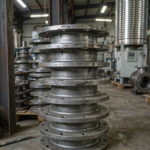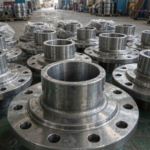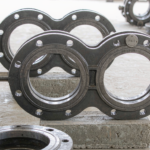
If you buy flanges globally, you have probably run into the EN 1092-1 vs ASME B16.5 question every time a project crosses the Atlantic — or the Pacific. Both standards describe the same product (a pipe flange with bolt holes), but they categorize pressure class, dimension series, and facing in completely different ways. Substituting one for the other without a stress calculation is one of the most common causes of flange leakage and pressure-equipment rejection at customs. This guide maps the two standards side-by-side so procurement, design, and quality teams can spec the right flange every time.
1. Why Two Standards Exist
EN 1092-1 is the European standard for steel pipe flanges, published by CEN. It uses PN (Pressure Nominale) ratings based on allowable working pressure at ambient temperature.
ASME B16.5 is the North American standard from the American Society of Mechanical Engineers. It uses Class ratings based on pressure-temperature tables that account for material strength derating with temperature.
The two systems are not directly interchangeable — the underlying design philosophy (allowable stress basis) is different, so a “PN16” flange is not the same as a “Class 150” flange even though both are commonly used at 16 bar / 150 psi working pressure at room temperature.
2. Pressure-Class Mapping (Approximate)
The table below shows approximate equivalents for carbon steel flanges at room temperature. At higher temperatures the equivalence breaks down because EN and ASME use different material derating curves.
| EN 1092-1 PN | Working Pressure @ 20 °C (bar) | Approx. ASME B16.5 Class | Working Pressure @ 100 °F (psi) |
|---|---|---|---|
| PN 6 | 6 | Class 75 (custom) | 75 |
| PN 10 | 10 | Class 125 (cast iron) | 125 |
| PN 16 | 16 | Class 150 | 150 |
| PN 25 | 25 | Class 150 (high-temp) / Class 300 | 150–300 |
| PN 40 | 40 | Class 300 | 300 |
| PN 63 | 63 | Class 400 | 400 |
| PN 100 | 100 | Class 600 | 600 |
| PN 160 | 160 | Class 900 | 900 |
| PN 250 | 250 | Class 1500 | 1500 |
| PN 320 | 320 | Class 2500 | 2500 |
Use this table as a starting point only. Always confirm the pressure-temperature rating of the specific flange material at the actual operating temperature of your system.
3. Dimensional Differences
Even when PN and Class are equivalent, the actual dimensions differ. Take a DN 100 / NPS 4 flange rated PN 16 / Class 150:
| Dimension | EN 1092-1 PN 16 | ASME B16.5 Class 150 |
|---|---|---|
| Outside diameter (D) | 220 mm | 228.6 mm (9 in) |
| Bolt circle (K) | 180 mm | 190.5 mm (7.5 in) |
| Number of bolt holes | 8 | 8 |
| Bolt hole diameter (L) | 18 mm | 19.1 mm (¾ in) |
| Bolt size | M16 | ¾ in (≈ M20) |
| Flange thickness (C) | 22 mm | 23.9 mm |
| Hub length (if WN) | 35 mm | 52.3 mm |
| Raised face height (RF) | 2 mm (Type A) | 1.6 mm |
The flanges are not interchangeable at the bolt circle. Bolting an EN 1092-1 flange to an ASME B16.5 flange would require a custom adapter ring.
4. Facing and Sealing Surface
Both standards support several facing types, but the naming is different:
| EN 1092-1 Facing | ASME B16.5 Facing | Sealing Method |
|---|---|---|
| Type A (flat face) | Flat Face (FF) | Flat gasket, full-face gasket required for FF |
| Type B (raised face) | Raised Face (RF) — default | Spiral-wound or compressed gasket |
| Type C (tongue) | Tongue (T) | Ring gasket |
| Type D (groove) | Groove (G) | Ring gasket |
| Type E (male-female) | Male-Female (M/F) | Ring gasket |
| Type F (recessed joint) | Ring-Type Joint (RTJ) | Metal ring (oval or octagonal) |
| Type B2 (raised face with 0.2 mm serration) | (no direct equivalent; serrated RF is custom) | Soft gasket for food/pharma |
| Type H (groove for O-ring) | (no direct equivalent) | Hydrocarbon service |
Important compatibility note: an EN flange with Type B facing (smooth RF) will mate with an ASME flange with RF facing using the same gasket — the surfaces are functionally compatible. But Type F (EN) and RTJ (ASME) ring grooves have different dimensions; you cannot mix.
5. Material Specifications
The two standards name materials differently:
| EN 1092-1 Material | EN Number | ASME B16.5 Material | UNS / Typical Application |
|---|---|---|---|
| P245GH | 1.0352 | ASTM A105 (forging) / A181 (casting) | K03504 / general carbon steel |
| P250GH | 1.0460 | ASTM A105 | K03504 / higher temp |
| P265GH | 1.0425 | ASTM A105 | K03504 / -20 °C |
| 16Mo3 | 1.5415 | ASTM A182 F1 | K12822 / 500 °C |
| 13CrMo4-5 | 1.7335 | ASTM A182 F11 | K11597 / 550 °C |
| X6CrNiMo17-13-2 | 1.4404 | ASTM A182 F316L | S31603 / stainless |
EN flanges are typically delivered with EN 10204-3.1 certificates; ASME flanges require ASME II Part A or B traceability. When importing, always confirm the certificate basis matches your project specification.
6. Bolting Differences
Bolt size and grade also differ between standards:
| EN 1092-1 Bolt | EN Bolt Grade | ASME B16.5 Bolt | ASME Bolt Material |
|---|---|---|---|
| M16 | 8.8 (or higher) | ½ in | B7 / B7M (alloy) |
| M20 | 8.8 / 10.9 | ⅝ in | B7 / B7M |
| M24 | 10.9 / 12.9 | ¾ in | B7 / B7M / B16 |
| M27 / M30 | 10.9 | ⅞ in / 1 in | B7 / B16 |
Torque values also differ. EN 1092-1 lists installation torque; ASME PCC-1 provides bolt-tightening procedures. Don’t apply ASME torque tables to EN bolts or vice versa — yield-stress assumptions are different.
7. Common Mistakes When Mixing Standards
- Assuming PN 16 = Class 150. Dimensionally close at room temperature but not interchangeable.
- Mixing EN and ASME bolts on the same joint. Different threads (metric vs UNC), different torque, different preload.
- Using RTJ gasket on Type F EN groove. Dimensions differ by ~0.3 mm — gasket won’t seat.
- Ignoring temperature derating. At 300 °C the gap between PN and Class ratings widens significantly.
- Buying “ASME B16.5 PN 16” flanges. This is a marketing trick — the standard only lists Class ratings.
8. Selection Decision Tree
- Project is for Europe / EU / Middle East / Africa: Specify EN 1092-1.
- Project is for North America / South America / Southeast Asia: Specify ASME B16.5.
- Project has both EU and US equipment (common in Asia-Pacific plants): Specify to ASME B16.5 (more common globally) and adapt European equipment to ASME weld-neck flanges.
- Project is for oil & gas upstream (offshore / subsea): Specify ASME B16.5 or API 6A — EN 1092-1 is not generally accepted by API specs.
- Pressure rating above PN 100 / Class 600: Both standards work, but dimensions diverge sharply. Don’t attempt cross-reference without detailed mechanical calculation.
9. How to Verify When Receiving Flanges
- Confirm the standard is stamped on the flange (e.g., “EN 1092-1 PN 16 DN 100” or “ASME B16.5 Class 150 NPS 4”).
- Check the material stamp matches MTC (e.g., “1.0460” or “A105”).
- Verify bolt-hole pattern, bolt circle, and number of holes match your mating flange.
- Measure raised face height with a depth gauge.
- Match gasket type to facing type (don’t use a spiral-wound on FF).
- For pressure equipment in EU, verify CE marking and PED 2014/68/EU compliance.
- For pressure equipment in US/Canada, verify ASME U-stamp or U3A-stamp when required.
Frequently Asked Questions
Is EN 1092-1 PN 16 the same as ASME B16.5 Class 150?
At room temperature on carbon steel, yes — both are rated for 16 bar / 150 psi working pressure. The dimensions, bolt pattern, and material naming differ, but the pressure performance is similar.
Can I bolt an EN flange to an ASME flange?
Not directly. The bolt circle, hole count, and hole size usually differ. You’d need a custom adapter spool or a special flange with mixed drilling. Avoid this where possible.
Which standard should I use for a Middle East refinery project?
Depends on the licensor. If the process design is from a US-based company (Honeywell UOP, Lummus), use ASME B16.5. If from a European licensor (Axens, Topsoe, Shell global), EN 1092-1 is acceptable. Many Middle Eastern EPCs accept both, but require consistency throughout the project.
What about EN 1092-2 for cast iron flanges?
EN 1092-2 is a separate standard for cast iron flanges. It shares the PN system with EN 1092-1 but is not interchangeable — material is grey iron or ductile iron, not steel. Use it only for water service and low-pressure applications.
Need EN 1092-1 or ASME B16.5 Flanges?
Huaxia-Steel supplies both EN 1092-1 and ASME B16.5 flanges in carbon steel, alloy steel, and stainless — including slip-on, weld-neck, blind, threaded, lap-joint, and socket-weld types. Every flange ships with EN 10204-3.1 mill certificate, dimensional report, and optional third-party inspection (SGS, BV, TUV). Send your specification to [email protected] for a 24-hour quote.
Related reading: Weld-Neck Flange · Blind Flange · ASME B31.1 vs B31.3 vs B31.4 Piping Codes