S235JR Steel Equivalent: EN 10025 Grades Explained
Introduction: One Grade Name, Four Critical Suffixes
S235JR is the most commonly ordered structural steel grade in the world outside North America. It appears in European project specifications, in third-country tenders written to EN standards, and in the catalogs of every serious Chinese export mill. Yet a surprising share of delivery disputes trace back to one detail: the buyer needed the impact toughness of the suffix (JR, J0, J2, or K2), and the supplier shipped the cheapest version with the right base grade name.
This guide explains what S235JR actually guarantees under EN 10025-2, how the suffix system works, which international grades are considered equivalent (and where the equivalences break down), and what to check on the mill certificate before you release payment.
What Is S235JR? Decoding the Designation
Under EN 10025-2 (hot rolled products of structural steels, Part 2: technical delivery conditions for non-alloy structural steels), the designation breaks down as follows:
S = structural steel
235 = minimum yield strength (Reh) of 235 MPa for the thinnest rolling range (≤16 mm)
JR = Charpy V-notch impact energy of 27 J minimum at +20°C (room temperature)
The same base grade with different suffixes changes only the toughness guarantee: J0 = 27 J at 0°C, J2 = 27 J at −20°C, and K2 = 40 J at −20°C. Everything else — chemistry windows, tensile ranges, tolerances — is identical. This suffix is not a formality: it is the single property that determines whether a member behaves predictably in a Nordic winter or a desert summer.
Chemical Composition (EN 10025-2)
Ladle analysis limits for S235JR (≤16 mm, flat and long products):
Element
S235JR (%)
Notes for Buyers
Carbon (C)
≤ 0.17
Low C gives excellent weldability
Manganese (Mn)
≤ 1.40
Main strengthener
Silicon (Si)
—
Not specified for JR in this thickness (no Si requirement for S235JR ≤16mm)
Phosphorus (P)
≤ 0.035
Tighter than most national equivalents
Sulfur (S)
≤ 0.035
Controls weld hot cracking
Nitrogen (N)
≤ 0.012
Important for strain aging resistance
Note the P and S ceilings: at 0.035% they are tighter than JIS SS400 (0.050%) and tighter than many commodity-grade national standards. This is one reason S235JR is preferred in European-endorsement projects — and one of the quiet quality gaps to check when a supplier proposes a “equivalent” national grade instead.
Mechanical Properties
Property
Requirement (EN 10025-2)
Yield strength Reh, ≤16 mm
≥ 235 MPa
Yield strength, 16–40 mm
≥ 225 MPa
Yield strength, 40–100 mm
≥ 215 MPa
Tensile strength, <100 mm
360–510 MPa
Elongation A80 / A5 (longitudinal)
≥ 26% / ≥ 24%
Charpy V-notch (JR)
≥ 27 J at +20°C (longitudinal)
As with all structural grades, yield derates with thickness. If your design was checked against 235 MPa, any plate above 16 mm must be re-verified against the correct band — a frequent source of failed approval when substituting suppliers.
The Suffix System: JR vs J0 vs J2 vs K2
Designation
Test Temp
Min Energy (long.)
Typical Application Climate
S235JR
+20°C
27 J
Temperate climates, indoor structures, general fabrication
S235J0
0°C
27 J
Outdoor structures in mild winter regions
S235J2
−20°C
27 J
Cold climates, transport equipment
S235K2
−20°C
40 J
Higher-toughness demand at low temp (note: K2 and J2 differ only in test direction for plates)
Buying rule: match the suffix to the lowest expected service temperature with margin. For most Middle East, Southeast Asia, and South America projects, JR is adequate. For Central Europe, China north, and central US, J0 is the safe floor. For Canada, Scandinavia, Russia, and high-altitude projects, J2/K2 — and consider stepping up a grade (S355J2) rather than just the suffix when sections are thick.
International Equivalents — and Where They Break
Standard
Grade
Yield (typ. ≤16mm)
Impact Test
Key Difference vs S235JR
EN 10025-2
S235JR
235 MPa
27 J @ +20°C
—
ASTM A36
A36
250 MPa
20 J @ +20°C (when specified)
Higher C ceiling (0.26%), different Mn logic
JIS G3101
SS400
245 MPa
None required
No impact guarantee, looser P/S (0.050)
GB/T 700
Q235B
235 MPa
27 J @ +20°C
Very close match; C ceiling 0.20 vs 0.17
GB/T 700
Q235C
235 MPa
27 J @ 0°C
Matches J0-level toughness
GB/T 700
Q235D
235 MPa
27 J @ −20°C
Matches J2-level toughness
Practical guidance on substitutions:
Q235B → S235JR: the closest and safest substitution in world trade. Chemistry overlaps almost fully; both carry a +20°C impact requirement. Most European buyers accept it with a 3.1 certificate.
SS400 → S235JR: NOT a true equivalent. SS400 has no Charpy requirement and looser impurity limits. Acceptable only where toughness is irrelevant (non-structural trim, general fabrication).
A36 → S235JR: A36 is slightly stronger in yield but permits more carbon. For welded dynamic structures, verify CEV and impact data per heat rather than trusting the equivalence.
Reverse substitution warning: if the spec says Q235C or S235J0 and the supplier offers JR “because it is the same steel,” refuse — the entire point of the suffix is the temperature at which toughness is proven.
Deoxidation and Supply Condition
S235JR is typically supplied as rimming-steel-equivalent in thin gauges or fully killed for thicker products; EN 10025-2 requires fully killed supply for J2/K2 and for thicknesses above 16 mm. If your application involves hot-dip galvanizing, insist on fully killed (Si-killed) material — non-killed steel can produce inconsistent galvanized coatings. State “fully killed” on the PO; it costs nothing extra and avoids the classic galvanizing blistering dispute.
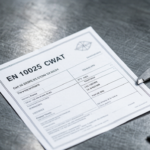
Reading the Mill Certificate: A 6-Point Checklist
Standard reference: certificate must cite EN 10025-2 and the full designation (e.g., “S235JR+AR” — AR = as-rolled, N = normalized).
Heat number traceability: match heat numbers to markings on the material and packing list.
Yield in the correct band: confirm Reh is reported for the actual thickness range, not the 16 mm value copied onto 25 mm plate.
Impact result: 3 specimens with individual values ≥27 J average at +20°C (individual minimum 19 J for JR… in practice require all ≥27 to be safe).
Chemistry within EN windows: particularly C ≤0.17 and P/S ≤0.035. Q235B certificates show 0.20 C ceiling — still acceptable, but know which standard you are certifying against.
CEV if welding matters: for S235JR CEV is typically ≤0.35; if the certificate does not report it, ask.
Frequently Asked Questions
1. Is S235JR the same as A36?
They are functionally similar structural grades but not identical. A36 permits up to 0.26% carbon (S235JR: 0.17%) and has a different yield verification logic; S235JR carries a mandatory 27 J Charpy guarantee, while A36 requires impact testing only supplementary. For welded structures, treat the substitution as engineering-approved, not automatic.
2. Can I use Q235B instead of S235JR?
In most non-code projects, yes — it is the closest international equivalent, with matching yield and the same +20°C impact requirement. Verify P/S values on the certificate meet your acceptance (Q235B allows 0.045%). For projects formally governed by EN standards, get designer approval in writing.
3. What does the “AR” or “N” after the grade mean?
Delivery condition: +AR (as-rolled) and +N (normalized) or +M (thermo-mechanically rolled for some grades). For S235, AR is standard and N is optional. Structural welding codes sometimes require a stated delivery condition — include it on drawings to avoid supplier guesswork.
4. Does thickness affect the toughness guarantee?
The Charpy requirement is independent of thickness, but thicker product in J2/K2 must be fully killed and the yield derates with thickness. For critical low-temp work above 40 mm, consider S355J2 or finer-grained grades instead of pushing S235 to its limits.
5. How is S235JR priced relative to Q235B?
For Chinese export supply, S235JR and Q235B normally price within 1–2% of each other — the premium, if any, is for EN-format certification and testing. If a “S235JR” offer is dramatically cheaper than market Q235B, it is usually SS400 or untested Q235A relabeled.
Conclusion
S235JR rewards buyers who read designations precisely. The base number tells you the strength; the suffix tells you the temperature at which that strength stays ductile; the standard tells you the chemistry discipline behind it. Specify all three on the purchase order, verify them on the 3.1 certificate, and the grade delivers exactly what European structural practice promises.
If you require further information about our metal sheet products or architectural projects, please don’t hesitate to leave your contact details and message here.
Our team of experts will respond within 24 hours to continue the discussion and provide you with any additional information you requires.