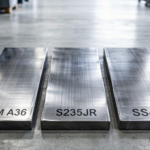
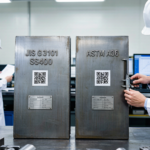
A36 and S235JR are the two most requested structural carbon steels in cross-border trade — A36 dominates projects specified to ASTM and American codes, while S235JR is the default grade under EN 10025-2 for European specifications. Because they sit at the same strength level and cost almost the same per tonne, buyers constantly ask whether one can simply replace the other on a project drawing. The short answer: most of the time yes, with conditions — but the differences in chemistry, impact testing, certification and dimensional standards mean a substitution must be justified in writing, not assumed. This guide compares A36 vs S235JR across chemistry, mechanical properties, weldability, certification and sourcing, and gives you a substitution checklist you can send to your engineering consultant.
What Is ASTM A36 Steel?
ASTM A36/A36M is the American standard for carbon structural steel, covering plates, bars, and structural shapes such as I-beams, channels and angles. It is a property-based specification: the grade is defined by a guaranteed minimum yield strength of 250 MPa (36 ksi) and tensile strength of 400–550 MPa (58–80 ksi), rather than by a tight chemistry window. Carbon content scales with thickness — up to 0.25% for sections 20 mm and under, rising to about 0.29% in thicker plates with corresponding manganese adjustment up to 1.20%. A36 is normally supplied hot rolled with mill scale, and Charpy impact testing is optional (supplementary requirement S5) unless the purchaser invokes it.
What Is S235JR Steel?
S235JR comes from EN 10025-2, the European standard for non-alloy structural steels. The name is a code: “S” for structural, “235” for minimum yield strength in MPa (for the thinnest range), “J” for 27 J Charpy energy at room temperature (+20 °C), and “R” for longitudinal test direction. Unlike A36, S235JR carries a mandatory impact requirement by definition — that is the single most important difference between the two grades. Chemistry is capped at C ≤ 0.17% for thicknesses up to 16 mm (rising with thickness), Mn ≤ 1.40%, P ≤ 0.035% and S ≤ 0.035%. In thicknesses above 40 mm the impact requirement moves to 0 °C (JO) or you must upgrade to S235J0/J2.
Key S235JR variants buyers encounter:
S235JR — 27 J at +20 °C, longitudinal, the base grade.
S235J0 — 27 J at 0 °C, for mildly cold climates.
S235J2 — 27 J at −20 °C, supplied normalized or with fine-grain practice.
Suffix +AR (as rolled) or +N (normalized) affects test frequency and grain size.
Direction matters: transverse impact values are reduced, so specify test direction if the design requires it.
Chemical Composition Comparison
Element
A36 (≤20 mm)
A36 (thick plate)
S235JR (≤16 mm)
S235JR (>40 mm)
Carbon (C)
≤ 0.25%
≤ 0.29%
≤ 0.17%
≤ 0.20%
Manganese (Mn)
—
0.80–1.20%
≤ 1.40%
≤ 1.40%
Phosphorus (P)
≤ 0.04%
≤ 0.04%
≤ 0.035%
≤ 0.035%
Sulfur (S)
≤ 0.05%
≤ 0.05%
≤ 0.035%
≤ 0.035%
Silicon (Si)
0.15–0.40%
0.15–0.40%
—
≤ 0.40%
Nitrogen (N)
—
—
≤ 0.012%*
≤ 0.012%*
*Applies where the steel is not aluminium-grain-refined; fine-killed S235JR typically shows N around 0.006–0.010%. The practical consequence of the tighter EN chemistry is a cleaner, more consistent steel: lower sulfur improves transverse ductility and weld metal quality, and the lower carbon ceiling keeps carbon equivalent low across the full thickness range — something A36 cannot guarantee in heavy plate.
Mechanical Properties Side by Side
Property
A36
S235JR
Min yield (≤16 mm)
250 MPa
235 MPa
Min yield (16–40 mm)
250 MPa
225 MPa
Min yield (40–100 mm)
250 MPa (plate ≤200 mm)
215 MPa
Tensile strength
400–550 MPa
360–510 MPa
Min elongation (80 mm gauge)
20–23%
26% (t≤40 mm)
Charpy V-notch
Optional (S5)
27 J at +20 °C, mandatory
Typical hardness
120–150 HB
110–140 HB
Three practical observations. First, A36’s flat 250 MPa yield across all thicknesses gives it an advantage in heavy sections — S235JR yield drops with thickness, so a 60 mm S235JR plate offers only 215 MPa minimum while A36 still guarantees 250 MPa. Second, the tensile windows overlap heavily (400–550 vs 360–510 MPa), so both steels behave nearly identically in generic fabrication. Third, elongation of S235JR is typically higher because the EN product standard (EN 10025-2) specifies generous minimums; real heats of both grades usually exceed the paper values by 3–5 points.
Weldability: Which Grade Welds Better?
Both grades weld excellently with SMAW, GMAW and FCAW processes. The carbon equivalent (CEV per IIW) tells the story: S235JR computes to roughly 0.26–0.34 because of its low carbon ceiling, while A36 in thick plate can reach 0.40–0.43 when carbon and manganese both run high. In practice neither grade needs preheat for sections under 25 mm. Above 40 mm, or on highly restrained joints, A36 deserves a 50–100 °C preheat and low-hydrogen electrodes; S235JR at the same thickness usually still welds without preheat, though good practice with any structural steel thicker than 50 mm is to dry the joint and use E7018-class consumables.
For galvanizing after fabrication, the lower-silicon S235JR (when ordered with Si ≤ 0.30%) behaves more predictably in the zinc bath; high-silicon heats of either grade can produce thick, brittle galvanized layers. If your fabrication will be hot dip galvanized, mention it in the RFQ — mills can select silicon-controlled heats at little or no premium.
Certification and Testing Differences
This is where sourcing decisions get made. A36 is certified to ASTM A6 general requirements with an EN 10204 3.1 certificate listing chemistry and tensile results; Charpy appears only if you ordered S5. S235JR is certified under EN 10025-2 with mandatory impact results, and European projects often require CE marking plus EN 1090 execution documentation — a compliance chain A36 simply does not have. If your project is certified under Eurocode (EN 1993), S235JR material with full EN 1090 traceability is essentially required; substituting A36 means preparing a project-specific engineering justification. Conversely, US-specified projects under AISC 360 expect A36 (or Grade 50), and S235JR substitution faces the same hurdle in reverse.
Mill certificate: demand EN 10204 3.1 for either grade, with heat number traceability to stamped marks.
Impact tests: 3 specimens per test unit for S235JR; add S5 supplement if a project requires Charpy on A36.
CE marking: only relevant for EN 10025 material destined for EU construction.
Third-party inspection (SGS/BV/TUV) is inexpensive insurance on first orders from a new supplier.
Can A36 Replace S235JR — and Vice Versa?
Engineers generally accept A36 as equivalent to S235JR for indoor, non-critical structural work because A36’s 250 MPa yield exceeds S235JR’s 235 MPa minimum. The reverse substitution is riskier in heavy sections because S235JR’s yield declines with thickness. Four situations make substitution inappropriate:
Impact energy is design-governing at low temperature: neither grade’s base version covers −20 °C; you need S235J2 or A36 with S5 plus specified energy.
CE-marked structures under EN 1090: material must carry EN 10025-2 certification, full stop.
Heavy plate above 40 mm in the European spec: A36’s chemistry freedom (C up to 0.29%) is outside the EN composition table even if strength matches.
Cold forming severity: S235JR’s lower carbon behaves better in deep bending; A36 heats vary more.
Many Chinese mills routinely produce dual-certified Q235B/A36 plate and some offer Q235B certified additionally to S235JR with impact testing. Dual certification is the cleanest commercial answer when a project references both standards — you pay a small testing premium and receive one material satisfying both documents. Always confirm the dual certification is printed on the mill test certificate, not just promised in an email.
Price and Availability in Export Trade
At Chinese export mills the FOB price gap between A36 and S235JR is typically 1–3%, dominated by testing cost rather than steelmaking differences. Availability differs by product form: A36 plate and structural shapes are stocked in enormous depth because US-market re-rollers keep the grades running; S235JR in EN-metric dimensions (e.g., 2000×6000 mm plates, metric hollow sections) sometimes requires production to order with a 15–25 day lead time when local stock is in ASTM-imperial sizes. For buyers in Southeast Asia, the Middle East and Africa, both grades ship from the same mills and consolidating one grade across your bill of materials usually saves more on freight and inspection than the per-tonne price difference between the two.
Substitution Checklist for Your RFQ
Confirm the governing design code (AISC vs Eurocode) and whether the material certificate must match.
Check lowest design temperature; upgrade to S235J2/J0 or add Charpy supplements as required.
Check plate thickness; compare the yield minimum that actually applies at your gauge.
Ask the mill for dual certification Q235B/A36/S235JR with all results on one 3.1 certificate.
Verify dimensional standards: EN 10025 plate sizes and tolerances (EN 10029) vs ASTM A6/A20.
If galvanizing is planned, request silicon-controlled heats.
State test direction (longitudinal/transverse) and test unit size in the PO to avoid dispute at inspection.
Choosing by Application: Which Grade Fits Your Job?
Start from the governing specification rather than from the strength number. If your drawings reference AISC 360 and ASTM A6, buy A36 — the project’s material certificates and inspection documents will match without engineering justification letters. If the drawings reference Eurocode 3 and EN 1090 execution classes, buy S235JR (or S275/S355 variants) with EN 10204 3.1 and the manufacturer’s CE documentation for construction products. For general fabrication with no code constraints — machine bases, brackets, plate work, non-critical frames — either grade performs identically and you should buy on price, availability and cut-to-size service.
Three application-specific rules of thumb: (1) for exposed façade and architectural steel where surface quality matters, S235JR’s lower carbon and sulfur give more predictable welding and grinding behaviour and a cleaner paint system; (2) for heavy welded nodes in plate above 40 mm, upgrade to S355J2 or A572 Gr50 rather than arguing over A36 vs S235JR — both base grades run out of strength margin first; (3) for galvanized components, specify silicon-controlled heats in either grade and confirm the Si range on the 3.1 certificate, because the zinc reaction is driven by silicon, not by the grade name.
Dimensional Standards: ASTM A6 vs EN 10029
Substitution conversations often ignore the dimensional standard, and that is where fitting problems appear. ASTM A6/A6M governs plate thickness, width and camber tolerances for US steel, with plate sizes commonly in imperial-friendly widths (48″, 60″, 72″, 96″) and thickness increments in inches or decimal inches. EN 10029 governs thickness tolerance (Class A–D), flatness and length/width tolerances for European plate, with metric widths (1500, 2000, 2500, 3000 mm) and metric thickness steps. A mill rolling both standards keeps separate tolerance tables — the same nominal 20 mm plate can be 19.4–20.6 mm under one standard and 19.8–20.8 mm under the other.
Plate width and length availability: European metric masters run 1500–3200 mm wide; US-oriented masters often 1219–3048 mm (48–120 in).
Thickness availability differs: EN plate below 5 mm is commonly cut from strip (EN 10051) with its own tolerance; ASTM A6 starts at 6 mm for plate proper.
Camber and out-of-square: both standards allow more than fabricators assume; if your laser or plasma table needs tight squareness, say so in the PO and pay for guaranteed squaring.
Flatness: shot blasting and leveling after cutting improve flatness measurably on thin plate — ask whether the supplier levels after cut-to-size.
Five Mistakes Buyers Make With These Grades
Ordering “S235JR” to an ASTM project without confirming impact test direction — transverse Charpy values are substantially lower and can fail a project review.
Assuming A36 covers cold weather: it does not. A36 with no S5 supplement has no impact guarantee at all; a −20 °C design needs S235J2 or A36 with S5 plus a specified energy and test temperature.
Accepting a certificate that lists only the standard name and no heat number — the certificate is then untraceable and worthless in a claim.
Mixing mill sources in one shipment to save USD 5/t: two heats means two certificate sets, two inspection lots, and a higher chance one lot fails dimensional checks.
Ordering plate by weight instead of by piece count: mills price and roll by piece; ordering “25 tonnes of 20 mm plate” leads to odd-size remnants you cannot use.
Avoid these five and the A36-versus-S235JR decision becomes a documented line item in your material schedule rather than a recurring argument at inspection. Where a project spans both standards, consolidate to dual-certified Q235B/A36/S235JR material — one heat, one certificate, both documents satisfied — and spend your inspection budget on dimensional and surface checks instead of paperwork.
Inspection Items to Put in the Purchase Order
The certificate is not the inspection. A complete PO inspection clause for structural plate covers four checks that take an inspector under an hour per lot and catch the great majority of real defects: (1) thickness measured at four corners plus mid-length on a sample of 10% of plates, against the ordered tolerance class; (2) surface condition — no laminations, heavy pitting, deep roll marks or weld repairs; (3) marking legibility and agreement with the certificate heat number on every plate; (4) dimensional check of length, width, diagonal and camber on the full lot. Add, where the project requires, ultrasonic testing per EN 10160 to detect internal lamination before the plate is cut — far cheaper than discovering a lamination in a finished girder.
Agree the rejection threshold in the PO: for example, plates outside the ordered thickness class are rejected and replaced at the supplier’s cost; surface defects exceeding EN 10163 Class A limits are repairable only with written approval and documented repair procedure; and any plate whose marking cannot be traced to a certificate is rejected regardless of measured properties. These three sentences, written before shipment, convert a potential argument into a straightforward sorting exercise at your warehouse.
Frequently Asked Questions
Is S235JR the same as A36?
No, but they are near-equivalents. Both are mild structural steels with similar strength; S235JR has mandatory 27 J room-temperature Charpy and tighter chemistry, while A36 guarantees 250 MPa yield at all thicknesses. Substitution is usually acceptable for generic fabrication but requires engineering approval for code-governed projects.
Which is stronger, A36 or S235JR?
In thin sections A36 is marginally stronger on paper (250 vs 235 MPa minimum yield). In sections above 40 mm the gap widens because S235JR yield drops with thickness while A36 stays at 250 MPa. Real heats of both typically test well above minimums.
What is the equivalent of S235JR in other standards?
Common equivalents: ASTM A36 (US, with caveats), JIS SS400 (Japan), GB/T 700 Q235B (China), IS 2062 E250 (India). None matches perfectly — the impact-test and certification differences are what separate them, so always compare certificates rather than grade names.
Can I buy dual-certified A36 / S235JR plate?
Yes. Many export mills certify plate to both ASTM A36 and EN 10025-2 S235JR, with chemistry, tensile and impact results printed on a single EN 10204 3.1 certificate. Confirm certification scope before ordering and include both standards on your purchase order and inspection plan.
Source A36 and S235JR From One Verified Factory
Huaxia-Steel supplies A36, S235JR/J0/J2 and dual-certified Q235B plate, bars and structural sections from audited partner mills, with EN 10204 3.1 certificates, Charpy testing to any temperature, third-party inspection on request and export packing to your port. Send your drawing or bill of materials and our engineers will confirm grade, size and certification within 24 hours.
If you require further information about our metal sheet products or architectural projects, please don’t hesitate to leave your contact details and message here.
Our team of experts will respond within 24 hours to continue the discussion and provide you with any additional information you requires.