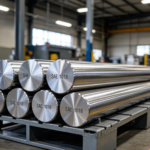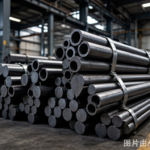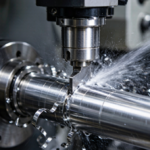
When procurement engineers specify low-carbon cold-drawn bar stock, two grades appear on datasheets more often than any others: SAE/AISI 1018 and SAE/AISI 1020. They share a similar chemistry envelope, both are widely stocked, both machine cleanly, and both weld easily — which is exactly why buyers get them confused. Substituting 1020 for 1018 (or vice-versa) rarely causes an obvious immediate failure, but it can change case-hardening response, weld metal dilution, and final part hardness in ways that affect fatigue life and dimensional control.
This guide compares the two grades side by side — chemistry, mechanical properties, cold-drawing behavior, machinability, weldability, carburizing response, and the downstream applications where each is the better technical choice.
Quick Comparison Table
| Property | SAE/AISI 1018 | SAE/AISI 1020 |
|---|---|---|
| UNS Number | G10180 | G10200 |
| Nominal Carbon Content | 0.15 – 0.20% | 0.18 – 0.23% |
| Primary Equivalent | DIN C15 / 1.0401, JIS S15C, EN C15E, GB 15# | DIN C22 / 1.0402, JIS S20C, EN C22E, GB 20# |
| Delivery Condition (typical) | Hot rolled, cold drawn, turned & polished | Hot rolled, cold drawn, turned & polished |
| Yield Strength (cold drawn, typical) | 490 MPa (71 ksi) min | 540 MPa (78 ksi) min |
| Tensile Strength (cold drawn, typical) | 550 MPa min | 620 MPa min |
| Elongation (cold drawn, %) | 15 – 20 | 12 – 18 |
| Hardness (cold drawn, BHN) | 130 – 160 | 150 – 180 |
| Machinability Rating (relative to AISI 1212 = 100%) | ~62% | ~65% |
| Weldability | Excellent (low C, low CEV) | Excellent to Good |
| Case-Hardening Suitability | Excellent (the standard carburizing grade) | Good (carburizes slightly deeper but with less case uniformity) |
| Common Forms | Round, hex, square, flat bar; cold-drawn tube | Round, hex, square, flat bar; cold-drawn tube |
| Typical Applications | Pins, shafts, studs, axles, light-duty gears, fasteners | Higher-stress shafts, couplings, hubs, gears, brackets |
SAE 1018 — The Reference Carburizing Steel
SAE 1018 is the textbook choice when a part needs a tough, ductile core with a hard carburized case. With a nominal 0.18% carbon core (range 0.15 – 0.20%), the steel offers excellent weldability and impact resistance, and it absorbs carbon rapidly during gas or pack carburizing. The standard carburizing cycle (880 – 930 °C / 1616 – 1706 °F) yields a typical effective case depth of 0.5 – 1.5 mm at 4 – 6 hours, with a surface hardness of 58 – 62 HRC after quenching and low-temperature temper.
In cold-drawn form, 1018 develops about 490 MPa (71 ksi) yield strength due to the strain hardening imparted by the drawing operation. This makes it suitable for high-volume CNC production: tight dimensional tolerances (typically ±0.025 mm on diameter for h9 tolerance), excellent surface finish (Ra 1.6 μm achievable), and consistent feed rates in automatic machining.
Where 1018 Excels
- Carburized parts: Splined shafts, gear blanks, pinion shafts, sprockets where the surface is case-hardened and the core must stay tough.
- Weldments: Brackets, mounting plates, agricultural equipment components where fabrication includes heavy welding.
- CNC-machined precision parts: Tight-tolerance pins, bushings, spacers that need stable dimensions.
- Hydraulic / pneumatic components: Cylinder rods, gland nuts, mounting flanges.
SAE 1020 — Slightly Stronger, Slightly Harder
SAE 1020 steps up the carbon content (0.18 – 0.23%, nominal 0.20%) compared with 1018, which translates into roughly 10 – 15% higher tensile strength and improved wear resistance in the as-cold-drawn condition. The trade-off is reduced weldability (not dramatically, but preheating is recommended for thick sections) and a slightly higher risk of quench cracking if through-hardening is attempted.
1020 is the preferred choice where:
- The part will be used in the as-cold-drawn condition without subsequent carburizing — for example, shafts transmitting moderate torque, hubs, sleeves, drive pins.
- The application calls for induction hardening at specific localized areas (splines, bearing seats). 1020 responds well to localized surface heating and quench.
- The buyer wants a single material grade that can also be case-hardened, albeit with a slightly coarser case than 1018.
- Higher surface hardness translates into longer wear life in sliding or rotating applications that don’t justify through-hardened alloy steel.
Chemistry Deep-Dive
Although the two grades look interchangeable on a glance, the small differences in manganese and residual limits add up in heat treatment:
| Element (wt%, heat analysis) | SAE 1018 (per ASTM A29 / SAE J403) | SAE 1020 (per ASTM A29 / SAE J403) |
|---|---|---|
| Carbon (C) | 0.15 – 0.20 | 0.18 – 0.23 |
| Manganese (Mn) | 0.60 – 0.90 | 0.30 – 0.60 |
| Phosphorus (P, max) | 0.040 | 0.040 |
| Sulfur (S, max) | 0.050 | 0.050 |
| Silicon (Si) | 0.10 – 0.35 (residual varies) | 0.10 – 0.35 (residual varies) |
| Iron (Fe) | Balance | Balance |
| Typical CEV (IIW) | ~0.19 | ~0.22 |
Key takeaway: 1018 typically carries more Mn than 1020 (0.60 – 0.90 vs 0.30 – 0.60). Manganese improves hardenability and deoxidation, which is why 1018 tends to give a more uniform carburized case with finer grain. Conversely, 1020’s lower Mn keeps the weld HAZ softer and tougher but means a coarser grain can develop if normalizing is skipped.
Mechanical Properties After Cold Drawing
| Property | 1018 CD | 1020 CD |
|---|---|---|
| Tensile Strength (Rm) | 550 – 700 MPa (80 – 102 ksi) | 620 – 790 MPa (90 – 115 ksi) |
| Yield Strength (Re or Rp0.2) | 490 MPa min (71 ksi) | 540 MPa min (78 ksi) |
| Elongation (A50, %) | 15 – 20 | 12 – 18 |
| Reduction of Area (%) | 40 – 50 | 35 – 45 |
| Brinell Hardness (HBW) | 130 – 160 | 150 – 180 |
| Modulus of Elasticity | 205 GPa | 205 GPa |
Note that the published ranges overlap, and the actual mechanical values depend strongly on the cold-drawing reduction ratio. A heavy reduction (>20% area) pushes both grades toward the upper tensile range; a light reduction leaves them near the as-rolled baseline. Always request the actual MTC values from your supplier rather than relying on catalog averages.
Machinability and Chip Control
Neither 1018 nor 1020 is a “free-machining” grade (those contain added sulfur or lead — 1212, 1215, 12L14). Both are considered moderate-machinability carbon steels, with 1020 marginally better than 1018 because of the higher carbon content producing slightly more brittle, easy-to-break chips.
Practical machining parameters:
- Cutting speed (m/min) for turning mild steel with HSS tooling: 1018 ~35 – 45 m/min; 1020 ~30 – 40 m/min. With carbide tooling, both can run 50 – 30% faster.
- Feed rates: Standard feeds of 0.10 – 0.30 mm/rev work for both grades.
- Chip form: 1018 tends to produce longer, stringier chips; 1020 produces slightly more segmented chips.
- Surface finish: With sharp tooling and proper speeds, both achieve Ra 0.8 – 1.6 μm in finish turning.
- Coolant: Standard soluble oil works well; both grades are not sensitive to water-based coolant corrosion.
Welding Behavior
Both grades are considered readily weldable by all standard processes — SMAW (stick), GMAW (MIG), GTAW (TIG), and resistance welding. With their low carbon and CEV values (typically below 0.25), preheating is rarely required for thin sections (under 12 mm). For heavier sections or restraint-sensitive joints, preheat to 100 – 150 °C and use low-hydrogen electrodes (E7018, ER70S-6) to avoid HAZ cracking.
In 1020, the slightly higher carbon warrants preheat when:
- Section thickness exceeds 20 mm
- Ambient temperature is below 5 °C
- The joint is highly restrained
- Hydrogen pickup risk is high (humidity, dirty plate)
Post-weld stress relieving at 595 – 650 °C is recommended for both grades on heavy fabrications where dimensional stability matters.
Heat Treatment Options
| Process | 1018 Response | 1020 Response |
|---|---|---|
| Carburizing (case hardening) | Excellent — uniform case, fine grain | Good — slightly deeper case, may need grain refinement |
| Induction Hardening | Good | Excellent |
| Flame Hardening | Good | Excellent |
| Through-Hardening (water quench) | Limited — low hardenability, soft core | Slightly better, but not recommended for critical sections |
| Normalizing | Refines grain for subsequent machining | Refines grain — recommended after forging |
| Annealing (spheroidize) | 850 – 900 °C, slow cool — soft for forming | 840 – 880 °C, slow cool |
| Stress Relieving | 595 – 650 °C for 1 hour per 25 mm thickness | Same as 1018 |
Neither grade is a candidate for through-hardening to high hardness. If you need a uniformly hard part (>45 HRC through-section), move up to alloy steel such as 4140, 4340, or 1045 (medium carbon). 1045 is the more frequent substitution, although it’s a different family with different welding behavior.
Equivalent Grades Worldwide
| Country / Standard | 1018 Equivalent | 1020 Equivalent |
|---|---|---|
| ISO / EN (EU) | EN C15E / 1.0401 / C15R / 1.1116 | EN C22E / 1.1151 |
| DIN (Germany, legacy) | DIN C15 / 1.0401 | DIN C22 / 1.0402 |
| JIS (Japan) | JIS S15C | JIS S20C |
| GB (China) | GB/T 699 15# / ML15 | GB/T 699 20# / ML20 |
| BS (UK, legacy) | BS 040A15 / 080A15 | BS 040A20 / 080A20 |
| GOST (Russia) | GOST 15 / Steel 15 | GOST 20 / Steel 20 |
| IS (India) | IS 2062 / IS 15C8 | IS 20C8 |
Note that direct equivalents are chemical, not always dimensional or processing-equivalent. If a project spec calls out a specific DIN or JIS grade, verify the chemistry range and delivery condition before accepting a cross-named substitute.
Application Selection Matrix
Choose SAE 1018 when:
- The part requires case hardening (carburizing + quench + temper) for surface wear resistance
- The fabrication involves significant welding without preheating capability
- Core toughness is more important than surface hardness (e.g., impact-loaded pins)
- The part is exposed to sub-zero service temperatures
- Material traceability and consistent grain structure are required (e.g., aerospace pin stock)
Choose SAE 1020 when:
- The part is used in the as-cold-drawn condition and needs higher tensile/yield than 1018
- Localized surface hardening (induction, flame) is in the manufacturing plan
- Wear resistance from base metal is needed (sliding sleeves, guide rails)
- The buyer wants a single material that bridges case-hardenable and direct-use applications
Procurement Checklist for Cold-Drawn Bar
- Specify condition: Hot rolled (HR) vs cold drawn (CD) vs turned & polished (T&P). Each has different tolerances, surface finish, and mechanical values.
- Confirm dimensional tolerance: Cold-drawn bar typically h9 (close) or h11 (standard). For precision shafts, specify h6 or h7.
- Surface finish requirement: Standard CD finish is Ra 1.6 – 3.2 μm; polished or ground finishes reach Ra 0.4 – 0.8 μm.
- MTC EN 10204 3.1: Independent mill certification listing chemistry, mechanical results, and dimensional inspection.
- Straightness: Standard 1 mm per meter; for precision machining, request 0.5 mm per meter.
- End finish: Cut-to-length with chamfered ends, or mill-cut straight ends.
- Length: Standard 3 m / 6 m; custom lengths by agreement.
- Packaging: Hexagonal bundles with steel strip, plastic wrapping, end caps for export shipping.
FAQ
1018 and 1020 in the as-hot-rolled (HR) condition have very different mechanical values from their cold-drawn (CD) counterparts. Cold drawing — pulling the bar through a die to reduce its cross-section — typically imposes a 10 – 25% area reduction. This:
- Increases yield strength by 60 – 100% (HR: ~280 MPa; CD: ~490 MPa for 1018)
- Increases tensile strength by 30 – 50% (HR: ~430 MPa; CD: ~550 MPa for 1018)
- Reduces elongation by 30 – 50% (HR: ~25%; CD: ~15 – 20% for 1018)
- Improves surface finish (Ra 1.6 – 3.2 μm in CD vs rough as-rolled)
- Tightens dimensional tolerance (CD: h9 close tolerance, ±0.025 mm or better; HR: loose, ±0.1 mm or more)
- Induces residual stresses that may require stress relief after heavy machining
For machined parts that don’t need high strength, hot-rolled 1018/1020 may be the more cost-effective choice — saving the cold-drawing premium. For precision shafts, pins, or parts that get cold-formed, the cold-drawn condition is worth the additional cost because of the tighter tolerance and better surface.
Storage, Handling, and Traceability
Cold-drawn bar is typically supplied in:
- Hexagonal bundles of 1,000 – 2,000 kg secured with 4 – 6 steel bands, with end protectors
- Plastic wrapping optional, especially for long storage or overseas shipping
- Identification tags on each bundle listing heat number, grade, condition, dimensions, weight, and mill test certificate number
- Standard lengths of 3 m / 4 m / 6 m, or custom cut-to-length with chamfered ends
Store cold-drawn bar in dry conditions to prevent surface rust. The mill-supplied rust-preventative oil coating gives 3 – 6 months of indoor protection. For longer storage, wrap in VCI paper or apply additional corrosion-prevention oil.
Standards and Specifications Reference
| Region | Standard | Specification Title |
|---|---|---|
| USA | ASTM A29 / A29M | General requirements for carbon and alloy steel bars |
| USA | ASTM A108 | Cold-finished carbon steel bars |
| USA | SAE J403 | Chemical composition of carbon and alloy steels |
| USA | SAE J412 | Heat treatment of carbon and alloy steels |
| EU | EN 10083-1 / 10083-2 | Steels for quenching and tempering / case hardening |
| EU | EN 10277 | Bright steel products |
| Japan | JIS G4051 | Carbon steels for machine structural use |
| Japan | JIS G3128 | Cold-finished carbon and alloy steel bars |
| China | GB/T 699 | High-quality carbon structural steels |
Is SAE 1018 the same as ASTM A36?
No — these are different product families. A36 is a structural plate / shape specification (ASTM A36 / A36M) for building applications with yield ≥250 MPa and a wider allowable chemistry including higher Mn. SAE 1018 is a bar/sheet/plate specification for machinery components with a tighter carbon range (0.15 – 0.20%) and lower Mn limit. A36 plate cannot be ordered to a tighter bar tolerance, and 1018 bar cannot be dual-certified to A36 plate. They are often confused because both sit near 0.20% carbon, but the application, form, and certification differ.
Can SAE 1020 be substituted for 1045 cold drawn bar?
For applications where 1045 is used in the as-cold-drawn condition at modest strength, 1020 can sometimes substitute — but expect ~10 – 15% lower tensile strength and noticeably lower wear resistance. For any application that calls out 1045 because of through-hardening, induction hardening depth, or fatigue performance, do not substitute with 1020 — move to an alloy grade instead.
What is the cost difference between 1018 and 1020 cold-drawn bar?
Typically 5 – 10% premium for 1020 over 1018 in the cold-drawn condition for the same diameter. The premium reflects the slightly higher carbon content and tighter Mn control in 1020. For larger diameter bar (>50 mm), the differential narrows because processing cost dominates over material cost.
Are these steels suitable for induction hardening?
Yes — both 1018 and 1020 respond well to induction surface hardening. 1020 is more commonly specified for induction-hardened shafts because of its slightly higher carbon content, which produces higher surface hardness (typically 55 – 60 HRC after induction quench). For through-section hardened parts, however, neither grade is appropriate — select 1045, 4140, or 4340.
What about cold-rolled sheet equivalents?
SAE 1018 and 1020 are also available as cold-rolled sheet (typically 0.5 – 3 mm). For sheet applications, the more common designations are ASTM A1008 CS Type B (1018 chemistry) and SAE J403 1020 sheet. Surface finish grades include CR (commercial), BFG (bright finish galvanized), and Exposed (Exposed quality for painted parts). Confirm chemistry and form when ordering — cold-rolled sheet has slightly different allowable processing routes.
Get a Quote
Need SAE 1018 or 1020 cold-drawn carbon steel bar for your project? Huaxia-Steel supplies both grades direct from Chinese mills in round, hex, square, and flat-bar profiles. Diameters from 5 mm to 100 mm, hot-rolled or cold-drawn finish, EN 10204 3.1 mill certificate, third-party inspection on request, and global shipping. Send your specification (grade, profile, size, tolerance, quantity, delivery port) to [email protected] for a mill-direct quotation within one business day.