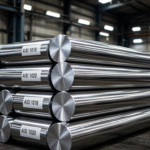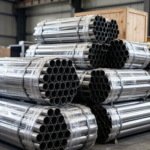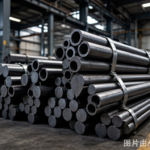
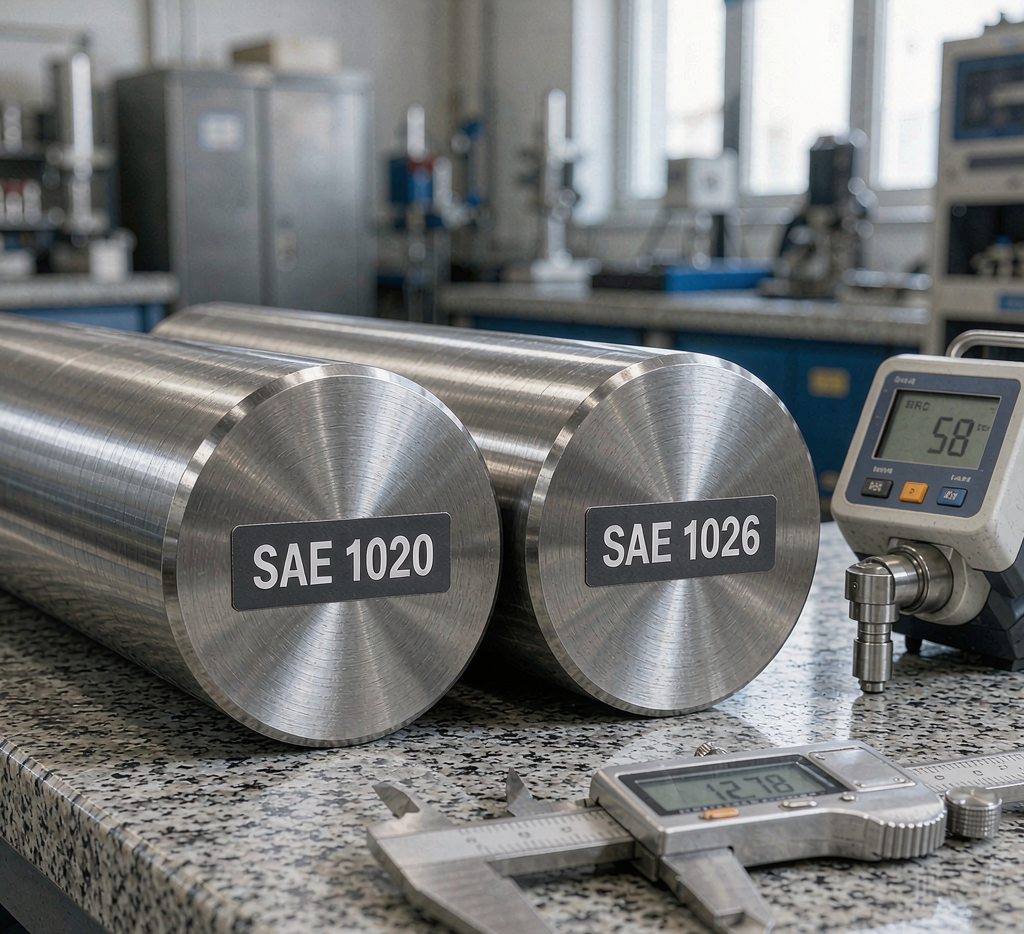
SAE 1020 and SAE 1026 are two of the most commonly specified low-carbon steel grades for cold-drawn bars, shafts, and precision mechanical components. While both grades fall within the 10xx series and share excellent weldability, the 0.06% difference in carbon content creates meaningful distinctions in strength, machinability, and cold-forming behavior. This comparison helps engineers and procurement teams select the right grade for cold-drawn bars, structural tubing, and machined parts.
1. Chemical Composition and Carbon Influence
The primary difference between SAE 1020 and SAE 1026 is carbon content. SAE 1026 contains approximately 0.22-0.28% carbon versus 0.18-0.23% for SAE 1020. This modest increase raises tensile strength and hardenability without significantly compromising ductility or weldability.
| Element | SAE 1020 (max/typical %) | SAE 1026 (max/typical %) |
|---|---|---|
| C | 0.18-0.23 | 0.22-0.28 |
| Mn | 0.30-0.60 | 0.60-0.90 |
| P | 0.040 | 0.040 |
| S | 0.050 | 0.050 |
| Si | 0.10-0.30 | 0.10-0.30 |
Note that SAE 1026 also carries higher manganese (0.60-0.90% vs 0.30-0.60%), which further boosts strength and improves response to cold working. Both grades are readily available as hot-rolled bars, cold-drawn bars, and seamless mechanical tubing.
2. Mechanical Properties: Hot-Rolled vs Cold-Drawn
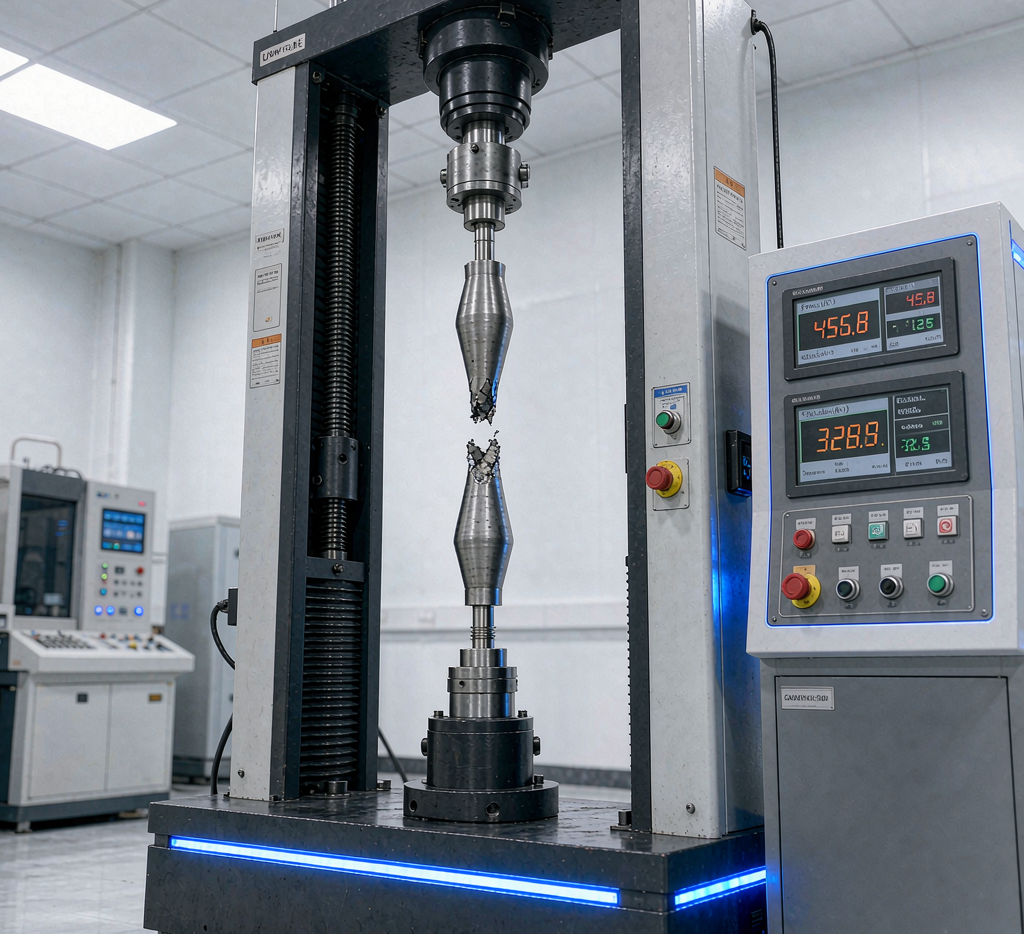
Cold drawing raises the strength of both grades through work hardening, but SAE 1026 starts from a higher baseline and achieves greater ultimate strength after drawing. This makes 1026 preferable for applications where higher load capacity is needed without upgrading to medium-carbon grades like 1045.
| Property | SAE 1020 HR | SAE 1020 CD | SAE 1026 HR | SAE 1026 CD |
|---|---|---|---|---|
| Tensile Strength (MPa) | 420 | 490-580 | 470 | 550-640 |
| Yield Strength (MPa) | 245 | 390-490 | 275 | 450-540 |
| Elongation (%) | 25 | 15 | 22 | 12 |
| Hardness (HB) | 120 | 150-180 | 135 | 170-200 |
Cold-drawn SAE 1026 typically achieves 10-15% higher tensile strength than cold-drawn SAE 1020. The trade-off is slightly lower elongation, which matters for applications involving bending or flaring.
3. Cold Drawability and Forming Behavior
Both grades are excellent candidates for cold drawing, but SAE 1020 offers marginally better ductility for severe deformation. If your application requires deep drawing, flaring, or swaging, SAE 1020 is the safer choice. For applications where the part is primarily machined or used as-drawn with minimal secondary forming, SAE 1026 provides better strength-to-weight performance.
Huaxia-Steel supplies cold-drawn bars in both grades with surface finishes ranging from standard commercial bright to precision ground (h6 tolerance). Typical cold-drawn reductions are 15-25%, with custom reductions available for specific strength targets.
4. Machinability and Surface Finish
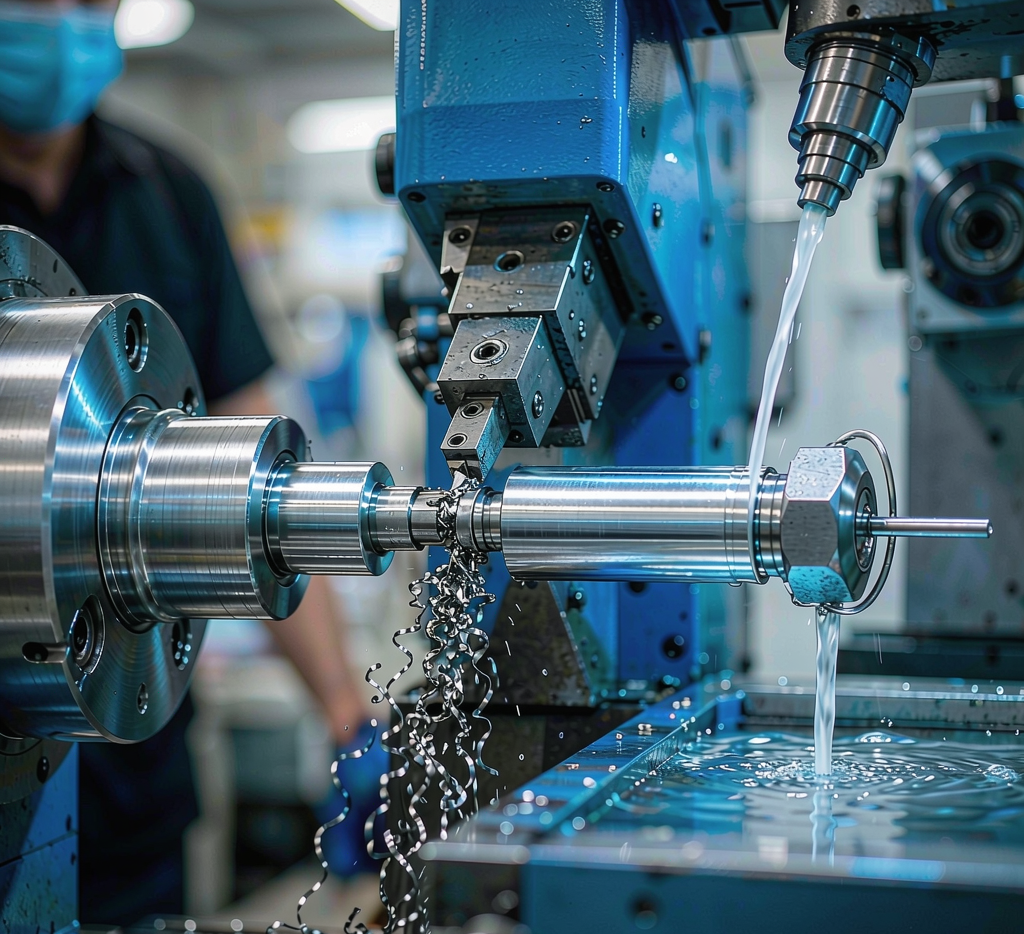
In the annealed or normalized condition, both grades machine freely with good chip breaking and acceptable tool life. SAE 1026 produces slightly more uniform chips due to its higher manganese content, which can improve CNC machining consistency.
For high-speed machining applications, leaded variants (10L20 and 10L26) are available with 0.15-0.35% lead added to improve chip fragmentation and reduce tool wear. Huaxia-Steel stocks both standard and leaded grades in round, hexagonal, and square bar profiles.
5. Weldability and Post-Weld Processing
Both SAE 1020 and SAE 1026 weld readily by MIG, TIG, and resistance welding methods. Neither grade requires preheat for thin sections (under 25mm). For thicker sections or restrained joints, a modest preheat of 50-100C is recommended to minimize hydrogen cracking risk.
Post-weld heat treatment is generally unnecessary for structural applications. For pressure-containing components, stress relief at 550-650C for 1 hour per 25mm thickness may be specified to reduce residual stresses.
FAQ
Can SAE 1026 be substituted for SAE 1020 in all applications?
Not universally. SAE 1026 is stronger but less ductile. For applications requiring extensive cold forming (flaring, expanding, severe bending), SAE 1020 is preferred. For machined shafts, pins, and structural tubing where strength matters more, SAE 1026 is the better choice.
Which grade is more cost-effective?
SAE 1020 is typically 3-5% less expensive due to higher production volumes and slightly lower alloy content. However, if SAE 1026 allows you to reduce bar diameter or wall thickness while maintaining load capacity, the overall part cost may be lower with 1026.
Is SAE 1026 available in seamless mechanical tubing?
Yes. SAE 1026 is one of the most common grades for DOM (drawn over mandrel) mechanical tubing. It offers excellent strength and tolerances for hydraulic cylinders, automotive components, and agricultural equipment. Huaxia-Steel stocks 1026 DOM tubing from 10mm to 150mm OD.
What is the difference between 1026 DOM and HFS tubing?
DOM tubing is cold-drawn over a mandrel after welding or piercing, producing tight tolerances (H8/H9) and smooth internal surfaces. HFS (hot-finished seamless) tubing is produced at high temperature with looser tolerances and heavier surface scale. DOM is preferred for precision applications; HFS for structural and general-purpose use.
Need SAE 1020 or SAE 1026 cold-drawn bars or mechanical tubing? Contact Huaxia-Steel for mill-direct pricing, custom cutting, and global delivery. We provide full material certification including chemical analysis, mechanical tests, and dimensional reports.