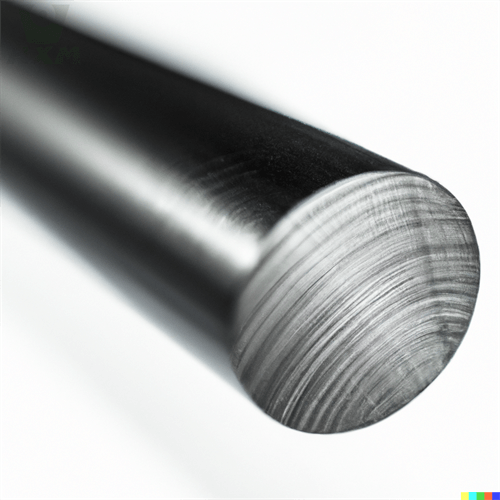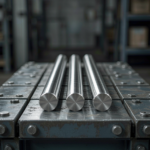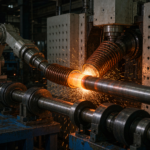
CK45 chrome plated rod — also known as induction hardened chrome plated bar (IHCPB) — is the standard piston rod material for hydraulic and pneumatic cylinders. The base bar is CK45 (EN 1.1191 / C45E) medium carbon steel, through induction hardening gives a deep wear-resistant case, hard chromium plating adds a corrosion- and scratch-resistant mirror surface, and precision grinding/polishing delivers the Ra 0.2 finish that rod seals need to survive millions of cycles. As a factory-direct supplier we stock the full size range and can supply cut-to-length, end-machined rods with MTC and third-party inspection.
Product Overview
| Item | Specification |
|---|---|
| Product name | CK45 induction hardened chrome plated rod |
| Base material | CK45 / C45E / EN 1.1191 (equivalent AISI 1045) |
| Diameter range | 8 mm – 300 mm |
| Standard lengths | 3 m, 4 m, 6 m (up to 8 m on request) |
| Surface hardness | HRC 55 ± 2 (min HRC 50 on request) |
| Hardening depth | 0.8 – 2.5 mm (per diameter, see table below) |
| Chrome layer | 20 – 25 μm hard chrome; 40+ μm for corrosive duty |
| Surface roughness | Ra ≤ 0.2 μm, polished |
| Straightness | ≤ 0.5 mm/m (≤ 0.2 mm/m precision option) |
| Tolerance | ISO f7 / f8 on diameter (h8/h9 optional) |
| Core hardness | Typically 25 – 30 HRC after induction hardening |
Dimensional Range and Hardening Depth
| Diameter (mm) | Typical hardening depth (mm) | Weight (kg/m) |
|---|---|---|
| 8 – 20 | 0.8 – 1.0 | 0.39 – 2.47 |
| 25 – 40 | 1.0 – 1.5 | 3.85 – 9.86 |
| 45 – 80 | 1.5 – 2.0 | 12.5 – 39.5 |
| 90 – 150 | 2.0 – 2.5 | 49.9 – 138.7 |
| 180 – 300 | 2.0 – 2.5 | 199.8 – 555.6 |
Available Grades and Equivalents
While CK45 is the workhorse grade, we also supply the same chrome plated product in alternative base materials for specific duty:
- CK45 / C45E (EN 1.1191): standard hydraulic/pneumatic piston rods; balanced cost and performance.
- 42CrMo4 (EN 1.7225 / AISI 4140): for higher core strength rods in large-bore heavy cylinders where bending loads dominate.
- ST52 / E355 (EN 1.0576): economical option for low-pressure pneumatic cylinders.
- 304/316 stainless base + chrome: food, marine and chemical environments (chrome over stainless for combined corrosion and wear duty).
Manufacturing Standards and Process
Our production route for chrome plated rod follows recognized industry practice:
- Base bar: peeled or centerless-ground CK45 round bar to EN 10278 / DIN 2391 tolerance, chemical composition verified per EN 10083-2.
- Induction hardening: continuous-line induction heating and spray quench, surface HRC 55 ± 2, depth per table above; bar straightened after heat treatment.
- Centerless grinding: removes distortion, achieves diameter tolerance f7/f8.
- Hard chrome plating: electrolytic hard chromium to ISO 6608 / ISO 7681 practice, 20-25 μm standard, micro-cracked structure for oil retention.
- Superfinishing/polishing: Ra ≤ 0.2 μm with bearing-ratio-friendly topography for seal life.
- 100% final inspection: hardness traverse, chrome thickness (eddy current gauge), straightness, roughness and visual under coated condition.
Applications
CK45 chrome plated rod serves wherever a rod slides through a seal under load:
- Hydraulic cylinders for construction machinery, agriculture, material handling and refuse vehicles.
- Pneumatic cylinders and automation actuators.
- Injection molding machine tie bars and ejector rods.
- Press and stamping equipment rams.
- Telescopic cylinders for dump trucks and cranes.
Quality Assurance
Every order ships with an EN 10204 3.1 mill test certificate covering base chemistry, and our own inspection report covering: surface hardness (HRC traverse across the case), effective hardening depth (sample microsection), chrome thickness and adhesion (bend/burnish test), roughness, straightness and dimensional tolerance. Adhesion failures — chrome flaking after seal cycling — are the industry’s most common chrome-rod complaint; our plating line uses pre-grind activation and post-plate hydrogen bake-out specifically to prevent it. Third-party inspection by SGS, BV or TUV can be witnessed before shipment on request.
Packaging and Shipping
Chrome surfaces damage easily in transit, so packaging is part of the product: each rod is wrapped in VCI paper plus foam sleeves, then packed in rigid wooden crates or bundles with plastic end caps; rods above 6 m ship in 40 ft flat-rack or open-top containers with full-length supports. Bundle count, diameter, length and heat number are stenciled on each crate. We export routinely to Southeast Asia, the Middle East, South America and Europe with FOB, CFR and CIF terms.
Choosing Between Options: A Quick Selection Table
| Your situation | Recommended option | Reason |
|---|---|---|
| Standard hydraulic cylinder, ≤ 25 MPa | CK45 + 20 μm chrome, f8 | Industry default; seal-friendly finish |
| Outdoor / marine exposure | CK45 + 40 μm chrome or nickel-chrome duplex | Corrosion life 3-5× standard chrome |
| Large bore press cylinder, side loads | 42CrMo4 base + 25 μm chrome | Core strength resists bending |
| Pneumatic actuator, low pressure | ST52 base + 15-20 μm chrome | Cost-optimized; loads are light |
| Food / chemical washdown | 316 base + chrome | Base metal corrosion resistance |
Installation and Handling Notes
Chrome plated rods fail more often from handling than from manufacture. Follow these rules to protect the investment: never slide rods across each other or on steel rails — chrome scratches become seal killers and corrosion seeds; support long rods at 1.5 m intervals when horizontal to avoid permanent bows; remove protective wrapping only at assembly, and keep the oil film on the surface (it is corrosion protection, not contamination); when threading rod ends in your shop, mask the adjacent chrome with tape and deburr thoroughly — a burr dragged through a rod seal destroys it in one stroke. For stored inventory, rotate stock and re-inspect wrapped rods every 6 months; VCI protection is effective but not eternal in humid warehouses.
Frequently Asked Questions
What is the difference between chrome plated rod and hard chrome plated hollow bar?
Hollow chrome bar (ID honed, OD chrome plated) is used for cylinder barrels where the piston rides inside; solid chrome rod is the matching piston rod. Both are made from the same induction-hardened base — order them together for matched hardness and finish.
Can you supply cut-to-length with threaded ends?
Yes. We cut to ±0.5 mm, machine male/female threads, wrench flats, chamfers and shoulders per your drawing, and re-protect the chrome at machined zones before packing.
What if my cylinder runs in a dusty environment?
Specify a wiper-seal arrangement and consider the 40 μm chrome option — dust erosion on standard 20 μm layers eventually thins the coating at the seal band, shortening rod life.
How does your rod survive salt-water spray environments?
Standard 20 μm chrome is a wear coating, not a marine coating — its micro-cracked structure is deliberately porous for oil retention. For salt exposure specify the 40 μm duplex option (nickel under-layer plus chrome) or a sealed chrome post-treatment; salt-spray results to 96-240 hours per ASTM B117 are available with test reports. Budget roughly 15-20% price premium for the duplex system — far cheaper than replacing rods in a marine dredge.
Why Buy From Us
- Factory-direct pricing from our partnered induction-hardening and plating lines — no trading company margin.
- Full size range 8-300 mm from stock; cut-to-length and end-machining (threading, chamfering, shoulder turning) available.
- Consistent HRC 55 ± 2 case with verified depth — every heat, every order.
- MTC + inspection report with every shipment; SGS/BV witness inspection welcomed.
- Flexible MOQ from 1 ton for standard sizes; 3-5 week lead time for production lots.
How CK45 Chrome Plated Rod Is Verified — Test by Test
Because chrome plated rod quality is invisible to the eye (a shiny rod can still have a soft case or thin chrome), the verification regime matters. Our standard test plan per order:
| Test | Method | Frequency | Acceptance |
|---|---|---|---|
| Surface hardness | HRC (Rockwell C) traverse | Every heat, 2 bars | 55 ± 2 HRC |
| Hardening depth | Microsection + hardness traverse | Per production batch | Per diameter table |
| Chrome thickness | Eddy current gauge / microsection | Every bar sampled | 20–25 μm (spec) |
| Chrome adhesion | Bend + burnish per ISO 1456 practice | Per batch | No flaking or blistering |
| Roughness | Profilometer, Ra | Sampling per shift | ≤ 0.2 μm |
| Straightness | Roller table + dial gauge | 100% | ≤ 0.5 mm/m |
| Diameter tolerance | Micrometer, 3 positions | 100% | f7/f8 |
Two tests deserve emphasis because cheap supply fails exactly there. Hardening depth: a rod hardened to only 0.3 mm will polish shiny and pass inspection, then develop a worn band at the seal within months as the soft core underneath deforms. Chrome adhesion: plating over contamination or skipping the hydrogen bake-out produces a beautiful rod whose chrome flakes in circular patches after a few thousand cycles — always ask how adhesion is tested, and reject any supplier who answers “visual”.
Cylinder Assembly Compatibility: Seals, Pressure and Rod Speeds
Chrome plated rod performance depends on the whole sealing system, so it helps to match rod specification to the cylinder’s duty:
| Seal family | Max rod speed | Pressure class | Rod surface requirement |
|---|---|---|---|
| Polyurethane U-cup | 0.5 m/s | ≤ 25 MPa | Ra ≤ 0.3 μm |
| NBR/Buna compact | 0.5 m/s | ≤ 16 MPa | Ra ≤ 0.4 μm |
| PTFE step seal + O-ring | 1.0 m/s | ≤ 40 MPa | Ra ≤ 0.2 μm |
| Full PTFE servo systems | 1.5 m/s | ≤ 40 MPa | Ra 0.1–0.2 μm, bearing-ratio controlled |
Our polished finish is compatible with all families above; for servo-grade systems specify the precision straightness option (0.2 mm/m) since seal leakage at high pressure amplifies any rod runout. When replacing rods in third-party cylinders, send the old rod’s diameter and the cylinder bore — we will confirm tolerance class and seal compatibility before quoting, which prevents the classic mismatch of an f7 rod specified into a cylinder machined for h8.
Cut-to-Length and End Machining Options
Most cylinder builders prefer rods delivered ready for assembly. Our machining cell supports: cutting to length ±0.5 mm on abrasive or saw equipment (no heat-affected zone into the chrome), external threading M10-M120 or per drawing, internal threading on hollow rods, wrench flats and spanner notches, chamfer radii for seal insertion, and shoulder steps for welded assemblies. Machined zones are degreased and masked, and each finished rod is re-wrapped before packing. Provide a drawing or a sketch with dimensions — our engineering team returns a machining confirmation sheet before production, so what arrives matches what your assembly line expects.
Send us your diameter, length and quantity for a firm CK45 chrome plated rod quotation within 24 hours — factory direct, with MTC, inspection report and global shipping included.