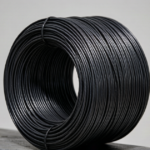
PC strand (prestressed concrete steel strand) is the high-strength seven-wire strand that gives prestressed concrete its carrying power. Manufactured from high-carbon steel wire drawn and stranded together, then stress-relieved or low-relaxation treated, PC strand delivers breaking loads from 80 kN to over 380 kN at 1,570–1,960 MPa tensile strength — several times stronger than rebar of the same diameter. Huaxia-Steel exports 7-wire PC strand to ASTM A416, GB/T 5224, BS 5896 and EN 10138-3 for bridges, buildings, ground anchors and post-tensioning systems worldwide.
Product Overview
A standard 7-wire strand consists of six helical wires wound around a slightly larger straight king wire. The lay length is 12–16 times the strand diameter, giving the strand its characteristic flexible-but-strong geometry. After stranding, the product is stress-relieved (normal relaxation) or stabilization-treated (low relaxation, class 2) to minimize permanent elongation under sustained load — the property that matters most in post-tensioned structures. Plain and indented (deformed) surfaces are both available; indented strand improves bond with concrete in certain systems.
Specifications and Dimensions
| Nominal dia. | Nominal area | Tensile strength | Min breaking load (Grade 270) |
|---|---|---|---|
| 9.53 mm (3/8″) | 54.8 mm² | 1,860 MPa | 102.3 kN (23.0 klb) |
| 12.70 mm (1/2″) | 98.7 mm² | 1,860 MPa | 183.7 kN (41.3 klb) |
| 15.24 mm (0.6″) | 140.0 mm² | 1,860 MPa | 260.7 kN (58.6 klb) |
| 17.78 mm (0.7″) | 191.0 mm² | 1,860 MPa | 353.0 kN approx. |
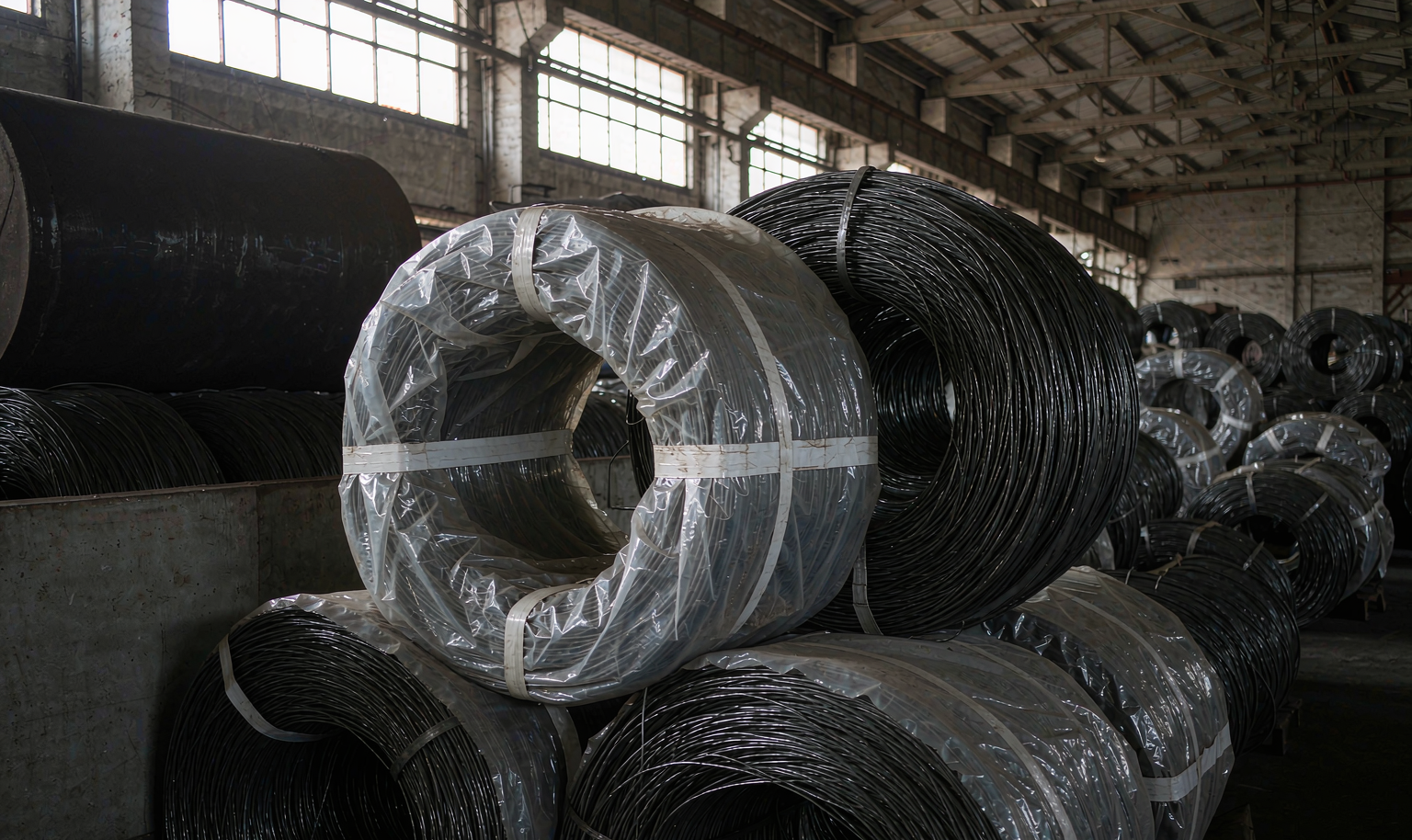
ASTM A416 recognizes Grade 250 (1,720 MPa) and Grade 270 (1,860 MPa); European practice uses 1,570–1,860 MPa classes per EN 10138-3 with 0.6″ 1,860 MPa the export workhorse. Coil weights run 2.5–4 tonnes, wound on collapsible reels or in carrier-less coils wrapped for sea transport.
Standards and Mechanical Requirements
| Standard | Coverage | Key tests |
|---|---|---|
| ASTM A416/A416M | Grades 250/270, low-relaxation | Breaking load, elongation ≥ 3.5%, relaxation ≤ 2.5% at 1,000 h |
| GB/T 5224-2014 | 1×7 structure, 1,570–1,960 MPa | Tensile, elongation ≥ 3.5%, relaxation, bending |
| BS 5896 / EN 10138-3 | European classes | Fm, Fp0.1, E-modulus 195 ± 10 GPa, relaxation class 1/2 |
- Raw material: 82B high-carbon steel rod (SWRH 82A/B) with phosphorus-controlled chemistry, descaled, drawn through 6–8 dies to final wire size, then stranded, heat-treated in a continuous stress-relieving furnace, spooled, and tested per heat. Anchor grades require straightness within 15 mm per 2 m and no free oil film that would impair grout bond.
Applications
PC strand is the tendons inside post-tensioned bridge girders, building slabs and transfer beams; the reinforcement inside prestressed concrete pipes (PCCP), sleepers and poles; and the tension element in ground and rock anchors, soil nails, LNG tank prestressing and cable-stayed structures. In export projects it is specified together with anchorage systems (wedge and barrel), ducting and grout — we can coordinate strand and anchorage supply to matched geometry.
Quality Assurance
- Every coil tested: breaking force, 0.1% proof force, elongation at max load ≥ 3.5%, and relaxation class.
- EN 10204 3.1 certificate per coil with actual test values, heat number and lay direction (left-hand standard).
- Low-relaxation certification: ≤ 2.5% at 1,000 h initial load 70% Fm (class 2).
- Optional third-party witness testing (SGS/BV) and full-body NDT for anchor-grade strand.
- Traceability from billet heat to coil number maintained in mill records for 5+ years.
Packing and Shipping
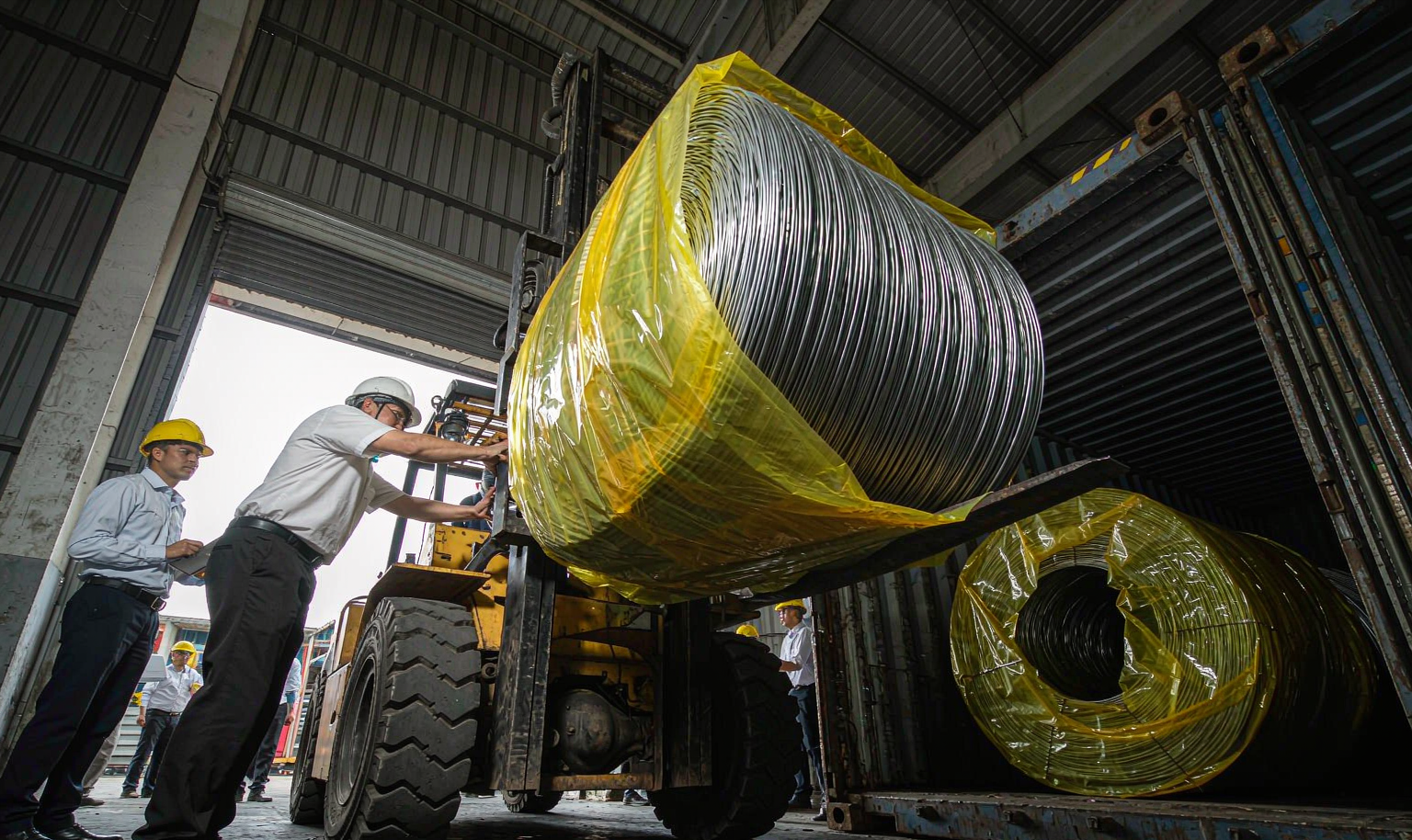
Coils are strapped with steel bands, wrapped in woven cloth plus moisture-barrier film, and palletized or cradled for container loading. A 20 ft container carries roughly 20–24 tonnes depending on coil size. Labeling includes diameter, grade, standard, relaxation class, coil weight and heat number. Lead time is typically 15–25 days for standard 15.24 mm Grade 270 low-relaxation production runs of 20–200 tonnes; odd diameters and indented surfaces may add one week.
Normal Relaxation vs Low Relaxation
Relaxation — the loss of tension in a stretched strand held at constant length — is the property that separates commodity strand from certified post-tensioning strand. Normal (stress-relieved) strand may lose up to 8% of initial stress at 1,000 hours; low-relaxation (stabilized) strand is limited to 2.5% at 70% of ultimate (class 2, EN) or about 2.5–3.5% per ASTM A416. Every bridge and building tendon specification today defaults to low relaxation; normal relaxation survives mainly in non-structural precast applications.
| Property | Normal relaxation | Low relaxation (class 2) |
|---|---|---|
| Relaxation at 1,000 h (70% Fm) | ≤ 8% | ≤ 2.5% |
| Elongation at max load | ≥ 3.5% | ≥ 3.5% |
| Modulus of elasticity | 195 ± 10 GPa | 195 ± 10 GPa |
| Typical price premium | Baseline | +3–6% |
Surface Types: Plain, Indented and Epoxy-Coated
Plain strand is the universal default. Indented strand carries surface dimples on the outer wires that improve mechanical bond in precast beds and in applications where grout anchorage alone must carry load. Epoxy-coated strand (with or without surface grit) serves corrosive environments — salt-storage facilities, marine structures and cable stays — at a substantial premium. For ground anchors in aggressive ground, plain strand inside corrugated duct with cement grout remains the most common protective system, with the duct, not the strand coating, doing the corrosion protection work.
Handling and Installation Notes
- Pay off coils with a rotating turntable or spider reel — never loop strand off a stationary coil, which kinks the outer wires and permanently reduces capacity.
- Cut with abrasive wheels or shears; flame cutting damages the surrounding wires’ temper.
- Keep strand dry and off the ground; surface rust that rubs off by hand is acceptable, pitting is not — reject pitted coils at inspection.
- Stress and elongation records during stressing must reconcile within 5% of calculated elongation; investigate discrepancies before lock-off.
Frequently Asked Questions
What does “Grade 270” mean on a PC strand certificate?
It is the guaranteed minimum ultimate tensile strength in ksi: 270 ksi equals about 1,860 MPa. A 15.24 mm Grade 270 strand therefore breaks at 260.7 kN minimum — the most quoted number in post-tensioning procurement.
Can one container mix different diameters?
Yes, coils of different sizes are loaded to a common weight target, provided each coil keeps its own label and certificate line. Confirm the anchorage wedges match each diameter — mixing wedge sizes is the classic site error.
How is strand protected against rust during ocean freight?
Mill-applied light oil film, sealed moisture-barrier wrap and desiccant in the packing. For long routes, VCI paper or full container fumigation-grade wrapping is offered — specify it when destination humidity is high.
PC Strand vs PC Wire vs PC Bar
| Form | Diameter range | Typical strength | Typical use |
|---|---|---|---|
| 7-wire strand | 9.3–21.8 mm | 1,720–1,960 MPa | Post-tensioning, bridges, precast beds |
| PC wire (smooth/indented) | 4–10 mm | 1,570–1,860 MPa | Pretensioned sleepers, poles, pipes |
| PC bar (threaded) | 15–75 mm | 1,030–1,230 MPa | Ground anchors, tie rods, temporary works |
Strand dominates where long tendons must be pushed or pulled through duct and stressed in one operation; wire suits short pretensioned elements; threaded bar wins where the tendon must be coupled, re-stressed or removed later.
Ordering Checklist for Importers
- Nominal diameter, grade and relaxation class (default 15.24 mm Grade 270 low relaxation).
- Standard (ASTM A416, GB/T 5224, EN 10138-3 or BS 5896) and any national approvals.
- Surface type: plain, indented or epoxy-coated.
- Coil weight, minimum coil length and packing (reel vs carrier-less coil).
- Testing scope: relaxation test report, elongation, E-modulus and 0.1% proof values.
- Third-party witness requirement and certificate language.
- Monthly volume and delivery schedule for rolling orders.
Shipping strand is weight-heavy and moisture-sensitive: a 20 ft container of 15.24 mm low-relaxation strand carries about 22 tonnes and needs dry, closed packing. Book early in monsoon seasons, and consider desiccant plus barrier film for routes crossing the equator.
Relaxation Testing Explained
The relaxation test is the slowest and most expensive part of PC strand qualification, which is why certificates matter more than re-testing at destination. A strand sample is loaded to 70% of its actual breaking force (80% in some specifications) at 20 ± 2 °C and held for 1,000 hours while the load loss is recorded continuously. The loss curve is extrapolated to 1,000 hours by ISO 15630-3 methods; a result at or below 2.5% qualifies as low relaxation. Class 1 (normal relaxation, EN) permits up to 8%. Every batch certificate should state the actual measured value, the test laboratory and the sample identification, because a 1,000-hour test cannot be repeated quickly if a shipment is disputed.
Project Planning and Lead Times
For a typical bridge or building post-tensioning package, plan backwards from the stressing date: production 15–25 days, inland transport and port handling 3–5 days, ocean transit 20–35 days to Europe or the Americas, customs and inland delivery 5–10 days — a total of roughly 60–75 days. Because strand is a high-value, weight-dense cargo stored on reels, delays at destination create demurrage quickly; booking a fixed sailing and confirming coil weights at the proforma stage prevents the usual last-minute surprise where actual weight exceeds booking weight by several tonnes.
Rolling monthly orders are best handled with a 90-day schedule shared in advance: the mill reserves drawing capacity and rod allocation, you get stable pricing, and neither side pays the premium for rush production.
Why Source PC Strand Factory Direct
Strand is a certified, safety-critical product where the paper trail matters as much as the steel. Sourcing through Huaxia-Steel gives you the mill’s own relaxation and tensile reports rather than a re-typed trader certificate, direct access to the production slot for rolling monthly volumes, and the ability to have a third-party inspector witness sampling at the mill. For post-tensioning contractors, that traceability is what lets a project close out its quality file without re-testing; for distributors, it is what protects them if an engineer asks for the original 1,000-hour relaxation curve.
We also coordinate anchorage and duct in the same container, so wedges, barrels and corrugated duct arrive with the strand they were dimensioned for — eliminating the most common site compatibility problem in post-tensioning supply.
Request a PC Strand Quote
Tell us your diameter, grade (250/270), relaxation class and monthly volume — Huaxia-Steel responds within 24 hours with mill-direct pricing, test certificates from stock and shipping schedules. Matching anchorage, duct and grout accessories can be quoted together for one-source procurement.