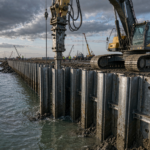
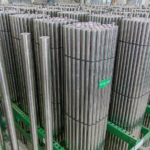
Steel pipe piles are large-diameter steel tubes driven or drilled into the ground to transfer structural loads to competent soil or rock, and to form retaining walls and cofferdams. Supplied as welded (ERW, SSAW/spiral, LSAW) or seamless tubes to ASTM A252, API 5L and EN standards, pipe piles are the default choice for deep foundations in ports, bridges, high-rise and offshore projects where high axial capacity per installed meter and fast driving rates matter. As a factory-direct supplier we produce pipe piles from 219 mm to 3,000 mm diameter with wall thicknesses up to 30 mm, cut to length, beveled and fitted with driving shoes when required.
Product Overview
| Item | Specification |
|---|---|
| Product name | Carbon steel pipe pile / pipe piling (open-ended or closed-ended) |
| Manufacturing | ERW (219–660 mm), SSAW spiral (219–3,000 mm), LSAW (406–1,422 mm), seamless (219–720 mm) |
| Standards | ASTM A252 Gr 1/2/3; API 5L PSL1/PSL2; EN 10219 / EN 10216; GB/T 13793 |
| Diameter range | 219 – 3,000 mm OD |
| Wall thickness | 6 – 30 mm (typical 8–16 mm) |
| Lengths | 3 – 15 m single lengths; spliced to 60 m+ by welding |
| Steel grades | A252 Gr 2 (yield 275 MPa), Gr 3 (310 MPa); API 5L X42–X65; S355JR/J2 |
| End preparation | Plain end, beveled for butt weld (30°+30°), driving points/shoes on request |
| Surface | Bare, galvanized, or with anti-corrosion coating (3LPE, FBE, epoxy coal tar) |
Available Grades (ASTM A252)
| Grade | Min yield strength | Min tensile strength | Typical application |
|---|---|---|---|
| A252 Gr 1 | 205 MPa (30 ksi) | 331 MPa (48 ksi) | Light friction piles, casing |
| A252 Gr 2 | 275 MPa (40 ksi) | 414 MPa (60 ksi) | Standard foundation piling — the default grade |
| A252 Gr 3 | 310 MPa (45 ksi) | 455 MPa (66 ksi) | Heavy loads, hard driving, marine structures |
| API 5L X52–X65 | 359–448 MPa | 455–531 MPa | Where line pipe surplus or dual certification is economic |
| S355J2H (EN 10219) | 355 MPa | 470–630 MPa | European projects, −20 °C impact requirement |
Size and Weight Reference (selected common sizes)
| OD × wall (mm) | Weight (kg/m) | Common use |
|---|---|---|
| 323.9 × 8 | 62.3 | Building foundations, friction piles |
| 406.4 × 10 | 97.8 | Bridge piers |
| 610 × 12 | 177.0 | Port fenders, retaining |
| 820 × 14 | 279.4 | Cofferdams |
| 1,220 × 16 | 474.3 | Marine berthing structures |
| 2,000 × 20 | 975.5 | Offshore jackets, large caissons |
Manufacturing Standards
Pipe piles are structural products — the governing standards focus on strength and weld integrity rather than pressure tightness. Our production and test regime: raw plate/coil with heat-number traceability; hydrostatic or non-destructive verification of weld seams per the manufacturing standard; dimensional control on OD, ovality, wall and straightness (typically ≤ 0.1% of length deviation allowance for driving); beveling to ASME B16.25-type geometry for field splicing; and weldability verification of the base chemistry (CEV) for the contractor’s splicing procedure. Every order ships with EN 10204 3.1 MTCs per heat. Optional third-party inspection (SGS/BV/CCIC) witnessed tensile, weld UT and dimensional survey before shipment.
Applications
- Deep foundation piles for buildings, bridges and industrial plants (open- or closed-ended driven).
- Marine works: quay walls, jetties, dolphins, breakwaters and fender piles.
- Cofferdams and temporary retaining structures.
- Cased bored piles: pipe as permanent casing for drilled shafts.
- Offshore platform legs and suction anchors.
- Solar farm and transmission tower micro-piling in soft soils.
Quality Assurance
Pipe pile failures in the field are almost always weld-seam or dimensional issues, so our QA focuses there: 100% weld seam UT (SSAW/LSAW) or Eddy/UT per standard; spiral weld stagger control so no two girths align; straightness measurement on every length; bevel profile gauging for splice welds; and optional full-length hydrostatic test where the specification calls for it. Coated pipes receive holiday (pinhole) testing per NACE SP0188 and coating adhesion checks. Documentation package: MTCs, weld procedure records, dimensional survey report and marking plan, matched to heat numbers stenciled on each pipe.
Packaging and Shipping
Pipe piles ship loose in bulk or in bundles (smaller diameters) with steel slings points protected; bevels are capped or taped to prevent corrosion of the weld face. Large-diameter pipe ships on flat racks or break-bulk with certified lifting plugs. We mark each length with OD, wall, grade, standard, heat number and length in paint per your marking plan. Export experience covers Southeast Asia, Middle East, Africa and South America; terms FOB/CFR/CIF, and we can consolidate piles with shoes, splicing bands and driving accessories into one shipment.
Open-Ended vs Closed-Ended Piles: Selection Notes
An open-ended pipe pile drives through dense soil with less displacement and can be inspected and concrete-filled after driving; a closed-ended pile (fitted with a flat plate or conical driving shoe) develops higher end-bearing resistance and better lateral performance in soft soils. Practical selection: in granular soils with boulders, open-ended piles with reinforced shoes drive more predictably; in soft marine clays, closed-ended piles mobilize shaft friction faster and shorten driving time. For friction-dominant designs, the pile capacity comes from skin friction along the embedded length — meaning longer, thinner walls often beat shorter, heavier sections on cost per ton of capacity. Share your soil report and design loads; we recommend the wall thickness and steel grade that minimize installed cost, not just material cost.
Splicing and Driving Accessories
Long piles are spliced by full-penetration butt welds between beveled ends, following AWS D1.1 or equivalent welding procedures. We supply matched accessories with the pile order: prefabricated driving shoes (cast or fabricated) welded at the mill, internal splicing rings for alignment during field welding, and lifting points. Delivering piles with shoes already attached removes a field welding operation from your critical path — on marine projects where weather windows are tight, this frequently saves more schedule than any price negotiation.
Frequently Asked Questions
What is the lead time for a typical pipe pile order?
Stock-size SSAW in common diameters: 2-3 weeks. Production LSAW or non-standard diameters: 4-7 weeks depending on plate availability. Coated orders add 1-2 weeks for 3LPE or FBE application.
Can you match my API 5L surplus to ASTM A252 requirements?
Often yes — surplus line pipe with X52 or higher grade exceeds A252 Gr 3 mechanical requirements, and dual certification on the MTC makes the substitution clean. We verify chemistry, weld seam NDT records and dimensional suitability before proposing the match.
How is pile straightness checked before shipment?
Each length is rolled and measured for bow; our standard is deviation ≤ 0.1% of length (≤ 15 mm over 15 m), with tighter values available for machine-slung driving where the rig guides the pile. Straightness records are included in the inspection report.
Why Buy From Us
- One source for ERW, SSAW and LSAW piling from 219 to 3,000 mm — matched to your driving rig, not just the cheapest process.
- A252 Gr 2/3 and API 5L dual-certified options for project flexibility.
- Cut-to-length, beveled, shoe-welded and coated supply ready for the piling gate.
- Third-party inspection welcomed; complete MTC and traceability package.
- Factory-direct pricing with large-diameter capability few mills offer.
Process Selection: ERW vs SSAW vs LSAW vs Seamless for Piling
Each manufacturing route has a diameter/size sweet spot, and matching the process to the pile duty saves real money:
| Process | Size range | Strengths for piling | Watch-outs |
|---|---|---|---|
| ERW | 219–660 mm | Tightest dimensional tolerance, lowest cost in small diameters | Wall limited ~16 mm; seam quality depends on mill |
| SSAW (spiral) | 219–3,000 mm | Any length from coil, big diameters economically | More weld length per meter; stagger girths; straightness needs control |
| LSAW (UOE/JCOE) | 406–1,422 mm | Heavy walls to 30 mm+, best seam NDT record for critical piles | Higher cost; lead time longer |
| Seamless | 219–720 mm | No seam at all; best for hard driving and casings | Highest cost per ton; diameter ceiling |
As a rule of thumb: standard building friction piles below 600 mm go ERW; large marine and cofferdam diameters go SSAW; heavy-wall critical offshore and bridge piles go LSAW; and casing-driven bored piles use seamless where driving stresses are highest. We quote across all four routes from our mill partners, so the recommendation reflects your duty — not whichever process a single mill happens to run.
Corrosion Protection Options for Permanent Piling
Steel below ground corrodes at rates that vary enormously with soil and water chemistry — 0.02 mm/year in undisturbed clay versus 0.1+ mm/year in marine splash zones — so protection is a design decision, not an afterthought:
- Corrosion allowance: the simplest method — add 2-4 mm to design wall thickness for a 50-year life in typical soils. Standard practice for bare A252 piles on land.
- Galvanizing: practical up to ~6 m lengths and 12 mm wall (zinc kettle limits); suits solar micro-piles and temporary works. Hot-dip per ASTM A123.
- Coatings: 3LPE or FBE on the exposed/splash zone, coal-tar-free epoxy alternatives for environmental compliance; holiday-tested before shipment.
- Cathodic protection: for marine structures, sacrificial anodes or impressed current designed per NACE — our piles can be supplied with anode bracelet attachments pre-welded.
- Concrete filling: for load-bearing piles, concrete fill both adds capacity and protects the internal surface — internal corrosion is rarely the governing issue when piles are filled.
Tell us the design life and environment — soil resistivity data or marine splash-zone exposure — and we will price the protection option that meets it at the lowest installed cost, rather than defaulting to the heaviest wall.
Dimensional Tolerances We Hold
Contractors planning splicing and driving tolerances should know our standard dimensional envelope: OD tolerance ±0.75% (per API 5L style) on welded piling, wall ±10% with minimum-wall guarantee available, ovality ≤ 1% of OD, bevel angle 30° (+5/−0°) with 1.6-2.4 mm root face, and length tolerance +50/−0 mm (cut to plus tolerance so net design length is always achieved). Tighter requirements — such as plus-only wall or API PSL2 full-body NDT — are quotable options for critical projects and should be stated at inquiry so the mill routes the order correctly.
Need pipe piles for your next foundation or marine project? Send diameter, wall, grade and total length — we respond with a firm factory-direct quote, mill certificates and production lead time within 24 hours.