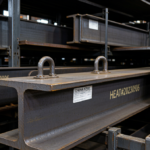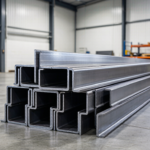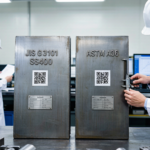
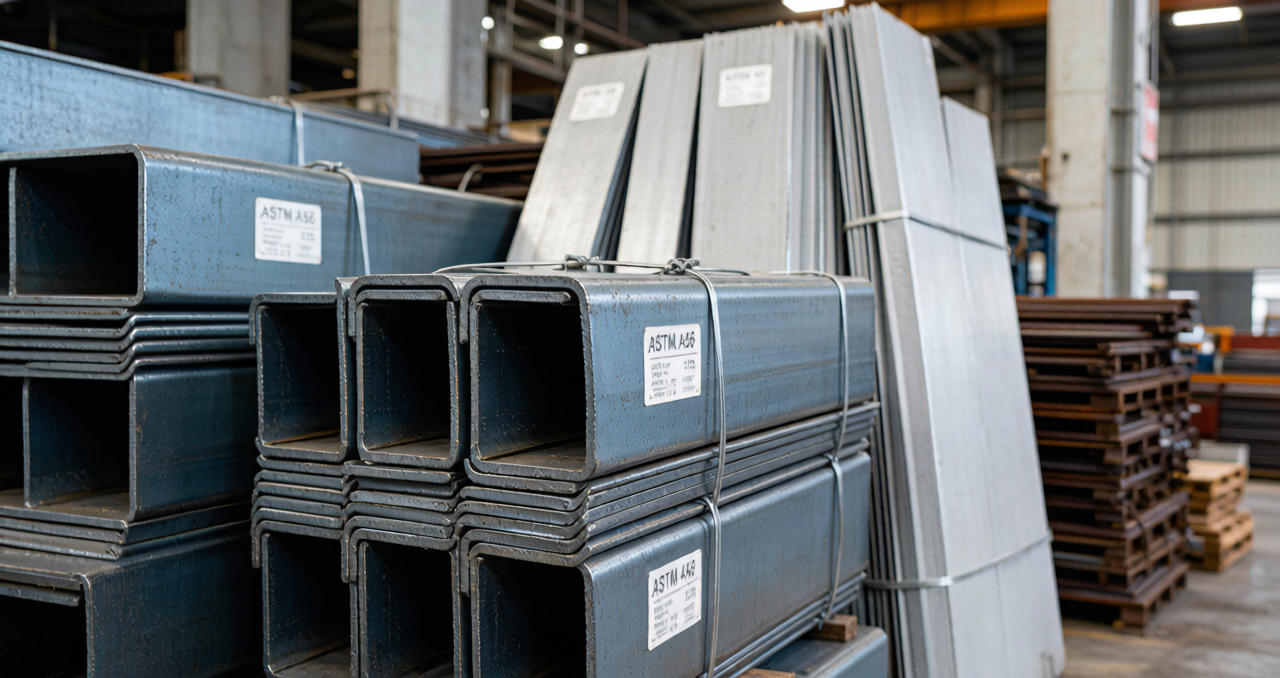
ASTM A36 channel (also called “C-channel”, “U-channel”, or “C-section”) is the asymmetric cousin of the I-beam, used where one face of the section is the primary load-bearing surface and the open side allows for connections, purlins, girts, or stair-stringer applications. It is one of the most specified structural shapes in steel construction because of its lightweight ratio, its handy purlin profile, and its universal compatibility with bolted and welded connections. Huaxia-Steel ships A36 channels mill-direct, with the standards dual-certification and the documentation chain your project needs.
Product Overview
Carbon steel channels are hot-rolled in a continuous mill from billets, producing a C-shape with two parallel flanges on one side and a thinner web on the other. The classic American Standard channel (C-shape) has sloped inner flange faces at approximately 16 2/3 %, while the modern MC-shape (miscellaneous channel) has parallel flanges. A36 is the dominant domestic grade, with A572 Gr.50 and dual-cert A36/A572 as common alternatives for higher strength.
Common applications include:
- Purlins and girts for metal building systems and pre-engineered warehouses.
- Wall studs and headers in light-gauge / hybrid construction.
- Stair stringers and stair treads (with the open side facing outwards).
- Bracing and bracing struts in frame design.
- Equipment frames, machinery supports, conveyor stringers.
- Truck and trailer frame rails.
- Solar mounting structures, torque tubes, and racking components.
- Architectural trim, exposed structural support, lintels, sign frames.
- Bridges — inner stiffeners, diaphragms, framing for utility bridges.
Specifications
| Attribute | Typical Range |
|---|---|
| Section nomenclature | C-shape (American Standard Channel), MC-shape (Miscellaneous Channel) |
| Depth (overall) | 3 in (76 mm) to 15 in (380 mm) standard; up to 18 in by agreement |
| Flange width | 1.410 in (35.8 mm) to 3.520 in (89.4 mm) for standard C-shapes; up to 4 in for MC-shapes |
| Flange thickness (avg) | 0.273 in to 0.784 in for typical sizes |
| Web thickness | 0.170 in to 0.520 in for typical sizes |
| Length | 20-40 ft (6.1-12.2 m) standard; custom cut-to-length on request |
| Steel grade | ASTM A36, ASTM A572 Gr.50, dual-cert A36/A572; Q235, Q345, SS400, S235JR, S275JR on equivalent requests |
| Surface condition | Hot-rolled black (mill scale), shot-blasted, primed, hot-dip galvanized |
| Camber tolerance | 1/8 in x length (in feet) / 10 = max camber in inches, per ASTM A6 |
| Sweep tolerance | 1/8 in x length (in feet) / 5 = max sweep in inches, per ASTM A6 |
| Mill test certificate | ASTM A6 supplementary test report; EN 10204 3.1 or 3.2 on request |
| Bundle packaging | Strapped bundles, lifting lugs, container-fit or break-bulk; 4-corner protection |
Standard Sizes We Stock
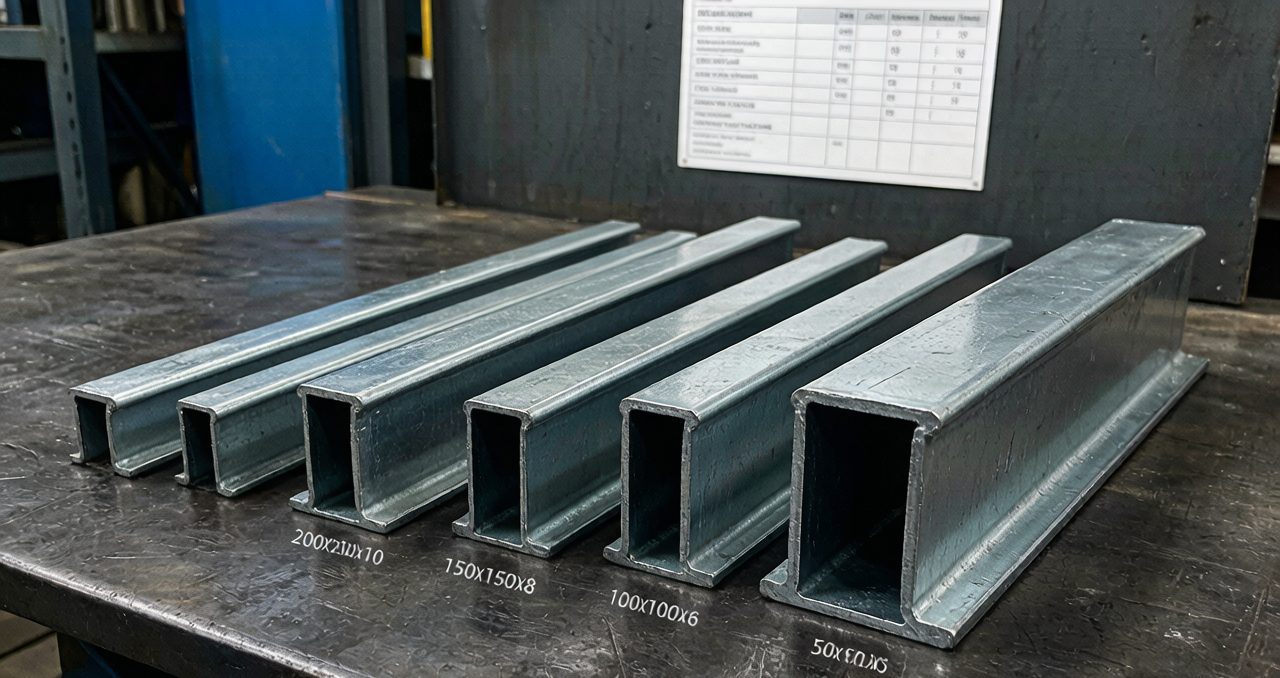
The table captures the most common C-shapes (American Standard Channels) we stock or mill-direct to. MC-shapes and larger sizes run on the same roll mill and can be cross-quoted in a few days.
| Designation | Depth (in) | Flange Width (in) | Web Thickness (in) | Avg Flange Thickness (in) | Weight (lb/ft) | Stock Status |
|---|---|---|---|---|---|---|
| C3 x 4.1 | 3.00 | 1.410 | 0.170 | 0.273 | 4.1 | Mill-direct |
| C3 x 5.0 | 3.00 | 1.498 | 0.258 | 0.273 | 5.0 | Mill-direct |
| C3 x 6.0 | 3.00 | 1.596 | 0.356 | 0.273 | 6.0 | Mill-direct |
| C4 x 5.4 | 4.00 | 1.584 | 0.184 | 0.296 | 5.4 | Mill-direct |
| C4 x 7.25 | 4.00 | 1.721 | 0.321 | 0.296 | 7.25 | Ex-stock |
| C5 x 6.7 | 5.00 | 1.750 | 0.190 | 0.320 | 6.7 | Mill-direct |
| C5 x 9.0 | 5.00 | 1.885 | 0.325 | 0.320 | 9.0 | Ex-stock |
| C6 x 8.2 | 6.00 | 1.920 | 0.200 | 0.343 | 8.2 | Mill-direct |
| C6 x 10.5 | 6.00 | 2.034 | 0.314 | 0.343 | 10.5 | Ex-stock |
| C6 x 13.0 | 6.00 | 2.157 | 0.437 | 0.343 | 13.0 | Ex-stock |
| C7 x 9.8 | 7.00 | 2.090 | 0.210 | 0.366 | 9.8 | Mill-direct |
| C7 x 12.25 | 7.00 | 2.194 | 0.314 | 0.366 | 12.25 | Mill-direct |
| C8 x 11.5 | 8.00 | 2.260 | 0.220 | 0.390 | 11.5 | Ex-stock |
| C8 x 13.75 | 8.00 | 2.343 | 0.303 | 0.390 | 13.75 | Ex-stock |
| C8 x 18.75 | 8.00 | 2.527 | 0.487 | 0.390 | 18.75 | Mill-direct |
| C9 x 13.4 | 9.00 | 2.430 | 0.230 | 0.413 | 13.4 | Mill-direct |
| C9 x 15.0 | 9.00 | 2.485 | 0.285 | 0.413 | 15.0 | Mill-direct |
| C9 x 20.0 | 9.00 | 2.648 | 0.448 | 0.413 | 20.0 | Mill-direct |
| C10 x 15.3 | 10.00 | 2.600 | 0.240 | 0.436 | 15.3 | Mill-direct |
| C10 x 20.0 | 10.00 | 2.739 | 0.379 | 0.436 | 20.0 | Ex-stock |
| C10 x 25.0 | 10.00 | 2.886 | 0.526 | 0.436 | 25.0 | Mill-direct |
| C10 x 30.0 | 10.00 | 3.033 | 0.673 | 0.436 | 30.0 | Mill-direct |
| C12 x 20.7 | 12.00 | 2.942 | 0.282 | 0.501 | 20.7 | Mill-direct |
| C12 x 25.0 | 12.00 | 3.047 | 0.387 | 0.501 | 25.0 | Mill-direct |
| C12 x 30.0 | 12.00 | 3.170 | 0.510 | 0.501 | 30.0 | Mill-direct |
| C15 x 33.9 | 15.00 | 3.400 | 0.400 | 0.650 | 33.9 | Mill-direct |
| C15 x 40.0 | 15.00 | 3.520 | 0.520 | 0.650 | 40.0 | Mill-direct |
| C15 x 50.0 | 15.00 | 3.716 | 0.716 | 0.650 | 50.0 | Mill-direct |
Standards and Grade Equivalence
| Standard | Grade | Yield (MPa) | Tensile (MPa) | Elongation | Typical Use |
|---|---|---|---|---|---|
| ASTM A36 | A36 | 250 | 400-550 | 23 % | General structural channel |
| ASTM A572 | Gr.50 | 345 | 450 min | 21 % | High-strength low-alloy |
| GB/T 706 | Q235 | 235 | 370-500 | 26 % | Chinese equivalent |
| GB/T 706 | Q345 | 345 | 470-630 | 21 % | Chinese high-strength |
| EN 10034 | S235JR (UPE/UPN) | 235 | 360-510 | 26 % | European channel (parallel flanges) |
| EN 10034 | S275JR (UPE/UPN) | 275 | 410-560 | 23 % | European higher-strength |
| JIS G3192 | SS400 | 245 | 400-510 | 21 % | Japanese channel |
Cross-reference note: European UPN channels have sloped inside flanges (similar to U.S. C-shapes), while UPE channels have parallel inside flanges (similar to MC-shapes). Cross-walks between A36 C-shapes and EN UPN/UPE require matching moment-of-inertia and section depth, not just weight-per-foot.
Why A36 for Channel
A36 has been the channel grade of choice for U.S. construction because its 250 MPa minimum yield supports most purlin, girt, and bracing loads in metal building systems, and its low carbon (0.25 % max in heat, 0.29 % max in product) keeps cold-forming and welding safe. The grade also fabricates well in the field with conventional E7018 or ER70S-6 consumables. Higher-strength grades (A572 Gr.50) come into play when the structural engineer is designing for tighter load paths, longer spans, or aggressive weight reduction.
Quality Assurance
Each heat is sampled at the mill; chemistry and tensile tests are reported on the A6 supplementary test report. Each channel carries heat marking consistent with ASTM A6 requirements.
- Chemistry: C, Mn, Si, P, S verified per heat per ASTM A36 chemistry window.
- Tensile: yield (ReH or Rp0.2), ultimate, elongation per ASTM A370 / A6.
- Dimensional: depth, flange width, web thickness, flange thickness (avg and at the toe), length, camber, sweep per ASTM A6.
- Visual: surface defects, flange and web alignment.
- Optional tests: Charpy impact for cold-service applications, ultrasonic examination for special acceptance criteria.
Applications and Engineering Notes
Purlins and girts (pre-engineered metal buildings): C8x11.5 to C12x25 channels form the longitudinal purlins and wall girts that support roof and wall cladding. Spaced at 4 to 6 ft on center depending on snow, wind, and roof load.
Stair stringers: C12x20.7 or C12x25 channels welded back-to-back or single with the open side facing out, forming the angled stringer for industrial staircases and mezzanines.
Equipment frames and machinery supports: C6x10.5 through C10x20.0 channels serve as the rails and cross-members for conveyor frames, machine bases, and equipment skids.
Bracing struts and diagonal bracing: Single channels are commonly used as lateral bracing in frame design, taking axial tension or compression in the plane of the wall or roof.
Trailer and truck frame rails: C8x11.5 to C10x25 channels are typical longitudinal members of trailer frames, tie into the cross members and accept the axle mounting plates.
Solar racking and structural supports: C6 to C12 channels serve as rails in ground-mount solar racking, often hot-dip galvanized after fabrication for outdoor service.
Architectural lintels and exposed structural trim: Channels welded into built-up sections form lintels, sign frames, mullions, and exposed architectural supports.
Bridges — stiffeners and diaphragms: Channels are the most common internal stiffener profile for I-girders, attached to the web to prevent buckling. Also used as cross-frames between I-girders in short-span bridges.
Ordering Information
When requesting a quotation, please specify:
- Section designation (C-shape or MC-shape, with full designation, e.g., “C8x11.5” or “MC10x8.4”).
- Length in feet or meters.
- Steel grade (ASTM A36 / A572 Gr.50 / dual-certified).
- Surface condition: hot-rolled black, shot-blasted, primed, hot-dip galvanized.
- End preparation: standard mill end, cropped square, miter cut, drilled/coped.
- Tolerances (ASTM A6 standard or tighter for special applications).
- Special tests: Charpy impact, ultrasonic, fracture-critical (FCAW requirements).
- Mill test certificate level (A6 supplementary test report, EN 10204 3.1 or 3.2).
- Bundle packaging and marking: bundle size, lifting lugs, container vs. break-bulk, heat markings.
- Quantity in tons or pieces per size.
- Destination port and Incoterm.
Packaging and Shipment
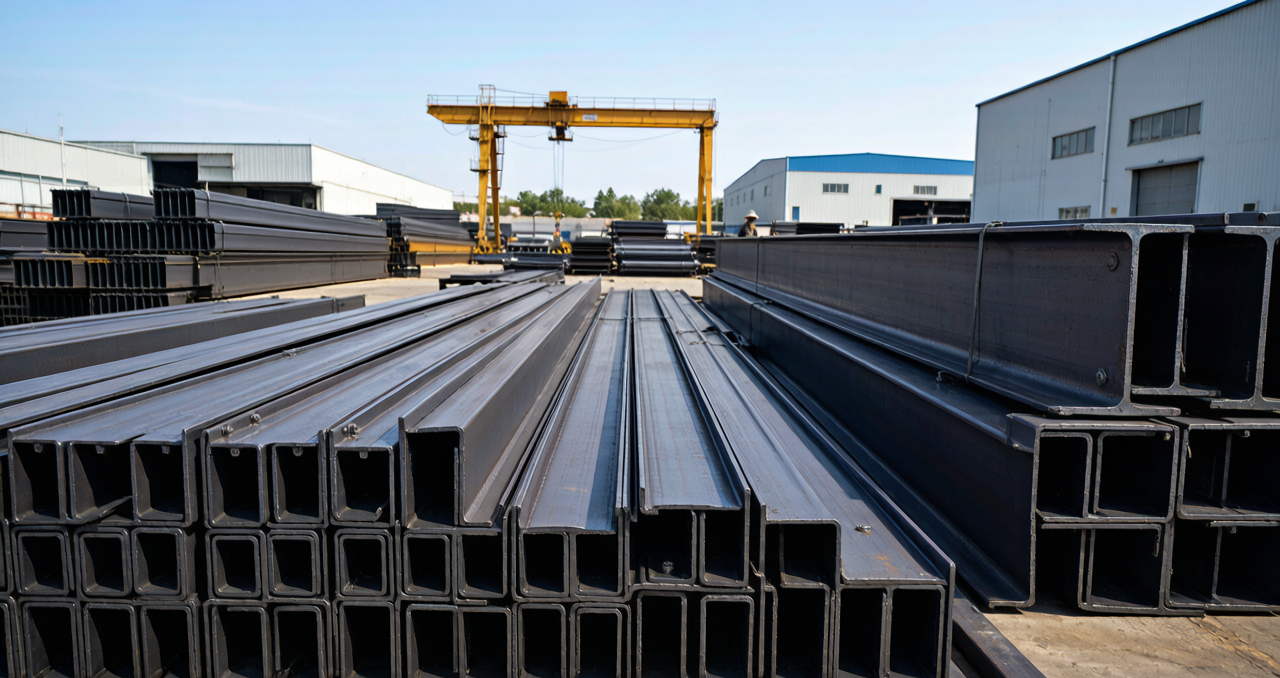
- Container: 20-ft container limits channel length to about 6 m; 40-ft HC extends to about 12 m for many C-shapes. Long channels usually go break-bulk.
- Break-bulk: strapped bundles with steel banding, sling points, corner protection, pine dunnage at the bottom. Containerized channels for export typically use steel-framed wooden bunk beds.
- Lead time: ex-stock C-shapes ship in 10-20 working days. Mill-direct sizes ship 25-45 working days.
- Documents: commercial invoice, packing list, MTC, country of origin, B/L, insurance, and any FTA certificate you need.
Frequently Asked Questions
What is the difference between a C-shape and a UPN?
Both are C-channel sections. C-shape uses AISC/ASTM designation (e.g., “C8x11.5”) with depth and weight-per-foot. UPN is the European equivalent (e.g., “UPN 80”) with parallel inner flange faces for some sizes. UPE is the European channel with parallel flanges throughout. Cross-walks should match moment-of-inertia and section depth, not just the linear weight.
Which channels are best for purlins?
C8x11.5 to C10x20.0 are the workhorse purlin and girt sizes for metal building systems. A36 is standard; A572 Gr.50 is used for long spans or high snow/wind loads. Channels are typically paired with a top compression flange (cap channel or hat section) to form a cold-formed roof purlin assembly.
Can channels be hot-dip galvanized?
Yes. We regularly supply hot-dip galvanized channels to ASTM A123 / ISO 1461 specification. Standard zinc mass is 75-150 micrometers (550-1075 g/m2). For closed cavities and configurations where acid might be trapped, vent and drain holes need to be specified.
Are there project submittal packages available?
Yes. We provide submittal packages including MTC, third-party test reports, country-of-origin, and mill contact details for engineering review. Pre-submittal by our engineering team in your format (AISC, BS, EN) is available on request.
Can you supply channels that are pre-coped or pre-punched?
Yes. We run downstream services for end coping, miter cuts, and hole patterns for bolted connections. Send your drawings for evaluation and quotation.
Request a Quotation
Send your section designations, lengths, grade, end-prep requirements, and destination port to [email protected]. We return a mill-direct offer with MTC, packaging, and the lead time you can schedule into your project’s procurement plan.
Browse Huaxia-Steel for additional structural sections, I-beams, angles, and mill-direct plate and bar products.
Related Images