Selecting the right cutting method for carbon steel is one of the most consequential decisions in metal fabrication. The choice between plasma, laser, and waterjet cutting affects not only production cost but also edge quality, post-processing requirements, and ultimately the performance of the finished part. Each technology has a distinct operating window where it excels — and where it fails.
This guide provides a data-driven comparison of the three primary industrial cutting methods for carbon steel, with actionable guidance for procurement professionals and fabricators.
Technology Overview: How Each Method Works
Plasma Cutting
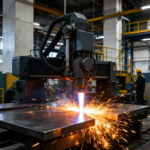
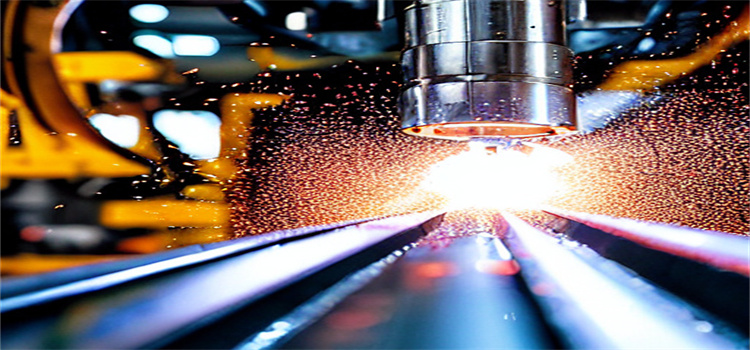
Plasma cutting uses a high-temperature, electrically ionized gas (plasma) jet to melt and blow away metal. An electrical arc forms between the electrode inside the torch and the workpiece. Compressed gas (air, oxygen, nitrogen, or argon-hydrogen) constricts the arc, creating a plasma jet reaching temperatures of 20,000-30,000°C. The molten metal is expelled by the high-velocity gas stream, creating the cut kerf.
Laser Cutting
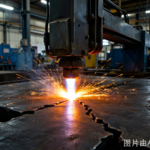
Laser cutting focuses a high-power laser beam (typically CO2 or fiber laser) through optics onto the workpiece surface. The concentrated energy melts, burns, or vaporizes the material. An assist gas (oxygen for carbon steel, nitrogen for stainless) blows away the molten material and can contribute exothermic energy (with oxygen) to increase cutting speed. Modern fiber lasers operate at 1-15 kW for industrial carbon steel cutting.
Waterjet Cutting
Waterjet cutting uses a high-pressure stream of water (up to 6,200 bar / 90,000 psi) mixed with abrasive particles (typically garnet) to erode material. The process is purely mechanical — there is no heat-affected zone (HAZ), no thermal distortion, and no change to the material’s metallurgical properties. Abrasive waterjet (AWJ) is required for carbon steel cutting; pure waterjet is only effective on soft materials.
Head-to-Head Comparison Table
| Criterion | Plasma | Laser (Fiber) | Waterjet (AWJ) |
|---|---|---|---|
| Max thickness (carbon steel) | 50-80mm (HD plasma) | 25-30mm (industrial) | 200mm+ |
| Optimal thickness range | 6-50mm | 0.5-20mm | 3-150mm |
| Cutting speed at 10mm | 2,500 mm/min | 3,500 mm/min | 120 mm/min |
| Cutting speed at 25mm | 1,200 mm/min | 900 mm/min (fiber) | 50 mm/min |
| Kerf width (typical) | 1.5-5.0mm | 0.2-1.0mm | 0.8-1.5mm |
| Edge quality (Ra) | 6.3-12.5 μm | 3.2-12.5 μm | 3.2-6.3 μm |
| Heat-affected zone (HAZ) | 0.5-2.0mm | 0.1-0.5mm | None |
| Dross/burr formation | Moderate to high | Low (optimized settings) | None |
| Taper angle | 3-5° | <1° | <1° |
| Operating cost per meter (10mm) | $0.30-$0.80 | $0.40-$1.20 | $2.50-$5.00 |
| Equipment cost (industrial) | $15K-$80K | $150K-$800K | $80K-$300K |
| Consumables cost | Moderate (electrodes, nozzles) | Low (lens, nozzles) | High (abrasive, mixing tube) |
| Material hardening at edge | Yes (HAZ hardening) | Yes (narrow HAZ) | No |
Plasma Cutting: Strengths and Limitations
Where Plasma Excels
- Thick plate cutting (12-50mm): Plasma is the cost-effective choice for medium to thick carbon steel. High-definition plasma systems achieve near-laser edge quality at a fraction of the cost.
- Speed on medium plate: For 15-25mm carbon steel, plasma is faster than fiber laser above certain power levels.
- Low capital cost: Entry-level CNC plasma tables start at $15,000, making them accessible for small to medium fabricators.
- Bevel cutting: Plasma torches can be tilted for weld prep bevels — a capability that laser systems struggle with.
Plasma Limitations
- Edge quality: Plasma-cut edges typically require grinding or machining for precision-fit parts.
- HAZ hardening: The heat-affected zone can create a hardened edge layer (especially in medium-carbon steels like S45C/1045) that complicates subsequent machining or welding.
- Taper: The 3-5° taper angle may be unacceptable for tight-tolerance parts.
- Minimum hole size: Hole diameter should be at least 1.5x plate thickness for plasma; smaller holes produce poor quality.
Laser Cutting: Strengths and Limitations
Where Laser Excels
- Thin to medium plate (0.5-20mm): Fiber laser delivers the best combination of speed, precision, and edge quality for this thickness range.
- Nesting efficiency: Narrow kerf (0.2-0.3mm for thin sheet) enables tight part nesting, reducing material waste.
- Complex geometries: Laser can cut intricate shapes, small holes, and fine features that plasma cannot match.
- Minimal post-processing: Laser-cut edges are often ready for welding or painting with no secondary finishing.
- Automation-ready: Modern fiber laser systems integrate with automated loading/unloading for lights-out production.
Laser Limitations
- Thickness ceiling: Even 15-20 kW fiber lasers are practical only to about 30mm in carbon steel. Beyond this, cut quality degrades rapidly.
- Surface condition sensitivity: Mill scale, rust, or oil on the plate surface affects cut quality and consistency.
- Reflective materials: While less of an issue with fiber vs. CO2 lasers, highly reflective materials can cause back-reflection damage.
- Capital intensity: A 6 kW fiber laser cutting system with automation typically costs $250K-$500K.
Waterjet Cutting: Strengths and Limitations
Where Waterjet Excels
- Ultra-thick plate (50mm+): Waterjet is essentially unchallenged for cutting carbon steel above 50mm thickness. It can cut 200mm+ with consistent quality.
- No HAZ: The cold cutting process preserves the material’s original metallurgical properties — critical for heat-sensitive alloys and applications requiring subsequent heat treatment.
- Multi-layer cutting: Waterjet can cut stacked plates simultaneously, improving throughput for thick-plate production.
- Material versatility: One machine cuts carbon steel, stainless, aluminum, titanium, composites, and stone — making it ideal for job shops with diverse work.
Waterjet Limitations
- Slow speed: Waterjet is 20-50x slower than laser and 10-20x slower than plasma on thin material. A 10mm plate cuts at 120 mm/min vs. 3,500 mm/min for laser.
- High operating cost: Abrasive (garnet) consumption and mixing tube replacement drive operating costs to $2.50-$5.00 per meter — 5-10x higher than plasma.
- Noise and mess: Waterjet cutting is loud (85-95 dBA) and generates abrasive-laden wastewater requiring filtration and disposal.
- Maintenance intensity: High-pressure pumps (60,000-90,000 psi) require regular seal and valve maintenance — typically every 500-1,000 operating hours.
Decision Matrix: Which Method for Your Project?
| Project Requirement | Recommended Method | Reason |
|---|---|---|
| Thin sheet <6mm, high volume | Fiber Laser | Fastest, best edge, tightest nesting |
| Medium plate 6-25mm, general fab | Plasma (HD) or Fiber Laser | Plasma cheaper; laser if edge quality matters |
| Thick plate 25-50mm | Plasma (HD) | Best speed/cost ratio in this range |
| Ultra-thick >50mm | Waterjet | Only practical method beyond plasma limits |
| Tight tolerance ±0.1mm | Fiber Laser | Best precision and repeatability |
| No HAZ required | Waterjet | Zero thermal effect on material |
| Bevel/weld prep edges | Plasma | Tilting torch for V, Y, K bevels |
| Minimal post-processing | Fiber Laser | Near-dross-free edges with O2 assist |
| Lowest capital investment | Plasma | $15K-$80K vs. $150K+ for laser |
| Job shop with mixed materials | Waterjet or Fiber Laser | Waterjet for thickness variety; laser for thin-sheet speed |
FAQ
Can laser-cut carbon steel be welded directly without edge preparation?
In most cases, yes. Laser cutting with oxygen assist gas produces a thin oxide layer on the cut edge. For structural welding (SMAW, GMAW, FCAW), this oxide layer does not typically require removal — the welding arc will consume it. However, for critical applications (pressure vessels, offshore structures) or when TIG welding, light grinding of the laser-cut edge is recommended to remove the oxide and any micro-cracking in the HAZ.
Which method produces the hardest cut edge?
Plasma cutting produces the deepest HAZ and highest edge hardening due to the broad heat input and relatively slow cooling. For medium-carbon steels (0.30-0.50% C), plasma-cut edges can reach 350-450 HV in the HAZ. Laser-cut edges show a narrower HAZ with less hardening (typically 250-350 HV for mild steel). Waterjet produces zero hardening — the edge hardness equals the base material.
What is the most cost-effective method for cutting 12mm A36 plate?
For 12mm A36 (S235JR) plate, plasma cutting is typically the most cost-effective at $0.35-$0.55 per meter of cut. Laser cutting costs $0.50-$0.80 per meter but delivers superior edge quality that may eliminate secondary grinding. If the parts require close-tolerance fit-up without post-processing, the higher laser cost may be justified by eliminating labor. Run a cost analysis that includes post-cut processing time, not just the cutting cost per meter.
Does waterjet cutting affect the mechanical properties of carbon steel?
No. Waterjet is a purely mechanical erosion process. The cut edge retains the exact hardness, microstructure, and mechanical properties of the base material. This makes waterjet the preferred method for cutting test coupons, heat-treated plates destined for subsequent processing, and materials where HAZ properties are critical. The only potential concern is garnet particle embedment, which is minimized with proper process parameters and typically less than 0.01mm penetration.
Can I cut stacked carbon steel plates with plasma or laser?
Neither plasma nor laser are suitable for stack cutting carbon steel. The molten metal from the top plate welds to the plate below, and the kerf gap prevents effective slag removal. Waterjet is the only method that reliably cuts stacked plates — up to 100mm total stack height with proper fixturing and clamping. This is a significant productivity advantage for thick-plate waterjet production.
Conclusion
There is no single “best” cutting method for carbon steel — the right choice depends on thickness, tolerance, volume, and budget. Plasma dominates the medium-thick range (12-50mm) with the best speed-to-cost ratio. Fiber laser rules thin to medium plate (<25mm) where precision and edge quality matter. Waterjet owns the ultra-thick domain (50mm+) and applications where thermal effects are unacceptable. Smart fabricators often combine two technologies — laser for high-volume thin sheet and plasma or waterjet for thick plate — to optimize their total production cost.
Need cut-to-size carbon steel plate? Contact Huaxia-Steel for CNC plasma, laser, or waterjet cut parts with tight tolerances, full MTC, and global shipping from our ISO-certified processing centers.